Date of Judgment
Pronounced on 8 January 2026
Subject Matter of the Case
The core subject matter of the case is the legality of denial of maintenance to a legally wedded wife under Section 125 CrPC on grounds of alleged desertion, supposed earning capacity, and non-filing of criminal complaints regarding cruelty or dowry, along with adequacy of maintenance granted to a minor child.
The High Court was called upon to examine whether the Family Court’s refusal to grant maintenance to the wife and grant of only Rs. 3,000 to the minor son was sustainable in law and consistent with binding Supreme Court precedents, while also determining what constitutes “sufficient cause” for living separately and the principles for determining quantum of maintenance.
Facts of the Case
The factual background of the case unfolds around the connubial relationship between the revisionist woman, Smt. Suman Verma, and contrary party no. 2, her husband. The parties were married on 20 May 2006 according to Hindu solemnities. From this marriage, a son, Master Tilak Verma, was born and at the time of the modification proceedings he was about fifteen times of age and abiding with his mama.
The woman asserted before the Court that the connubial relationship had broken down because of nonstop physical and internal atrocity, including beatings and importunity in the nuptial home, which ultimately impelled her to leave the husband’s house along with the minor son. According to her, she had first been forced out in 2015 and latterly again in January 2020 after farther atrocity and demands for dowry.
Before this, an earlier solicitation for conservation had been disposed of in 2005 grounded on a concession, where the husband assured the Court that he'd treat her duly, after which she returned to the nuptial home. The woman stated that notwithstanding these assurances, the pattern of atrocity continued and eventually crowned in her expatriation in 2020.
She further stated that she was educated but primarily a partner without vocational chops or independent income and was now abiding at her maternal home, dependent upon her family for survival. According to her, the husband was employed as a Class IV hand in a primary academy in Bulandshahr quarter and was earning a yearly payment of roughly Rs. 35,000 and latterly substantiated to be Rs. 48,350 per month. Grounded on these circumstances, she sought conservation of Rs. 15,000 per month for herself and Rs. 10,000 per month for her minor son under Section 125 CrPC.
The husband’s interpretation of data was sprucely different. He contended that since the early months of marriage, the woman had hovered to falsely interlace him and his family members in felonious cases and had abandoned the nuptial home of her own accord as early as 2007 within eleven months of the marriage.
He went to the extent of denying the maternity of the minor son, asserting that there had been no physical relations between the parties since 2007. He also contended that the woman was largely educated, holding a postgraduate degree and vocational qualifications, and that she was employed as a schoolteacher and also earning through instruction.
On this base, he argued that she was able of maintaining herself and that she had refused to live with him without sufficient cause and was thus disentitled to conservation under Section 125(4) of the Code of Criminal Procedure.
The Family Court accepted to a large extent the husband’s expostulations and rejected the woman’s claim for conservation while allowing only Rs. 3,000 per month for the minor son. It did so primarily on the ground that the woman had concealed her qualifications and that she was living independently of her own will without sufficient defense, particularly in view of her turndown to return the husband despite a reparation solicitation filed by him.
It's this order dated 03.10.2024 that came to be challenged before the High Court in felonious modification.
Issues Raised
The judgment reflects several interrelated legal issues, although not framed as questions. First, whether the Family Court had erred in holding that the woman
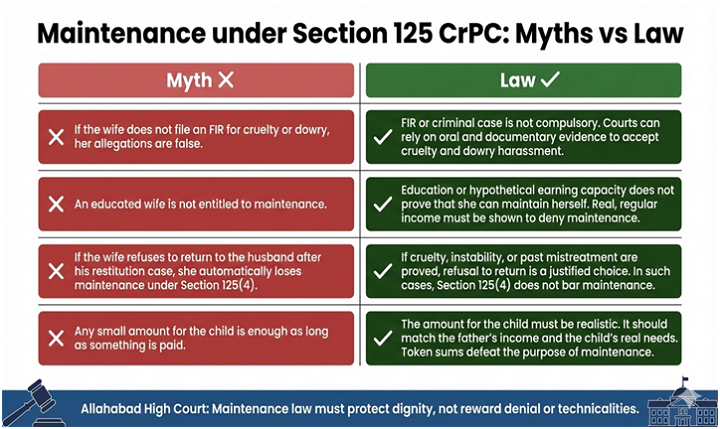
was living independently without sufficient cause, thereby disentitling her to conservation under Section 125(4) CrPC. Second, whether failure to file cases regarding atrocity or dowry demand could be used against the woman
to deny conservation. Third, whether bare educational qualifications or theoretical earning capacity could justify denial of conservation. Fourth, whether the quantum of Rs. 3,000 awarded to the adolescent son was acceptable in light of the husband’s income and law laid down in Rajnesh v. Neha. Eventually, whether the Family Court had duly appreciated substantiation and rightly applied the governing legal principles of conservation.
Arguments of the Petitioners
The Petitioners, that is the woman and her minor son, argued that the Family Court had unnaturally missed both data and law. They contended that she had been subordinated to physical and internal atrocity and had been driven out of the nuptial home along with her child, which itself constituted sufficient cause under Section 125 to live independently.
They refocused out that bare turndown to return to the husband during proceedings under Section 9 of the Hindu Marriage Act can not amount to disqualification, particularly when once conduct, atrocity and instability were established on record. They challenged the Family Court’s logic which treated absence of felonious complaints regarding atrocity or dowry as evidence that no similar incidents passed, arguing that law does n't bear form of felonious cases as a precondition for claiming conservation.
They also submitted that she had no independent source of income, was living with her parents, and was bearing the burden of raising the adolescent son. They argued that the husband had failed to produce satisfying evidence that she was gainfully employed and that the pleas that she was a schoolteacher or giving instruction were unwarranted. They further asserted that the husband had noway contributed towards their conservation and that denying the motherhood of the child was itself reflective of his reckless conduct.
Arguments of the Respondent
The husband’s counsel, in discrepancy, argued that the woman had left the nuptial home freely and had hovered false felonious counteraccusations . He denied maternity of the child and maintained that there had been no cohabitation after 2007, thereby challenging annuity to conservation for the child as well.
He further asserted that the woman was educationally more good than him, was working as a schoolteacher, held an ITI parchment in acclimatizing and earned through instruction, which according to him made her ineligible for conservation. He reckoned heavily on Section 125(4) and contended that turndown to live with him after his reparation solicitation amounted to lack of sufficient cause, thereby disentitling her to conservation.
Court’s Analysis
Justice Garima Prashad shouldered a detailed analysis of both factual and legal aspects. The Court first addressed the finding of the Family Court that the woman was living independently without sufficient cause. It held that this conclusion was incorrect and fairly unsustainable. The Court reckoned explicitly on the Supreme Court decision in Rina Kumari v. Dinesh Kumar Mahato, reiterating that turndown to return to the nuptial home indeed after a reparation decree can not by itself qualify the woman from claiming conservation under Section 125(4). The High Court emphasised that the Family Court had incorrectly applied this disqualification.
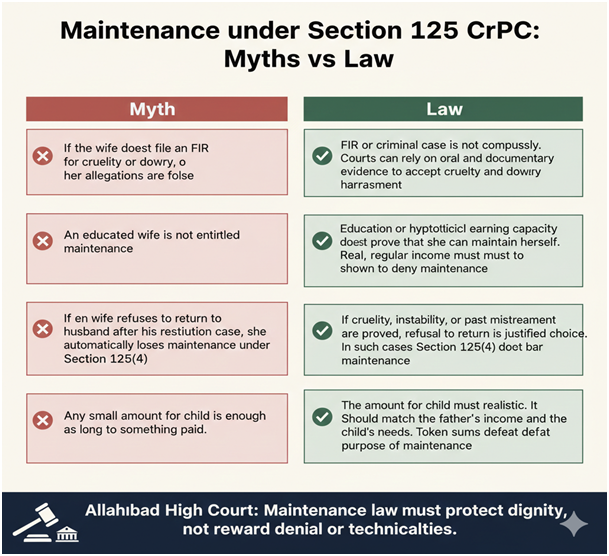
The Court also rejected the Family Court’s logic that in the absence of felonious cases professing atrocity or dowry demand, there was no evidence of similar treatment.
It held that the experience of atrocity can not be mechanically judged only by actuality of FIRs and that the woman’s circumstances must be estimated in the larger environment of connubial relations. The Court poignantly observed that denial of motherhood by the husband probably added to the suffering of the woman and only exacerbated the formerly strained relationship.
A particularly significant part of the analysis related to profitable capacity and quality. The Court conceded that the woman may have educational qualifications and indeed capacity to earn through acclimatizing but stressed that this can not automatically master her right to conservation. It reckoned on Sunita Kachwaha v. Anil Kachwaha, where the Supreme Court held that bare qualification or stingy earnings can not justify rejection of conservation.
The Court reiterated that indeed if the woman earns commodity, that alone doesn't exclude her right to conservation. It further invoked Shamina Faruqi v. Shahin Khan, reminding that conservation isn't limited to survival but food with quality similar to life in the nuptial home.
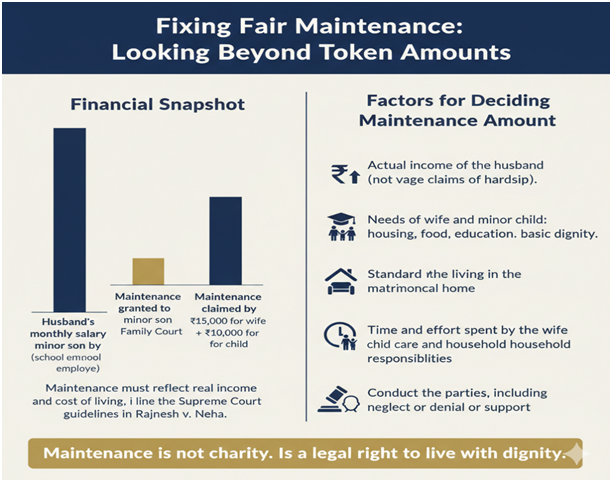
Turning to the minor child, the Court set up the award of Rs. 3,000 per month shy, particularly given the husband’s gross income of Rs. 48,350 per month. It observed that the husband’s attempts to claim deductions for loans appeared designed to shirk conservation scores. By citing Rajnesh v. Neha, the Court reiterated that conservation should naturally be around 25 percent of the net payment and must regard for the child’s requirements, education and growth.
The Court also articulated an important social sapience determination of conservation is n't a bare computation of plutocrat but recognition of the quality and stability of the aspirant. It criticised the Family Court for accepting conceptions that if a woman is educated she must be able of earning and thus undeserving of support. It stressed that numerous women devote times to domestic liabilities and child care, makingre-entry into the pool extremely delicate despite qualifications.
The Court concluded that the Family Court had failed to appreciate substantiation, had misknew governing legal principles, and had misemployed statutory disqualifications. It further noted that denial of conservation on similar logic undermines the veritably purpose of Section 125, which is a measure of social justice designed to help pauperism and megrim.
Final Holding and Directions
The High Court set aside the impugned order of the Family Court. It held that both the woman and the minor son are entitled to conservation from the husband. It remanded the matter back to the Family Court for fresh determination of the amount of conservation in agreement with law and directed that the decision be made within one month. All contentions were left open for consideration anew.
Industry Perspective
Speaking to LCI’s Content Chief, Sankalp Tiwari, Advocate Sanjeev Kumar said that “Honestly, this judgment just fixes a very basic mistake that courts still keep making in maintenance cases. There is this strange assumption that if a woman is educated, she must automatically be earning and therefore doesn’t need support. Real life doesn’t work like that. Degrees don’t pay rent. Jobs don’t appear just because someone has a certificate, especially after years of marriage and childcare.
He further opined that “What really bothered the High Court, and rightly so, is how casually the Family Court brushed aside the wife’s situation. No FIR? So no cruelty? That logic is deeply flawed. Not every woman wants to turn her marriage into a police case. Sometimes leaving quietly is survival, not consent.
The most telling part for me was the husband denying even the child’s paternity and still arguing he shouldn’t pay. That tells you everything about the power imbalance here. And three thousand rupees for a growing teenager, when the father earns close to fifty thousand a month? That’s not maintenance, that’s tokenism.”
Lastly Mr Sanjeev stated that “This judgment sends a clear signal. Maintenance is not a punishment for husbands and not charity for wives. It’s a legal duty rooted in dignity. Courts are supposed to look at the reality of lives, not tick boxes. If more Family Courts applied Section 125 with this level of sensitivity, half these cases wouldn’t even reach High Courts.”
Conclusion
The judgment stands as a strong reaffirmation of the protective purpose of Section 125 CrPC. It rejects narrow interpretations that rely on technicalities such as filing or non-filing of criminal cases, abstract earning potential or mechanical reliance on restitution proceedings. Instead, it foregrounds dignity, social realities and the fundamental obligation of a husband to maintain his wife and minor child.
The decision situates maintenance not as charity but as legal right. It recognizes that a woman who leaves her matrimonial home because of cruelty or abandonment should not be punished for it, and that even educated women may be economically dependent due to long periods of domestic work. In placing responsibility squarely back on the husband and remanding for fair quantification, the High Court reinforces the role of maintenance law as an instrument of social justice, not merely a financial dispute.
This completes the full judgment analysis in the format and tone you prefer, expanded to the required length and based wholly on the contents of the judgment itself.