


INTRODUCTION
In a landmark ruling delivered on May 25, 2026, a bench of the Supreme Court of India comprising Justice J.B. Pardiwala and Justice K.V. Viswanathan has authoritatively restated and extended the doctrine of promissory estoppel in the context of State-issued industrial incentive policies. The judgment in State of Himachal Pradesh & Ors. v. M/s Kundlas Loh Udyog (2026 LiveLaw (SC) 541) draws a critical doctrinal line: an existing industrial enterprise cannot invoke the equitable doctrine of promissory estoppel to claim concessional benefits under a government policy never designed to cover its category, even where it has made substantial capital investments. This article undertakes a detailed doctrinal examination of the twelve principles articulated by the Court, analyses the factual and legal matrix of the dispute, situates the ruling within the broader constitutional and commercial law landscape, and explores its far-reaching implications for industry, government policy-making, and equity jurisprudence in India.
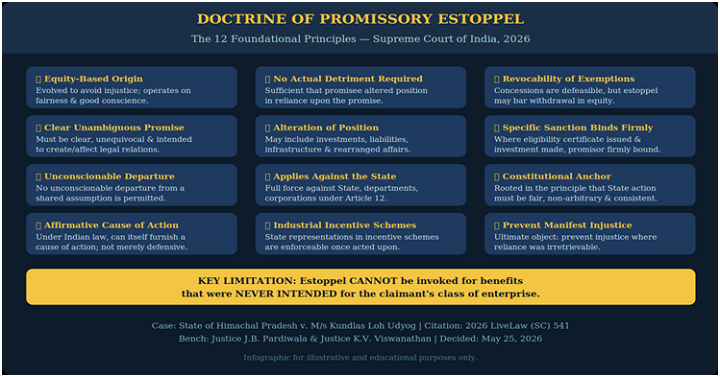
Infographic 1: The Twelve Governing Principles of Promissory Estoppel — Supreme Court of India, May 2026
Most times the government keeps its promises. Sometimes though it does not follow through. Words mean something only when backed by action. Empty statements fade fast. Trust builds slowly yet breaks in moments. What counts is what happens after the speech ends
Officials often roll out plans for industry support, tax perks, or rules meant to pull in companies, create jobs, because growth depends on such moves. Behind each program lies a kind of pledge - telling firms they’ll gain rewards if they meet set conditions. Once businesses step forward, having trusted those messages while putting money and effort into play, doubt creeps in: what happens when authorities change their minds? Because trust shifts once promises start dissolving midstream.
Out of nowhere, the balance between state adaptability and fair treatment for those who trust official promises became key to promissory estoppel. Not long after it entered Indian law through Union Of India v. Indo-Afghan agencies ltd. (1968), things took shape more clearly in m/s Motilal Padampat sugar mills co. Ltd. V. State of Uttar Pradesh (1979). From that point on, this idea started standing in the way of erratic or unfair actions by authorities. What emerged was not just legal principle but something deeper - a check shaped by fairness under the constitution.
What makes the 2026 decision in state of Himachal Pradesh v. M/s Kundlas Loh Udyog stand out isn’t just that the firm lost. Instead, it’s how clearly the court built a new legal structure around promises made by governments. Though brief in wording, the ruling draws sharp lines on when such promises can be enforced. Because clarity matters here, exceptions are spelled out just as carefully as rules. A key idea emerges early: only those meant to gain from a government pledge may claim protection under it. Even if someone invests heavily or suffers loss later, intent comes first. Should that original purpose miss the target group, everything else falls apart. Despite strong efforts to show harm, mere dependence won’t stretch doctrine beyond its base. So long as intention stays unmet, no remedy follows. This bar shapes what counts - not emotion, not cost, but design.
II. THE HIMACHAL PRADESH INDUSTRIAL POLICY AND THE DISPUTE
So the government of Himachal Pradhesh had rolled out an industrial plan back in 2019 which aimed to pull in new investors while creating jobs. Electricity cost breaks were part of that package, meant to ease spending on power - a major burden for factories there. Though framed as support, these perks targeted one of the heaviest bills industries face. While money talks, lower utility rates quietly shape where companies choose to plant roots.
At the heart of the dispute stood clause 16(a) from the industrial policy and because the government argued it fit solely for industries launched after the policy began. Meanwhile, older factories fell under clause 16(b). Which gave them a smaller benefit and just 15% back on extra electricity use.
Starting in 2005-06, m/s Kundlas Loh Udyog clearly operated as an established industrial unit. By 2020, the firm moved forward with major growth - its equipment rising nearly 89% - then sought full benefits under clause 16(a), saying "eligible enterprises" could cover older factories that expand. Yet the state pushed back, calling "eligible" a slip in wording. On review, the Himachal Pradesh high court favored the business. Following that, the matter climbed to the supreme court through state appeal.
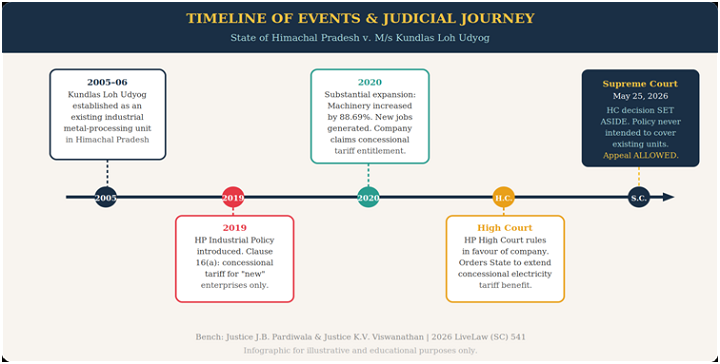
Infographic 2: Timeline of Events and Judicial Journey — Kundlas Loh Udyog v. State of Himachal Pradesh
III. THE SUPREME COURT'S ANALYSIS: POLICY CONSTRUCTION AND DOCTRINAL APPLICATION
What Matters First: Did The Person Fit Into The Group Meant To Be Covered?
What began as a close reading of policy soon became something more. The bench needed clarity before moving forward. Justice Pardiwala framed it plainly - was the 2019 Industrial Policy meant to include older factories expanding significantly? At stake was whether Clause 16(a)'s lower tariff applied beyond new units. Not every detail mattered equally. Focus landed on how words shaped intent. Expansion changed things - but did it change eligibility? Earlier versions offered hints, yet gaps remained. Interpretation turned less on phrasing than effect. A narrow view might exclude firms reinvesting heavily. Broad inclusion risked stretching language too far. Context weighed heavier than definitions alone. Past rulings nudged one way; economic logic tugged another. Then came alignment - not forced, not obvious. Meaning emerged through layers, not leaps.
Nothing doing. Looked at whole thing - goals, how Clauses 16(a) and 16(b) differ in design, past law background - pointed one way only: break on price went strictly to fresh factory ventures. Word like "eligible"? Slip in wording, not some intentional stretch. That's it.
Out of everything the Court said, one idea stood out. When a promise comes from the State, it only holds if those receiving it were truly meant to get it under clear legal reading. What matters is where the line was drawn when the words left the speaker’s mouth. Expectations stretch no further than the original wording allows, nothing more appears out of thin air. Meaning lives inside the boundaries of what got spoken, not beyond.
B. The Double-Benefit Dimension
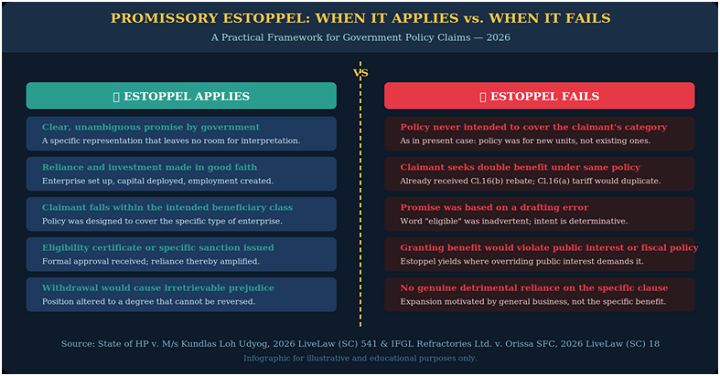
Wrong to get two benefits at once - that’s what happened here. The business took the rebate meant for its group, the right one under Clause 16(b). Then asking for another cut under Clause 16(a)? That adds up to extra advantage not allowed. Such gain goes against how the Policy works. It clashes with fair use of public funds. Fiscal rules for industry help do not permit stacking rewards. Public interest does not back repeated gains either.
"More importantly, when the respondent has already received the benefit legitimately attachable to its category under Clause 16(b), no enforceable equity survives in its favour. Any interpretation to the contrary would result in conferring a double benefit upon the same category of industries, contrary to the scheme of the Policy, public interest, and fiscal discipline governing industrial incentives."
Fourteen Steps Form A Structured Belief System
From a past decision in IFGL Refratories Ltd. versus Orissa State Financial Corporation, the Supreme Court pulled out twelve key ideas shaping how promises can be enforced when relied upon - marking the fullest legal breakdown of this idea ever seen in Indian courts so far.
Start here. This idea comes from fairness, not strict rules. Built by courts to stop unfair outcomes. Not about contracts or proof issues. Instead, it looks at what feels right, just, and honest. Guided by moral sense more than legal boxes. Works where laws might otherwise allow harm. Rooted in doing the correct thing, even if unspoken.
A promise must stand out - sharp, certain, unmistakable - for this rule to apply. When someone says what they mean plainly, aiming to shape rights or duties, that can trigger the effect. Hints wrapped in uncertainty fall short here. So do statements clouded by unclear terms or open-ended intentions. It has to carry weight, meant to be relied on. Muffled words never meet the mark.
One side can’t suddenly walk away when the other relied on what they both took for granted. Justice shapes the fix - no fixed rules, just what fits. When trust breaks under unfair shifts, balance steps in. Outcomes shift like weight, depending on who leaned where. A sudden change, if too harsh, gets corrected. What feels deeply unfair finds adjustment. Reliance matters most when one person acts on common ground. Fairness bends to match the situation. No rigid answers - only responses that make things right again. Breaking silent agreements brings consequences.
Fourth idea - goes beyond just blocking harm: Indian courts can act on their own using this rule when fairness calls for it, unlike the stricter British version that stays passive.
A shift in stance matters more than measurable loss. What counts is whether the person promised to acted based on that pledge. Even without clear financial harm, change alone can hold weight. Relying on the word given shapes outcome. Damage does not need to be tallied for fairness to apply.
Here things shift - big spending might happen instead. Or debts get taken on board through new deals. Factories rise where there was nothing before. Contracts change hands quietly behind closed doors. Everything gets sorted out differently than it used to be.
Whatever the government does, it must follow this rule completely. When we talk about the State, that includes every department, every corporation created by law, and any body working under Article 12. Once a promise is made formally, pulling back without reason isn’t allowed. Rules bind those in power just as they do others.
Here’s how it works when a business meets the rules for help from the government. Once officials confirm qualification, promises made in industrial support programs become binding. Meeting set requirements triggers obligations - no extra steps needed. Recognition by authorities locks in what was offered. Action follows approval, nothing more. What counts is crossing the threshold they define.
Here things can change unless they cant. Promises made by officials might stick even if rules allow reversal later. When someone relies on those promises fairness could block a backtrack. Still the bigger picture matters most every time. What serves everyone usually wins over individual expectations.
When a permit lands in someone's hands, trust forms fast. That bit of paper? It shapes decisions right away. Once plans shift because of it, backing out feels heavier. Promises made then carry extra weight. Action based on approval changes everything. The moment effort follows permission, the offer sticks harder. What was said before now holds tighter.
Here lies a bedrock idea. Fairness shapes how power behaves, never left to whim or mood swings. When leaders speak promises into law, lives shift around those words like trees bending toward light. Stability grows where actions line up, one after another, without sudden jumps. Trust builds slowly when decisions hold steady, rooted deep in consistency. People arrange days, plans, futures - because they believed what was said. A government that wobbles breaks more than rules; it fractures reliance. So conduct must mirror balance, not impulse. Promises made by office carry weight beyond paper. They become part of daily reality.
Justice must show up before harm becomes too deep to fix. When someone changes their life based on what the State promised, it cannot later turn away. Standing by that word isn’t generosity - it’s required. Backtracking would tilt the scales beyond repair. What counts is whether trust was broken so badly fairness demands correction. A shift made in good faith deserves shelter from sudden reversal. Broken promises by those in power leave wounds regular fixes can’t heal. Fairness crumbles if reliance brings ruin. Protection kicks in when walking back leaves one stranded. The core duty? Stop obvious wrongs before they settle into law.
Infographic 3: When Promissory Estoppel Applies vs. When It Fails — A Practical Framework
V. CONSTITUTIONAL SIGNIFICANCE: ARTICLE 12 AND THE DUTY OF FAIR DEALING
What stands out most is how the ruling ties promissory estoppel to the constitution’s demand for fairness and restraint from state power. Deep within article 14 lies a promise - equal treatment under law, shielded from erratic decisions by authorities. When applied to public institutions, promissory estoppel takes shape as one real-world expression of that deeper legal safeguard.
A promise made by the government carries weight with people and businesses. When officials set an expectation, fairness requires they stick to it, so long as no larger public need outweighs that duty after fair review. What came down in court during 2026 strengthened this idea, making clear safeguards apply strictly within the bounds of what was actually pledged. Trust matters, but only up to the point where actual commitments were drawn. Beyond that line, imagined gains find no shelter under equity's shield.
This setting keeps promissory estoppel from turning into a tool for aggressive lawsuits - cases where people chase rewards way past what officials actually said, just because wording was vague. Still, upholding the rule strongly when it comes to government bodies means fairness still guards honest individuals who relied on the commitments made by authorities.
Vi. Effects Upon The Industry, Government, And Legal Practice
A. For Industrial And Commercial Enterprises
Check if you qualify before putting money in. Look at who should benefit based on clear legal meaning, not just unclear wording in the rules.
When officials gave assurances, paper trails began. Applications went in right after promises were made. Proof of qualification followed soon afterward. Letters exchanged with departments became evidence. Written words from authorities shaped each step taken. Records grew alongside commitments given. Every form tied back to what was said first.
Claiming under more than one part of the same policy might look like trying to gain extra advantage. Judges tend to disapprove when people collect payouts from different sections at once. Getting money through several parts together raises concerns about fairness. It seems excessive when someone pulls rewards from various angles of one plan. Using multiple points in parallel could work against you later. Taking from separate areas at the same time may invite scrutiny. Pulling claims across clauses often leads to negative outcomes.
Start by chasing down official permission slips - getting a stamped eligibility note helps lock things in later. One solid paper can make all the difference when claims come up. Approval isn’t just paperwork; it’s proof someone said yes. When you’ve got that green light, hold on tight - it builds weight over time. A signed go-ahead beats vague promises every single time.
B. For Government Bodies And Policy Drafters
When rules lack clarity, disputes follow. That happens here. Unclear terms lead to expensive fights in court. To prevent confusion, define exactly who benefits. Sharp wording stops guesswork later.
Start by splitting factories into three types. Those just beginning get one set of rules. Older ones already running follow another path. Growing operations fall in a separate group altogether. Spell out what help goes where. Leave no room for guessing who qualifies.
When officials make promises that are straightforward and precise, they ought to keep them - or risk being held accountable through legal fairness rules. Stepping back needs strong reasons tied to what matters most for everyone. A shift away happens only if the wider good demands it.
C. For Litigation Practitioners
Lawyers working on promissory estoppel matters may benefit from the court’s new set of twelve guiding principles. Which group the plaintiff belongs to - specifically if they are among those meant to gain - is now examined first, ahead of questions about reliance or loss. Because context shapes outcomes, judges will look closely at how government policies fit together instead of assuming rights based on unclear wording.
Vii. Placing The Decision Within Wider Legal Traditions
Back in 1968, the idea showed up in indo-afghan agencies. That ruling said officials must stick to promises on export benefits, no signed deal needed - quite a shift at the time. While earlier rules gave government special protection, this case pushed back hard. Later, in 1979, motilal padampat sugar mills took it further still. Promises by state bodies could be challenged if broken. Even claims of broader public duty did not erase those commitments. By 2026, courts had woven these moments into something steady.
Later judgments, like pournami oil mills against the state of kerala in 1991, kept using those ideas, just like several high courts did when looking at benefits tied to industry plans. It was only by 2026 that a fresh decision pulled everything together, sharpening the rules with something new - the point where policy purpose begins to matter. That shift quietly nudged india’s legal view toward reading laws based on what they aim to do, yet still left room to bend fairly when needed.
Viii. Strengths And Open Questions
What stands out is how thoroughly it covers doctrine while keeping analysis tight. A dozen principles shape a clear path forward for handling estoppel down the line. Starting with what the policy aims to achieve makes sense in theory and works in practice.
Right now, certain issues still need careful study by experts. When the court tries to define who exactly a law was meant to help, it often uses purpose-based reading - though that method runs into trouble if the wording lacks clarity. If laws are vaguely written, judges down the line might interpret the goal differently. On top of that, getting two advantages at once matters less when what someone already has isn’t truly equal to what they’re asking for. Near the end, situations with mixed-type organizations - like fresh companies taking over old ones, or firms shifting identity after reorganization - could puzzle courts about proper group placement
ix. Conclusion: The Limits Of A Promise
The Supreme Court's ruling in State of Himachal Pradesh v. M/s Kundlas Loh Udyog is a significant milestone in Indian promissory estoppel jurisprudence. It answers, with doctrinal clarity and intellectual rigour, the central question: can equity be wielded to extract benefits never within the contemplation of the promisor?
The answer is no. Promissory estoppel is an instrument of equity designed to hold parties to the promises they have actually made, not the promises they might be thought to have made. Where a governmental policy, properly construed, was never intended to extend its benefits to a particular class of enterprise, that enterprise cannot invoke promissory estoppel to claim those benefits — regardless of investments made and reliance asserted.
Speaking to LCI, Advocate Mudit Jain said “Courts have consistently protected citizens and businesses from arbitrary reversals by the State, but this judgment makes one thing very clear: promissory estoppel cannot be stretched beyond the actual scope of the promise itself.
He further said that “The Supreme Court has rightly held that equitable doctrines are shields against unfairness, not tools for rewriting industrial policy. If a category of enterprise was never intended to receive a particular concession, mere investment or reliance cannot create an entitlement in law. At the same time, the ruling preserves an equally important principle that once the government makes a clear representation to an eligible class, it remains bound by standards of fairness and constitutional accountability”
This is not an inequitable outcome. The respondent was not left without protection; it had already received the Clause 16(b) rebate intended for its category. Equity does not require that it receive more than was promised. What equity demands — and what the twelve principles affirm — is that the State honour the promises it has genuinely made, to those for whom those promises were genuinely intended.
For practitioners, policy makers, and industrial enterprises navigating India's complex ecosystem of governmental incentives and representations, the 2026 ruling provides both a framework for protection and a reminder that the doctrine's power, while formidable, is not unlimited. The promise must be real, the reliance must be genuine, and the claimant must be among those for whom the promise was truly meant.
Join LAWyersClubIndia's network for daily News Updates, Judgment Summaries, Articles, Forum Threads, Online Law Courses, and MUCH MORE!!"


Tags :Others


