
1. Introduction
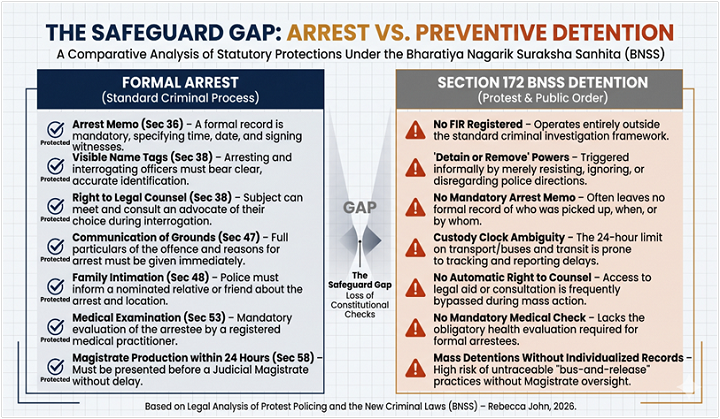
In India, a murder suspect is frequently placed under a well-established legal system. His arrest must be documented in a memo, the reasons for it must be explained, a relative must be notified, a lawyer must be appointed, a medical examination must be performed, and a judicial magistrate must assess his case and determine if he may remain in jail within 24 hours. When a student gets arrested close to Jantar Mantar for wearing a placard, he can end up on a bus that is going to a stadium or the police station. He would be held for a few hours before being released in the evening, and there would be no record of when, why, or by whom he was picked up.
This contrast is what Senior Advocate Rebecca John had in mind when she spoke to LiveLaw (18 October 2026) in the wake of the Delhi protests against the Election Commission’s chief election commissioner Gyanesh Kumar. According to her, people arrested for participating in peaceful protests face a far worse legal environment than people formally arrested for the most serious crimes. In this article, I subject her contention to a close examination against the backdrop of statutes, the Constitution, and case law and conclude with a few observations from a legal, rather than political, perspective. The backdrop, as you will see, involves the CJP and the Delhi detentions.
2. The Backdrop: The CJP Protests and the Delhi Detentions
As you may know, the controversies surrounding the Election Commission’s Special Intensive Revision (SIR) of voter rolls, which has so far resulted in the deletion of over 130 million Indian voters’ names from the rolls, ranging from deceased to voters whose addresses had changed or couldn’t be found, have triggered the latest round of protests. While the Election Commission has denied targeting any particular group, the Opposition alleges that a specific community’s names have been deleted in droves. The Election Commission has also argued that delisted voters can re-register, but the ruling party, the BJP, alleges that the Opposition wants to sabotage the voter roll.
The protests have so far revolved around the Cockroach Janta Party (CJP). This self-described youth group and satirical organization was founded in early May 2026 by Abhijeet Dipke, whose Jantar Mantar sit-in precipitated the resignation of the Union Education Minister following the
NEET examination paper leak.
What ensued were days of preventive detentions. When the CJP tried to stage a rally in New Delhi on 10 October, the police imposed curfews across the capital, and Al Jazeera reported that over 2,000 people, including Opposition lawmakers, journalists, and lawyers, were detained. Dipke and two others were released by an executive magistrate the next day. Delhi Police announced on 12 October that Jantar Mantar would no longer be a protest venue and that Ramlila Ground, Burari Ground, and the CBD Ground in East Delhi had been approved by the Union Home Affairs Ministry as the alternatives, with directions for the implementation of the order to follow. On the other hand, the CJP contends that while it applied for permission to hold a protest at Jantar Mantar, it was not shown the date or reason for the denial.
On 13 October, twelve CJP workers, including Ashutosh Ranka and Saurav Das, climbed over the barricades at Jantar Mantar and were detained. “You cannot denotify the resistance,” Dipke said. Ranka and Das were then sent to jail for five days for violating the terms of their release on bail, with the police claiming that they had repeatedly disregarded the directions and that further defaults would result in more severe action.
According to a report on 16 October, Dipke was stopped outside his home while on his way to his Connaught Place demonstration by police, who stated that he would be formally arrested the following day for violating his peace bond dated 10 October. He was released after signing a fresh peace bond the same day.
In addition to the approximately 150 arrests made on 16 October, a habeas corpus petition was filed in the Supreme Court under Article 32 seeking the production of the 1,500-odd people arrested on 10 October, as well as copies of arrest memos and CCTV footage, although the CJP’s lawyer claimed that the petition had not been filed by the CJP.
3. Rebecca John’s Critique
John does not object to any particular provision. She reads a set of powers in the BNSS, the Delhi Police Act, and police standing orders together as an ability to detain agitators without registration of an FIR and hence without the safeguards normally due to a person arrested in a criminal case. A person arrested is entitled to have the arrest recorded, to be informed of the grounds, to consult a lawyer, to get medical examination and to be produced before a magistrate who will read out the case diary and ask whether the person has been ill-treated. A protester not arrested is at best asked to sign a bond and none of these safeguards are available.
She singles out Section 172 BNSS which directs that a person disregarding a directions of a police officer can be detained or removed by the police. She also draws attention to the clock which begins to run not when the bus carrying the detenu reaches the detention centre but when he/she is handed over to it. Protesters are sometimes taken to police stations or even to a stadium and released at night or even far away from their homes with particular effect on women. “The idea is to trouble the citizen, the protesting citizen,” she said.
She objected to Delhi Police standing orders dated 2018 and 2022 which require an application for permission to hold a protest and leave it to the Deputy Commissioner of Police to decide the terms if any. A fundamental right cannot be qualified by such a requirement. Finally, she said that there was no justification for police to conceal their identity by not displaying name tags as it did with effect from date X. Their very concealment ought to arouse suspicion.
4. The Statutory Framework, Provision by Provision
The powers she aggregates need to be unpacked, because each contains triggers of its own and offers different levels of protection.
Section 163 BNSS authorizes an executive magistrate to issue orders in urgent cases of nuisance or apprehended danger, typically prohibiting assembly in a certain area.
Section 126 BNSS authorizes an executive magistrate to require a person likely to commit a breach of peace to show cause why a peace bond should not be issued against him. This is what the CJP cases are about.
Section 170 BNSS is the famous preventive detention power:
“(1) A police officer knowing of a design to commit any cognizable offence may arrest, without orders from a Magistrate and without a warrant, the person so designing, if it appears to such officer that the commission of the offence cannot be otherwise prevented.
(2) No person arrested under sub-section (1) shall be detained in custody for a period exceeding twenty-four hours from the time of his arrest unless his further detention is required or authorised under any other provisions of this Sanhita or of any other law for the time being in force.”
Section 172 BNSS provides:
“(1) All persons shall be bound to conform to the lawful directions of a police officer given in fulfilment of any of his duty under this Chapter.
(2) A police officer may detain or remove any person resisting, refusing, ignoring or disregarding to conform to any direction given by him under sub-section (1) and may either take such person before a Magistrate or, in petty cases, release him as soon as possible within a period of twenty-four hours.”
The difference in language is crucial. Section 170 uses the word “arrest” and requires the police officer to have knowledge of a design to commit a cognizable offence which cannot be prevented in any other way. Section 172 uses the words “detain or remove” and is triggered by “resisting, refusing, ignoring or disregarding” a direction. The sole limitation on the power in 172(2) is that the direction of the police officer concerned must be lawful. The language of Section 172 is important because the BNSS contains a number of detailed safeguards applicable only to an arrest.
These include preparation of an arrest memo (Section 36), requirement that the arresting officer must show his name tags (Section 38), right to consult a lawyer (Section 38), communication of grounds of arrest (Section 47), intimation to a relative or friend (Section 48), medical examination (Section 53), production of the arrested person before a magistrate within 24 hours (Section 58) and a bar on arrest of women after sunset save in exceptional circumstances with the permission of a magistrate (Section 43(5)). By treating a detention pursuant to Section 172 as one not involving an arrest, the police can avoid all these safeguards. This is the textual basis for the John critique.
5. Arrest and Detention in Constitutional Law
The more crucial issue is whether the Constitution makes the same distinction. Article 22(1) says that an arrested person shall not be detained without being informed of the grounds or denied the assistance of a lawyer and Article 22(2) directs that he/she shall be produced before the nearest magistrate within
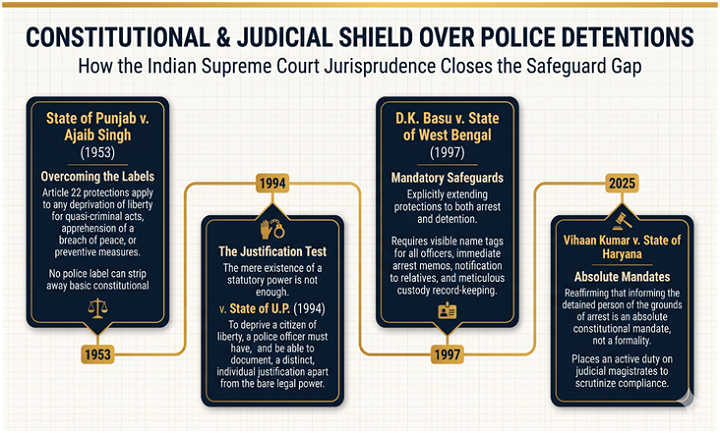
24 hours. Again these protections are contingent on a detention being an arrest. The seminal case on this issue is State of Punjab v. Ajaib Singh,. A five-judge bench held that taking an abducted woman into protective custody even without any charge did not constitute an arrest for the purposes of Article 22. However, the Court indicated that the expression was wide:
“The language of article 22(1) and (2) indicates that the fundamental right conferred by it gives protection against such arrests as are effected otherwise than under a warrant issued by a court on the allegation or accusation that the arrested person has, or is suspected to have, committed, or is about or likely to commit an act of a criminal or quasi-criminal nature or some activity prejudicial to the public or the State interest.”
Thus, a person deprived of liberty on the apprehension of a breach of the peace would fall within the mischief of Article 22(1). Similarly, a person detained for refusing to obey a direction of the police which itself constitutes an offence (safeguarded by Section 172 BNSS) is also caught by the mischief of Article 22(1). If the wording of Ajaib Singh is applied literally to the facts of the CJP case, the refusal of the protesters to obey the directions of the police would be an offence “of a quasi-criminal nature” for the purposes of Article 22(1).
Thus, the very fact of detention would amount to an arrest and all the consequential protections (communication of grounds, production before a magistrate, etc.,) would be attracted by
virtue of Article 22(2). The caveat that the Court did not intend to lay down an exclusive test for arrest is of little relevance in my view since no subsequent Supreme Court has disagreed with this precedent. It is entirely possible that, if called upon to decide the very issue, the Supreme Court would hold that the mischief of Section 172 BNSS also fell within the definition of arrest in Article 22(1).
The case law on the requirements of an arrest also points to the same conclusion. Joginder Kumar v. State of U.P. provides:
“No arrest can be made because it is lawful for the police officer to do so. The existence of the power to arrest is one thing. … The police officer must be able to justify the arrest apart from his power to do so.”
Similarly, D.K. Basu v. State of West Bengal, para 35 observes:
“The directions for implementation of the orders under these provisions shall be issued by the State Governments concerned keeping in view the directions issued by this Court in all cases of arrest or detention till legal provisions are made in that behalf as preventive measures.”
This is a direct answer to John’s objection to anonymity of police. The first limb of Section 3 says:
“(1) The police personnel carrying out the arrest and handling the interrogation of the arrestee should bear accurate, visible and clear identification and name tags with their designations…”
It is important to note that the words “or detention” which appear in the original order have been omitted by mistake and yet the ratio is applicable to Section 172 BNSS. Most recently, Vihaan Kumar v. State of Haryana, 2025 INSC 162, para 14 states:
“…the requirement of informing the person arrested of the grounds of arrest is not a formality but a mandatory constitutional requirement. Thus, the person arrested cannot remain in custody even for a second…”
The Court added in para 21(e) that:
“…it shall be the duty of the magistrates to which the persons arrested are produced to satisfy themselves as to compliance of the aforesaid directions including but not limited to the directions contemplated in Article 22(1) of the Constitution…”
Taken together, these decisions indicate that the protection of the Constitution is indeed a hurdle to unbridled use of preventive detention. Section 172 BNSS may not have escaped the custody of Article 22, though it is still uncertain whether a Section 170 detention would fall within the mischief of Article 22(1).
6. Regulating Protest: What the Supreme Court Has Held
The other aspect of the debate is the regulation of protest. The Supreme Court has consistently indicated that regulation is permissible but prohibition is not. In Himat Lal K. Shah v. Commissioner of Police, Ahmedabad, a Constitution Bench struck down a regulation requiring prior police permission for holding meetings. The rule was held to be vague since it gave no guidance on when permission could be refused. Justice K.K. Mathew, whose opinion is referred to by Amit Sahni in paragraph 17, observes:
“Streets and public parks exist primarily for other purposes and the social interest promoted by untrammelled exercise of freedom of utterance and assembly in public street must yield to social interest which prohibition and regulation of speech are designed to protect. But there is a constitutional difference between reasonable regulation and arbitrary exclusion.”
In In re Ramlila Maidan Incident, (2012) 5 SCC 1, Justice Swatanter Kumar observes in para 28:
“Wherever a ‘prohibition’ is imposed, besides satisfying all the tests of a reasonable ‘restriction’, it must also satisfy the requirement that any lesser alternative would be inadequate.”
And in para 47:
“The restraint has to be reasonable and further must be minimal. Such restraint should not be allowed to exceed the constraints of the particular situation either in nature or in duration. The most onerous duty that is cast upon the empowered officer by the legislature is that the perception of threat to public peace and tranquility should be real and not quandary, imaginary or a mere likely possibility.”
With due caution it must be added that the oft-quoted pronouncement in the Ramlila Maidan case about the fundamental right to assembly and peaceful protest and its non-frangibility by executive or legislative action is actually to be found in para 81 as the view of one of the respondents and not as the opinion of the Court.
In Mazdoor Kisan Shakti Sangathan v. Union of India, (2018) 17 SCC 324, the Court, as mentioned by Amit Sahni in paragraph 15, observed that prohibitory orders issued repeatedly around the Parliament complex created a situationtantamount to a ban on demonstrations and directed that guidelines be issued permitting use of Jantar Mantar for holding protests. In Amit Sahni v. Commissioner of Police, (2020) 10 SCC 439, following the Shaheen Bagh protests, the Court stated in para 16:
“These rights, in cohesion, enable every citizen to assemble peacefully and protest against the actions or inactions of the State. The same must be respected and encouraged by the State, for the strength of a democracy such as ours lies in the same.”
But it added in para 17:
“public ways and public spaces cannot be occupied in such a manner and that too indefinitely. Democracy and dissent go hand in hand, but then the demonstrations expressing dissent have to be in designated places alone.”
Finally, in Anuradha Bhasin v. Union of India, (2020) 3 SCC 637, para 152, the Court laid down that “the power under Section 144, Cr.P.C cannot be used to suppress legitimate expression of opinion or grievance or exercise of any democratic rights”, that the magistrate “is duty bound to balance the rights and restrictions based on the principles of proportionality and thereafter, apply the least intrusive measure”, and that “repetitive orders would be an abuse of power.” These principles are directly applicable to Section 163 BNSS.
7. The Debate
The case for the authorities is not trivial. Delhi is the seat of Parliament, the ministries and the Supreme Court, and managing crowds of thousands is genuinely hard. Amit Sahni expressly endorses designated protest sites, and police have offered three.
Peace bonds are a lawful statutory mechanism, some protesters did scale barricades into an area declared off-limits, most detainees were released within hours, and the jailing of two leaders followed a magistrate's order for breach of their own undertakings. On this view, the police are doing what the Supreme Court has said they may do: regulate time, place and manner.
The critics' case rests on how those powers have been used. People have been picked up before any protest began, some from their homes or, according to the habeas petition, from an airport. Jantar Mantar, the site the Supreme Court itself treated as the designated venue in Mazdoor Kisan, was de-designated mid-standoff, with replacement sites on the periphery and procedures yet to be published. Permission was reportedly refused without reasons. Section 172 detention leaves no paper trail comparable to an arrest, and unidentified officers make later complaints of excessive force hard to pursue.
The legal question, therefore, is not whether the police may regulate protests. They plainly may. It is whether the manner of regulation satisfies the standards of necessity, minimal restraint and procedural fairness that the SC has set.
8. A Legal Assessment
The following are the author's conclusions confined to the legal issues and devoid of any opinion of the merits of the electoral dispute which sparked the protests.
First the label should not dictate the safeguards. On the reasoning in Ajaib Singh, a person restrained on apprehension of an imminent breach of the peace or for disregarding a direction whose breach is itself an offence is arrested in the constitutional sense and D.K. Basu in terms applies to 'arrest or detention'. There is a strong argument that Article 22 and the D.K. Basu requirements apply to every Section 170 and Section 172 detention, whatever the police call it and that courts should read down Section 172 accordingly and not treat it as a zone of custody outside arrest chapter.
Second, preventive powers require individual justification. Section 170 demands knowledge of a 'design' and a belief that the offence 'cannot be otherwise prevented'; Joginder Kumar demands that each deprivation of liberty be justified apart from the bare power. Detaining hundreds of people as they arrive at a site without individualised material, sits uneasily with both. Likewise, Section 172 can only rest on a 'lawful' direction, and a direction enforcing an order that fails the Ramlila Maidan or Anuradha Bhasin tests is not lawful.
Third, John's concern about the clock is the most concrete and easily remedied. The twenty four hour limit in Article 22(2) and in Section 170(2) runs from the moment of arrest; if restraint begins on the bus, so does the clock. Recording the time and place of first restraint, the place of detention and the time of release, and sharing that record with the detainee and a nominated relative would cost the State very little and answer much to the criticism.
Fourth, regulating protest sites is legitimate but must be reasoned. Himat Lal and Mazdoor Kisan both turn on the danger of unguided discretion. Refusals of permission or the withdrawal of a long standing protest site ought to be in writing and with reasons alongwith a quick avenue of review, so they can be tested against the 'lesser alternative' requirement as given in the Ramlila Maidan judgement. Whether peripheral venues are a genuine alternative or a constructive prohibition is a question of fact for a court and the same should not be presumed either way.
We should also know that accountability goes both ways. Protesters who climb barricades or breach undertakings voluntarily given, cannot claim that the legal consequences are themselves unconstitutional. The same is reflected in Article 51A which makes it clear that the right carries duties. Equally, officers using force on peaceful citizens must be identifiable. Visible name tags are already required by the D.K. Basu guidelines and by Section 36 of the BNSS for arrests there is no principled reason for them to vanish during crowd control
9. Conclusion
Rebecca John's comparison is rhetorically sharp but, on close reading, substantially accurate as a description of practice. Where it is less accurate is in implying that the law itself sanctions the gap. The constitutional framework, from Ajaib Singh in 1953 to Vihaan Kumar in 2025, does not readily permit a category of State custody that escapes Article 22 merely because no FIR has been registered. The problem lies in reading new provisions such as Section 172 in isolation from that framework, and in the absence of simple record-keeping that would let courts supervise them.
The Delhi protests will eventually end. The detention practices they have exposed will not, unless courts or Parliament make clear that every person taken into police custody, for whatever stated purpose, carries the Constitution with them onto the bus.
Join LAWyersClubIndia's network for daily News Updates, Judgment Summaries, Articles, Forum Threads, Online Law Courses, and MUCH MORE!!"


Tags :Others