
A SINGLE, KIND OF SMALL FACT CAN MESS UP, AN ENTIRE CASE
A laboratory report can end up sounding more official in a courtroom than it ever really is in science. One short line that says no spermatozoa were detected on a bit of clothing may feel like an ending line. People can start treating it like it settles everything. It does not, it settles only a small narrow question about what was seen in that exact sample that actually reached the lab.
This kind of problem arose when the High Court of Jammu, Kashmir and Ladakh revoked bail given to an individual on trial for rape, wrongful restraint, and criminal intimidation. The trial court relied on a number of factors, including the absence of spermatozoa on the complainant's pants, the failure to confiscate a lighter and a silencer that were allegedly used during the incident, some inconsistent information regarding the location and time of the incident, and the amount of time the complainant had already spent in custody.
Justice Sanjay Dhar said these things could not be used the way the trial court used them. The High Court did not convict the accused. It also did not declare that each and every word from the complainant is automatically proved.
Instead it pointed to something more limited, but also legally important: the bail court had gone too far, did an overly fine grained evaluation of evidence, depended on considerations that were not decisive, and arrived at a too early view on whether the complainant was credible before other eyewitnesses were even examined.
This is, in a way, where the real value lies in the ruling. The case is not only about whether sperm was found. It is about how courts understand forensic reports, how they handle a sexual assault complaint, and how much they should do at bail stage.
WHAT HAPPENED IN THE CASE
As per the prosecution story that appears in the High Court judgment, the complainant was carrying cow dung to agricultural land. The accused was said to have followed her, torn her clothes and then forced sexual intercourse with her. The allegation also said that women working in nearby fields stepped in and helped her.
The complainant was medically examined. Her trousers were taken and sent to the forensic laboratory. No spermatozoa were detected on the clothing. Her statement was recorded before a Magistrate. The accused was then arrested and later a charge sheet was filed. Charges under Sections 341, 376 and 506 of the IPC were filed in April of 2023
When the accused finally applied for bail, the trial court had recorded the statements of the complainant and her father. Ten of the twelve prosecution witnesses still had not been examined. In June 2024, the Additional Sessions Judge at Bandipora granted bail, after looking at several supposed gaps in the prosecution case and noting that the accused had been in custody for about eighteen months.
The Union Territory challenged the bail order. The High Court accepted the said suit and had further cancelled the bail along with asking the accused to surrender within one month. Significantly, the High Court also permitted him to move for bail again after the other eyewitnesses were examined. That instruction matters, because it suggests the court was not slamming the liberty door forever. It was only correcting the point in time at which the trial court had drawn its conclusions.
WHY THE TRIAL COURT GRANTED BAIL
The trial court’s thinking was not a single isolated point. It mentioned that the written complaint seemed to be prepared by a police officer rather than written directly by the complainant's father. It then relied on the negative forensic outcome from the complainant's trousers. It also talked about the fact that a lighter allegedly used to threaten her was not seized, and that a muffler allegedly used to gag her was also not seized.
The court additionally noted a difference between the site plan and what the complainant described in court, it pointed to an alleged delay in reporting the incident, and it also highlighted that the accused had been in custody for more than one and a half years, while only two witnesses had been examined.
Some of these points can matter, at some stage. Delay, contradictions, investigation gaps, and the duration of custody are not empty things. The issue was the conclusion drawn from them and how deeply the trial court tested them. A bail hearing is not the final trial.
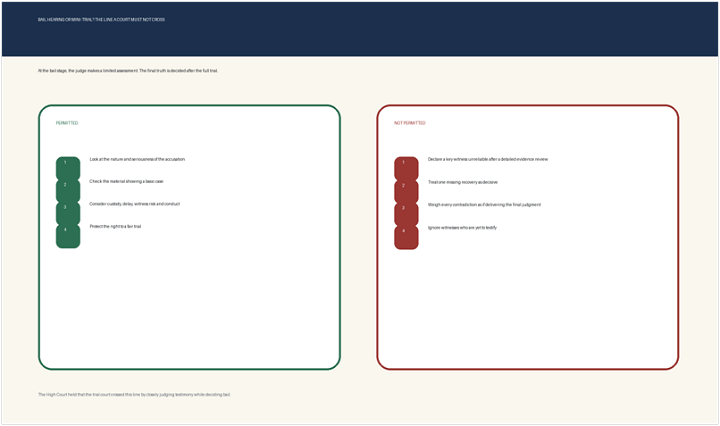
At bail stage, the judge looks for things like whether a basic case exists, how serious the accusation is, whether the accused may abscond or influence witnesses, how long the custody has continued, and whether the trial is actually moving forward. The judge should not decide which witness will ultimately be believed after examining only part of the prosecution evidence.
The High Court said that this line was crossed. It described the bail order as having been built on irrelevant material, and as a product of a detailed, premature review of the complainant's evidence.
WHAT THE HIGH COURT ACTUALLY DECIDED
The most commonly cited part of the ruling states that the lack of spermatozoa on the seized trousers does not render the complainant's statement unreliable if the statement is otherwise of high quality.
On its own, this sentence might seem to suggest that forensic evidence is unimportant. However, the judgment does not make that claim.
The High Court's argument was that a negative result from testing clothing cannot, by itself, undermine a witness's credibility if the witness has otherwise provided a reliable account and has withstood cross-examination.
The same logic was applied to the missing lighter and muffler. Their absence could point to a weakness in the investigation, but it did not automatically show that the incident was fabricated.
The court also pointed out that small discrepancies regarding the location or date of the incident, particularly when the complainant is illiterate, should not be seen as definitive flaws at the bail stage.
It noted that there was no clear prior hostility that would explain a false claim. It also emphasized that the women who were allegedly involved had not yet given testimony. As a result, the trial court had formed an opinion before hearing witnesses who could directly influence the case.
THE FINAL DECISION WAS BASED ON BAIL LAWS.
Generally, a higher court does not casually revoke bail. However, it may intervene if the initial decision overlooks important information, depends on irrelevant factors, or is so flawed that it risks a wrong verdict. The High Court concluded that this threshold was met in this case. 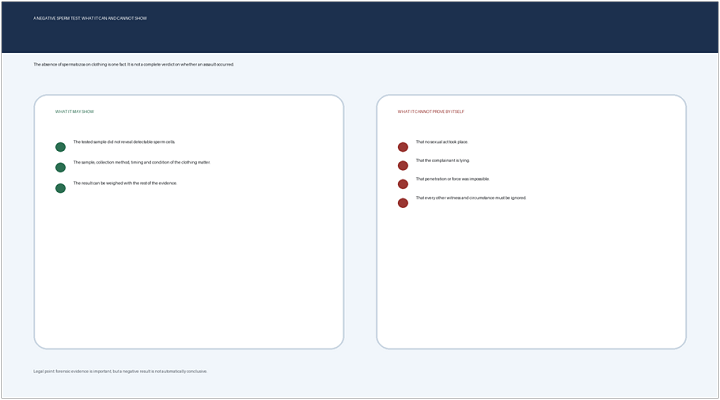
A NEGATIVE SPERM TEST RESULT DOES NOT PROVE THAT AN ASSAULT DID NOT HAPPEN.
Public discussions about sexual offences often treat medical or forensic evidence as a simple yes or no.
If semen is found, the allegation is seen as true. If it is not found, the allegation is seen as false. However, real-life situations do not work this way.
Under Indian law, rape is defined by the act of prohibited penetration and the absence of valid consent as per the law.
Ejaculation is not a necessary part of the offence. A person can commit rape without ejaculating. The presence or absence of semen can be affected by various factors such as using a condom, not ejaculating, delays in collecting the sample, washing, changing clothes, biological breakdown, the area from which the sample was taken, how it was stored, and the sensitivity of the lab tests.
GUIDANCE FROM AUTHORITATIVE SOURCES REFLECTS THIS LIMITATION.
The United Nations Office on Drugs and Crime has stated that not finding semen does not mean that an assault did not occur. India's health guidelines also warn that physical evidence cannot be interpreted simply. The absence of injuries does not prove consent, and the chance of finding biological evidence decreases over time.
This does not mean that forensic tests are unimportant.
A positive DNA result can strongly connect a person to biological material. A negative result, if properly collected, can also support a defense depending on the specifics of the case, the timing, and the expected evidence. The right approach is to ask what the test could actually show in the specific situation. A negative sperm test on clothing cannot be given more weight than what the science allows.
WHY THE PHRASE 'STERLING QUALITY' NEEDS TO BE USED CAREFULLY
The term 'sterling witness' sounds appealing because it suggests a simple categorization: either a witness is reliable or not.
The actual standard set by the Supreme Court is more complex and should not be simplified into a catchphrase.
In Rai Sandeep v State (NCT of Delhi), the Supreme Court defined a sterling witness as someone of very high quality whose account is consistent about the key events, survives intense cross-examination, and aligns with supporting evidence in important ways.
Later decisions have repeated that a conviction may rest on the sole testimony of a survivor if the testimony is reliable and convincing. They have also made it clear that a witness does not automatically become truthful just because the case involves rape. This balance is important.
Courts must not demand independent confirmation as a rule in every sexual assault case. These crimes often occur in the absence of neutral witnesses. At the same time, the defense has the right to examine the complaint, highlight serious contradictions, and use medical or scientific evidence where it directly conflicts with the accusation.
THE J&K HIGH COURT USED THE TERM CONDITIONALLY.
It stated that a negative sperm result alone would not make a statement unreliable if the statement was otherwise of sterling quality. It did not conclude at the bail stage that the complainant had fully met the strict test. The final evaluation belongs to the trial court after all the evidence is heard.
Bail is not a decision of innocence, and refusing bail is not a finding of guilt
Much of the confusion in cases like this arises from treating bail as an early judgment on the case.
Bail has a different function. It decides whether the accused should remain in custody while the case is ongoing. The accused is considered innocent until convicted in a trial.
When deciding bail, a court must consider the seriousness of the accusation, the available evidence, the possible punishment, the risk of flight, the chance of witness tampering, the accused’s behavior, the progress of the trial, and the length of custody.
The court must do enough to make a reasoned decision, but not so much that the bail order replaces the final judgment.
This is why the High Court objected to a 'meticulous' analysis of the complainant's evidence.
At that stage, only two prosecution witnesses had testified. Others who were said to have been present had not yet given evidence. A conclusion that the complainant was unreliable could affect the trial atmosphere before all the evidence was presented.
The reverse warning is equally important.
A judge cannot refuse bail simply by repeating that the accusation is serious.The court must still consider the possibility of release, the progress of the trial, and the actual risks involved.The seriousness of the case is important, but it cannot replace proper reasoning.A fair bail system protects both the complainant's ability to testify without fear and the accused’s right to not be punished before a conviction.
WHEN CAN BAIL THAT HAS ALREADY BEEN GRANTED BE CANCELLED?
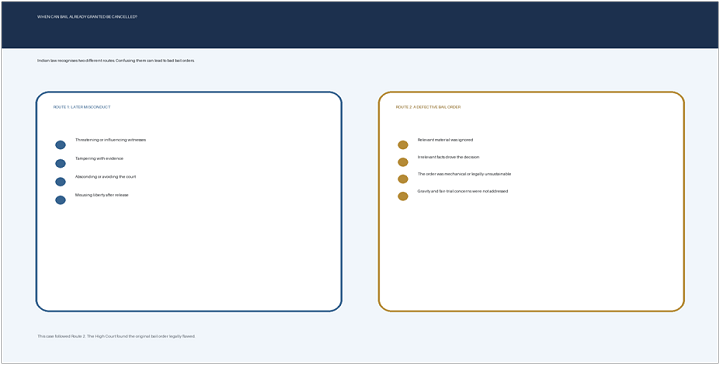
Cancellation of bail is more difficult than not granting it in the first place. Once a person is released, the law usually requires a strong reason to take that freedom away. The Supreme Court has outlined two general ways to cancel bail.
The first way involves events after the person is released meaning that the accused threatened witnesses, tampered with evidence, skipped court, committed additional offences, interfered with the investigation, or otherwise abused their freedom, bail may be withdrawn.
The second way involves the original bail decision. A higher court can overturn it if the lower court ignored important information, relied on irrelevant factors, failed to consider the seriousness of the case or the risks to a fair trial, or made an order that cannot stand legally. The J&K High Court used this second route.
This distinction answers the defense argument that bail couldn't be canceled because there was no later misconduct.
While later misconduct is one reason, it's not the only one. A bail order can be corrected if the process used to grant it had serious flaws. However, a higher court must clearly identify the flaw and can't just replace the first judge's decision with its own.
WAS CANCELLING BAIL THE RIGHT DECISION?
Based on the case details, the High Court had a strong reason to reject the trial court's reliance on a forensic report as nearly conclusive.
The absence of spermatozoa on trousers does not logically prove or disprove penetration, force, or the overall complaint. The failure to seize a lighter and muffler speaks more to the investigation's quality than to the truth of the allegation.
Timing was also important.
The alleged eyewitnesses hadn't been examined. If the trial court thought the case was stalled, it could have set a clear schedule, directed the prosecution to produce witnesses, and reviewed bail after some progress. The High Court similarly set a schedule for remaining witnesses and allowed a new bail request after their statements.
However, there is one area of caution in the reasoning. The judgment pointed out that granting bail early in a rape trial can have a chilling effect on women's safety and noted the societal impact of the crime. While crimes against women clearly have serious public consequences, bail should not be used to send a social message. The legal question remains whether custody is justified for the individual case.
The best interpretation of the decision is procedural, not symbolic. Bail was revoked because the original order unfairly discredited a key witness, treated a negative forensic result as more conclusive than it was, and ignored evidence that hadn't yet been considered. This is a narrower and stronger reason than saying that people accused of serious crimes should generally remain in jail.
WHAT THE RULING DOES NOT SAY?
The ruling does not claim that every rape complaint is automatically true or that forensic evidence is unimportant. It also does not say that contradictions can never justify releasing a suspect or that keeping someone in custody for a long time is unnecessary. It also refuses to declare the accused guilty.
The accused has the right to question the complainant’s story during the trial. They can use forensic reports, site plans, timelines, missing items, earlier statements, and any inconsistencies in the story. The court must look at these after the prosecution finishes its case and the defense has had a full chance to review them.
The High Court allowed for a new bail request once all the other witnesses have testified. This is important because the situation can change after that point. Once key witnesses have been questioned, there may be less chance of outside influence. If the trial is delayed, it may be harder to justify long custody. Bail decisions are not final and can change depending on the case’s stage and facts.
Readers should avoid two extreme headlines: "A negative forensic report proves a false case" and "A survivor’s story always overrides science." Both are wrong.
The law needs evidence to be considered carefully at the right time, without stereotypes or overreaching claims.
INVESTIGATORS SHOULD NOT MISUNDERSTAND THE HIGH COURT'S COMMENT ON MISSING ITEMS LIKE A LIGHTER OR MUFFLER.
A weak investigation can hurt a real case. Objects mentioned in the first report should be found quickly. Clothing should be handled quickly, properly stored, and kept in a chain of custody. Medical and forensic work should begin without unnecessary delays.
A negative result is easier to understand if the record answers basic questions.
When was the clothing collected? Was it changed or washed? How was it stored? What exact tests were done? Was sexual testing the only kind done, or was DNA tested? What is the lab’s detection limit? Without this information, lawyers may argue about a single result without knowing the science behind it.
Investigators must quickly record statements from independent witnesses and help the court get those statements.
In this case, the High Court ordered the trial court to set a schedule and the prosecution to bring the remaining eyewitnesses forward.Speed is important for both sides.Delay can fade memories, pressure witnesses, and increase the accused's time in custody.
FORENSIC EVIDENCE SHOULD BE USED CAUTIOUSLY BY DEFENCE ATTORNEYS.
The attorneys can draw attention to an unfavourable report, but they shouldn't take it as a response to a query it wasn't meant to answer. Asking specific enquiries, such as if the clothing was worn during the incident, whether the complainant's narrative was altered, and whether the alleged behaviour would have left some biological trace, is the most successful method. When paired with inconsistencies, reliable alibis, past hostility, or contradicting medical data, a negative result may be more convincing.
The Supreme Court has demonstrated that a single credible account can survive even in the absence of scientific proof, but substantial discrepancies and a lack of support from medical or forensic evidence can result in convictions being reversed.
THE LEGAL RULE IS NOT BLIND BELIEF, BUT RATHER A RIGOROUS APPRAISAL.
At the bail stage, defense lawyers should link the weakness to proper bail factors like lack of a strong case, long custody, examination of key witnesses, low flight risk, or delays not caused by the accused.
This is more effective than asking the bail judge to set aside the case early. Prosecutors may welcome this ruling because it rejects the idea that every sexual assault case needs a positive lab result.
They should not use the ruling as a shield against legitimate questions. A survivor’s testimony may be enough in law, but only if the court finds it reliable after fair testing. Prosecutors should explain inconsistencies rather than dismissing them as minor. They should present the collection timeline, bring in experts if needed, and explain what a negative result means. They should not ask the court to ignore mistakes in the investigation simply because the crime is serious.
The strongest prosecution case is one that treats the complainant as someone who can make mistakes and not otherwise. It is one that supports her account where there is evidence, acknowledges limitations in science, and allows for fair cross-examination without harassment or character attacks.
THIS RULING WILL REMAIN RELEVANT UNDER THE NEW CRIMINAL LAWS.
The case dates back to 2022, so it involves the Indian Penal Code and the Code of Criminal Procedure. The broader principles still apply under the new laws.
The new law defines rape through specific acts and conditions where consent is missing or not valid.
It does not require ejaculation or the recovery of sperm. The new law also gives high courts and lower courts the power to issue bail and direct arrests. The distinction between misconduct after release and flawed bail orders is likely to remain important. That is why this High Court ruling has value beyond Jammu and Kashmir. It cautions judges not to use a restricted bail hearing like a full trial and not to allow science to say more than it can.
Answers to important questions like what the accusation is, what constitutes a basic case, which key witnesses have been questioned, the risk of threat or flight, how long the accused has been in custody, who is responsible for delays, whether forensic results contradict the claim, whether test differences are crucial, and whether conditions or scheduling can protect both liberty and case integrity are all included in a useful checklist for courts.
THE ORDER SHOULD EXPLAIN THE ANSWER WITHOUT DECIDING GUILT.
If bail is given, the conditions should be realistic and linked to actual risks. If not given, the seriousness of the case should not be the only factor. Delays should be identified with clear dates and responsibility, not vague language.
If bail has already been given, a higher court should first examine the possible route for cancellation.
Was the accused misusing freedom after release? Or was the original order based on irrelevant facts or a legal mistake? Clear identification of these routes ensures cancellation is rare and justified.
This High Court decision is useful because it highlights these questions. Its lasting message is not that one side always wins, but that courts must ask the right questions at the right time.
The bigger point is that science should help justice, not replace it. Forensic evidence has changed criminal trials, and rightly so. DNA can identify, exclude, and connect people. Labs can find facts that memories can’t. Science enters through samples collected by people, under real conditions after time has passed. A result is only as meaningful as the question asked, the material tested, and the method’s limits.
Speaking to LCI Advocate Shyam Sundar Dutta stated that “See, it is a really important one for how courts look at forensic reports during bail hearings.
Basically, the court made it clear that just because a lab report did not find any spermatozoa on the clothes, it does not mean the assault did not happen. The trial court had granted bail by leaning heavily on that negative test result and the fact that some items like a lighter were not found. The High Court ended up cancelling that bail. They said the trial court was basically running a mini-trial way too early because they tried to decide how reliable the survivor was before even hearing from most of the eyewitnesses. “
He further stated that “The main point the High Court stressed is that bail is not the time to weigh every single contradiction or piece of scientific evidence as if you are delivering the final verdict. A bail hearing is supposed to look at things like how serious the charge is, the risk of witness tampering, and whether the trial is moving along.”
Lastly he stated that “They did not say the accused was guilty or that the forensic test is totally useless. They just said the trial court got ahead of itself. They actually allowed the accused to apply for bail again once the rest of the eyewitnesses have testified, so they are not keeping him locked up forever. It is a good reminder that science is there to help, but it cannot replace a full trial.”
WITNESSES HAVE LIMITS TOO.
Memory can be affected by stress, time, language, and questions.Statements can be wrong.Some allegations may be false. That’s why courts use cross-examination, medical evidence, surrounding circumstances, and the burden of proof. The answer is not to put testimony above science or vice versa, but to understand both.
In Union Territory of J&K v Parvaiz Ahmed Ganie, the High Court found that the trial court used a negative sperm finding and missing items to decide bail before all the evidence was in.
The court corrected this, sent the accused back into custody, ordered faster examination of witnesses, and preserved his right to apply for bail again.
This ruling matters because it rejects the dangerous idea that finding no sperm means no rape.
It also should not be interpreted as the final endorsement of the complainant’s claim.The trial still has to prove the case beyond reasonable doubt.Fairness comes from holding both ideas together.
Publication and SEO Details
|
Recommended headline |
No Spermatozoa Found, But Bail Cancelled: What the J&K High Court Ruling Really Means |
|
Alternative headline 1 |
No Spermatozoa, No Acquittal: Why the J&K High Court Cancelled Bail in a Rape Case |
|
Alternative headline 2 |
Can a Negative Sperm Test Disprove Rape? J&K High Court Explains the Limit |
|
SEO title |
Negative Sperm Test Does Not Disprove Rape: J&K High Court Bail Ruling |
|
Suggested URL slug |
negative-sperm-test-rape-bail-jk-high-court |
|
Meta description |
J&K High Court cancelled bail in a rape case, holding that absence of spermatozoa on clothing cannot by itself discredit reliable testimony. |
|
Primary keyword |
absence of spermatozoa rape case |
|
Secondary keywords |
J&K High Court rape bail, negative forensic report rape, bail cancellation rape case, survivor testimony forensic evidence, sterling witness rape law |
|
Suggested excerpt |
A negative laboratory result can be important, but it cannot answer a question the test was never capable of deciding. The J&K High Court ruling explains why bail courts must not turn one missing forensic trace into an early acquittal. |
Suggested social media hook
No spermatozoa were found on the seized trousers. The trial court treated that as a serious weakness. The High Court cancelled bail. Why? Because a negative forensic result can be important without being conclusive, and a bail hearing cannot become an early trial. This ruling is a sharp lesson in how courts should read science, testimony and liberty together.
Frequently Asked Questions
Does the absence of spermatozoa prove that rape did not occur?
No. It means sperm cells were not detected in the tested sample. It does not by itself rule out penetration, force or sexual assault.
Did the High Court convict the accused?
No. It cancelled bail and directed surrender. The criminal trial must still decide guilt after all evidence is recorded.
Can a survivor's statement alone support conviction?
Yes, if the court finds it reliable and trustworthy after full trial. There is no fixed rule requiring corroboration in every case.
Can forensic evidence still help the defence?
Yes. A negative or conflicting result may be important when read with the allegation, timing, collection method, medical evidence and other contradictions.
Why was bail cancelled if there was no later misconduct?
A higher court can cancel bail not only for misconduct after release, but also when the original order ignored relevant material or relied on legally irrelevant considerations.
Can the accused apply for bail again?
Yes. The High Court expressly allowed a fresh application after the remaining eyewitnesses are examined.
Join LAWyersClubIndia's network for daily News Updates, Judgment Summaries, Articles, Forum Threads, Online Law Courses, and MUCH MORE!!"


Tags :others