


A Magistrate may act when release conditions are broken or fraud is properly shown. What the court cannot do is reverse an earlier custody order on a one-sided police request.
|
THE TAKEAWAY |
A seized vehicle can become useless long before a criminal case reaches its end. It may remain exposed in a police station, lose value, gather rust, miss loan payments and stop earning income for the person who depends on it. That is why criminal courts regularly release vehicles to a claimant for temporary custody, subject to strict conditions and a promise to produce the vehicle whenever required.
But what happens after the court has already granted that release? Can the same Magistrate cancel the order months later, based only on a request from the investigating officer, without hearing the person who is holding the vehicle?
The Orissa High Court has answered that question in clear terms. In Batakrushna Dehury v. State of Odisha, Justice Sanjeeb Kumar Panigrahi held that a Magistrate cannot take back a vehicle released under Section 457 of the Code of Criminal Procedure merely by reconsidering the earlier decision. Before an order affecting the holder is passed, the holder must be given notice and a real chance to respond. The court also cannot use a cancellation application as a hidden way to review its own final order.
The ruling is important because disputes over seized vehicles are common in cases involving accidents, alleged fraud, theft, narcotics, excise offences and ownership claims. The judgment does not say that an interim release can never be cancelled. It says that cancellation must have a lawful reason and must follow a fair process. A court cannot take away custody first and hear the affected person later.
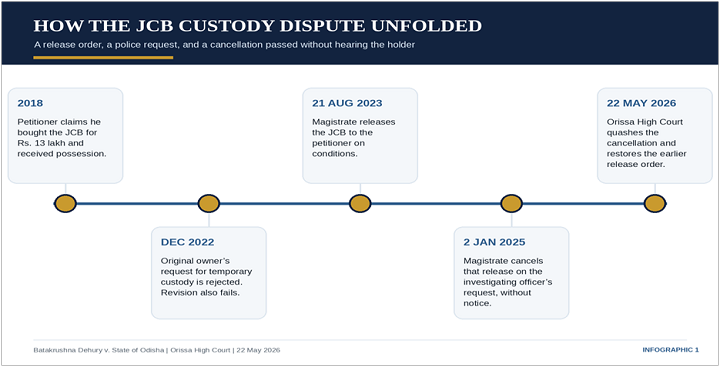
The dispute concerned a JCB excavator. According to the petitioner, the original owner had agreed to sell the said subject matter to him for Rs. 13 lakh because of financial difficulties. The petitioner claimed that he paid the consideration and received possession in November 2018. Since he did not have experience in operating the machine, the parties allegedly agreed that the original owner would continue managing it and would pay Rs. 50,000 every month as rent.
Master CPC - Once and for All: Master Course by Adv. Roma Bhagat. Enrol Now!
The arrangement later broke down. The petitioner alleged that no rent was paid and that possession of the machine was not returned. He lodged a first information report against the original owner and his family members for cheating, criminal breach of trust, intimidation and related offences. During the investigation, the police seized the JCB and reported the seizure to the Sub-Divisional Judicial Magistrate at Kamakhyanagar.
The original owner first applied for interim custody of the machine. The Magistrate rejected that request in December 2022 after hearing the parties. A revision before the Additional Sessions Judge also failed. The petitioner then filed his own application. On 21 August 2023, the Magistrate allowed it and released the JCB to him on conditions. He complied with the order and obtained possession the next day.
In December 2024, the investigating officer approached the Magistrate with two requests. The first was to take the JCB from the petitioner and hand it to the original owner. The second was to cancel the earlier interim release order. On 2 January 2025, the Magistrate rejected the first request. Yet, through another order passed on the same day, the Magistrate allowed the second request and directed the petitioner to return the machine to the investigating officer within ten days.
The petitioner was not given notice before the release order was cancelled. He was not asked to explain the alleged documents, the police findings or whether he had violated any condition of custody. He approached the High Court under the court's inherent powers and asked for the cancellation order to be set aside.
The Question Was About Process, not final ownership
It’s kind of easy to slip and think this was some final rumble about who owned the JCB, but it wasn’t, not really. The High Court wasn’t deciding some permanent title in the machine. It was basically looking at whether the Magistrate could cancel an interim custody order in the way they did, and yes, in that manner, there was a problem.
And honestly that distinction, it matters. An order releasing seized property during an investigation is, by nature, temporary. It keeps the thing in useable condition, and it puts it with someone who’s supposed to safeguard it and produce it again when asked. . The criminal case underneath, any civil claim, and even the truth of documents in dispute can still be worked out later, based on evidence.
So the narrow question before the High Court was pretty straightforward: if a claimant has already received the vehicle because of a judicial order and they complied with the conditions, can the Magistrate then cancel that order, without hearing them, and by re-checking the same ownership dispute?
The High Court said no.
What Section 457 Of The CrPC Was Meant To Do
Section 457 comes into play where the police seize property and then report the seizure to a Magistrate, but the property doesn’t get produced before a criminal court during the inquiry or trial. In that scenario, the Magistrate can decide who should hold the property on a temporary basis, and the Magistrate can attach conditions about custody and production.
The idea is practical, because a vehicle shouldn’t just sit around for years in a police yard just because it might somehow connect to a criminal case. Courts can protect the evidence by recording identifying particulars, taking photos or video, requiring a bond, preventing sale or alteration and directing production whenever it’s needed.
The Supreme Court has repeatedly said that storing vehicles at police stations for long periods serves little value. In Sunderbhai Ambalal Desai v. State of Gujarat, the Court said Magistrates should pass proper orders promptly, and they may require bonds, guarantees and security for the return of the vehicle. More recently, in Bishwajit Dey v. State of Assam , the Supreme Court observed that a commercial vehicle kept unused may lose value and also deprive its owner of income, while loan liabilities just keep going.
The Orissa High Court ruling then deals with the next stage. It explains what happens after the Magistrate already used that power and handed the vehicle over. Interim custody may be temporary, but the order that grants it is still a judicial call. It can’t be undone like it’s just a casual administrative tweak.
Why Interim Release Is More Than A Paper Order
For a lot of owners, a truck, taxi, tractor or excavator isn’t “just equipment”. It’s where income comes from. Seizure can switch off a small business overnight, while loan instalments, insurance costs, and depreciation keep moving. A JCB left idle can also lose contracts and clients, and even if the State doesn’t intend to harm anyone, there’s not much gain in that kind of damage when the machine can be identified using records, photographs, and strict conditions.
So temporary custody has to be a balance—needs of the investigation on one side, and preservation of valuable property on the other. If you cancel the arrangement, you disrupt possession, livelihood, and the asset’s value. That’s not something that should be treated as a routine step with zero consequences.
First Rule: No Adverse Order Without A Hearing
The main flaw the High Court pointed out was the absence of notice. The petitioner had received the JCB under an order dated 21 August 2023, and they complied with the conditions mentioned there. Later, when the investigating officer asked for cancellation, the Magistrate didn’t issue notice, didn’t call for a reply, and didn’t hear the petitioner before changing course.
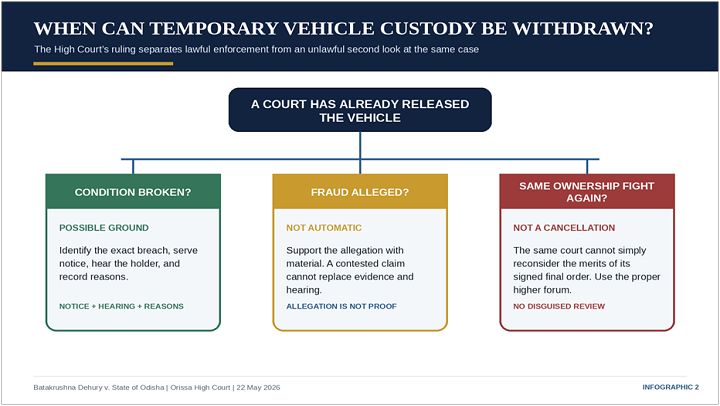
The High Court treated this as a basic fairness failure. Before a court passes an order that takes away a benefit or touches a person’s rights, the affected person should ordinarily be informed about what is alleged, and should be given a chance to answer it. The issue isn’t some “formality for formality’s sake”. A hearing can surface a factual error, uncover a missing document, show that a condition was already followed, or make it clear that the requested cancellation isn’t legally available.
The allegations here made the hearing even more necessary. The parties were disputing the authenticity of a sale deed, the signatures on it, the sequence of events, and the basis on which the earlier release had been granted. These aren’t things you can safely accept from one side only. The investigating officer’s view may be put before the court, but that view can’t replace the court’s duty to hear both sides.
The High Court relied on M/s Daffodills Pharmaceuticals Ltd. v. State of Uttar Pradesh, where the Supreme Court emphasized that an adverse order should not be imposed without prior notice , and without a real and fair chance for response.
The Second Rule: Cancellation is not a Review
The second part of the ruling is just as vital. Section 362 of the CrPC stops a criminal court from changing a final order after it is signed. Courts can only fix small typos or math errors. This rule ensures the law stays certain. A court cannot reopen a case just because a new request frames the argument differently.
The High Court found that the Magistrate did not cancel the release due to a broken rule. Instead, the Magistrate looked at the ownership papers again. This included a sale deed, a tax bill, a no objection letter, and payment records. The Magistrate then decided the petitioner's claim seemed unlikely.
This was not a simple way to enforce the first order. It was a second ruling on the same facts. Labeling it as a cancellation of custody did not change what it actually was. The High Court stated the court had reviewed and changed its final order, which Section 362 forbids.
This gap is the core of the case. A Magistrate can enforce release conditions, for example, if a person sells the car, hides it, or uses it in a crime. However, the Magistrate cannot reopen the fight over who owns the property to make a new choice.
What if fraud was used to get the release?
Claims of fake papers make this ruling more relevant. The original owner said the petitioner used a forged sale deed. Fraud is a serious matter. No one can keep an order they got by lying to the court.
The High Court did not protect fraud. It agreed that a court can revisit a release if rules are broken or if the person lied. But a claim is not a fact. In this case, the signatures and the document itself were disputed. The original paper was missing. Both sides told different stories about who made it.
A Magistrate cannot decide a fight over forgery in a quick cancellation hearing based only on a police claim. That would be a trial without real evidence. The right way is to show the new evidence to the court. The court must notify the other side and let them respond. The state or the other owner can also ask a higher court to stop the release. The judgment sets a clear line. Proven fraud allows for strong action. A mere accusation cannot be used to skip legal steps and evidence.
POLICE REPORTS ARE NOT FINAL VERDICTS
The High Court held that what the police conclude, is not the end of a custody fight. In this matter an officer filed a report in one proceeding, and then a charge sheet in another, so yeah the timeline matters. But still, those steps don’t become a final court ruling on things like who owns property, or whether some document is fake or not.
A police report essentially tells what the officer says was seen during a probe. The Magistrate may agree with it or may disagree, and they can also consider what the protest petition alleges. In other words, the report is not the final say on guilt or ownership until the court actually acts. If fresh material shows up, it may trigger a fresh move , but the court has to examine it properly, and after giving the other side a fair chance to respond.
In the Batakrushna Dehury case, the petitioner filed a protest petition. The High Court directed the Magistrate to decide it after hearing everyone involved. The court also said the Magistrate should not be guided by an earlier order that was already cancelled, or “washed off” in effect. That direction basically kept the investigation moving, but it also corrected what the court saw as an unfair way the vehicle was taken away.
TWO ORDERS ON ONE DAY SHOW A REAL TANGLED CONFLICT
Here, the Magistrate passed what looked like a confusing set of decisions. The officer had filed two requests. In the first request, the officer wanted permission to take the JCB from the petitioner and then hand it to the person described as the original owner. The Magistrate rejected that.
Then, on the same day, the officer filed another request asking to end the petitioner’s interim custody. This time the Magistrate agreed, and even told the petitioner to bring the JCB to the officer.
But the second direction did, in practice, what the first direction would not allow. After the officer got the vehicle, he returned it to the original owner anyway. The High Court pointed out the inconsistency. It said the Magistrate didn’t really think through the outcome , instead of just passing contradictory sounding directions.
Courts have to assess what an order actually results in, not just what the application is named as. If cancelling custody ends up placing the vehicle with a rival, the court has to be upfront about that reality. It can’t refuse a direct request and then allow the same result through a sidestep, like a roundabout route.
THE BNSS ANGLE, AND WHY IT STILL FEELS FAMILIAR
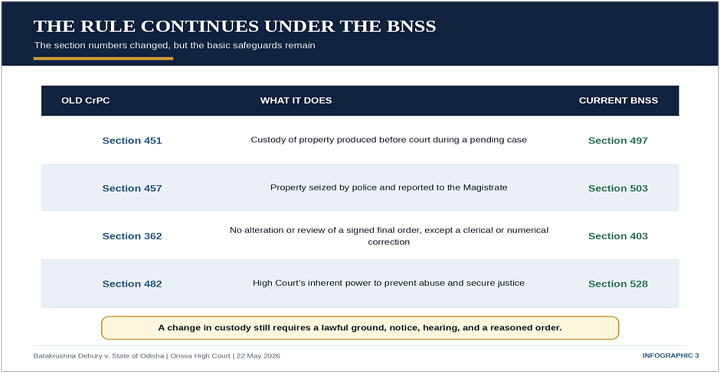
This case began under the CrPC and due to the same reason, the High Court relied on Sections 457, 362, and 482. Now, newer matters are dealt with under the Bharatiya Nagarik Suraksha Sanhita, where the framework is broadly comparable.
Section 503 of the BNSS covers seized property that the police report to a Magistrate. Section 497 deals with property brought before the court during a case. Section 403 blocks a court from relooking into its own signed order , except where there’s some slip like a typo or a mathematical mistake. Section 528 keeps the High Court’s general powers intact.
Still, the central idea remains the same. A custody order is a judicial act. Any change requires a hearing, and a court can’t reopen a case just because there’s a newer version of the facts. Also, under the BNSS, photos and video evidence can be used. This can help show what the vehicle looked like, so it doesn’t end up getting “mysteriously altered” or argued away over time, in a lot.
What A Vehicle Owner Should Do After Interim Release
A person who gets a seized vehicle really should keep the release order, bond, photographs , insurance papers and proof of compliance, like dont loose them or act ,as if you can wing it. Every direction to produce the vehicle should be followed promptly. The holder should not sell, mortgage, repaint or otherwise alter it, against the court’s conditions. Permission should be sought before major repairs.
If cancellation is asked for, the holder should take the application and supporting materials, then file a clear response. The reply needs to show whether any release condition was broken ,and also whether the request is just an attempt to reopen the original decision. Temporary custody also has to be understood for what it really is. It does not become permanent ownership, and the vehicle must stay available to the court
What Investigating Officers And Magistrates Should Do
The police may act when there is real misuse, concealment or fraud, but the fresh material must be put before the court using the correct application. The exact condition allegedly broken should be identified. A fraud claim should be backed up by documents, forensic material or clear steps taken in the investigation, not by just a bare statement.
The Magistrate should issue notice and split three questions , kind of in three buckets. first, was a condition broken. second, is the original decision being challenged again. third, does a special law create a separate confiscation process. The court’s immediate job is to preserve the property and evidence, not decide final ownership. Photographs, video, identifying numbers, bonds and transfer restrictions can usually protect the case. If the real challenge is to the original decision ,it may have to go to a higher court
What A Proper Cancellation Order Should Record
If a court is asked to withdraw temporary custody, its order should clearly mention who filed the request, what new fact is relied upon, and which release condition is said to have been broken. It should record that notice was served, summarise the holder’s response and explain why a less severe step would not safeguard the vehicle or the investigation.
The court should also say whether it is enforcing an existing condition or revisiting the earlier entitlement to custody. That difference stops a short cancellation application from turning into a second hearing on the same issue. Where disputed signatures, ownership papers or allegations of forgery are at the core, the order should explain what evidence has been tested and why an immediate change of possession is necessary. Clear reasons help both sides, and let a higher court see exactly what got decided
Why This Judgment Matters Far Beyond One JCB
Temporary orders can last for years and effectively decide whether someone can work, repay a loan or keep a business running. They cannot be altered casually just because they are called interim. The Orissa High Court confirms that temporary custody can be changed, but the affected person must be heard, and the court must point to a recognised ground.
The ruling also draws a line between investigation and decision. Police collect evidence and place their view before the court. The court then decides after hearing the parties. This guidance will matter in disputes involving trucks, taxis, tractors, construction machinery and other valuable property where rival claims are strong and delay gets expensive
Protection Does Not Mean Permanent Possession
The decision should not be read as if the petitioner has been declared the true owner of the JCB. The High Court restored the earlier temporary release because the cancellation process was unlawful. It directed the petitioner to keep obeying every condition, and to produce the machine whenever the trial court requires it.
The protest petition, criminal allegations and document dispute stay open, and they remain for decision. If later evidence shows fraud, breach of conditions, or a superior legal claim, the competent court can act through the procedure permitted by law. The ruling protects the pathway to a decision, not a party from the consequences of proved wrongdoing.
This balance is one of the judgment’s strengths. It stops sudden dispossession without turning interim custody into something untouchable. It also respects the need to examine alleged forgery, while still refusing to let an allegation become an automatic order.
The Real Message Of The Orissa High Court
This judgment is ultimately about the responsible use of judicial power. A court cannot take back released property by changing its mind, accepting only one side’s version, or renaming a review as cancellation.
Before custody is withdrawn, the holder must understand the allegation, and be given a real chance to answer it. The court must find a lawful basis, like breach of a condition or properly established fraud. A direct challenge to the correctness of the original order has to be brought before the forum that is empowered to examine it.
A seized vehicle can be evidence, a disputed asset, and someone’s livelihood all at once. Batakrushna Dehury v. State of Odisha shows that protecting all three interests starts with one simple rule ,hear the person before taking possession away.
Frequently Asked Questions
Can a Magistrate cancel the interim release of a seized vehicle?
Yes, but not merely because the court or police later prefers another claimant's version. Cancellation may be considered where a condition of release is broken or where fraud on the court is properly established. Notice and hearing are ordinarily required.
Does interim release decide who permanently owns the vehicle?
No. It decides temporary custody while the case continues. Final ownership may be decided during the criminal proceedings, through a final property order or in a civil case, depending on the dispute.
Can the police take back a released vehicle on their own?
Ordinarily, the police must act under a lawful court order and according to its terms. They may approach the court with new material, but the court must examine the request and hear the affected holder before passing an adverse order.
What if the holder does not produce the vehicle when directed?
Failure to produce the vehicle can amount to breach of the release conditions. The court may take action under the bond and may reconsider custody after following the proper process.
Which BNSS provisions now deal with seized property and review of orders?
Sections 497 and 503 of the BNSS deal with custody and delivery of seized property in different situations. Section 403 prevents a court from altering or reviewing a signed final order except for a clerical or numerical correction. Section 528 preserves the High Court's inherent powers.
Join LAWyersClubIndia's network for daily News Updates, Judgment Summaries, Articles, Forum Threads, Online Law Courses, and MUCH MORE!!"


Tags :others


