
SEO title
Husband's Failure To Explain Wife's Death In Matrimonial Home: Supreme Court on Section 106 Evidence Act
Meta description
A detailed, original article on the Supreme Court ruling that upheld a husband's conviction after his failure to explain his wife's death inside the matrimonial home under Section 106 of the Evidence Act.
Focus keywords
Section 106 Evidence Act, matrimonial home death, Supreme Court wife death case, circumstantial evidence murder conviction, adverse inference husband wife death, burden of proof matrimonial death
Introduction
It isn’t always about inventing fresh rules - sometimes it’s how old ones get used that counts. Take the Supreme Court’s ruling in Chetan Dashrath Gade v State of Maharashtra. A basic yet strong principle sits at its center. Death occurs in a shared household under odd conditions, where only the surviving partner truly knows what unfolded nearby. Then comes the weight: an account must follow, truthful and clear. If words fail, dodge, or sound false, doubt begins to shape the outcome. That silence itself may speak louder than evidence.
This ruling demands careful scrutiny for a clear reason. Not merely another case upholding a conviction on appeal does it stand out. Rather, it shows what Section 106 of the Evidence Act truly means - no mere tool to fast-track prosecution's success. At the same time, it holds real weight, far from meaningless words in law books. When solid facts are placed before the court by prosecutors, silence from the accused won’t work as if truth were absent. Only he may know the full story - so ignoring his duty to speak makes little sense.
This piece examines the verdict anew instead of repeating standard coverage. Questions swirl around marriage secrets, indirect proof, who must explain what, how judges handle odd fatalities behind closed doors. Still more emerges - guilt in law rarely hinges on loud admissions or someone seeing it happen. Clues pile up quietly, leading where they will.
The Factual Background That Shaped The Case
It started when a woman died, days after marrying the man appealing now, back on 24 April 2012. Court records show claims she faced pressure about cash and gold soon after marriage. From her father came testimony: the groom wanted one lakh rupees to get a pickup truck, then received it from her relatives. All this emerged during proceedings, although charges tied to dowry weren’t ultimately proven in trial court.
Something shifted forever on 23 August 2015. From the man’s family came claims she’d hanged herself. First they carried her to a private clinic, later rushed her to a second facility - there doctors said she arrived without life. Her father spotted bruises across her face when he looked at her, rope marks circling her neck, while earrings, anklets, even toe rings were missing. After that sight, police recorded a complaint.
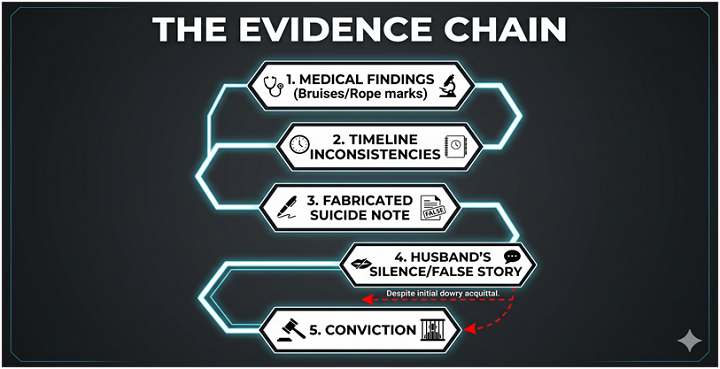
Here’s why that order matters - it shows the death didn’t fit the pattern of an ordinary household incident. Suicide was the story put forward by the defence. Yet the prosecution built its position on medical findings, context clues, what followed after, along with the husband’s failure to offer a solid account. From there, the matter passed through the trial level, climbed up to the Bombay High Court, eventually landing at the Supreme Court.
Supreme Court What Was Actually Said
It was the Supreme Court that confirmed the man’s guilty verdict in his wife’s killing. Not once did the judges doubt the evidence built by the prosecution - each piece locked into place, leaving no room for innocence. Inside the shared house, the woman died, a detail the justices found hard to overlook. Silence came from him when questioned formally under legal procedure, which added weight against his case. What stood out was how every circumstance lined up without gaps. Their ruling rested firmly on those unbroken links. No alternate story fit better than the one presented.
Looking at this piece of the judgment needs close attention. It wasn’t claimed by the judges that each mystery death in a shared household ends in guilt - because making that assumption risks twisting how crime laws work. Rather, what stood out was how the man offered no clear account of events, seen not alone but as part of a broader picture. Medical findings played their role. So did the way things unfolded around the time of passing. His actions afterward mattered too. Then came the made-up story about a suicide letter, something the bench pointed to as clearly untrue.
What sets it apart matters most when understanding the ruling. Not once did section 106 take over the job of proving guilt from the prosecution. Instead, it applied since specific details lay clearly within the husband’s awareness; silence on his part then added weight to what was already building through separate proofs. The absence of an answer shaped perception more than expected.
Why Section 106 Matters So Much In Cases Like This
Most folks get Section 106 of the Evidence Act wrong when they talk about it. It doesn’t suddenly make the accused prove they didn’t do it - guilt still needs solid proof by the side bringing charges. Truth is, courts operate on the idea that someone can’t be convicted unless doubt is truly erased. Yet here’s what matters: certain details sit only within one person’s mind. If waiting for outside evidence became mandatory each time, fairness might never catch up. So sometimes, the weight shifts - not fully - but just enough where silence speaks louder than distant clues.
Inside the family house, killings follow a familiar pattern. A place meant to be safe hides what happens behind closed doors. Few who saw anything come forward. Only those under the same roof ever learn how it ended. When evidence shows murder - or something close - and one partner had every chance to see, their quiet means something now. They can’t just say nothing, then act like silence should protect them.
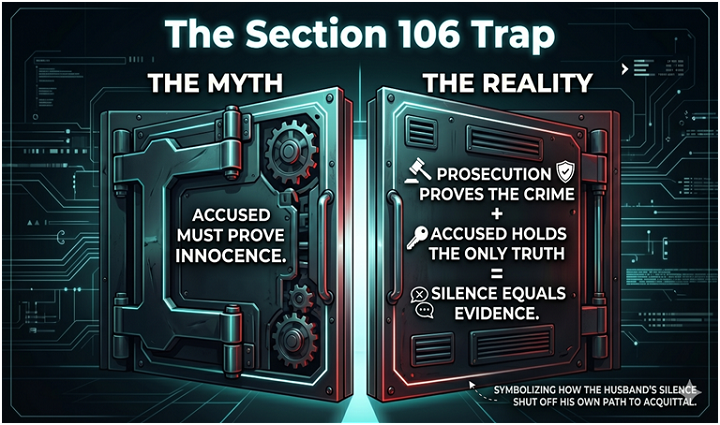
One might think silence leads to punishment, yet it is really about what judges can conclude. When someone knows things only they know, staying quiet speaks volumes. The woman passed away where she lived with her spouse. Marks on her body showed harm had occurred. What he said made little sense under scrutiny. His words failed to interrupt the pattern forming against him.
A Broader Reading Of The Case
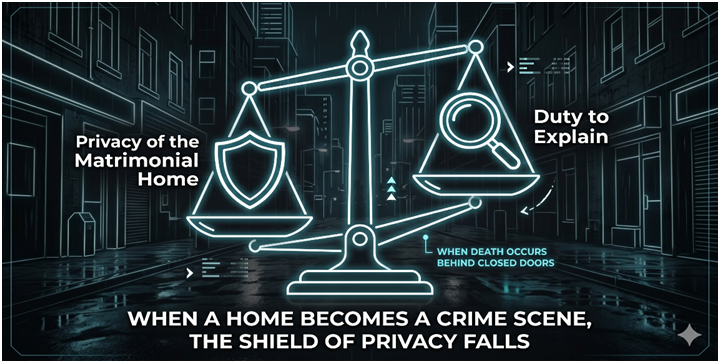
It matters because of both law and society. Suspicious deaths of women in marriage homes tie into power within families, stress between spouses, money pressures - silence covers it all up. Homes are meant for closeness, yet those same rooms sometimes hide harm.
A death behind closed doors forces courts to weigh one danger against another. Wrongful convictions might happen when suspicion replaces proof. Serious crimes could vanish into the quiet corners of home life because privacy blocks the view.
Nowhere does the ruling claim quiet equals guilt. Only when mystery surrounds how someone died might staying silent matter at all. Before that point, nothing sticks. What shifts things is proof the person should have spoken up if innocent. Here, logic shapes how the law steps in, not pressure or guesswork. The moment fits the rule, not the mood.
Inside marriage, lives overlap deeply - same home, same routines, same everyday closeness. When violence takes one partner within that shared world, the survivor isn’t just someone passing by. Moral weight shapes how choices are judged here.
Silence, especially when it feels convenient, won’t satisfy what the situation demands. Laws step in because unanswered questions sit heavily when death strikes so close. Hard answers may be required - it’s not evasion disguised as privacy.
Why The Acquittal On Some Charges Does Not Weaken The Murder Conviction
Surprisingly, the trial court cleared everyone on accusations tied to cruelty and dowry-related death, since evidence didn’t meet what’s legally needed. Still, the man ended up found guilty of killing his wife. At first glance, that might seem off balance. Truth is, each charge lives by its own set of rules. What fits for one crime won’t necessarily work for another.
Just because a dowry death case falls apart does not mean someone didn’t kill her. The judge might say there’s not enough proof for cruelty tied to dowry demands, although the facts could still point straight at the husband taking her life. Murder, after all, doesn’t depend on dowry laws being broken. It rests on different clues altogether.
Surprisingly, the Supreme Court signed off on just such an arrangement here. Without a dowry death ruling, the man still faced heavy pressure from indirect proof tied to murder. What stands out is how clearly the decision draws lines between heated claims and what law requires for guilt.
Circumstantial Evidence Is Not Weak Evidence
Most people wrongly assume indirect proof carries less weight in public debate. Yet judges keep dismissing such doubts. When every piece fits, circumstantial clues form a solid picture. Truths behind closed doors usually come to light through these very hints.
Nowhere near loose ends here - the sequence of events added up just enough. Instead of guessing, judges leaned on what they could trace step by step. From back then, a known yardstick returned: nothing missing, no room for innocent explanations left standing. Proof without an actual witness? Still possible, so long as gaps didn’t linger. This time around, doubts faded once all pieces clicked into place. Not one thread dangled out of reach.
Most people overlook how tightly stories must fit when deciding guilt today. What medicine reveals, actions following an event, lies told by one side, where someone died, and missing reasons - these pieces lock into place more often than expected. Certainty builds even without eyewitnesses standing nearby during the act.
Inside tight circles, trust matters more than facts. What counts isn’t proof but who believes whom. Power hides where voices echo without challenge. Truth bends when few are allowed to speak. Belief shapes reality behind sealed doors
Look closer at the ruling. Not just focused on Section 106, but trust within tight circles. When something occurs behind closed doors run by few hands, courts weigh what those insiders say - or hide - differently. False stories matter here. Silence speaks louder than words sometimes. Seen often where power stays hidden: jails, homes, offices. Each setting shares that quiet tension when truth gets shaped by those in control.
Every time, a quiet rule stays hidden beneath the surface. When someone holds power over an area, they must answer for events inside it. Courts do not assume blame just from presence alone, yet unchecked authority draws suspicion. This decision matters outside family killings because of that point. Hidden rooms should never escape scrutiny when fairness is at stake.
Looking at it this way, the ruling quietly underscores how far such madeup explanations can go. When the claimed story clashes with wounds, time gaps, behaviour, or hospital reports, judges have reason to treat it as untrue. Should such a weak explanation ride alongside silence on things only the accused could know, the Crown’s position gains weight without needing more proof.
The Role Of Conduct After The Incident
What stands out next is how the court looked closely at what the person did afterward. Not every detail matters, yet actions following an event tend to carry weight when facts are unclear. Though behavior alone cannot replace solid evidence, it might make a version of events seem more likely - or less so.
What stands out is how the judges went beyond hospital files. Instead of stopping at clinical details, they examined what unfolded after the woman died - the man’s version of events, plus that claimed farewell letter. Timing matters here. Behavior afterward often shows not grief, but effort: one reacting to sudden loss, another building a cover once it happens.
Here is why Section 313 CrPC still holds weight in such cases. Because when judges let the accused speak about suspicious facts, what comes out counts. Not saying much won’t shift things. Giving an answer proven wrong might pull the case deeper against them. This judgment reveals how silence or lies mix into the full proof stack.
Why This Judgment May Influence Future Cases
One day, judges might point to this decision when handling similar tragedies at home - wives gone under odd shadows. Often, guilt hangs on hints rather than proof, with husbands offering little that makes sense. From now on, if key truths come out, silence won’t shield someone who knows more than he lets on. Legal teams may pull up these words when fairness demands answers, not just denials. The weight shifts slightly, leaning toward those who carry secrets alone.
Still, defense attorneys might reference the ruling sideways to push a different angle. Because the judges looked at every detail together, not just someone staying quiet, they could claim later that Section 106 can’t cover big holes in what prosecutors bring forward. That view holds up well enough. Strong rulings tend to sharpen arguments on either side by showing exactly where lines are drawn.
One reason this case might matter later is how it stays centered. Not tipping too far one way, it protects being seen as innocent at first while stopping someone from hiding behind that idea when facts point clearly elsewhere. What stands out is its demand for actual proof before anything else. Only after that does silence from the defendant - on things no one but him would know - start to carry weight under law.
Speaking to LCI, Advocate Abhishek Purohit stated that so about that SC’s decision, it’s actually a massive deal. Basically, the court just killed the classic "I didn’t see anything" defense guys use when their wife dies under shady conditions at home.”
He further said that “The play used to be staying quiet or spinning some fake suicide story to hide what really happened behind closed doors, but the court is officially calling BS on that now. Section 106 doesn't mean you have to prove you're innocent, but if the prosecution has already lined up the medical facts and the timeline, you’re basically cornered. Since you’re the only one who was actually in the room, if you don't give a real explanation, the court is gonna treat your silence as actual proof of guilt.”
Lastly he said that “Long story short: "privacy of the home" isn't a get-out-of-jail-free card anymore. If the facts are already pointing to you, staying silent is basically the same thing as a confession in their eyes. Don't expect the judges to buy the "I don't know" routine when you're the only one who knows the truth.”
Final Takeaway
Out of nowhere, the Supreme Court weighed in on what silence means when someone dies under odd conditions at home. This case, called Chetan Dashrath Gade versus State of Maharashtra, doesn’t invent some tough new standard. Instead, it uses a long-standing principle without going too far. When evidence builds up enough, staying quiet - without a good reason - can speak volumes. Section 106 isn’t meant to replace actual proof. Yet if facts are already pointing one way, then failing to explain things clearly can tilt the balance.
Truth doesn’t show up neatly when someone dies under strange circumstances at home. More often it comes in pieces - broken bits of behavior, wounds, what was said, and what wasn’t. Missing parts matter, especially if only one person knows them yet says nothing useful. That quiet speaks louder than words. Silence like that becomes evidence on its own. The weight shifts without a trial needing fireworks.
Join LAWyersClubIndia's network for daily News Updates, Judgment Summaries, Articles, Forum Threads, Online Law Courses, and MUCH MORE!!"


Tags :Others