
Table of Contents
- Introduction
- Understanding the Public Domain
- Anti-Circumvention Law and the Persistence of Digital Locks Beyond Copyright Expiry
- What Section 65A of the Copyright Act, 1957 Actually Provides
- Three Categories of Persons Bearing the Legal Cost
- Constitutional and Competition Law Dimensions
- Key Takeaways
- What Legislative Reform Should Look Like
- Conclusion
Frequently Asked Questions (FAQs)
1.Introduction
The foundational premise of copyright law rests on a temporal bargain: a creator is granted exclusive rights over a work for a fixed and limited period. Upon expiry of that period, the work passes into the public domain and becomes freely available to all members of society. Any person may reproduce, adapt, translate, or otherwise use the work without requiring permission or making payment. This structure monopoly for a term, public access thereafter has been the cornerstone of intellectual property law since the Statute of Anne, 1710.
Under the Copyright Act, 1957, copyright in India subsists for a period of sixty years following the death of the author, calculated from the beginning of the calendar year following the year of death. Separate periods apply to cinematographic films, sound recordings, photographs, and works of government authorship, but the governing principle remains uniform: copyright is time-limited, and its expiry is legally absolute.
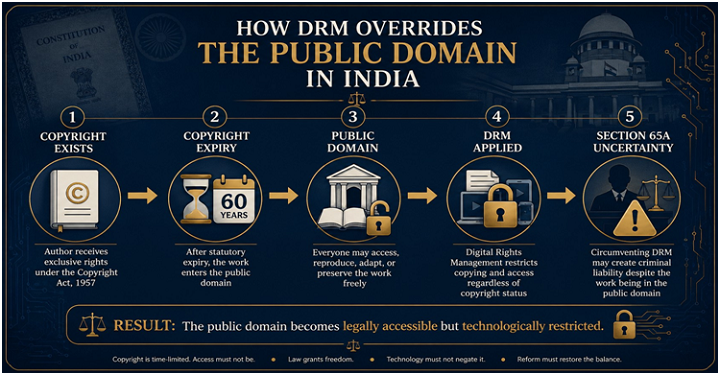
However, the practical operation of this principle has been significantly complicated by the proliferation of Digital Rights Management (DRM) technology. DRM refers to technological protection measures applied to digital content that restrict copying, reproduction, format conversion, or access to that content. These locks are increasingly deployed on works that are legally in the public domain works whose copyright has expired under the Copyright Act and Indian law does not currently prohibit such deployment.
The more acute problem lies in the anti-circumvention provision introduced by the Copyright (Amendment) Act, 2012. Section 65A of the Copyright Act makes it a punishable offence to circumvent technological protection measures applied to a work, subject to the requirement of intent to infringe. As a matter of statutory text, Section 65A can be read as permitting circumvention where the purpose is not prohibited by the Act. However, no Indian court has authoritatively resolved whether this reading is correct, and the resulting legal ambiguity creates genuine deterrence for libraries, research institutions, disability organisations, and archivists seeking to access works they are legally entitled to use.
This article examines the doctrinal contours of this problem, identifies the categories of persons most directly affected, considers the constitutional and competition law dimensions of the issue, and proposes a framework for legislative reform.
2.Understanding the Public Domain
2.1 The Statutory Framework
The public domain is not a residual or incidental category. It is a constitutive feature of copyright law the space that copyright law actively creates and protects by imposing limits on the duration of the rights it grants. The Copyright Act, 1957 gives effect to this through Chapter V (Term of Copyright), which specifies the duration of copyright for each category of work.
For literary, dramatic, musical, and artistic works, Section 22 provides that copyright subsists until sixty years from the beginning of the calendar year following the year in which the author dies. For anonymous and pseudonymous works, Section 23 provides a separate computation. For cinematographic films and sound recordings, Sections 26 and 27 respectively provide a sixty-year term running from the beginning of the calendar year following the year of publication. Government works are governed by Section 28. Upon expiry of the applicable period, the work enters the public domain: no person holds copyright in it, no permission is required for its use, and no payment can be demanded as a condition of access.
This framework is not a technical loophole or a policy concession. It is the mechanism through which copyright law fulfils its social purpose. The temporary monopoly granted to creators is the price that society pays for incentivising creative output; the public domain is the return on that investment the cumulative stock of human knowledge and expression that belongs to everyone.
2.2 The Digital Disruption of the Public Domain Bargain
|
Concept |
Legal Position |
|
Creator's right |
Exclusive rights over the work for the duration specified under Chapter V of the Copyright Act, 1957 |
|
Society's return |
Full and unrestricted access to the work upon expiry of copyright the public domain |
|
Duration under Indian law |
60 years after death of author (Section 22); separate terms apply to films, recordings, and government works |
|
Effect of public domain entry |
No copyright subsists; use without permission or payment is lawful |
|
What DRM does |
Applies technological locks that remain operative regardless of copyright status no mechanism to distinguish between subsisting and expired copyright |
|
The legal gap |
Section 65A of the Copyright Act makes circumvention of technological protection measures potentially punishable, without a clear carve-out for public domain works |
The problem addressed in this article arises from the interaction between DRM technology and the legal framework for anti-circumvention. DRM systems are designed to enforce access restrictions through code. They do not track copyright status. A work that entered the public
domain thirty years ago is, from the perspective of a DRM system, indistinguishable from a newly published commercial title. The lock remains in place regardless of whether any legal basis for it continues to exist.
Standing alone, this is a technological inconvenience rather than a legal problem. What transforms it into a legal problem is Section 65A of the Copyright Act, which attaches criminal consequences to the act of circumventing a DRM lock without clearly distinguishing between locks applied to works still under copyright and locks applied to works in the public domain.
3.Anti-Circumvention Law and the Persistence of Digital Locks
3.1 The Function of DRM
Digital Rights Management encompasses a range of technologies used to control the reproduction, distribution, and use of digital content. Common implementations include encryption systems that prevent copying, access controls that restrict the number of devices on which a file may be used, and platform-specific restrictions that prevent interoperability. These mechanisms are enforced at the level of code and operate independently of any legal authorisation.
The original policy rationale for DRM was grounded in the economics of digital reproduction: in the absence of technological protection, perfect copies of a digital work can be produced and distributed at near-zero cost, which would potentially undermine the commercial value of copyright. DRM was therefore adopted as a mechanism to protect the economic interest of rights holders during the subsistence of copyright.
That rationale has force but only for the period during which copyright subsists. The technology, however, does not implement any automatic expiry mechanism. A DRM system applied to a work when it was first published continues to operate unchanged after the copyright term expires. There is no technical or commercial incentive for a platform to remove locks from public domain works; in many cases, platform operators may not even maintain records of the copyright status of individual works in their archives.
3.2 The Legal Consequence Under Section 65A
Section 65A was introduced by the Copyright (Amendment) Act, 2012. It provides that any person who circumvents an effective technological protection measure applied for the protection of any right shall be punishable with imprisonment up to two years and a fine. Critically, the provision specifies that the offence is constituted only where circumvention is done with the intention of infringing copyright or abetting such infringement.
India's approach is therefore more narrowly drawn than the anti-circumvention regime under the United States Digital Millennium Copyright Act, 1998 (DMCA), which makes circumvention unlawful regardless of purpose, subject to specified exemptions. Section 65A requires proof of infringing intent, which, in principle, means that circumvention for a non-infringing purpose should not attract liability.
Section 65A also contains an exception clause, which permits circumvention for purposes that are 'not expressly prohibited by this Act.' This language would, on one arguable reading, permit circumvention where the purpose falls within Section 52 the fair dealing provision or where the underlying work is in the public domain. However, this interpretation has not been tested or confirmed by any Indian court, and the statutory language is sufficiently ambiguous to sustain a contrary reading as well.
The legal position, as it currently stands, is one of unresolved uncertainty: there is no judicial pronouncement that conclusively establishes whether circumventing a DRM lock to access a public domain work is permissible under Section 65A. In this vacuum, institutions operating under legal risk management constraints universities, libraries, archives have systematically chosen non-access over exposure to potential criminal liability.
4.Section 65A of the Copyright Act, 1957 A Doctrinal Analysis
4.1 Text and Structure of the Provision
Section 65A reads, in relevant part, as follows: any person who circumvents an effective technological protection measure applied for the protection of any right conferred under this Act, with the intention of infringing such rights, shall be punishable with imprisonment which may extend to two years and shall also be liable to fine.
The provision further specifies that nothing in this section shall prevent any person from doing anything referred to therein for a purpose not expressly prohibited by this Act.
The structure of the provision therefore involves two elements: a primary prohibition on circumvention with infringing intent, and a saving clause that preserves the lawfulness of circumvention for purposes not prohibited by the Act. The question of whether access to a public domain work or the exercise of a fair dealing right under Section 52 constitutes a 'purpose not expressly prohibited' by the Act is, as yet, judicially unresolved.
4.2 Relationship with Section 52 (Fair Dealing)
Section 52(1)(a) of the Copyright Act provides that fair dealing with a work for the purposes of private or personal use, including research, does not constitute an infringement of copyright. Section 52(1)(zb), inserted by the Copyright (Amendment) Act, 2012, provides that the adaptation of a work into a format accessible to persons with disabilities does not constitute infringement. These provisions form part of India's fair dealing framework, which, unlike the US fair use doctrine, operates as a closed list of enumerated exceptions rather than an open-ended balancing test.
If the saving clause in Section 65A is construed as permitting circumvention for purposes falling within Section 52, then researchers, educators, disability organisations, and libraries would be insulated from criminal liability when circumventing DRM locks for purposes that the Act itself permits. However, this construction requires the reading of 'purpose not expressly prohibited' as incorporating the Section 52 exceptions by reference an interpretation that has not been confirmed by Indian courts.
4.3 Absence of Judicial Clarity
To date, no Indian court has delivered a ruling that addresses the specific intersection of Section 65A, DRM circumvention, and access to public domain works or fair dealing. The
Delhi High Court has addressed questions of copyright infringement in the digital context in cases such as Super Cassettes Industries Ltd. v. Myspace Inc. & Anr. (2016), and the question of fair dealing has been considered in cases including The Chancellor, Masters & Scholars of the University of Oxford v. Rameshwari Photocopy Services (2016), popularly known as the Delhi University Photocopying Case. However, neither of these decisions directly resolved the Section 65A question in the context of DRM circumvention.
The absence of judicial guidance on this specific point is a significant lacuna. The legal position cannot be regarded as settled, and institutions that rely on the arguable reading of Section 65A to justify circumvention do so without the benefit of authoritative legal support.
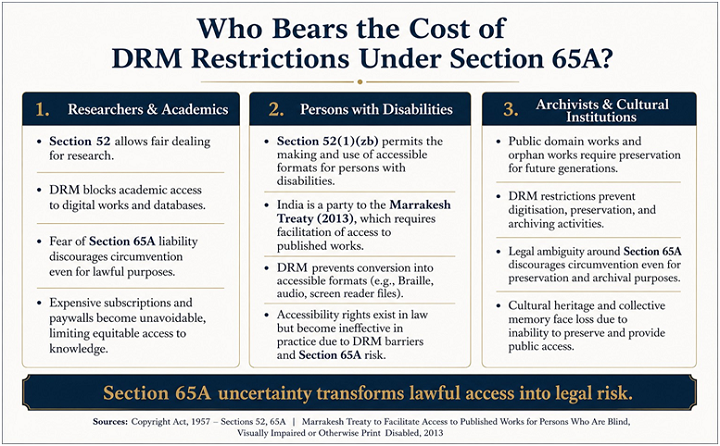
5.Three Categories of Persons Bearing the Legal Cost
|
Category |
Statutory Right |
Practical Barrier |
|
Researchers and Academics |
Section 52(1)(a): Fair dealing for private study and research does not constitute infringement |
Academic databases and digital archives frequently apply DRM to their content. Circumventing such locks to exercise the Section 52 research right creates exposure to criminal liability under Section 65A, in the absence of judicial confirmation that the saving clause applies. Most researchers absorb the cost of expensive subscriptions or forgo access. |
|
Persons with Visual and Print Disabilities |
Section 52(1)(zb): Adaptation into accessible formats for persons with disabilities is not infringement. The Rights of Persons with Disabilities Act, 2016 independently affirms this right. India ratified the |
Converting a DRM-locked textbook or publication into a screen-reader-compatible format requires circumventing the lock, which may attract liability under Section 65A. India's international commitments under the Marrakesh |
5.1 Researchers and Academics
The provision of fair dealing for research under Section 52(1)(a) is a statutory entitlement, not a discretionary permission. However, the practical ability to exercise that entitlement is substantially curtailed where the work in question is locked behind DRM and the legal risk of circumvention is unresolved. The result is an effective privatisation of access to knowledge resources that the Copyright Act recognises as belonging to the public interest.
Major academic databases including JSTOR, Elsevier ScienceDirect, and Springer apply DRM restrictions to their content. Researchers based in Indian universities, particularly those without institutional subscriptions, are therefore materially prevented from exercising rights that the Act confers upon them. This is a structural problem with implications for the quality and reach of academic research in India.
5.2 Persons with Disabilities
The intersection of disability access rights and anti-circumvention law represents perhaps the clearest instance of legislative incoherence in this area. The Copyright Act, the Rights of Persons with Disabilities Act, 2016, and India's obligations under the Marrakesh Treaty collectively establish a robust legal framework for accessible format copies. The Marrakesh Treaty, in particular, was specifically designed to address the global book famine faced by persons with visual impairments a condition that the World Blind Union has documented as leaving over ninety per cent of published works inaccessible to blind persons in developing countries.
India's ratification of the Marrakesh Treaty in 2014 created an international legal obligation to ensure that its domestic law facilitates accessible format reproduction. The failure to amend Section 65A to provide an explicit exemption for this purpose means that India's implementation of its Marrakesh obligations is legally incomplete.
5.3 Archivists and Cultural Preservation Institutions
India possesses an extensive and irreplaceable archive of early cinema, regional literature, classical and folk music, and colonial-era documents, a substantial portion of which has entered the public domain. The physical preservation of this material is a matter of national cultural importance. The National Film Archive of India and various state-level institutions have undertaken digitisation efforts, but the legal framework does not provide clear protection for circumvention carried out for preservation purposes.
Where early Indian films or pre-independence literary works have been digitised by commercial platforms and placed behind DRM, the situation is particularly acute: the public domain status of the underlying work confers an entitlement to access, but the technological measure prevents it, and the law does not unambiguously resolve which takes precedence.
6.Constitutional and Competition Law Dimensions
6.1 Constitutional Framework
The constitutional dimensions of this issue engage primarily with Article 19(1)(a) and Article 21A of the Constitution of India.
Article 19(1)(a) guarantees freedom of speech and expression. The Supreme Court in Secretary, Ministry of Information and Broadcasting v. Cricket Association of Bengal (1995) held that the right to freedom of speech and expression includes the right to receive information. This principle has been affirmed in subsequent decisions. Where DRM locks prevent a person from accessing a public domain work, and the law declines to permit circumvention, a question arises as to whether the state is indirectly facilitating a restriction on the constitutional right to receive information not through governmental action, but through a legal framework that accords protection to private technological measures applied beyond the scope of any legitimate legal right.
Article 21A, inserted by the Constitution (Eighty-Sixth Amendment) Act, 2002, guarantees the right to free and compulsory education for children between the ages of six and fourteen. The Supreme Court in Unni Krishnan v. State of Andhra Pradesh (1993) had earlier held, prior to the constitutional amendment, that the right to education was an integral component of Article 21. Inaccessibility to educational materials including public domain textbooks and instructional resources on account of DRM locks has a bearing on the substantive content of this right.
It must be noted, however, that these constitutional provisions do not operate as self-executing rights against private parties. The constitutional analysis identifies a policy concern that the state is, through Section 65A, using the legal apparatus of criminal law to protect private technological restrictions that exceed any legitimate property right rather than establishing a directly cognisable constitutional violation against platform operators.
6.2 Competition Law Dimension
Section 65A was enacted to protect copyright. However, DRM technology is frequently deployed for purposes that extend beyond copyright protection: preventing device interoperability, restricting format-shifting of legitimately purchased works, and locking users into proprietary ecosystems. In such cases, the anti-circumvention provision of copyright law is being used as a legal instrument to achieve market outcomes that have no connection with the protection of copyright.
The Competition Act, 2002 prohibits anti-competitive agreements and the abuse of dominant positions. The Competition Commission of India has jurisdiction to examine practices that distort market competition, including those involving the misuse of intellectual property rights. However, there is presently no formal coordination mechanism between copyright enforcement and competition law oversight, which means that market-distorting applications of DRM are not being subjected to competition scrutiny.
A comprehensive reform framework should address this gap by establishing coordination between the Ministry of Commerce, the Competition Commission of India, and copyright enforcement authorities, so that the deployment of DRM for purposes unrelated to copyright protection does not receive the incidental protection of Section 65A.
7.Key Takeaways
|
Issue |
Current Position |
Reform Required |
|
DRM on public domain works |
Not currently prohibited under Indian law. No provision of the Copyright Act restricts the application of DRM to a work whose copyright has expired. |
Statutory prohibition on application of DRM to public domain works; removal of Section 65A protection for such locks. |
|
Circumvention for fair dealing |
Arguable under the saving clause of Section 65A, but not confirmed by any Indian court. Legal ambiguity creates genuine criminal risk. |
Explicit amendment to Section 65A confirming that circumvention for Section 52 purposes does not attract criminal liability. |
8. What Legislative Reform Should Look Like
8.1 Prohibiting DRM on Public Domain Works
The most foundational reform is the clearest: the Copyright Act should be amended to provide that no technological protection measure applied to a work that has entered the public domain shall receive protection under Section 65A. If copyright has expired, the legal basis for restricting access to the work has also expired. A digital lock applied to a public domain work confers no copyright protection because there is no copyright left to protect and its application is, in effect, a use of technology to extend exclusivity beyond the period sanctioned by law. This is antithetical to the design of the copyright system.
8.2 Explicit Safe Harbours for Lawful Circumvention
Section 65A should be amended to provide explicit exemptions for circumvention carried out in the exercise of rights conferred by Section 52, including fair dealing for private study and research under Section 52(1)(a), library and archival preservation under Section 52(1)(n) and (o), and accessible format reproduction for persons with disabilities under Section 52(1)(zb). The amendment should specify that where the purpose of circumvention is a permitted purpose under Section 52, and the circumvention does not facilitate further infringement, no criminal liability attaches.
This approach preserves the commercial function of DRM in protecting genuinely copyrighted works while removing the chilling effect on lawful access. The intent to infringe standard, which Section 65A already adopts, should remain the operative test for criminal liability.
8.3 Explicit Disability Access Exemption
India's obligations under the Marrakesh Treaty require that its domestic law permit the creation and distribution of accessible format copies without the authorisation of the rights holder. An explicit amendment to Section 65A, conferring an exemption for format conversion for persons with print disabilities, is necessary to bring domestic law into alignment with India's international commitments. This is not a policy choice it is a legal obligation that India accepted upon ratification in 2014.
8.4 Protection for Archiving and Preservation
Libraries, public archives, and cultural institutions that digitise and preserve deteriorating public domain works early Indian cinema, pre-independence literature, regional folk recordings should be explicitly exempted from criminal liability under Section 65A when circumventing DRM for preservation purposes. The National Film Archive of India and state-level archival institutions should be specifically identified as eligible entities.
8.5 The Portuguese Legislative Model
Portugal's Code of Copyright and Related Rights, as amended by Law 36/2017, provides the closest working international model for the approach proposed here. Articles 217 onwards of that legislation explicitly permit circumvention of technological protection measures for the purposes of research, education, disability access, and preservation, subject to two conditions: that there is no reasonable alternative means of access, and that the circumvention does not facilitate further infringement. This conditionality is workable and can be adapted to the Indian legislative context without undermining the protection of commercially valuable copyrighted works.
8.6 Competition Commission Coordination
The Government of India should establish a formal coordination mechanism between the Ministry of Education, the Ministry of Social Justice and Empowerment, the Competition Commission of India, and the copyright enforcement apparatus of the Ministry of Commerce. The purpose of this mechanism would be to ensure that DRM deployed for purposes unrelated to copyright protection market lock-in, prevention of device repair, restriction of interoperability does not receive the protection of Section 65A, and that such deployment is subject to scrutiny under the Competition Act, 2002.
9.Conclusion
The public domain is not a peripheral concept in copyright law. It is the counterpart of the rights that copyright law grants: the space that is created when the temporary monopoly conferred on creators comes to an end. The Copyright Act, 1957 has consistently maintained this structure by imposing time limits on copyright and providing, through Section 52, a set of rights that ensure access even during the subsistence of copyright.
The problem identified in this article is not that the law has abandoned these commitments. The text of the Copyright Act continues to recognise fair dealing, disability access, and the public domain. The problem is that the anti-circumvention provision introduced in 2012 Section 65A has, through a combination of drafting ambiguity and the absence of judicial guidance, created a practical environment in which those rights cannot be exercised without legal risk. The result is an inversion of the copyright bargain: the public domain is locked, fair dealing rights are effectively unenforceable against DRM, and the internationally binding obligations of the Marrakesh Treaty remain unimplemented in practice.
The reform proposed in this article does not require the dismantling of DRM protection for commercially valuable works. It requires the law to clearly implement what it already appears to intend: that circumventing a digital lock to do something that the Copyright Act expressly permits is not a criminal act, and that no technological lock applied to a work whose copyright has expired is entitled to legal protection.
The legislative tools are available. The international models are documented. The case for reform is legally and constitutionally sound. What is required is the legislative will to enact it.
Frequently Asked Questions
Q1. What is the public domain and what is its legal basis in India?
The public domain consists of works in which copyright has expired under the Copyright Act, 1957. For literary, dramatic, musical, and artistic works, copyright expires sixty years after the death of the author, computed from the beginning of the calendar year following the year of death (Section 22). Separate terms apply to cinematographic films (Section 26), sound recordings (Section 27), and government works (Section 28). Upon expiry, no copyright subsists in the work, and it may be reproduced, adapted, or used by any person without permission or payment.
Q2. What is DRM and how does it affect access to public domain works?
Digital Rights Management (DRM) refers to technological protection measures applied to digital content to restrict copying, reproduction, or access. DRM systems do not monitor or respond to changes in copyright status: a lock applied to a work remains in operation regardless of whether the copyright underlying it has expired. A work legally in the public domain may therefore remain practically inaccessible if it is stored behind DRM on a digital platform.
Q3. Does Section 65A make it criminal to access a public domain work that is behind a DRM lock?
The position is legally uncertain. Section 65A requires proof of intent to infringe copyright as an element of the offence. A person accessing a public domain work has no infringing intent, because there is no copyright to infringe. The saving clause in Section 65A also appears to permit circumvention for purposes not prohibited by the Act. On an arguable reading, accessing a public domain work would fall within this saving clause. However, no Indian court has definitively confirmed this interpretation, and the legal ambiguity continues to deter institutional access.
Q4. What is India's legal obligation under the Marrakesh Treaty?
India ratified the Marrakesh Treaty to Facilitate Access to Published Works for Persons Who Are Blind, Visually Impaired, or Otherwise Print Disabled in 2014. The Treaty obliges signatory countries to ensure that their domestic law permits the creation and cross-border sharing of accessible format copies of published works for persons with print disabilities, without requiring authorisation from the copyright holder. India's domestic framework
Section 52(1)(zb) of the Copyright Act and the Rights of Persons with Disabilities Act, 2016 provides the substantive right, but the failure to amend Section 65A to exempt format conversion for disability access means that the Treaty obligation cannot be fully discharged in practice.
Q5. What are the two legislative changes that would resolve the core problem?
First, the Copyright Act should be amended to provide that no technological protection measure applied to a public domain work a work whose copyright has expired receives protection under Section 65A. Second, Section 65A should be amended to provide explicit exemptions for circumvention carried out for purposes permitted under Section 52, including research, education, disability access, and archival preservation, provided that the circumvention does not facilitate further infringement. Portugal's Law 36/2017 provides a working legislative model that India can adapt for this purpose.
Join LAWyersClubIndia's network for daily News Updates, Judgment Summaries, Articles, Forum Threads, Online Law Courses, and MUCH MORE!!"


Tags :Others