
INTRODUCTION
Indian matrimonial law has developed over time has been in a very patriarchal context, wherein marriage was not only considered a contract between two individuals, but a socio-cultural institution that was built around gendered expectations. In this context, wives have been frequently been expected to ignore their own goals, career advancement, and personal independence in favour of domestic tasks, caregiving, and marital continuity. Although constitutionally guaranteed equality and dignity, at times courts have unconsciously upheld the stereotypes by defining a woman's career aspirations, independent mobility, or refusal to play her traditional marriage role as proof of cruelty or desertion.
The Supreme Court strongly condemned such a patriarchal assumption in a landmark and socially relevant judgment in 2026 in a matrimonial dispute where the lower courts had found a dentist wife's professional aspirations as evidence of matrimonial cruelty. Such observations are “highly objectionable”, the Court said, and it is a woman's right to choose her career, which can't be considered a legal wrong in marriage.
The judgment isn't just a divorce decree. It is an act of constitutional intervention in the manner of understanding the autonomy of women that has been prevalent in the jurisprudence of marriage throughout. On a higher level, the decision poses important questions regarding the definition of cruelty by the courts in India and the extent to which the matrimonial laws are influenced by the patriarchal values, as well as the shift of constitutional morality in the process of family law adjudication.
In this article, the Supreme Court's decision is critically examined, the concept of the professional autonomy of women in matrimonial disputes has been discussed in the historical context, the concept of ‘cruelty’ has been explored from the perspective of Hindu marriage laws, and the implications of the judgment in a constitutional and social context have been analysed.
BACKGROUND OF THE CASE
The conflict in front of the Supreme Court has stemmed from a marital issue between a husband in the armed forces and his wife, who is a qualified dentist. Unfortunately, the marriage did not last long because there was a lack of understanding, disagreements about work, and prolonged separation. The husband wanted to get divorced due to cruelty and desertion, claiming the wife's career has taken precedence over her marriage.
While considering the matrimonial case before them, the lower courts made observations indicating that the wife's professional goals and career path were insensitive towards the responsibilities of marriage. This kind of observation was a vivid depiction of the wife's drive to further her career as a cause of cruelties in the marriage.
The Bench strongly disapproved these findings when the matter came before the Supreme Court. The Court noted that to find a woman's career ambitions cruel "is to assume deeply problematic, and patriarchal, values that are antithetical to the constitutional principles to which the Constitution adheres. The Court further noted that being ambitious is not a selfish act and is not legally culpable and that a woman can not be compelled to sacrifice her own identity in order to marry.
The Court similarly acknowledged that marriage is now a relationship that takes place against a different social backdrop, where both parties have equal opportunities for professional development, dignity, and self-determination.
The ruling was therefore not only because of the result but also because of the language used by the Court to overturn stereotypes of women in marriage.
UNDERSTANDING CRUELTY UNDER MATRIMONIAL LAW
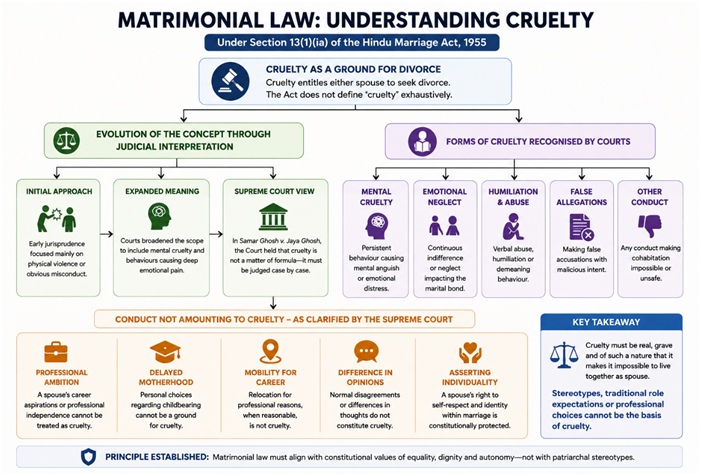
Under Section 13 of the Hindu Marriage Act, 1955 Cruelty is recognised as a ground for divorce, according to the Hindu Marriage Act, 1955. The legislation does not give a strict and complete definition of cruelty, however. With time, courts have widened the definition of cruelty to encompass both physical and mental cruelty.
At first, matrimonial jurisprudence was mainly concerned with violence or conspicuous bad behaviour. Over time, though, judicial interpretations broadened the definition of "cruelty" to encompass mental anguish, embarrassment, prolonged neglect, false accusations, emotional manipulation and behaviours that made it impossible to live together as man and wife.
In Samar Ghosh v. Jaya Ghosh, the Supreme Court acknowledged that cruelty is not a matter of mere formula but must be judged in a particular case keeping in mind the facts of the case.
However, although there has been such doctrinal development, marital law has sometimes been open to the influence of moral intuitions. In times gone by, wife behaviour which did not conform to the traditional definition has been read as selfishness, indifference and/or cruelty.
Examples include:
- lack of communication with the husband, and
- trusting in God's will,
- delayed motherhood,
- maintaining professional independence,
- challenging the traditional role of caregivers.
This kind of thinking illustrates the way in which the concepts of marriage can sometimes turn into legal requirements.
But it is precisely in the recent dentist wife judgment, where the Supreme Court squarely faced this trend, that it's important.
PATRIARCHAL ASSUMPTIONS EMBEDDED IN MATRIMONIAL JURISPRUDENCE
The judiciary history of marriage cases in India has been a test as to the role of courts as neutral bodies free from the general attitudes of that society. Judicial reasoning has often coincided with popular patriarchy beliefs about male and female roles in marriage. While the Constitution, under Article 14, 15 and 21 aim at equality and dignity, the concept of matrimonial litigation has frequently been affected by the traditional morality of society and not by the constitutional morality.
Throughout the history of India, marriage was seen as a socio-cultural phenomenon where the husband was the man with authority and the source of livelihood and the wife was expected to have domestic, emotional and caregiver roles. The traditional view of matrimonial duties has been maintained in some instances despite the growing numbers of women in higher education and in professional careers.
A common stereotype in marital quarrels is that women are the main maintainers of marital peace. In such instances, the wife's focus on career development, a job move or achieving professional independence can be perceived as neglecting the relationship or indifference to the marriage itself.
This is very problematic since it turns social expectations into legal standards. The law starts off punishing women for not adhering to traditional gender roles rather for breaking the law.
Another disturbing trend in marriage law can be seen in the approach to professional aspirations. In some cases of displacement or lack of compatibility between the professions, the court has tacitly considered the husband's profession to be superior in economic or social status. When a husband moves in order to seek a better job, he's regarded as to be making good use of his opportunities, while any wife doing the same is believed to be neglectful or too career-focused.
All the foregoing assumptions are directly challenged by the Supreme Court in the present case. The Court overturned the lower court's reasoning and acknowledged that women cannot be made to renounce their individuality, ambition and professional identity because of the expectations of the patriarchy.
The judgment is thus significant because it reorients matrimonial rationale, moving from conventional moral to constitutional equality.
CONSTITUTIONAL MORALITY AND THE TRANSFORMATION OF FAMILY LAW
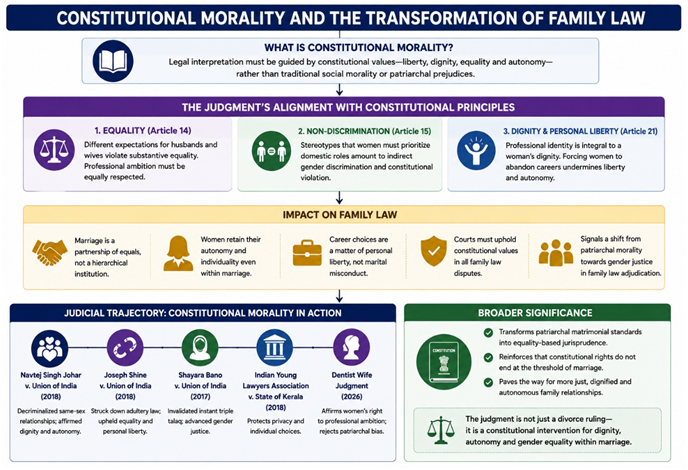
One of the significant aspects of the judgment is its constitutional implications. The Supreme Court's reasoning is illustrative of the growing role of constitutional morality in the administration of family law.
Constitutional morality is the idea that the interpretation of law should not be predicated on the majority social morality or traditional prejudices but constitutional values like liberty, dignity, equality and autonomy. In the past ten years alone, the Supreme Court has used constitutional morality to reach out to protect individual rights and to destroy discriminatory social structures.
When confronted with cases like Navtej Singh Johar v. Union of India, Joseph Shine v. Union of India, Shayara Bano v. Union of India and Indian Young Lawyers Association v. State of Kerala, the Court understood that constitutional rights were not meant to be placed under the thumb of conservative social practice.
The Court's decision to overturn the doctrine that a woman's professional drive is cruel struck a major blow for those who believe that marriage is not a death sentence. A woman who enters into marriage is not an individual with no separate personality.
The judgment is notable for three constitutional principles, it reinforces.
Equality Under Article 14
The Constitution provides for equality under the law. Matrimonial law should not have different rules for husbands and wives. Treating similar ambition in women as cruelty is a violation of substantive equality if it is socially accepted by men.
Non-Discrimination Under Article 15
The use of stereotypical ideas of what is feminine in judgements can lead to the indirect discrimination of women. The courts have no authority to accept assumptions that women have a duty to put their home and family above their career.
Right to be treated with dignity and right to personal liberty under Article 21
Article 21 has always been interpreted liberally and it has been held that dignity, privacy, autonomy and self-determination are all included in this right. As part of the dignity of the person, professional identity is an integral part. Requiring a woman to give up her career goals to match expectations of marriage is to the detriment of constitutional liberty.
So, the judgement is more than matrimonial adjudication. It symbolises the constitutionalisation of family law in India.
The Supreme Court's remarks take on greater significance as they recognise this imbalance in structures. The Court did not mean to say that compromise is out of the picture as concerns marriage relationships. Instead, it has rejected the notion that sacrifice is a one-way process that is solely against women.
From a constitutional perspective, marriage should be a partnership, not a pyramid, with women's lives and identities erased along the way.
Mental Cruelty and the Danger of Subjective Standards
The judgment also raises a bigger doctrinal issue in matrimonial law: that of mental cruelty being a subjective fact.
Mental cruelty is not clearly defined in the legislation and is different from physical cruelty. When deciding whether certain behaviour makes it impossible to live in the same house, Courts have considerable discretion. Such flexibility provides judges with the opportunity to consider the emotional context and evolving social conditions. It also poses the risk of personal morality shaping the legal standard, however.
In the years that have passed, courts have considered various acts to be mental cruelties, such as:
- false criminal allegations,
- sustained humiliation,
- refusal of cohabitation,
- emotional neglect,
- abusive language,
- intentional harming of reputation.
However, where there are no hard-and-fast rules, sometimes courts can look at behaviour through the eyes of culture rather than harm.
This is illustrated in the present case. The fault level cast on the wife was not characterized by abusive actions, violence or malicious behaviour; it was primarily for her attempts to maintain her professional identity and to move forward her career.
When this type of behaviour is defined as cruel, the doctrine itself is open to being misused by the patriarchy. Mental cruelty must not be used as a means by which women are punished for being independent.
The Supreme Court's involvement thus sets a very important doctrinal limit. Sexism is not cruelty simply for the sake of being unpopular with conventional ideas of gender roles in marriage.
This understanding could have a huge impact on the adjudication of future marriages as it will deter people from relying on stereotypes, which are presented as legal arguments.
COMPARATIVE PERSPECTIVE: MATRIMONIAL EQUALITY ACROSS JURISDICTIONS
The conflict between marriage and women's working autonomy is by no means specific to India. In other jurisdictions, issues of equality in close relationships have been raised in court.
United Kingdom
British family law has grown more accepting of the idea of marriage being an equal partnership between husband and wife. Typically, judicial analyses do not bring traditional domestic norms to bear on women. If either spouse makes a career advancement, it is usually considered part of his or her personal life.
United States
In the United States, too, there is respect for personal freedom in marriage. When spouses make career choices for work, it is not considered cruelty unless there is intentional emotional abuse or abandonment. Values from the Constitution are strong factors in family law reasoning, including the right to privacy and the right to autonomy.
Canada
Equality principles are deeply entrenched in the interpretation of Canadian family law. Matrimonial proceedings are conducted in a gender neutral way and courts are skeptical of stereotyping women in their decision making on career options.
South Africa
The obligations of the family in relation to dignity and equality are very prominent in South African constitutional jurisprudence. A pattern of courts holding that intimate relationships have to "fit" the constitutional protections and not the traditional discriminatory ones has already emerged.
Indian matrimonial law still grapples with this conflict between modernity and conservatism in a society, as seen in comparison to these jurisdictions. Overall, the current verdict is a step towards embracing more equality-based marriage norms.
THE SOCIAL SIGNIFICANCE OF JUDICIAL LANGUAGE
Judicial rulings can have ramifications beyond the case at hand. Courts influence not only legal doctrine, but also social attitudes. Thus, judgments have a strong normative force in their language.
Judicial pronouncements that equate ambition with selfishness or an insensitive attitude towards marriage are valid statements of wider stereotypes about women that are present in society. They strengthen the notion that women should focus on family before their work.
By contrast, if the Supreme Court deems such assumptions “highly objectionable,” they make a strong constitutional statement.
The present judgment has two important roles:
- It resolves a matrimonial dispute.
- It redefines the scope of legality with regard to women's autonomy.
In India, the role is important because the judicial pronouncements have the potential to shape the public morality and institutional behaviour.
The judgment could thus be part of social change in relation to:
- working women,
- dual-career marriages,
- female mobility,
- and equality within intimate relationships.
Legal decisions are not necessarily the end of patriarchy, but they certainly question the legitimacy of the discriminatory assumption.
CONCLUSION
The Supreme Court's judgment on the dentist wife's career aspirations is another landmark decision in the history of Indian matrimonial laws. The Court condemned the idea that a woman's professional goals are cruel, which is an important rejection of historical family law assumptions that have been entrenched in the patriarchy.
The decision confirms that marriage must not be legally required to kill the woman or to make her disappear from her workplace. The autonomy, dignity and ambition of a wife are constitutionally guaranteed even in the context of marriage.
More significantly however, the decision demonstrates the tendency to constitutionalize family law in India. The principle of equality, dignity and liberty in a constitution has a growing impact on judicial perspectives on intimate relationships.
The case also reveals the continued existence of gender stereotypes in legal settings. Professional ambition was described as cruel in itself, which in turn highlights the extent to which the notions of marriage are still shaped by a patriarchy.
The judgment is not to be seen as one more divorce ruling, therefore. It is a piece of a bigger constitutional battle about gender equality, individual sovereignty and the definition of marriage in a new and democratic society.
As a result, the Supreme Court's words are unambiguous: marriage isn't a legal construct that stifles women's desires. Constitutional equality cannot stop at the doors of the matrimonial home.
Join LAWyersClubIndia's network for daily News Updates, Judgment Summaries, Articles, Forum Threads, Online Law Courses, and MUCH MORE!!"


Tags :Others