Introduction
Identifying the appropriate court to use in order to enforce intellectual property (IP) rights may be a complex undertaking. The right-holders and legal professionals are frequently prone to handling a plethora of statutory provisions and evolving judicial interpretations. Fundamentally, the interaction between Code of Civil Procedure, 1908, and the particular IP laws such as Trademarks Act, 1999, and Copyright Act, 1957, determine territorial jurisdiction in IP cases. These acts, in contrast to normal civil litigation, provide such additional forums which allow the plaintiffs to sue at the place they live or operate business, and not just at the place where the defendant is located or where the problem occurred.
With more and more business shifting online, old jurisdiction lines are challenged. This paper gives a judicial review of how Indian courts have maneuvered these problems. Since the landmark Supreme Court decision in Indian Performing Rights Society Ltd. v. Sanjay Dalia, through subsequent interpretations by the High Courts, the legal system has influenced the way in which the correct venue to be used in IP cases is determined. Examining the legislative motives of these additional jurisdictional benefits and the escalating complications in the context of online infringement, this article offers an insight into the procedural peculiarities instrumental in safeguarding and enforcing intellectual property in India.
The issue of territorial jurisdiction in intellectual property cases poses complicated legal issues, which entail the facts and the applicable laws. The right holders are usually confused about which court to initiate a suit. This article will define the applicable laws and provisions, describe the contents of these laws and discuss the court decisions that will guide the lawyers and the right holders to decide on the right court to go to.
Relevant Provisions
The relevant proviso dealing with the territorial jurisdiction under various IP laws such as Trademarks Act,The Copyright Act, The Patent Act, The Designs Act are as follows:
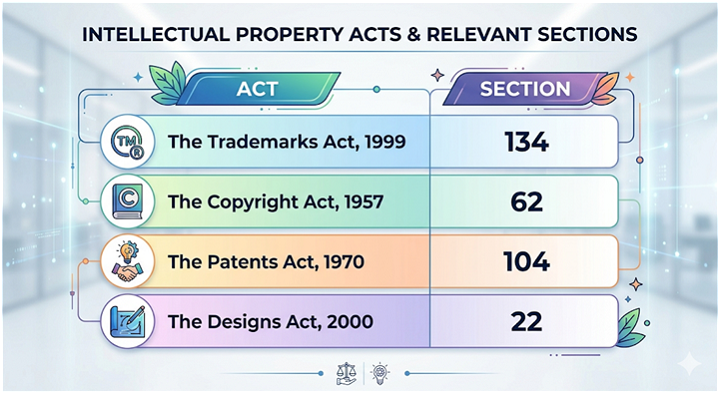
According to the Patents Act and the Designs Act, infringement suits are supposed to be filed in a District Court. Nonetheless, they do not specify which District Court is suitable. So, the place where the suit is to be filed will be decided by Section 20 of Code of Civil Procedure (1908). The District Court to the right will be located in the location where the defendant, or any of several defendants, resides and conducts some business, or where the incidents that led to the suit occurred.
Now we will have a glimpse of the Trademarks Act (1999) and Copyright Act (1957). The two Acts provide some means through which people are able to sue infringement and seek other remedies but this is lacking under the ambit Patents Act or Designs Act.
Section 134 of the Trademarks Act (1999) allows the registered owner or plaintiff to file a suit in a District Court located where the person filing the suit lives, does business, or works for pay. Section 62 of the Copyright Act(1957) resembles Section 134, and expresses the same meaning. According to the Trademarks Act and Copyright Act, the right holders or wronged parties may sued in a District Court where they are living.
The distinguishing factor with trademark and copyright cases is that more of them are typically based on the purchase and sale of goods or services via the internet. In such instances, right holders need to sue at the right court which has the jurisdiction to hear the suit. The issue of territorial jurisdiction was a complex issue, which has been over the years clarified by the Supreme Court and other High Courts.
Sections 134 & 62 were thoroughly discussed and interpreted by the Supreme Court in the important case of Indian Performing Rights Society Ltd. v. Sanjay Dalia. The Supreme Court in this case examined the purpose of enacting Section 134. Adding this section was primarily to have an extra platform through which right holders would be able to structure their claims on infringement without having to cover long distances to do so. This landmark ruling made it clear that a plaintiff or right holder has the choice between two forums according to Section 20 of the CPC or Section 134 of the Trademarks Act(1999).
Judicial Interpretations
The High Court of Delhi later reconsidered the decision in Ultra Homes Pvt. Ltd. v. Purushottam Kumar Chaubey. based on the Supreme courts’s ruling of Indian Performing Rights Society Ltd (supra). The High Court clarified some of the scenarios whereby an aggrieved party may initiate a suit. The High Court outlined four possible scenarios and mentioned the appropriate forum for filing the suit. The following is the table in Para. 13 of the judgment.
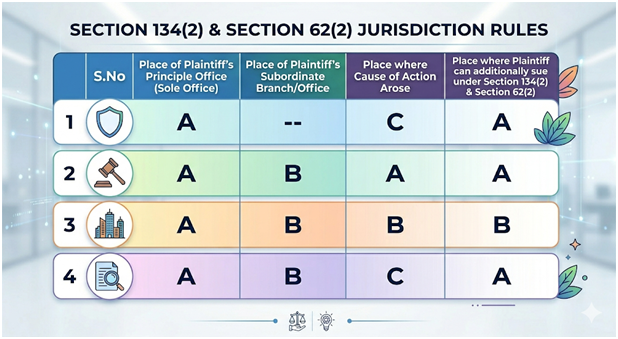
The four scenarios entail the probable scenarios that tend to happen in IP cases. The court pointed out a connection between Section 20 and Sections 134 and 62. It stated that due to the Supreme Court's decision in the Sanjay Dalia case, the term "carries on business for gain," as mentioned in Sections 134 and 62, will have the same meaning as in Section 20 regarding the plaintiff.
Along these lines, the High Court of Delhi in Burger King Corporation v. Techchand Shewakramani and Ors. held that the clauses in Section 134 of the Trademarks Act and Section 62 of the Copyright Act are not exclusions of Section 20 of CPC.
The ruling of Ultra Homes is not unanimously accepted by courts. High Court of Bombay in Manugraph India Ltd. v. Sigmarq Technologies Pvt. Ltd. differed with the ratio that the meaning of Section 20 and Sections 134 and 62 are identical. The court considered the sections to be independent and made it clear that there was nothing in the Sanjay Dalia judgment that implied that Section 20 limited Sections 134 and 62.
While there may be conflicting views from the High Courts, all judicial precedents regarding territorial jurisdiction in cases of "physical presence" or "physically carrying out business" at a location do not eliminate the application of any of the three provisions. The question of jurisdiction when it comes to infringement on the basis of online marketplaces is a more complicated issue. It is obvious that Section 134 and 62 will come into play but can the aggrieved party resort to Section 20(c)? Where and how the cause of action occur in the online transactions is always difficult to ascertain. A number of judicial precedents, however, can aid in coping with this complexity.
In World Wrestling Entertainment Inc. v. M/s Reshma Collection & Ors., the plaintiff company was based in the USA while the defendants were in Mumbai. The plaintiff filed a suit for infringement and passing off in Delhi High Court. The plaintiff filed a suit for infringement and passing off in Delhi High Court. The one judge ruled against the plaint, claiming that the court had no jurisdiction. The Division Bench, however, reversed this decision concerning the fact that the cause of action could be considered to have occurred in Delhi since the site can be accessed in Delhi, commercial transactions can be made online in Delhi and payments can be made in Delhi. Therefore, a portion of the cause of action was considered to have occurred in Delhi..
However, it is worth mentioning that just visiting a defendant in his or her Web site does not establish a cause of action in a particular place. Factors to be considered are:
(a) the site should be interactive and support real-life transactions;
(b) the site needs to focus on consumers in the jurisdiction of the court; and
(c) the actions should be detrimental to the plaintiff.
This was reaffirmed by the Delhi High Court in Banyan Tree Holding (P) Ltd. v. A. Murali Krishna Reddy and Anr. and Impresario Entertainment and Hospitality Pvt. Ltd. v. S&D Hospitality.
In the modern times when the internet dictates most transactions, it is important that right holders decide on the right forum to apply when they are seeking to protect or enforce their rights. The High Court in WWE case considered a 1966 Supreme Court case in Bhagwan Goverdhandas Kedia v. Girdharilal Parshottamdas and Co. where the court determined that a portion of the cause of action had accured in Ahmedabad as the contract was accepted there. The Supreme Court thus affirmed that the Ahmedabad City civil court had the jurisdiction to listen to the case since the cause of action occurred via the telephone. Today, the manner in which we do business has gone way past phone calls and telegrams and the jurisdiction of intellectual property case has also changed. Although the issue of jurisdiction is still a complicated matter, judicial precedents have always given some insight into the difficulties of IP cases. To sum up, before filing a suit, parties should pay adequate attention to the problem of the territorial jurisdiction to avoid undesired complications that might cause them to fail in enforcing their intellectual property rights.
Conclusion
The evolution of territorial jurisdiction in Intellectual Property (IP) law demonstrates an endeavor by Indian law makers and courts to strike equilibrium between creators and contemporary commerce requirements. The interplay between Code of Civil Procedure (CPC), 1908, and individual IP laws demonstrates that the determination of the right forum is no longer limited to the residence of a defendant. At this point, it needs to think strategically that can significantly influence the speed and efficiency of solving legal problems.
The main point from the legal framework is the difference between "traditional" and "additional" forums. The Patents Act, 1970 (Section 104) and the Designs Act, 2000 (Section 22) continue to connect to the general rules of Section 20 of the CPC that proceedings ought to be instituted in the place where the defendant is living or where the dispute began. Nevertheless, the Trademarks Act, 1999 (Section 134) and the Copyright Act, 1957 (Section 62) are very helpful to the plaintiff. These laws allow a registered owner or right-holder to start a case where they live or do business, clearly shifting the "burden of travel" away from the infringement victim. This is a legislative objective that was affirmed by the Supreme Court in its landmark ruling in the Indian Performing Rights Society Ltd.(supra) to ensure that the right-holders are not harassed by the infringers at a remote location.
The courts have, however, taken due caution to avoid the misuse of these "additional forums" in the form of forum shopping or judicial harassment. The case of Ultra Homes Pvt. Ltd. (supra) of the Delhi High Court gave much-needed clarity in a tiered analysis of the scenario. It emphasized on that in case a plaintiff has in the same place a main office and in another a secondary office the cause of action will dictate the place the case must be filed. This allows the two CPC and IP laws to maintain a reasonable relationship whereby a plaintiff cannot transfer a case to a different jurisdiction due to a distant branch office.
The digital revolution has produced the greatest amendment to the jurisdictional law. The emergence of online market place has erased physical boundaries, which is why physical boundaries are becoming blurry, as observed in World Wrestling Entertainment Inc. v. M/s Reshma Collection. The transition to the so-called static sites to the so-called interactive sites implies that the portion of the cause of action can now be located at any point where a customer is able to access the site, complete a transaction and place a payment. Nevertheless, the courts uphold a criterion of purposive availment in that it is not enough to have a site available; there must be a deliberate targeting of the customers within the jurisdictional area of the court, which causes injuries to the plaintiff.
To sum up, territorial jurisdiction in IP is one of the dynamic areas of law. The legal bases are solid, but their enforcement is constantly evolving because of the advancements in technology. To right-holders and legal practitioners, the message is simple: the selection of the forum is an important decision, which must be carefully made, taking into account physical presence, on-line activity, and the character of the infringement. As the Indian judiciary perfects these boundaries, the objective is to come up with a balanced system where IP rights may be effectively executed without compromising with the principles of fairness and justice. Finding the most appropriate court to deal with cases has become the key aspect of success in IP litigation today, not only based on the merits of the case.
Join LAWyersClubIndia's network for daily News Updates, Judgment Summaries, Articles, Forum Threads, Online Law Courses, and MUCH MORE!!"


Tags :Others