
I. Introduction
Words slip out in daily talk that make listeners wince. Some speech unsettles, stuns, or makes cheeks flush. Then again, obscenity stands apart - defined tightly within Indian law as an act punishable by penalty. Blurring these lines has often twisted routine coarseness into grounds for harsh charges. Since ages, this mix-up has fed abuse of the legal system. On April 6, 2026, clarity came through a ruling: Sivakumar v. A fresh reminder comes from State Rep. by the Inspector of Police. Clear words were laid down: labelling another person a bastard amid a land quarrel fails to meet the mark of obscenity per Section 294(b) of the Indian Penal Code, 1860.
One judge named Pamidighantam Sri Narasimha, another called Manoj Misra - they cleared two people found guilty under Section 294(b) IPC. Their ruling brought back an idea courts mention often yet somehow keep needing to repeat: just because speech feels crude does not make it illegal. Offense alone doesn’t equal crime. Through this piece, explore how India defines "obscene" in law. See how years of court decisions shaped that definition slowly, like layers building on stone. Notice also the part where the 2026 verdict involving Sivakumar fits into past rulings. Follow laws written long ago, watch how judges tested them over time through real cases, study exact lines from judgments that drew limits. Understand clearly where the line stands now - what gets punished, what slips free, simply because it crosses no legal edge.
II. The Statutory Framework: Where Does Obscenity Live in Indian Law?
What counts as offensive in law shows up in many Indian laws. Main rules come from a 1860 code. One part, called Section 292, covers actions tied to vulgar content - like sharing, showing, or moving such things among people. Anyone involved in selling, renting out, spreading, displaying, or otherwise releasing lewd writings, pictures, sketches, prints, or images faces penalties under it. Though old, the rule still applies today. In Sivakumar, the legal focus landed on Section 294 of the IPC - this part targets public behavior seen as lewd. An act considered indecent, performed where people gather, draws penalty if it bothers those around; that falls under clause (a). Meanwhile, spreading vulgar lyrics, verses, or speech within earshot of public areas meets punishment via clause (b). Jail time may stretch to ninety days, sometimes money penalties apply, occasionally both follow.
Later on came the Information Technology Act, 2000, bringing new rules for online stuff. If someone puts up digital content that's lewd or meant to stir sexual thoughts, Section 67 says they can be punished. Not far behind, Section 67A steps in when the material shows actual sex acts or overtly sexual behavior. Long before that, back in 1986, another law already drew lines - depicting women in a vulgar way through ads or print wasn’t allowed anymore. Every rule shares something quiet. None ever spell out what obscene means. Judges took that job instead. Their rulings built depth where words were thin. Meaning grew through court decisions, not laws written down.
III. The Undefined Word and the Problem It Creates
Not having a written rule about what counts as obscene isn’t rare worldwide, yet in India it has led to real impact. When there’s no precise meaning, cases often follow personal unease instead of fixed legal rules. A person upset by certain speech might label it obscene, even if it does not clearly fit. Should a judge feel similar discomfort, they may allow police to begin investigating. Over time, this has meant actions taken against words or themes seen as rough or provocative - though not necessarily matching what the law intends.
Nowhere does the IPC spell out what "obscene" actually means - this much the Supreme Court confirmed in Sivakumar, para 18. Instead, meaning comes crawling in through Section 292, painting obscenity as material likely to stir up shameful curiosity. That link, stretching from Section 294 back to 292, matters more than it first appears. What counts as obscene under criminal law isn’t handed down by lawmakers; judges piece it together, pulling threads across sections. They borrow too - from older legal systems, like England's and America's - where ideas about decency shifted slowly, unevenly. To see how India arrived here, you must glance backward at those shifting standards.
IV. From Hicklin to Community Standards: The Evolution of the Legal Test
A. The Hicklin Test and Its Adoption in India
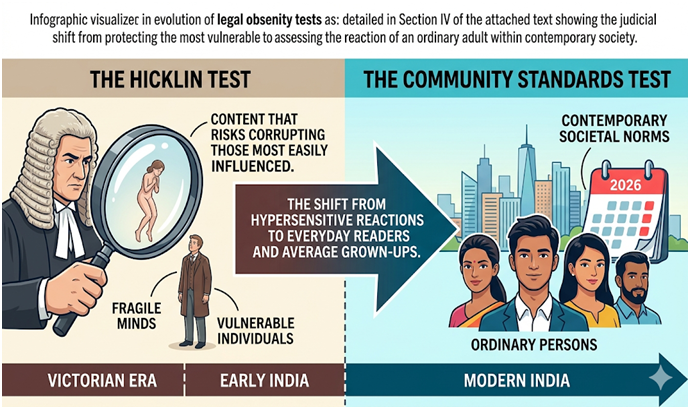
Obscenity laws in India trace back to Victorian-era Britain. From Regina v. Hicklin came a legal standard shaping court views across English-speaking nations for decades. That ruling said content counted as obscene when it risked twisting the morals of anyone who could be influenced by indecent ideas, whoever they happened to be. Its outlook rested on protection, not personal judgment. Instead of measuring impact on mature individuals, it measured danger to the easiest ones to sway - like young people or those easily led astray.
Another decision regarding the said subject matter came from the case Ranjit D. Udeshi v. State of Maharashtra, and the case involved the question of guilt wrt to a bookseller distributing DH Lawrence's Lady Chatterley's Lover. That decision leaned on the Hicklin standard, asking if the material could lead people toward moral decay. Instead of balance, the judges said art needs to overpower anything seen as obscene - otherwise it fails. When both expression and explicitness exist together, one outweighs the other only when its presence drowns out the rest. Sometimes, though, offensiveness might be too small to matter at all. For creators, the weight shifts entirely onto proving their work carries enough value to excuse certain elements. Hard proof becomes necessary - not preference, but measurable worth.
B. The Community Standards Test and the Rejection of Hicklin
What made the Hicklin test weak stood out clearly - it measured content based on how the most easily influenced individual might react. Over time, courts across nations began turning away from it. Across America, change arrived through Roth v. United States. There, the highest court set down a new standard: judgment now rested on what an ordinary person, guided by current local norms, saw as the main message when viewing material entirely. Instead of focusing on fragile reactions, attention shifted toward common responses. That pivot from from hypersensitive outliers to everyday readers, opened legal doors once tightly shut.
In Aveek Sarkar v. State of WB, the Apex court moved away from the old Hicklin rule. Instead of focusing on how fragile minds might react, it said context matters more now. What counts is how an average grown-up views content, given today’s local values. This doesn’t depend on outrage from easily shocked individuals. Shifting to current societal norms raises the bar for calling something obscene. Expression gets stronger shielding under this view. Prosecutors find fewer openings because of it.
A change like this carries real weight. With Hicklin in place, anything seen as possibly harmful to a sensitive individual counted as obscene. Now the focus shifts. Would most people see the content as sexually suggestive, driven by base interest, or capable of leading others into moral decline? Suddenly, background matters more. Why was it made? Who is meant to see it? How does it land when taken as a whole, not just one part pulled out? Each detail shapes the outcome.
V. The Legal Ingredients of Obscenity: What Section 292 Requires
A ruling in 2024 by India’s highest court, known as Apoorva Arora and Anr. v. State (Govt. of NCT of Delhi) and Anr., laid out clearly how Section 292 along with related legal clauses should be understood today. Trouble started when police took notice of rough words spoken during one scene of a digital show called College Romance - this led to a formal complaint naming those behind it. Yet the judges, specifically Justice A.S. Bopanna alongside Justice P.S. Narasimha, erased that complaint after closely examining what counts as offensive under current standards. Their thoughts on indecency didn’t just settle that matter - they shaped key ideas later echoed in another major decision involving Sivakumar.
Down in paragraph 17 of the Apoorva Arora ruling, the judges pulled together how obscenity is defined under both Section 292 of the IPC and Section 67 of the IT Act, boiling it down into three parts. Obscenity shows up when content stirs lustful thoughts - this comes first. Then again, it might count if what's shown grabs attention purely through base sexual appeal. Another path appears where the overall impact risks twisting or poisoning those who could come across it, especially considering context. Each point circles back to one core idea: sex becomes an issue only when portrayed in ways that warp or degrade. Thinking about lewdness? That points straight to sparking improper desire. Curiosity about sex, when intense and unbalanced, becomes prurience. Though shaped differently back then, the legal idea of corrupting morals always centered on such sexual exposure.
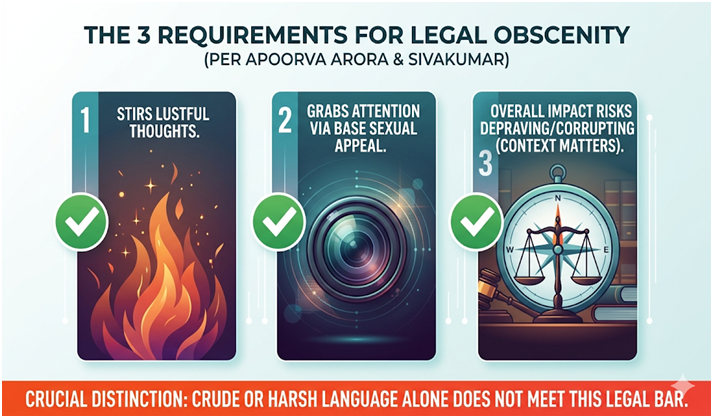
At paragraph 20, the Sivakumar bench repeats what was said clearly in Apoorva Arora’s ruling - specifically at paragraph 41. That earlier decision made one thing unmistakable: offensive words alone are not automatically obscene. Just because speech feels crude or harsh does not mean it crosses into illegality. What matters instead is whether something stirs sexual desire - not mere discomfort. Swearing might trigger offense, even anger; yet still fall short of being legally indecent. Such clarity shapes how courts today separate foulness from filth across India's legal landscape.
Out here, reactions shape how we judge things - that’s what came up in Apoorva Arora. Not about clean speech or everyday talk across India when looking at Section 292 of the IPC or Section 67 of the IT Act. What matters instead? Whether material stirs lustful thoughts, feeds dirty curiosity, or pushes people toward moral decay. Playing it safe by asking if something fits inside a courtroom won’t work. That kind of thinking shrinks creative space too much, forces artists into legal stiffness and bureaucratic word choices.
VI. Sivakumar v. State: The Judgment and Its Analysis
A. The Facts of the Case
Sivakumar’s story is clear enough. Trouble started one morning near Thiruvidaimaruthur, back in September of 2014. A property line had been argued over for years - this time it boiled over. Kaliyamurthy decided he would mark his section by putting up a fence. That act lit the spark. His cousin, Senthil - the person appealing now - grabbed a farm blade known locally as an aruval. Instead of going after Kaliyamurthy, he went for the brother. A heavy blow came when A-2 hit the victim on the head with a piece of wood. The impact broke the skull, leading to fatal damage inside the brain. While the fight unfolded, someone hurled the insult "bastard" at the person who later died.
One month behind bars - that is what both defendants got for breaking a law about public behavior, after judges upgraded their case on appeal. Originally found guilty of minor harm, the first person faced charges only for intentional injury, while the second was punished more harshly due to serious bodily damage done. Still, neither had been held responsible earlier for acting indecently in public - until the higher court stepped in. Following grief-driven legal moves by the victim’s wife, justices in Madurai changed course, adding new consequences where none existed before. Now facing combined penalties, the two also saw the second individual reclassified under stricter terms involving fatal wrongdoing without murderous intent. With tension rising through layers of judgment, the matter climbed further, reaching India’s top bench amid disputes over whether that added charge made sense at all.
B. The Court's Analysis on Obscenity (Paragraphs 17 to 20)
We can see that at paragraph 17, the Apex court expanded upon how the matters are handled under Section 294(b). Section 294 of the Indian Penal Code appears in full right there. Though the term obscene lacks a precise definition in the code, the judges point to Section 292 for guidance instead. It has come to mean material likely to stir vulgar curiosity in someone. Backed by a past ruling - Director General, Doordarshan versus Anand Patwardhan - the idea takes shape quietly. That decision from 2006, found in volume 8 of the SCC at page 433, lends weight without drawing attention. By then, the reasoning settles into place across four paragraphs, steady but unembellished.
Down at paragraph 19, the ruling leans on Apoorva Arora like an anchor, pulling in a long stretch from paragraph 41 to sketch how vulgarity differs from obscenity. Instead of fixed rules, it treats obscenity as something shaped by today's social norms, circling back - much like Aveek Sarkar did - to what communities broadly accept. Notions shift; judgments adapt, yet some touchstones stay, quietly reused when needed. What counts isn’t carved in stone but molded by shared views over time, present here again through older echoes. This approach doesn’t invent - it recalls, reshapes slightly, then moves on.
That key conclusion about Section 294(b) comes in paragraph 20. Looking back at earlier rulings, the judges felt calling someone a bastard alone does not stir sexual excitement in people. Especially since such language pops up often today when tempers flare and because of the same it was decided the punishment under Section 294(b) of the Indian Penal Code cannot stand. So, without further conditions, the ruling wipes out the guilt for both individuals charged. Those lines erased the obscenity verdict completely.
Starting with meaning, the term bastard - no matter how harsh it sounds - does not trigger sexual imagination. Though it might spark outrage, shame, or pain, feelings like these fall short when measuring legal prurience. What matters next: today’s speech often includes strong language amid arguments. That everyday usage shapes what society accepts. Politeness of parlors or dignity of courtrooms isn’t demanded by statutes. What matters is whether speech turns sexual in a harmful way. Swearing in frustration barely comes close.
VII. What the Law Does and Does Not Treat as Obscene
A. What Falls Within the Legal Definition
Sexual content often forms the core of what courts in India consider obscene. When laws are read together with past rulings, certain types of speech stand out. These materials may stir desire, twist behavior, or influence minds along carnal lines. What ties them together isn’t just nudity - it’s the effect they might have on someone’s thoughts. Judges look at how such expressions appeal to base instincts. Not every suggestive piece gets flagged - only those pushing toward corruption do. The context matters as much as the image or word itself. Past decisions help shape which works cross the line. Though standards shift slowly, one thing stays: if it feeds lust more than art, it risks being banned.
Stuff meant to stir up sexual feelings fits right into what Section 292 IPC covers. A tendency to provoke lustful thoughts marks such content. Images or texts showing sex acts plainly - when they lack art, science, or learning value - are judged obscene if their main impact stirs desire. Pornography published, sold, or shared purely for turning people on, offering nothing useful to society, lands at the core of this rule.
Something designed to stir base desires counts as the second type. According to the U.S. Supreme Court in Roth, such material targets a twisted or shameful fascination with nakedness, sex, or bodily waste. India's judges have echoed those words closely. This isn’t just normal curiosity about sexuality - it runs deeper, darker, fixated beyond what’s considered natural or balanced. A talk about human sexuality in a medical book won’t stir up lustful curiosity. Something written to spark arousal fits that description - intent shapes the impact, not just the topic on its own. What matters legally isn’t what’s discussed but why it’s presented.
Now imagine a rule meant for stuff that twists people’s morals, especially around sex. Courts in India look at who might see it, how it plays out, what surrounds it. They’ve leaned on an old signal from Samaresh Bose versus Amal Mitra, 1985, page 289, fourth SC volume. That case said: art with real weight shouldn’t be dragged down by rough bits seen alone. Those pieces need room to breathe inside the full story. As long as the core aim isn’t to rot someone’s decency through lust, then flashes of intimacy won’t poison the whole thing.
When it comes to online spaces, Section 67 of the IT Act deals with what Section 292 handles offline - only it applies to digital content. Transmission or sharing of anything showing sexual acts falls under Section 67A. In the case of Apoorva Arora, judges pointed out such material might still avoid being labeled obscene if presented artistically or devotionally. Whether something pushes people toward immoral behavior or targets base curiosity matters most. Just because a piece shows sex openly does not automatically make it illegal. What counts is its overall effect on viewers.
B. What the Law Does Not Treat as Obscene
A quiet shift has taken place in court decisions lately - not loud, but clear. What slips through the cracks of obscenity rules keeps gaining shape over time. Offense alone does not make something obscene; that line matters more now. Judges have spent less energy saying what counts and more on naming what doesn’t. That backdoor path - what escapes labeling - has started to hold real weight. The unspoken part of the rule often shapes outcomes more than the written test ever did.
A single swearword might sting, yet fail to cross into forbidden territory. Not every offensive phrase ties back to sex - this truth stands clear after rulings like Apoorva Arora and Sivakumar settled the matter. Harsh speech can wound deeply, provoke rage or nausea even, but if it stirs no lust, then legally, it stays outside obscenity's bounds. Even when words cut hard, their power to unsettle doesn’t equal sexual provocation by law. Take "bastard" - the Supreme Court examined it closely in paragraph 20 of Sivakumar - and found no trace of lewd excitement sparked. Shouting harsh words when upset follows a similar pattern. Though ugly to hear, such language isn’t legally obscene unless it zeroes in on sex - meant either to excite or humiliate someone sexually.
Just because someone swears does not make something dirty. In one case involving a show online, judges said strong words might feel rude but still fall short of being illegal. A story about student years using rough speech stays within bounds if it lacks anything meant to stir lust. Whether people find phrases polite misses the point entirely. What matters instead is whether those phrases invite shameless curiosity about sex.
A picture showing naked people might still fall under art or news without being vulgar. When the Supreme Court reviewed Aveek Sarkar's case, it looked at a photo of unclothed partners inside a sports journal meant to reflect unity across races. Though public norms matter, judges found the image did not stir sexual thoughts since its aim leaned toward expression, not titillation. What counted most was why the bodies appeared and how they fit within the story. Most level-headed individuals today would see nothing lewd in such framing when viewing it with care.
Nowhere does a label of obscenity stick when substance holds real weight in art, letters, science, or teaching - this shelter lives within Section 292’s own saving clause. If truth be told, diagrams meant for doctors’ eyes, writings on human form, or stories praised by critics keep their standing even if some scenes show intimacy central to meaning. Though judges in Ranjit D. Udeshi saw that rule, they turned away from shielding the book at hand. Over time, tribunals began leaning differently - more ready now to honor creative worth, so long as it runs deep.
VIII. The Standard of Assessment and Measurement?
A key issue in obscenity cases involves picking the right yardstick for judgment. Over time, India shifted its approach multiple times on this matter. Today’s stance turns away sharply from the strict moral oversight seen during the Hicklin days.
Nowhere does it say we must think like someone fragile. Instead, picture an average grown person who gets how things usually go among people. Not every little edge case shapes the rule. A kid’s view won’t set the bar. The way a judge lives inside court walls makes no difference either. Starting off differently, the judges in Apoorva Arora made clear that judging something as obscene shouldn’t depend on whether it fits neatly within a courtroom’s atmosphere. Instead, measuring legality by how well it aligns with court etiquette risks demanding too much restraint from those who create. Because if standards shift toward legal settings’ stiffness, expressive rights begin shrinking without real justification. Expression then bends under expectations never meant for art or speech outside such spaces.
The judges pointed out how views on what counts as offensive shift over time, tied closely to current social norms. Because of this, local values matter when deciding such cases - borrowed loosely from Aveek Sarkar but shaped for India's reality. One should keep in mind that the metric of 'standards' tends to change and so something seen as inappropriate fifty years ago might seem ordinary decades later. Words shift meaning depending on who says them, how they’re said, when, and to whom. Seen differently by different people, terms such as bastard pop up regularly in intense moments today. This matches what real life sounds like, not just rulebooks. Sivakumar, para 20, catches that change clearly. Not every strong word shocks equally - timing shapes impact.
A courtroom figures out obscenity through steps spelled out clearly in Apoorva Arora, building on past rulings like Samaresh Bose. Instead of jumping to parts called offensive, it looks at everything the piece includes before narrowing down. From there, attention shifts - what mattered to the person making it now gets weighed alongside why they shaped it that way. Seeing through the artist’s eyes helps spot deeper meaning, maybe even artistry tucked beneath surface impressions. Then perspective flips again, landing on whoever might actually watch or read it, imagining how thoughts could shift after exposure. After moving between these views slowly, only then does judgment form about crossing legal lines.
IX. Section 294 Specifically: The Requirements for Criminal Liability
Obscenity laws mostly grow from Section 292, yet Section 294 stands apart with unique conditions worth noting. What happens under Section 294 involves offensive behavior or singing, built on more than just what counts as lewd. Annoyance to people around matters - this shapes whether an act or spoken word crosses the line. Location plays a role too: for clause (a), it's about actions taken where everyone can see; when it comes to clause (b), voices rise in or close to spaces anyone might pass through.
What bothers other people matters here - so actions done alone, no matter how offensive, aren’t covered by Section 294. This rule focuses on behavior out in the open, where shared expectations exist. It isn’t about policing personal choices behind closed doors. Something said quietly among private walls won’t count under this section, even if it breaks different rules elsewhere. Stillness in a room doesn’t meet the threshold, regardless of content.
Out near the edge of some land, things turned tense between people arguing over where one plot ended and another began. Down below, judges treated what got said as loud enough, open enough, for Section 294 to kick in. Up above, the highest court let that part stand - no need to touch it. Still, they wiped away the charge under Section 294(b), clear and flat, because the speech didn’t meet the law’s bar for being obscene. What the government leaned on - a claim built around calling someone a bastard - got spelled out in paragraph 15 like this: proof exists, so guilt follows. Yet by paragraph 20, the justices pushed back - the term doesn’t stir anything sexual or filthy in meaning, so holding onto the verdict makes no sense. Calling names? That stings. But that isn’t the same as crossing into dirty territory. Mixing those two up - that mistake came from the State. The top bench stepped in, drew the line straight.

X. Obscenity Law and the Freedom of Speech
Freedom of speech sits at the heart of India's Constitution. Still, limits can apply when public morals are at stake. What counts as offensive isn't always clear-cut. The state may step in, yet only so far as fairness allows. Boundaries shift, depending on context and impact. Not every objection leads to a ban.
In Ranjit D. Udeshi, the Supreme Court held that Section 292 of the IPC counts as a fair limit on free expression under Article 19(2), given its aim to uphold public decency and moral standards. Still, just because obscenity laws pass constitutional scrutiny doesn’t automatically justify each time they’re used. When such rules target words that aren’t sexual but simply upset people, free speech faces an unfair curb. That kind of move twists a legal tool into something it never meant to be.
Discomfort alone cannot justify silencing speech, the Supreme Court noted in Ajay Goswami v. UOI, drawing from U.S. thought on free expression. Rather than bowing to unease sparked by distasteful words, legal limits need stronger grounding - actual damage to minds, especially via sexually degrading material. Later rulings in India leaned on this idea when handling cases about obscenity. What matters is not whether someone feels offended but whether there's real risk of moral decay. Laws aimed at suppressing speech must point beyond personal sensitivity toward tangible societal injury. Mere dislike of bold or challenging views should never be enough.
In the Apoorva Arora case, India's legal thinking on obscenity found one of its clearest expressions lately. Not everything laced with harsh speech deserves punishment just because someone feels insulted by it, the judges made clear. Imagine making art under threat of jail simply for using words some listener dislikes - such fear has no place where free expression matters. What counts as truly harmful isn’t about shock value but real danger: twisted influences tied to sex, not discomfort alone. Mere dislike? That stays outside the reach of police and courts.
Speaking to LCI, Advocate Maitry Barma said that “ Look, the law has never said you need to be polite. It says you cannot be obscene. Those are two very different obligations and the gap between them is enormous.
When the Madras High Court convicted these men under Section 294(b) for saying bastard during a land dispute, it essentially told every person who has ever lost their temper in a argument that they are a criminal. That cannot be right. The Supreme Court understood that.
She further maintained that “What obscenity law is actually concerned with is sexual corruption. That is the entire architecture of the provision. Section 292, Section 294, Section 67 of the IT Act, they are all built around the same idea, that some material is so sexually depraving that the law needs to step in. A man shouting at his neighbour over a boundary wall does not fit anywhere in that picture.”
Lastly she said “The reason this keeps coming up is that Section 294 uses the word obscene without defining it, and that gap invites misuse. Complainants weaponise it, magistrates sometimes go along with it, and you end up with convictions that the Supreme Court then has to undo.”
XI. The Broader Significance of the Sivakumar Judgment
Not so much a shift, the 2026 ruling in Sivakumar stands solid on what was already known. With sharp clarity, it repeated long-standing rules after lower judges misapplied them. Words spoken in anger - just one rough phrase - had led the Madras High Court to jail two people under Section 294(b) IPC during a land quarrel at home. Yet past rulings never allowed such punishment for that kind of outburst. So this time, the highest court stepped in, wiped the verdict clean.
What stands out about the ruling comes down to a few clear points. Not only does it show Apoorva Arora (2024) reaches beyond digital spaces or creative works, but also covers speech during common street fights. Vulgar language, when stripped of sexual meaning, stays outside the definition of obscenity - this holds true regardless of how or where it's said. Though some might tie such ideas to specific situations, here the rule shows it travels across settings. Its reach isn’t shaped by format or backdrop, just by substance.
Then again, courts below might take care not to mix up separate kinds of misconduct. One thing is saying something harsh - this could matter under different rules or in lawsuits between people. Quite another is uttering something obscene, where sex-related meaning defines the issue. In Sivakumar's case, the High Court slipped by calling a crude term enough for Section 294(b), never checking if it carried that required sexual shade. By paragraph 20, the top court fixed the misstep clearly, putting things straight in words anyone ought to grasp.
Third, the judgment reflects a pragmatic and realistic understanding of how language actually functions in contemporary Indian society. Courts are not arbiters of good manners. Criminal law is not an instrument for enforcing standards of polite conversation. Words like bastard are, as the Court acknowledged, commonly used in heated conversations in the modern era. Criminalising their use as obscenity would sweep far too broadly, would not serve the purposes that Section 294 was designed to achieve, and would open the door to criminal proceedings in virtually every acrimonious dispute in the country.
XII. Conclusion
The law of obscenity in India, as it stands in 2026, rests on a foundation of clear principle even if the application of that principle is not always straightforward at the margins. The foundational principle is that obscenity is not about offensiveness in general but about a specific kind of harm: the arousal of prurient interest, the corruption of minds in a sexual sense, the dissemination of material that is lascivious or depraving. Vulgarity, rudeness, shock, and disgust are not obscenity. The two may sometimes coexist in the same piece of expression, but the existence of vulgarity does not make expression obscene, and the absence of offensiveness does not make expression non-obscene. The legal test is directed exclusively at the sexual dimension.
The trajectory from Ranjit D. Udeshi in 1965 through Aveek Sarkar in 2014, Apoorva Arora in 2024, and now Sivakumar in 2026 shows a judiciary that has progressively tightened the standards for what qualifies as obscenity and progressively expanded the space for expression that is offensive, crude, or provocative but does not meet the legal threshold. This is not moral permissiveness but legal precision. It is an insistence that criminal law be used for the harms it was designed to address and not as a general-purpose instrument of moral policing or personal grievance.
The Sivakumar judgment is a small but clear contribution to this story. A family dispute turned violent, a man died, and in the course of the altercation someone said bastard. The murder charge, the culpable homicide charge, and the grievous hurt charge were addressed on their own terms. But the obscenity charge had no business being there. The Supreme Court removed it, and in doing so reminded every court below, every magistrate tempted to treat a harsh word as a criminal obscenity, and every complainant who reaches for Section 294 to punish someone who has said something offensive rather than something sexually corrupting, that the law of obscenity has a specific and limited target. It is not, and must not be allowed to become, a tool for prosecuting bad manners.
Join LAWyersClubIndia's network for daily News Updates, Judgment Summaries, Articles, Forum Threads, Online Law Courses, and MUCH MORE!!"


Tags :others