


SYNOPSIS
- Introduction
- Judicial Recognition of the Need for Paternity Leave
- The Judgment in Hamsaanandini Nanduri v. Union of India
- Constitutional Foundation of Parental Leave
- Limitations of the Existing Indian Framework
- Comparative International Perspectives
- Lessons for India
- The Way Forward
- Conclusion
INTRODUCTION
The history of labour welfare in India can be described as a process that extends throughout the years and is marked by a transition to justice, as opposed to formal equality. Although statutory recognition and enhancement of maternity benefits have been accomplished by enacting the Maternity Benefit Act, 1961 and reinforced by the 2017 amendment, lack of a holistic framework of paternity leaves remains an indication of structural imbalance in the legal interpretation of nurturing.
This has been a disproportion that has received court interest in the recent past. The Supreme Court has pressured the Union Government to think of providing a law, which would identify paternity leave, noting that these are some of the essential steps towards social welfare and child upbringing. This court opinion represents a wider constitutional shift to shared parental responsibility.
Meanwhile, The Court was involved in Hamsaanandini Nanduri v. Union of India exposes more inconsistencies in the maternity benefit regime itself, especially on how it handles adoptive mothers. The case is essentially about maternity leave, but its arguments can be used to add to the discussion on the rights of parents in general.
JUDICIAL RECOGNITION OF THE NEED FOR PATERNITY LEAVE
The recent comments of the Supreme Court to the legislative intervention on the paternity leave is an important normative change. The Court acknowledged that paternity leave was not only a service benefit but it was a social welfare issue related to the raising of a child and the welfare of the family.
To begin with, it defies the conventional belief that childcare is a maternal prerogative. The Court indirectly ensures substantive gender equality by recognizing the importance of fathers in the early child development.
Second, the Court is child focused in which parental leaves are tied to the welfare and development of the child and not just the rights of the workers.
Third, it brings out the gap in the legislation in India. Currently, paternity leave does not have a consistent legislation to regulate it, but rather, it is restricted to disjointed service regulations, or employer policies. This leads to non-uniform and non-equitable access.
In this way, the action of the Court is indicative of a more expansive constitutional vision in which labour welfare is made consistent with dignity, equality, and social justice.
THE JUDGMENT IN HAMSAANANDINI NANDURI V. UNION OF INDIA
In Hamsaanandini Nanduri v. Union of India, maternity leave is a central concern of as a form of social welfare legislation and not the paternity leave.
It was against Section 5(4) of the Maternity Benefit Act, 1961 (as amended in 2017) and its corresponding provision under the Social Security Code, 2020. The provision only provides maternity benefit to adoptive mother where the child adopted is at an age of less than three months, and the adoptive child will be entitled to get twelve weeks of the leave that will commence when the child is handed over.
This provision has had the following effect on the maternity leave benefits; adoptive mothers who have children exceeding three months are no longer entitled to any maternity leave benefits. The Court considers the Maternity Benefit Act to be a social welfare act, and so as such it is essential to interpret such act in such a way that it promotes its purpose, which is to protect motherhood and child care.
One of the key questions that the Court had was the age-based classification that meets the requirements of Article 14. The Court mentions the claim of the petitioner that there is no rational classification in the limitation of the maternity benefits according to whether the child adopted is under or over three months. The categorization does not cover a group of adoptive mothers, who are otherwise similarly situated in regard to the care giving roles.
The Court in itself raises the question of the reasoning of the provision, which is what is the ground to restrict maternity benefits to those who only adopt children who are of a certain age. This is of the constitutional prerequisite that the classification has to possess intelligible differentia and a reasonable nexus with the object of the law.
This provision might not meet this test as the concern of the Court points. The maternity benefit legislation is aimed at supporting the child care and maternal well-being. But child needs and care giving burdens of a parent do not end once the child is over the age of three months. Thus, the exclusion does not seem to have any logical relation to the legislative purpose.
The other important point raised by the Court is that the provision causes an entire denial of benefits, not a gradual or proportionate restraint. This reinforces the position of arbitrariness. The Court further observes that the Maternity Benefit Act has been overtaken by the Social Security Code, 2020, in which an identical provision remains. Based on this, the struggle stretches to the novel statutory model, meaning that the problem is structural and not a singular one. Although the Union Government provided justifications to the Court, its observations strongly indicate that arbitrariness and breach of equality is serious when adoptive mothers are excluded on the sole reason that the age of the child is lower.
The ruling therefore confirms that the concept of maternity leave is not only a biological right but a welfare provision that is based on child care and constitutional equality and dignity provisions.
CONSTITUTIONAL FOUNDATION OF PARENTAL LEAVE
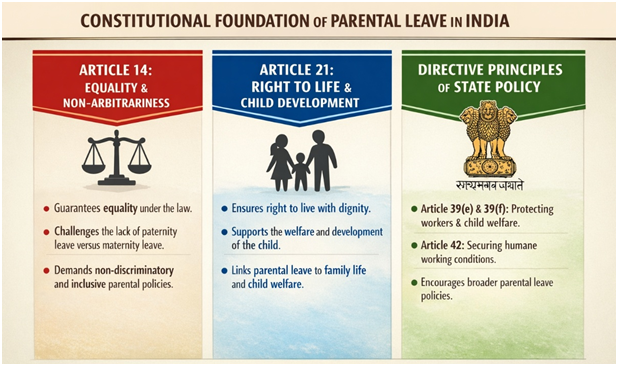
The establishment of parental leave (maternity and paternity) finds solid legitimacy in the Indian constitutional provisions. Even though the Constitution does not mention such a concept as paternity leave directly, its wording, when applied purposively, assist in the cultivation of a gender-neutral and child-focused caregiving regime.
1.Article 14: Equality and Non-Arbitrariness.
Article 14 ensures equality under the law and protection of the law under equal concerns. It is not limited to formal equality and it has the effect of disallowing arbitrary state action and unreasonable classification.
Structural imbalance in the parental leave situation arises due to the lack of statutory paternity leave. Although maternity leave has been identified as a statutory right, fathers are mostly not provided with benefits regarding care giving. Although this distinction may have some historical basis on a biological basis, it becomes an issue when viewed in the context of changing social realities and the principle of substantive equality.
The line of argument taken in Hamsaanandini Nanduri is especially applicable here. The reasonable classification and rational nexus insistor of the Court imply that welfare legislation exclusions should be well-grounded. Building on this reasoning, the lack of paternity leave altogether can be considered to be devoid of rationality in a constitutional system in which shared parenthood is a recognised fact.
Article 14, therefore, offers an argument that parental leaves policies can and should shift to non-discriminatory and all-inclusive structures.
2.Article 21: The right to Life, Dignity, Child Development
Article 21 has been interpreted broadly to encompass the right to live with dignity, the right to health and the right to develop. Courts have constantly stressed that this right is not limited to individuals but also to conditions that are essential to a meaningful life.
Article 21 takes place in two levels in the context of parental leave:
First, it takes care of the dignity and welfare of parents and makes sure that they can juggle between work and family life without working too hard.
Second and more importantly is that it protects the best interests of the child. The childhood care, emotional attachment, and the parenthood are necessary elements of child development. Refusal to provide proper parental leave can thus have an indirect impact on the child to a dignified and healthy life.
Caregiving has become a trend in judicial decisions and it has been realised that the issue of caregiving is not only a private role but also a constitutional issue. The connection between the parental leave and Article 21 makes the argument of paternity leave being a subordinate right to a family life and child welfare even stronger.
3.Directive Principles of State Policy
The non-justiciable Directive Principles are of essential guidance in drawing an interpretation of the welfare legislation.
- Article 39(e) guides the State to provide that the economic necessity does not compel workers to perform labor which is not appropriate to their power.
- Article 39(f) acts upon the fact that children should be provided to grow in a healthy way.
- Under Article 42 the State is specially obligated to ensure just and humane working and maternity relief conditions.
Although Article 42 specifically mentions the maternity relief, its rationale is the family welfare and child care. In the modern society this goal cannot be limited on mothers only. These principles are purposively interpreted to imply that there is a wider provision of parental leave to which paternity leave belongs.
The Directive Principles therefore serve as a normative guide in reforming legislation whereby the State is encouraged to enact policies that will lead to shared caregiving and social justice.
LIMITATIONS OF THE EXISTING INDIAN FRAMEWORK
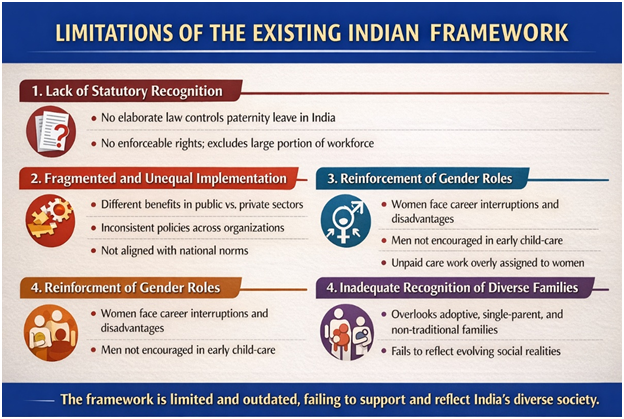
1.Lack of Statutory Recognition
There is no elaborate law that controls paternity leave in India. In contrast to maternity leave, which is written law, paternity leave is only known in limited forms, namely, service regulations that are applicable to government employees or employee-specific policies.
This means that there are no enforceable rights and a huge proportion of the workforce is without any form of paternity leave.
2.Fragmented and Unequal Implementation
The existing system is very disjointed. The benefits offered by the different sectors are different levels, and there are no benefits by far in most instances.
This leads to:
- Equality of public and private employees,
- Inequality in accordance with organisational policies,
- Inconsistency with national norms.
This kind of fragmentation negativity affects the concept of parental leave as a universal social security measure.
3.Reinforcement of Gender Roles.
Specifically, given that the legal framework mostly addresses the aspect of maternity leave, it contributes to the existing stereotype according to which only the female gender is a caregiver.
There are several implications of this:
- Women experience discontinuities in their careers and disadvantages in the workplace,
- Men are not encouraged to engage in early child-care,
- Unpaid care work has continued to be disproportionately assigned to women.
Lack of paternity leave therefore propagates structural gender inequality, which is against constitutional values.
4.Inadequate Recognition of Diverse Families
As pointed out in Hamsaanandini Nanduri, even the maternity laws have not taken into proper consideration the adoptive parents.
Also, the framework fails to consider in full:
- Surrogacy arrangements,
- Single-parent households,
- Non-traditional family setups.
It is an indication of a limited and archaic definition of the family that is not in line with the social realities that are changing.
COMPARATIVE INTERNATIONAL PERSPECTIVES
Comparative study of parental leave regimes in jurisdictions shows that there is an evident international trend in the way modern welfare states have acknowledged caregiving as a communal parental duty and not a gender role. The models have tremendous implications to India especially in developing a framework that is flexible, equal and enforced.
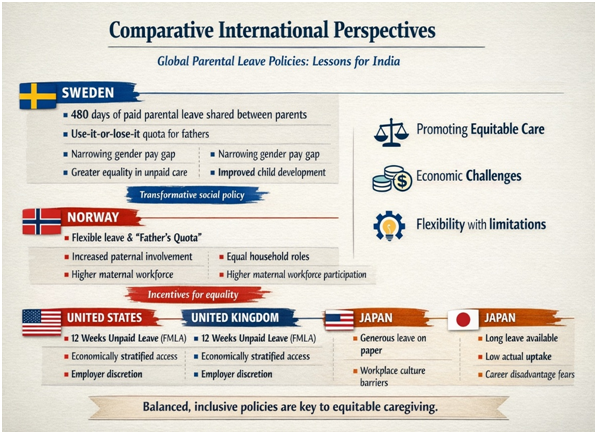
1.SWEDEN
The parental leave system in Sweden is generally considered to be the model of progressive family policy. It offers 480 days of paid parental leave, which will be shared between parents. Importantly, a part of such leave is specifically allocated to the fathers by the so-called use-it-or-lose-it system.
This aspect is important in that it will convert the paternal leave into a right that is theoretically on paper to a right that is used practically. Sweden has been able to induce fathers to be involved in early childcare by offering them incentives to take leave. This has led to, in its turn, the following:
- Narrowing of gender pay disparities,
- Greater equality in the distribution of unpaid care,
- Better child development results with increased parental involvement.
The Swedish model shows that policy design can actively transform social behaviour as well as simply derive it.
2.NORWAY
A similar practice is carried out in Norway which has a combination of shared parental leave and a father quota. The parents are free to have longer leave, but at a lower pay; and shorter leave, but at higher pay, which is flexible depending on the preferences of the family.
The quota of the father is at the centre of making sure that the paternal input is not left behind. Norwegian studies have shown that in cases where fathers do go on leave:
- In the long run they are still more involved in childcare.
- There is a more equal distribution of household roles,
- The participation of maternal workforce is enhanced.
Therefore, the model of Norway emphasizes the role of systematic incentives in the development of substantive equality.
3.UNITED KINGDOM
The United Kingdom is more of a moderate. It gives a statutory two week paternity leave and a shared parental leave scheme where parental leave can be shared among the parents.
Although the time that a paternity leave take is quite low, the shared leave system creates a degree of flexibility. Parents are able to design caregiving options, depending on financial and personal factors.
Nevertheless, the experience of the UK also shows some limitations:
- The adoption of shared parental leave is still low,
- The fathers are commonly discouraged to take leave due to financial limitations,
- The care giving patterns are still affected by cultural norms.
4.UNITED STATES
The American example is rather different. Eligible employees under Family and Medical Leave Act (FMLA) should be given 12 weeks of unpaid leave, which can be taken by either of the parents.
The fact that there is no single paid parental leave policy is also a major disadvantage to this framework. There are numerous employees who are not able to take unpaid leave, especially workers with low income.
As a result:
- The ability to avail parental leave is economically stratified,
- Employer discretion plays a big role.
- There are still gender differences because of consideration of money.
The U.S. example shows that unless supported by the state funding, parental leave policy could be unsuccessful in having significant social implications.
5.JAPAN
The best parental leave on paper is that of Japan, which allows fathers to enjoy a long period of leave with a paycheck.
Actual adoption is however minimal because of:
- •Work environment culture that does not encourage long leave,
- Men being expected to be in the workforce and not attend to the family, social expectations.
- Career disadvantage fears.
This offers a disparity between social practice and legal entitlement. The case of Japan shows that well-designed laws need to be transformed culturally and supported by an institution to be efficient.
LESSONS FOR INDIA
The comparative analysis can teach India a number of valuable lessons in the changing framework.
To start with, it must have statutory recognition. Paternity leave is not a consistent benefit without a strict legal requirement, but it is at the discretion of the employer.
Second, fatherly non-transferable leave is essential. There has been experience internationally that where leave is optional or transferable, men tend to underutilise it. A quota, which is reserved guarantees real participation.
Third, there must be mechanisms of financial support. Paid leave promotes the uptakes and makes benefits available to socio-economic groups.
Fourth, the policies should be accommodative and inclusive and should include adoptive parents, surrogacy practices and different family formations. This conforms to the issues expressed by Hamsaanandini Nanduri in the issues of exclusionary provisions.
Lastly, the legal reform should be coupled with cultural and institutional change. To normalise the paternal involvement in childcare, awareness activities, employer policies and workplace flexibility are required.
THE WAY FORWARD
India is on the groundbreaking crossroad and judicial observations and constitutional principles can help in legislative reformation.
The initial one is the legislation of an inclusive statutory provision of parental leave, in which both the maternity leave and the paternity leave should be regarded as the part of the social security.
Paternity leave must become a legal right, but with a prescribed minimum leave period and, hopefully, part of it should be non-transferable so that people feel motivated to take it.
At the same time, the current maternity laws should be re-evaluated to eliminate unreasonable categories, such as mentioned in case of Hamsaanandini Nanduri, and be inclusive of adoptive and non-traditional families.
Moreover, the policy formulation should focus on ensuring the division of caregiving roles, thus decreasing gender differences in home and work life domains.
Lastly, the workplace reforms and sensitization are needed so that legal rights are reflected into the actual behaviour.
CONCLUSION
Practical experience shows that the concept of treating parental leave as a mutual obligation is not only possible but also the key to the realization of gender equality and child welfare.
The remarks of the Supreme Court on paternity leave as understood and read with its arguments in Hamsaanandini Nanduri give an excellent normative basis on which to base a reform. Although the decision itself is about maternity leave, it redefines the concept as a welfare provision based on care and not just biology.
India can now shift towards a holistic and broad-based parental leave policy that is inclusive and has a reflection of the constitutional values and the international best practices. This kind of structure would not just help fill the legal loopholes but also help in creating a more balanced and child-focused society.
Join LAWyersClubIndia's network for daily News Updates, Judgment Summaries, Articles, Forum Threads, Online Law Courses, and MUCH MORE!!"


Tags :others


