
Index
1.Introduction
2.Existing Legal Framework in India
- 2.1.The Information Technology Act, 2000
- 2.2.The IT Rules, 2021 and Subsequent Amendments
- 2.3.MeitY Advisories on Deepfakes and AI
3.Deepfakes and Synthetic Media: Legal Challenges
- 3.1.Attribution and Traceability
- 3.2.Harmful Manipulation versus Legitimate Expression
- 3.3.Detection Limits and the Risk of Over-Removal
4.Intermediary Liability and Section 79
- 4.1Practitioner’s perspective : Constitutional Risks in Accelerated Takedown Regimes
5.Judicial Developments: Case Law Analysis
- 5.1.Shreya Singhal v. Union of India (2015)
- 5.2.Super Cassettes Industries Ltd. v. MySpace Inc. (Delhi High Court, 2016)
- 5.3.Christian Louboutin SAS v. Nakul Bajaj (Delhi High Court, 2018)
6.Regulatory Gaps and Policy Concerns
7.Comparative Perspective: The EU AI Act
8.Recommendations for Future Regulation
9.Conclusion FAQs
1.Introduction
Generative artificial intelligence technologies have transformed the creation, manipulation and circulation of audio-visual content. Hyper-realistic deepfakes and other forms of synthetic media can replicate speech, likeness and events with striking authenticity, often leaving limited technical traces. For legal systems built upon attribution, evidentiary reliability and individual accountability, this technological shift presents significant doctrinal and enforcement challenges.
India’s response has largely evolved through existing legal instruments rather than deepfake-specific legislation. The Information Technology Act, 2000 (“IT Act”), the Information Technology (Intermediary Guidelines and Digital Media Ethics Code) Rules, 2021 (“IT Rules, 2021”), and executive advisories together form the current legal framework governing harms arising from AI-generated media. Recent policy discussions and proposed amendments indicate a gradual shift toward explicit regulation through disclosure requirements and accelerated takedown mechanisms.
Any such framework must remain compatible with constitutional guarantees under Articles 19(1)(a) and 19(2) of the Constitution of India. In Shreya Singhal v. Union of India (2015), the Supreme Court cautioned against intermediary obligations that create a chilling effect on lawful expression. The central challenge for Indian cyber law is therefore twofold: mitigating harms caused by deepfakes while preserving freedom of expression and the conditional safe-harbour protection available to intermediaries under Section 79 of the IT Act. This article examines the statutory framework, judicial interpretation of intermediary liability, emerging regulatory directions, and the constitutional tensions shaping India’s evolving approach to synthetic media regulation.
2.Existing Legal Framework in India
2.1.The Information Technology Act, 2000
Although the IT Act does not expressly mention deepfakes, several provisions already address harms commonly associated with synthetic media. Section 66D criminalises cheating by personation through computer resources and becomes relevant where deepfakes are deployed for fraud or identity-based deception. Sections 66E, 67, 67A and 67B address privacy violations and sexually explicit material, including non-consensual deepfake pornography.
Section 69A empowers the Central Government to direct blocking of online information on grounds consistent with Article 19(2), subject to procedural safeguards under the Blocking Rules, 2009. Section 79 provides conditional safe harbour to intermediaries for third-party content, provided they function as neutral facilitators and comply with due diligence obligations. Together, these provisions form the statutory foundation upon which later policy responses to synthetic media have developed.
2.2.The IT Rules, 2021 and Subsequent Amendments
The IT Rules, 2021 significantly expanded intermediary obligations and introduced a layered compliance framework. Significant Social Media Intermediaries (SSMIs) are subject to heightened duties, including the appointment of compliance officers, grievance officers and nodal contacts, reflecting the scale at which digital harms can spread. Rule 3(1)(b) requires intermediaries to inform users not to upload content that is defamatory, invasive of privacy, obscene or misleading — categories frequently implicated in harmful deepfake dissemination.
Rule 3(1)(d), read alongside Shreya Singhal v. Union of India, links takedown obligations to “actual knowledge” arising from court orders or lawful government notices, thereby preserving judicial oversight over speech restrictions. The Rules also prescribe accelerated timelines for removal of intimate or sexually explicit content, reflecting concern over irreversible harm caused by rapid online circulation. Subsequent amendments introducing Grievance Appellate Committees (GACs) seek to add an additional layer of oversight over platform moderation decisions, although debates persist regarding institutional independence and executive influence.
From a constitutional perspective, Rule 3(1)(d) assumes particular significance because it operationalises the “actual knowledge” standard articulated in Shreya Singhal, functioning as a structural safeguard against private censorship and limiting intermediaries’ role as arbiters of legality. At the same time, expanding compliance duties may create pressure toward risk-averse moderation, as platforms faced with strict timelines and liability concerns may opt for precautionary takedowns. The constitutional tension therefore lies not only in the text of the Rules but also in their practical operation, as ongoing judicial scrutiny reflects the unresolved balance between platform accountability and freedom of expression under Article 19(1)(a).
2.3.MeitY Advisories on Deepfakes and AI
Prior to formal rulemaking, executive guidance emerged through advisories issued by the Ministry of Electronics and Information Technology (MeitY). The December 2023 advisory reiterated that existing legal obligations apply to AI-generated impersonation and deception, encouraging prompt intermediary action. A subsequent advisory in March 2024, initially perceived as imposing stricter obligations on under-tested AI models, was later clarified following industry feedback.Although advisories lack the force of delegated legislation, they signal the executive’s evolving interpretation of intermediary due diligence in the context of generative AI and reflect policy experimentation ahead of formal legislative reform.
3.Deepfakes and Synthetic Media: Legal Challenges
Deepfakes challenge existing legal frameworks not merely because they are technologically novel, but because they disrupt foundational assumptions about attribution, intention and accountability in digital communication. Three structural characteristics make regulation particularly complex.
3.1.A.ttribution and Traceability
Synthetic media often moves rapidly across multiple platforms, encrypted channels and jurisdictions, making attribution difficult. The originator may remain anonymous, content may be repeatedly modified, and distribution may occur through decentralised networks. Traditional
notice-and-takedown models, which rely on identifiable actors and clear jurisdictional anchors, therefore struggle to function effectively.
This difficulty shifts enforcement pressure toward intermediaries rather than original creators, raising difficult questions about where responsibility should lie within digital ecosystems.
3.2.Harmful Manipulation versus Legitimate Expression
The same techniques that enable deception are also used for legitimate purposes such as satire, artistic expression, filmmaking and accessibility tools. Deepfake regulation therefore cannot rely on technological categorisation alone. Any attempt to prohibit synthetic media broadly risks intruding upon protected expression under Article 19(1)(a), while narrow definitions may fail to address harmful misuse.
The regulatory challenge lies in distinguishing context and intent without creating standards so vague that they encourage arbitrary or inconsistent enforcement.
3.3.Detection Limits and the Risk of Over-Removal
Detection technologies remain imperfect and operate on probabilistic assessments rather than certainty. As synthetic media tools become more sophisticated, false positives and false negatives remain unavoidable. Platforms operating under strict compliance timelines may consequently err on the side of removal to minimise potential liability.
Such precautionary moderation creates the risk of indirect censorship, where lawful speech is suppressed not through formal state action but through liability-driven private decision-making. This dynamic underscores the importance of procedural safeguards that prevent technological uncertainty from producing systemic chilling effects on expression.
4.Intermediary Liability and Section 79
Section 79 of the IT Act lies at the heart of India’s intermediary liability regime. It grants safe-harbour protection for third-party content provided intermediaries remain neutral conduits and comply with due diligence requirements. Section 79(3)(b) withdraws this protection where intermediaries fail to act upon receiving “actual knowledge” of unlawful content.
In Shreya Singhal v. Union of India, the Supreme Court interpreted this requirement narrowly, clarifying that actual knowledge arises only through court orders or lawful government directions grounded in Article 19(2). This interpretation prevents private parties from forcing platforms to act as arbiters of legality.
The IT Rules operationalise this framework through compliance obligations and takedown timelines, yet neither statutory law nor judicial precedent imposes a general duty to proactively monitor all content. The Delhi High Court in Super Cassettes Industries Ltd. v. MySpace Inc. rejected broad pre-screening obligations as disproportionate and technologically impractical.
For deepfakes, intermediaries generally retain safe harbour where they remain passive and respond to lawful directions. However, as recognised in Christian Louboutin SAS v. Nakul Bajaj, platforms that actively promote, curate or monetise unlawful content may lose intermediary protections.
4.1.Practitioner’s Perspective : Constitutional Risks in Accelerated Takedown Regimes
From a practitioner’s perspective, as noted by Adv. Devendra Sabadra, accelerated takedown timelines risk transforming intermediaries into private adjudicators of legality. When platforms are required to determine within hours whether content is unlawful, risk-averse over-removal becomes the most rational compliance strategy. This dynamic raises a serious constitutional concern: indirect censorship through private enforcement may chill lawful expression even in the absence of formal state prohibition. The legitimacy of any rapid-response regulatory framework therefore depends on procedural safeguards, transparency obligations and meaningful appeal mechanisms that ensure speed does not displace due process or constitutional balance.
5.Judicial Developments: Case Law Analysis
5.1Shreya Singhal v. Union of India (2015)
The Supreme Court struck down Section 66A for vagueness and overbreadth, reaffirming that restrictions on speech must fall strictly within Article 19(2). Crucially, it limited intermediary takedown obligations to lawful court orders or government directions, establishing a foundational constitutional safeguard for online speech.
5.2.Super Cassettes Industries Ltd. v. MySpace Inc. (Delhi High Court, 2016)
The Court held that intermediaries retain safe-harbour protection unless they possess specific knowledge of infringing content. General awareness was deemed insufficient, reinforcing that platforms are not obligated to pre-screen all user-generated content — an important principle in the context of AI-generated media.
5.3.Christian Louboutin SAS v. Nakul Bajaj (Delhi High Court, 2018)
The Court distinguished passive intermediaries from active participants. Platforms that materially influence transactions or actively curate listings may lose safe harbour protection. Applied to synthetic media, this reasoning suggests heightened liability where AI tools are deliberately promoted for deceptive use.
6.Regulatory Gaps and Policy Concerns
Despite existing provisions, significant regulatory gaps remain. India lacks a precise statutory definition of synthetic media, creating uncertainty for enforcement and compliance. Responsibility for upstream AI developers remains underdeveloped, and notice-and-takedown frameworks are inconsistently applied across platforms.
Broad misinformation categories linked to safe-harbour compliance may encourage over-moderation. The constitutional concerns identified in Shreya Singhal continue to shape debates regarding the permissible expansion of intermediary obligations.
7.Comparative Perspective: The EU AI Act
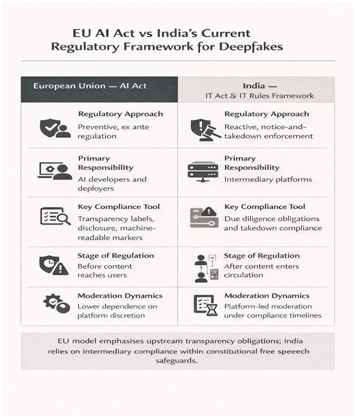
The European Union’s AI Act adopts a preventive approach to synthetic media regulation by placing obligations on AI developers and deployers before content reaches public circulation. Rather than relying primarily on takedowns after harm occurs, the framework emphasises transparency measures such as mandatory disclosure when users encounter AI-generated content and the use of machine-readable labels. This reflects the EU’s broader preference for risk classification and early intervention, with the aim of reducing downstream enforcement burdens on online platforms. In practical terms, responsibility shifts upstream, requiring providers of generative AI systems to integrate transparency mechanisms into their products so that users and platforms can identify synthetic content earlier, limiting virality and reducing reliance on rapid reactive moderation.
India’s regulatory model remains comparatively platform-centric. Under the IT Act and the IT Rules, enforcement operates largely through notice-and-takedown processes after content has already entered circulation. Intermediaries retain safe-harbour protection only when they comply with due diligence obligations, concentrating regulatory pressure at the platform level rather than at the stage of AI system design. As a result, moderation decisions often occur under time-sensitive conditions and high volumes of user-generated content. The contrast reflects differing regulatory realities: while the EU distributes responsibility across developers, deployers and platforms, India continues to rely heavily on intermediary compliance to manage emerging harms such as deepfakes. Although policy discussions increasingly consider disclosure or labelling requirements, any gradual move toward upstream accountability will need to align with constitutional safeguards governing speech and intermediary liability.
8.Recommendations for Future Regulation
A few principles should guide future reform. First, the constitutional safeguards articulated in Shreya Singhal should be expressly reflected in subordinate legislation to ensure that “actual knowledge” arises only from legally valid orders grounded in Article 19(2). Second, clearer standards are needed to determine when AI platforms move from passive intermediaries to active participants, drawing from MySpace and Christian Louboutin. Third, definitions of synthetic media should focus on
deceptive intent or material risk of harm so as not to capture parody or legitimate creative expression. Fourth, accelerated takedown timelines must be balanced by procedural review, transparency reporting and effective appeal mechanisms to reduce chilling effects. Finally, deepfake regulation should align with data protection and evidentiary reforms, given its implications for privacy and evidentiary reliability.
9.Conclusion
India’s approach to deepfake regulation has evolved from reliance on general statutory provisions and executive advisories toward a more explicit regulatory direction. Judicial decisions in Shreya Singhal, MySpace, and Christian Louboutin continue to define the doctrinal boundaries of intermediary liability through principles of actual knowledge, conditional safe harbour and differentiation between passive and active intermediaries.
Emerging regulatory proposals including disclosure obligations and accelerated takedown timelines signal an important policy shift. Their constitutional sustainability, however, will depend on careful implementation, procedural safeguards and judicial oversight to ensure that efforts to mitigate harms from synthetic media do not undermine foundational commitments to free expression within India’s digital constitutional framework.
Frequently Asked Questions (FAQs)
Q1. What are deepfakes and why do they raise legal concerns in India?
Deepfakes are AI-generated or synthetically altered audio-visual content that can realistically imitate real persons or events. They raise legal concerns because they may facilitate misinformation, impersonation, privacy violations, reputational harm, and online abuse while challenging existing legal and constitutional safeguards.
Q2. Does Indian law specifically regulate deepfakes?
India does not currently have a standalone law dedicated to deepfakes. However, existing provisions under the Information Technology Act, 2000, the IT Rules, 2021, and related criminal laws are used to address harms arising from synthetic media.
Q3. How does Section 79 of the IT Act apply to deepfake content?
Section 79 grants intermediaries safe harbour protection for third-party content if they act as neutral platforms and comply with due diligence obligations. Platforms are generally required to act upon lawful court orders or government notifications rather than proactively monitor all user content.
Q4. Why are rapid takedown requirements controversial from a constitutional perspective?
Accelerated takedown timelines may encourage platforms to remove content quickly to avoid liability, which can result in over-removal and a chilling effect on lawful speech. This raises concerns under Article 19(1)(a) relating to freedom of expression.
Q5. What should future deepfake regulation in India focus on?
Future regulation should balance harm prevention with free speech protections by providing clear definitions of synthetic media, transparent compliance standards, procedural safeguards, and effective appeal mechanisms to prevent arbitrary censorship.
Join LAWyersClubIndia's network for daily News Updates, Judgment Summaries, Articles, Forum Threads, Online Law Courses, and MUCH MORE!!"


Tags :others