
SYNOPSIS:
- Introduction
- Conceptual and Structural Differences of Hindu Law and UCC
- Why the UCC is in the News
- Constitutional Framework: Article 44 and Religious Freedom
- Directive Principles vs Fundamental Rights
- Judicial Interpretation and Landmark Case Laws
- A Balanced Perspective on the UCC Debate
- Impact of UCC on Hindu Personal Law
- Comparative Implications for Muslim, Christian and Other Personal Laws
- Way Forward: Gradual Reform and Consensus Building
- Conclusion
INTRODUCTION
The Uniform Civil Code (UCC) is a law reform proposal that aims at replacing religion-based personal laws with a common set of secular laws which will regulate the personal matters such as marriage, divorce, adoption, inheritance, and succession of all Indian citizens irrespective of their religions. Thus, while the criminal law is the same and applies to all the citizens of the country, in India, the personal laws are still governed by religion-based statutes.
The constitutional basis for the UCC is in Article 44 of the Constitution of India, which is a part of the Directive Principles of State Policy. It suggests that the State shall "endeavour to secure for the citizens a uniform civil code throughout the territory of India." Although not enforceable by courts, Directive Principles represent the constitutional vision and legislative aspirations of the framers. Therefore, the debate over the UCC is not just legal but deeply constitutional. It means harmonizing Part III (Fundamental Rights), especially right to religious freedom Articles 25, 28 with Part IV's reformative objectives. It is a fundamental question at the core of the UCC debate whether the civil rights in a modern republic should be religion-neutral or legal pluralism should still continue to characterize the personal law system of India.
Master Muslim Laws - Indian Judiciary Special Course by Adv. Uday Singh Rathore. Enroll Now!
CONCEPTUAL AND STRUCTURAL DIFFERENCES OF HINDU LAW AND UCC
In contemporary India, a system of legal pluralism is followed, where people of different religious groups are regulated by their own sets of personal laws. Hindu personal law, which has been codified through the enactment of various statutes like the Hindu Marriage Act, 1955 and the Hindu Succession Act, 1956, applies not only to Hindus but also to Sikhs, Jains, and Buddhists. On the other hand, Muslims, Christians, and Parsis also follow their own respective personal law systems.
The Uniform Civil Code, on the other hand, is a concept that presents a single, religion-neutral, and standardized civil framework for all citizens of the country. The main difference lies at the source of power: while Hindu law gets its authority from religious identity (and the legislature has codified it), the UCC aims at taking the authority from constitutional citizenship.
For example, Hindu law requires monogamy to be strictly followed, and daughters are entitled to have the same rights over ancestral property as sons, after the 2005 amendment to the Hindu Succession Act. On the other hand, it was allowed under Muslim personal law for the husband to have more than one wife at the same time (however, triple talaq has now been declared invalid), and the rules of inheritance vary widely from one religious community to another.
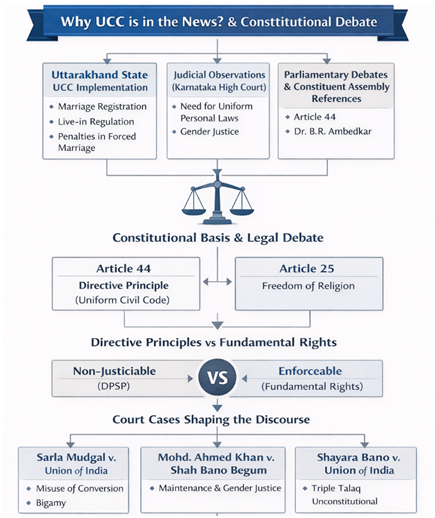
WHY UCC IS IN THE NEWS?
The UCC or Uniform Civil Code debate has been reignited by recent legislative and judicial happenings with the most prominent being the State of Uttarakhand. Uttarakhand has become the first state that has, in effect, a UCC post-implementation of the state legislation facilities like standardising marriage registration, regulating live-in relationships, and prescribing stricter penalties, for example, in forced marriage cases and thus setting the path for the rest of the country.
The Karnataka High Court delivered a judgment in which it pointed out the necessity of having uniform personal laws to guarantee justice, especially to women who, under the different religious systems, are exposed to discriminatory provisions. Such judicial hints or recommendations, so to speak, are not binding but still have persuasive score in influencing the public as well as the lawmakers.
Moreover, the question has got fresh air in the Parliament discussions with the leaders of the political parties reaffirming the constitutional ideal behind Article 44. B.R. Ambedkar's references and those of other members of the Constituent Assembly have been invoked to assert that the UCC is a constitutional promise that has been left incomplete and is not a political invention of the present times.
CONSTITUTIONAL BASIS & LEGAL DEBATES
The constitutional basis of the Uniform Civil Code can be seen as a reform proposal entwined with religious freedom. On one hand, Article 44 of the Constitution of India asks the State to aim at a uniform civil code, on the other hand, personal laws are justified under Article 25 of the Constitution of India which guarantees freedom of conscience and the freedom to profess, practise and propagate religion.
DIRECTIVE PRINCIPLES VS FUNDAMENTAL RIGHTS
This debate over Directive Principles and Fundamental Rights is central to the UCC issue. Directive Principles are non-justiciable and, thus, they cannot be really enforced in a court of law. Nevertheless, they are essential for the country's governance. Contrary to them, Fundamental Rights are enforceable and occupy a higher position in constitutional adjudication.
Therefore, the problem is not only about whether the State has the power to bring in a UCC, but whether such a step will violate religious freedoms. The judiciary has, in fact, repeatedly stated that a person's religious belief will always be protected but accompanying-secular activities can be regulated. The areas of marriage, divorce, inheritance are very often left outside the sphere of religious practices and thus, are considered civil matters and can, therefore, be reformed within the framework of the Constitution.
COURT CASES SHAPING THE DISCOURSE
The Courts, through their orders, have played a vital role in shaping the understanding of the UCC. The case of Sarla Mudgal v. Union of India was one such example where the Supreme Court pointed out the exploitation of personal laws for bigamy and further remarked that the non-existence of a uniform code is responsible for legal inconsistencies. The Shah Bano case is yet another example where the Supreme Court's decision to grant alimony to a divorced Muslim woman sparked a heated nationwide debate over the association of gender justice with personal law autonomy.
In the recent case of Shayara Bano v. Union of India, the Supreme Court of India declared instant triple talaq to be unconstitutional. With this ruling, it has reinforced the principle that personal laws cannot be allowed to overshadow constitutional guarantees like equality and dignity. By these verdicts, the judicial branch has indirectly indicated that constitutional morality and human rights can, under some conditions, be prioritized over unyielding ritualistic personal law practices.
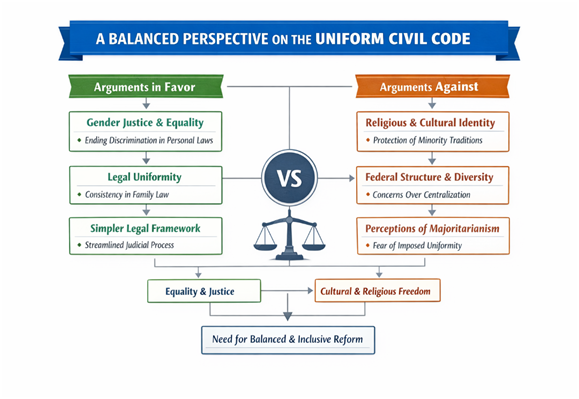
A BALANCED PERSPECTIVE ON THE UNIFORM CIVIL CODE:
Gender Justice & Equality
A major argument for UCC revolves around gender justice. Historically, the personal laws of various communities have contained clauses that discriminate against women, be it in the contexts of inheritance, divorce, or guardianship. The establishment of a uniform civil structurecould wipe out discrepancies and make sure that the equality guaranteed by
Article 14 of the Constitution of India in family law is not just a theoretical concept.
The supporters argue that being equal should not be dictated by one's religion. They maintain that civil rights must be derived from constitutional citizenship and not from community membership.
Legal Uniformity
The plural personal law system in India often leads to different and sometimes even contradictory standards being applied to the resolution of similar civil disputes. A uniform code will bring predictability, consistency and transparency in the adjudication of family law. Besides, it will cut down on the phenomena called "forum shopping" where individuals convert or strategically utilize personal laws with a view to obtaining a legal benefit.
Uniformity, in this context, is considered as helping to reinforce the secular nature of the Constitution by making sure the civil obligations do not merely belong to one religion.
Simpler Legal Framework
On the administrative front, a single civil code would simplify the work of the courts and eliminate interpretative issues that arise when there is more than one personal law regime. Uniformity achieved through the code may also bring civil law closer to the people who, in fact, mostly have a hard time understanding the different legal systems.
Religious Freedom and Cultural Identity
Those who oppose the idea argue that personal laws are a part of religious and cultural heritage. The minorities may see the uniform law as an attack on their freedom of religion and culture that are guaranteed by Articles 25 and 29 of the Constitution.
For many cultures and communities, their personal law is not simply one that regulates the way they do things at home but a symbol of their being together as a community. Turning the page on such law suddenly may result in the law being considered as a tool of cultural homogenization rather than the progress it really represents.
Federal Structure and Diversity
India has a constitutional framework that allows for the differentiation of people in different parts of the country and different communities. Different groups have had their own family laws which, to an extent, helped in the evolution of the pluralistic ethos of India. The central government's swift imposition of a UCC without the states having any say in the matter might lead to the raising of federal concerns.
What two be a few days ago initiative by Uttarakhand depicts a state-led approach, thereby hinting that a gradual and decentralised reform might be less constitutionally controversial than a national mandate of the sweeping sort.
Perceptions of Majoritarianism
Maybe the most politically charged argument is the one relating to the viewpoint that the UCC in reality might be a road to majoritarianism. In case a uniform code aligns more with the personal law of a dominant community and is less in tune with the other personal laws it would be, therefore, a huge gamble on the trust people have in the secular nature of the law.
Therefore the success of a UCC is not just a question of its being constitutional but also being accepted by the public. A reform carried out without the agreement may lead to breaking of social bonds rather than having amicable relations.
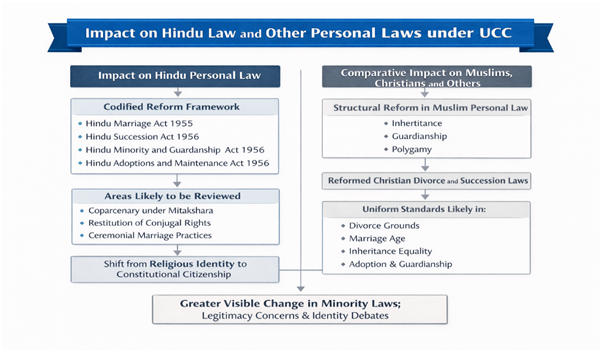
IMPACT ON HINDU LAW AND OTHER PERSONAL LAWS
The adoption of a Uniform Civil Code would not be a law isolated from other laws. It would definitely affect personal laws that have already been codified such as the Hindu law, which has been through a lot of legislative reforms since independence. Hence, the main question now is not if UCC will change personal laws but rather how and to what extent it will change them.
Changes in Hindu Personal Law
Currently, Hindu law is mainly based on statutes that resulted from the reform measures of the 1950s after Independence. The four key enactments being the Hindu Marriage Act, 1955, the Hindu Succession Act, 1956, the Hindu Minority and Guardianship Act, 1956, and the Hindu Adoptions and Maintenance Act, 1956. These laws significantly brought traditional Hindu jurisprudence up to date by introducing monogamy, divorce provisions, judicial separation, and codified succession rules.
On the one hand, Hindu personal law is in many ways consistent with constitutional equality norms especially after the 2005 amendment of the Hindu Succession Act allowing daughters to have equal coparcenary rights. On the other hand, a few parts may still require the review under a UCC framework such as:
- the status of coparcenary system based on Mitakshara principles.
- the relief of restitution of conjugal rights that has been questioned on constitutional grounds.
- ceremonial practices of the community-specific Hindu marriage.
A UCC could probably eliminate or even change entirely these unique doctrinal concepts to a more gender-neutral and religion-neutral framework. At the same time, however, a big problem emerges: if the UCC was to reflect mostly the current provisions of Hindu law, it might give rise to the impression that "uniformity" simply means imposing a majority framework on other communities.
Therefore, the effect on Hindu law may not be major in terms of only the content but it can still be significant in terms of the source of legitimacy redefined from religious identity to constitutional citizenship.
COMPARATIVE IMPLICATIONS FOR MUSLIMS, CHRISTIANS AND OTHERS
There is a chance that the transformation of Muslim personal law may go beyond just one component and have a more structural impact. Instant triple talaq, for instance, has already been ruled unconstitutional in Shayara Bano v. Union of India. However, other issues such as inheritance distribution, guardianship norms, and polygamy still differ from Muslim statutory law.
By and large, Christian divorce law traditionally had very limited grounds (however, through amendments, it has been possible to introduce some reforms), and the different succession arrangements reflect the varied religious principles of the communities.
The main changes resulting from a UCC would most probably be:
- Situations and grounds for divorce in different religions;
- Legal age and conditions for marriage;
- Inheritance rights reflecting gender equality;
- Adoption and guardianship regulations.
So, while Hindu law might be refined, minority personal laws may be changed more drastically and quite visibly. The situation explains partly why the debates over the UCC often stir stronger feelings among the minority groups, who are concerned about their autonomy and identity.
Case Laws Directly Shaping the Hindu Law v. UCC Debate
The Supreme Court has consistently reflected on the dilemma of personal law pluralism on the one hand, and constitutional uniformity, on the other, often talking about the attractiveness of a Uniform Civil Code.
In Sarla Mudgal v. Union of India, through the example of Hindu men who converted to Islam only to get a second marriage without divorcing the first, the Supreme Court illustrated the problem. The Court reacted strongly against these conversions being abused as a way to evade monogamy under Hindu law. It stated very clearly that the lack of a UCC results in conflicting duties and legal manipulations.
The statements of the Court went much further than the point at issue. They expressed a general sense of frustration of the Constitution with a plethora of personal laws that, among other things, render gender justice very difficult.
In a similar vein, the Lily Thomas v. Union of India case, is indicative of the Court's view that monogamy should not be evaded through conversion under the Hindu law. Furthermore, this decision upholds the notion that personal law cannot be so elastic as to override statutory discipline.
Moreover, in the Mohd. Ahmed Khan v. Shah Bano Begum case, though it related to Muslim personal law, the Supreme Court unequivocally supported the establishment of a UCC, which would thus allow the prevention of such contradictions between secular law on criminal maintenance and religious personal laws. The political backlash that followed clearly illustrated how fraught questions of UCC are within the pluralistic society of India.
WAY FORWARD, CAN INDIA IMPLEMENT A UCC?
Whether or not a Uniform Civil Code can be implemented is ultimately a matter of constitutional prudence rather than test of constitutional power, which Parliament undoubtedly has.
Gradual Reform Approach
Incremental harmonisation rather than complete replacement is one of the ways. India, over history, has been following a reform-by-evolution model, codifying Hindu law in the 1950s, criminalising triple talaq decades later, and gradually amending succession laws.
A phased approach could start with universally acceptable reforms:
- Mandatory marriage registration
- Uniform age of marriage
- Gender-neutral inheritance rights
- Adoption rights irrespective of religion
Consensus-Building vs Unilateral Implementation
In a plural democracy, a legal reform gets its legitimacy not only from the constitutional text but also from the public acceptance. It will be a must to consult religious bodies, women's rights organisations, jurists and civil society in order to avoid a situation when the UCC would be perceived as a political move.
PRACTISING ADVOCATE’S OPINION
From a advocate's point of view, the question of a Uniform Civil Code is not so much about ideology but more about the art of lawmaking. The main issue is how such a code would be created, understood, and applied in practice. A poorly designed UCC may lead to endless court cases, confusion during the transition, and even challenges to the constitution, particularly in the areas of inheritance and matrimonial remedies. The drafters must be very clear, the new law must not contradict the old ones, and the existing rights must be protected, thus avoiding legal uncertainty.
Also, any civil code must take into account the intersecting realities of tribal customs, matrilineal societies, and local practices without wiping out lawful diversity. The goal should not be a forced uniformity but consistent principles based on justice, agreement, and personal freedom. Looking at the experiences of other multicultural societies, civil changes only take place successfully when they are the natural result of talking and gradual lawmaking.
In the end, a winning UCC would rely more on institutional preparedness, judicial understanding, and general trust than on constitutional declarations. In order to last, the reform has to be technically correct, socially wide-ranging, and legally consistent.
CONCLUSION
The discussion over Uniform Civil Code goes beyond changing family law; it is a constitutional discussion about the identity of the Indian Republic. It brings face to face with two equally treasured constitutional commitments, equality and diversity.
Besides it is the happiness of substantive equality, that is embedded in Articles 14 and 15 of the Constitution, a happiness that the change of civil rights should not depend on religious identity. Gender justice, uniform standards in marriage and inheritance, and legal clarity all are powerful reasons that civil law in a secular republic must finally and legitimately get its authority from citizenship rather than community affiliation.
Besides it is the protection of the constitutional religious freedom and cultural autonomy under Articles 25 and 29. India's plural personal law system is a reflection of the civilizational diversity, where law has historically accommodated multiple traditions. For many communities, personal law is not only a procedural framework but also an extension of collective identity and historical continuity.
The Constitutional task thus is not to decide between the two extremes equality and pluralism, but to synergize them.
If a Uniform Civil Code is to be brought into force, its validity will not only depend on constitutional authority but also on constitutional sensitivity. Such a code that merely copies one community's law and applies it to others, would be throwing away the very secularism it wants to promote. On the other hand, a code that has been made after consultation, inclusiveness, and principled neutrality could herald the final stage of the Indian civil rights movement.
The fact of the matter is, the Uniform Civil Code is not about wiping out identity, but rather about changing the platform of legal obligation. The question is whether India envisions itself primarily as a federation of communities governed by differentiated norms, or as a republic of citizens bound by common civil principles. The answer will shape not only the future of Hindu law and other personal laws, but the evolving meaning of secularism in India’s constitutional democracy.
Join LAWyersClubIndia's network for daily News Updates, Judgment Summaries, Articles, Forum Threads, Online Law Courses, and MUCH MORE!!"


Tags :Others