
Index of Headings
1.Introduction
2.Statutory Framework for Evidence Collection in India
- 2.1 Code of Criminal Procedure (Sections 53, 53A, 54, 164A)
- 2.2 Indian Evidence Act (Sections 45, 65A, 65B)
- 2.3 Scientific Expert Reports under Section 293 CrPC
3.The United States’ Daubert Standard
- 3.1 The Frye Test and Its Evolution
- 3.2 Daubert v. Merrell Dow Pharmaceuticals (1993)
- 3.3 Gatekeeping Role of Judges under Rule 702
- 3.4 Application and Variability of Daubert Across Circuits
4.The United Kingdom’s Regulatory Approach to Expert Evidence
- 4.1 Criminal Procedure Rules and Expert Qualification
- 4.2 Role of the Forensic Science Regulator (FSR)
- 4.3 Police and Criminal Evidence Act 1984 (PACE)
- 4.4 Effect of Non-Compliance with FSR Codes
5.Contested Techniques and Judicial Scepticism
- 5.1 R v. Dallagher (2003): Ear Print Evidence
- 5.2 R v. Harris & Others (2005): Shaken Baby Syndrome
6.The Daubert Gatekeeping Function in the United States
- 6.1 Reliability and Relevance Assessment
- 6.2 The Five Daubert Factors
- 6.3 Empirical Validation and Error Rates
7.India’s Qualitative Admissibility Assessment
- 7.1 Section 45 of the Indian Evidence Act
- 7.2 Role of Cross-Examination and Judicial Scrutiny
- 7.3 Constitutional Constraints and Selvi v. State of Karnataka
Constitutional Constraints and Selvi v. State of Karnataka
8.Procedural Mechanisms for Evidence Collection and Handling
9.Chain of Custody in India
- 9.1 CFSL Guidelines and Supreme Court Directions
- 9.2 DNA Evidence Collection and Preservation
- 9.3 Impact of Breaks in Chain of Custody
10.US Federal Discovery and Evidence Preservation
- 10.1 Federal Rule of Criminal Procedure 16
- 10.2 Laboratory Standards and Accreditatio
- 10.3 Decentralized Oversight in the United States
11. Procedure of Cross-Examination in India
- 11.1 Examination-in-Chief and Cross-Examination
- 11.2 Court’s Power to Summon Experts
- 11.3 Disclosure Through Adversarial Process
12.United Kingdom’s Disclosure Obligations and Expert Duties
- 12.1 Criminal Procedure Rules Part 33
- 12.2 Disclosure of Conflicts, Limitations, and Controversies
13.Case Law Illustrating Admissibility Standards
- 13.1 Selvi & Ors. v. State of Karnataka (2010)
- 13.2 United States v. Mitchell (2002–2004)
- 13.3 R v. Harris & Others (2005)
14. Conclusion
15. FAQs
Introduction
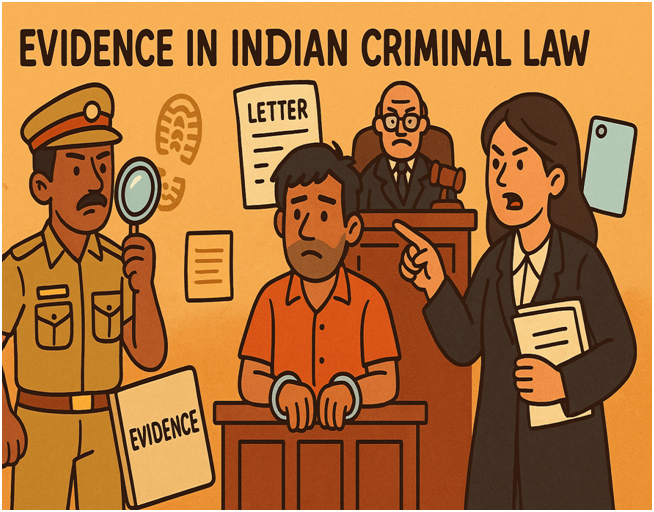
In the modern Indian criminal justice system, the collection of evidence is strictly regulated by the Code of Criminal Procedure (CrPC), which authorizes police to utilize medical science during investigations. Under Section 53 and its related provisions (Sections 53A, 54, and 164A), authorities may secure biological samples ranging from blood and semen to DNA profiling from both the accused and victims, ensuring that medical examinations are conducted by registered practitioners within close proximity to the crime. However, the collection of such materials is only the first step; their utility in court is governed by the Indian Evidence Act. This Act provides the gateway for expert testimony under Section 45 and specifically addresses the modern necessity of digital forensics through Sections 65A and 65B, which lay down mandatory conditions for the admissibility of electronic evidence.
Further, Section 293 of CrPC allows for any report submitted by a scientific expert in the employ of the state to be used as evidence in court, but the courts may call these scientific experts in to be questioned by the courts about their conclusions. In addition, the act has introduced the concept of the use of electronic evidence by including 65A/65B which creates a set of guidelines for the procedure needed to solicit information from computers and the process used to collect electronic documents so that they meet the standard for being treated as secondary evidence in court. In this article, we shall compare the forensics used in India to those used in the jurisdictions in the UK and US, with the focus predominantly on the latter initially.
The United States' Daubert Standard
Following Daubert v. Merrell Dow Pharmaceuticals, Inc. (1993), which established a different type of evidentiary standard than the previous Frye standard (like Daubert), the United States uses a standard that is much different from other countries. The Frye test was introduced in 1923, where all forms of scientific evidence needed to be "generally accepted" by the scientific community before admissible in court. This strict standard was in place for about seventy years before it was replaced with an evidentiary standard more compatible with the Federal Rules of Evidence.
The Daubert standard provides a more flexible approach to expert testimony. It allows judges to function as "gatekeepers" in determining whether or not expert testimony has a sound basis and is relevant to the case. The Supreme Court provided five factors that must be considered in making this determination: whether the technique can be tested through the scientific method; if it has undergone peer review and has been published; the known or potential rate at which the procedure may produce an erroneous outcome; if there are standards by which it operates; and if it has "general acceptance" in the scientific community. In 2000, with the revisions made to the Federal Rules of Evidence (702), an additional requirement that expert testimony be based on enough facts or data, that it uses reliable principles and methods, and that it applies them to the evidence for the case.
The United Kingdom's Regulatory Approach
A unique regulatory framework that is based on validating and overseeing the Qualifications of an Expert is used in the United Kingdom. The Criminal Procedure Rules of Great Britain have set forth a system by which Expert Witnesses may be utilized in criminal trials. The methodology established in Great Britain is substantially dissimilar from the Methodology established by Daubert: Judges under the Daubert model are empowered to act as gatekeepers for determining the admissibility of Expert Witness Evidence; while Judges in Great Britain rely heavily on the validated pre-trial process conducted by Forensic Science Regulator (FSR), as outlined in the decision of R v Reed & Anor, to determine the admissibility of Expert Witness Evidece.
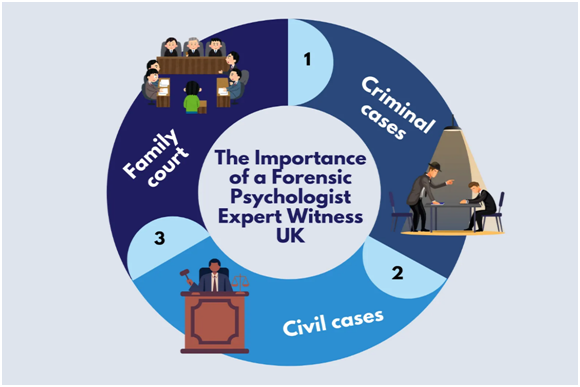
The Police and Criminal Evidence Act 1984 (PACE) provides the foundation for the procedures used in handling all types of evidence in the United Kingdom. The PACE Code B provides specific information pertaining to the method of conducting a search and seizing property. The FSR Code is intended to be used by all providers of forensic science services, as set forth in the Forensic Science Regulator Act 2021, and requires that such services be conducted in compliance with validated and quality-assured methods. In the FSR Code, the means of validating methods, laboratory competence, confidence in external evidence, etc. are outlined. Important to remember is that non-compliance with the FSR Code does not automatically prohibit the admissibility of evidence, but rather that the court will evaluate the reliability of each piece of evidence based on the particular circumstances of each case. Submission of the evidence to the jury will depend upon a variety of factors, including the nature of the evidence, the challenge to the evidence posed by opposing experts, if there are concerns regarding the reliability of the evidence, and if there are means of addressing these concerns via jury instructions on the evidentiary weight of the evidence.
Contested Techniques and Judicial Scepticism
The UK courts have recently reviewed unreliable evidence from previously untested forensic methods. The case of R v Dallagher (2003) UK was an excellent example of this reassessment. The conviction for murder was overturned when subsequent DNA evidence proved that the alleged "ear print" found at the scene of the crime could not have belonged to him. The Court of Appeal determined that the evidence for reliable ear print identification was not properly considered during the original trial, despite the testimony of a Dutch police officer who claimed expertise in the emerging technology. The ruling in Dallagher shifted the approach taken by courts in all situations involving the use of novel forensic technology that had no scientific validation.
Another excellent example was the case of R v Harris & Others (2005) UK, where the Court of Appeal extensively reviewed the reliability of SBS (Shaken Baby Syndrome) diagnosis using the "triad" of findings, extensive bilateral retinal hemorrhage, subdural hematomas, and encephalopathy. The court held that just because the triad findings were present does not necessarily or automatically equate to the diagnosis of an abusive head injury, stating that the complete set of facts in each individual case must be taken into account. Consequently, this decision fundamentally changed the way experts are allowed to provide testimony regarding the causation of abusive head injuries and the need for all possible alternate explanations for abusive head injuries.
The Daubert Gatekeeping Function in the United States
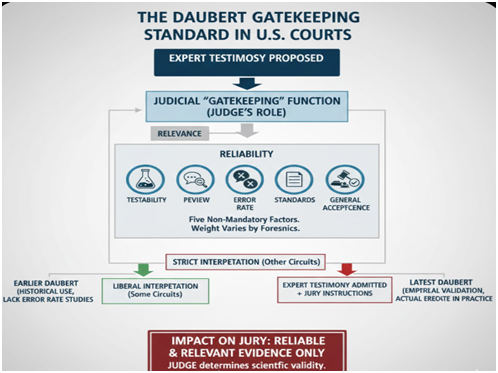
The Daubert standard represents the strength of a structured gatekeeping process for expert testimony. Prior to reaching a jury, judges must ensure the reliability and relevance of any proposed expert testimoniary evidence, as the Daubert standard assumes that judges will be able to determine whether or not scientific evidence is scientifically valid, based on their experience and judgement, thereby being more qualified than juries. However, the Daubert standard also gives the judge discretion in interpretation, creating variation between circuits on how the Daubert standard is applied. Some circuit courts have strictly interpreted Daubert to exclude new methods of proving expert testimony, while some others have liberally interpreted Daubert and allowed the introduction of expert testimony with jury instructions advising caution.
The five Daubert factors, including opportunities for experts to have their theories tested, whether the theory has undergone peer review, scientific consensus around the error rate of a theory or methodology, guidelines by which the underlying scientific method operates, and whether the theory is generally accepted within the scientific community, should not be considered mandatory factors nor are they the only five considerations that a judge may consider. The weight of each factor can change depending on the unique features of the forensics that the forensic expert is testifying about. The original applications of Daubert in court required the ability of a technique to be historically significant and widely used by law enforcement officers, which downgraded the value of the lack of rigorous error rate studies. The latest applications do require additional empirical validation, especially the ability of forensic expert witness to write and develop the actual error rate in practice rather than the theoretical error rate used for testing.
India's Qualitative Admissibility Assessment
India's emphasis is placed on the substantive reliability and relevance to the issues in dispute of the expert evidence rather than a more systematic assessment of gatekeeping factors that would be required to establish whether or not such evidence is admissible.
Courts primarily determine the admissibility of the expert's opinion through cross-examination where the opposing counsel questions the expert about his or her foundation for knowledge, methodology and conclusions reached in the opinion. In accordance with Section 293 of the CrPC, the reports of the scientific experts employed by the Government are also admissible to the courts as long as the experts are present to be summoned and examined by the courts in relation to their reports; this demonstrates the emphasis placed on the testification of the expert and the ability of the courts to conduct judicial scrutiny of the expert's findings.
The Indian Judiciary has shown an evolving sophistication in evaluating forensic evidence. The Judgment in Selvi held that in determining the admissibility of forensic evidence, it is the duty of the Court to critically analyse whether the forensic techniques have been developed on scientifically valid foundations and whether the use of those techniques presents an unacceptable risk of violation of the Constitution. This ruling does not eliminate the use of advanced and modern forensic techniques; however, the ruling gives the requirement of an individual giving their voluntary consent for the use of intrusive techniques in order to protect their fundamental rights. This demonstrates that an approach to admissibility in India is constitutionally based on protecting Human Rights as well as considering the degree of scientific reliability of the evidence being introduced into evidence by way of expert opinion.
Procedural Mechanisms for Evidence Collection and Handling
Chain of Custody in India
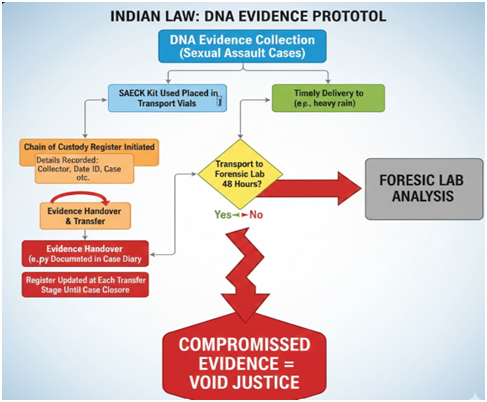
The judicial system of India enforces and outlines the protocols for the collection, preservation and examination (the 'chain of custody') of physical evidence. The comprehensive guidelines issued by the Centre of Forensic Sciences Laboratory (CFSL) govern the collection and transportation of evidence and follow the directions of the Supreme Court of India in Kattavellai @ Devakar v. State of Tamil Nadu (2025). The records related to the collection of evidence must state the FIR number, date, relevant statutory sections, the name of the investigating officer and the signature of a qualified medical practitioner, and must be in accordance with the Supreme Court's guidelines. In particular, biological specimens must be collected and preserved using non-reusable collection devices to prevent the contamination of biological specimens and must have unique identifiers that allow for identification and location during the entire chain of custody.
Indian law has a specific provision requiring the transportation of DNA specimens to forensic labs within 48 hours of their being collected and any delays must be documented in the case diary, but the case diary can also be used to document other matters as well. When evidence is collected, it is recorded in the chain of custody register, which must be completed from the time of collection until the closure of the case. Standardized protocols are outlined for the collection of DNA evidence in sexual assault cases via Sexual Assault Evidence Collection (SAECK) kits. Evidence that is compromised at any stage of the chain of custody, including errors made during the collection process, can have a significant effect on the weight and value of the evidence presented at trial.
US Federal Discovery and Evidence Preservation
The United States relies on Federal Rule of Criminal Procedure 16 to govern discovery obligations regarding forensic evidence. The rule requires prosecutors to permit defendants to inspect and copy reports of physical or mental examinations and scientific tests if the materials are material to preparation of the defense, the government intends to use them in its case-in-chief, or the materials were obtained from or belong to the defendant. Discovery obligations extend to laboratory testing protocols, quality assurance procedures, accreditation reports, and proficiency testing results. These provisions aim to ensure that defendants have access to the full evidentiary basis for forensic conclusions, facilitating meaningful cross-examination.
Federal DNA Analyst Training (FDAT) programs and quality assurance standards established by organizations such as ASCLD/LAB (American Society of Crime Laboratory Directors) provide guidance on laboratory accreditation and competency maintenance. The FBI and state laboratories must demonstrate proficiency through regular testing and maintain chain of custody documentation meeting established standards. However, the US lacks a unified regulatory body equivalent to the UK's Forensic Science Regulator, with responsibility diffused across federal agencies, state crime laboratories, and professional associations. This decentralized approach creates variation in standards and oversight.
The Procedure of Cross-Examination in India
As per Bombay High Court advocate Avesh Ganja, Expert evidence provided by forensic experts in India is subject to an examination-in-chief from the counsel examining the expert, after which opposing counsel may conduct a cross-examination of the expert to try to discover any inaccuracies, inconsistencies and/or weaknesses therein. The CrPC (Section 293) allows the Court to summon and examine an expert, as the Court may feel necessary, in relation to their report. This allows Judges to ask questions to clarify their understanding of the evidence and allow Judges to assess the reliability of the evidence provided by the expert without an adversarial context. If a Governmental Scientific Expert cannot attend the hearing in person, that Expert may be represented by another Officer who is knowledgeable about the case facts; however, the Courts may require the Expert to attend in person at their discretion.
The Indian Evidence Act does not provide for any formal requirement that experts disclose all underlying data before providing an opinion; instead, the requirement for disclosure of underlying data occurs as part of the cross-examination process. An expert opinion is only admissible if it passes through the cross-examination process, and if the expert has provided sufficient justification for the opinion, given the expert's knowledge and experience in the area. The burden rests heavily on opposing counsel to develop effective cross-examination techniques, requiring prior knowledge of the methodology and data utilised by the expert.
UK's Disclosure and Expert Duties
Expert witnesses are subject to stricter pre-trial disclosure requirements under UK procedure. Experts are required by Criminal Procedure Rules Part 33 and the Criminal Practice Directions to include in their written reports any information that they know could reasonably cast doubt on their opinions or diminish their credibility or objectivity. Conflict of interest disclosure, unfavorable court rulings in the past, and non-accreditation in situations where it would be expected are all examples of this. In addition to identifying the factual underpinnings of their opinions, experts must recognize the areas in which their field's methodologies are controversial.
Case Law Illustrating Admissibility Standards
1.Selvi & Ors. v. State of Karnataka (2010)
The legal proceedings involve a challenge to a detention order issued on 14 March 2025 against Sreejith under Section 3(1) of the Kerala Anti-Social Activities (Prevention) Act, 2007. This order, which classified the detenu as a known rowdy, was confirmed by the Government on 16 May 2025 and directed his detention for a period of six months. The proposal for this action was initiated by the District Police Chief, Palakkad, based on the detenu's involvement in eight prior cases, with the most recent being Crime No. 61/2025 involving alleged offenses under the Bharatiya Nyaya Sanhita.
The court, led by a bench including Jobin Sebastian, J., and P.B. Suresh Kumar, J., analyzed the contentions given by the opposing parties step-by-step. Regarding the delay, the court found the timeline justifiable given the administrative necessity of verifying details across eight different cases. On the issue of bail, the court observed that the impugned order explicitly noted the detenu's bail status and recorded the authority's specific conclusion that the existing bail conditions were not enough to prevent further criminal activity.
The court in this case addressed the temporal gap between crimes by relying on the precedent set in Ammini v. State of Kerala. The principle therein established that the cumulative effect of crimes committed within the previous seven years provides a valid factual foundation for subjective satisfaction, regardless of periods without registered offenses. Subsequently, the court also determined that while an FIR alone might not always suffice, the specific overt acts assigned to the detenu in the case records provided enough material to treat the latest activity as a qualified reason for detention.
Ultimately, the writ petition was dismissed, and the court held that the detention order was lawfully passed after proper application of mind.
United States: United States v. Mitchell and Daubert Analysis
United States v. Mitchell (2002–2004) represents the most extensive Daubert hearing ever conducted on fingerprint evidence. The Daubert Standard is a legal rule used in United States federal courts to determine whether scientific expert testimony is reliable enough to be admitted as evidence during a trial. This standard originated from a 1993 Supreme Court case involving the drug Bendectin, which was used to treat pregnancy-related nausea but was alleged to have caused birth defects in the children of women who took it. The Supreme Court used this case to clarify that the older Frye Standard, which required scientific evidence to be generally accepted by the scientific community, had been replaced by the more flexible Federal Rules of Evidence.
The defense challenged the admissibility of latent fingerprint identification, arguing that the methodology lacked sufficient scientific validation to satisfy Daubert's criteria. The government responded with an unprecedented experimental design: it sent two latent fingerprints and a complete ten-print card from the defendant to 53 law enforcement agencies, requesting that qualified examiners determine whether matches could be made. The government presented evidence of fingerprint uniqueness supported by published research, error rates derived from examiner studies, and general acceptance within law enforcement and forensic science communities.
Ultimately, The Third Circuit ruled that fingerprint evidence has "survived the Daubert threshold," noting that this long-standing method of identification is well-established, both within the broader scientific community and based on proven reliability in this instance. Also, while Daubert provides safeguards for the admissibility of scientific evidence, the Third Circuit indicates that courts will continue to follow the Daubert standard when performing fingerprint analysis on future cases. In some instances, lower courts have refused to accept fingerprint evidence as evidence when the examiner's qualifications or methods used were found to have been inadequate.
The Daubert Standard is a legal rule used in United States federal courts to determine whether scientific expert testimony is reliable enough to be admitted as evidence during a trial. This standard originated from a 1993 Supreme Court case involving the drug Bendectin, which was used to treat pregnancy-related nausea but was alleged to have caused birth defects in the children of women who took it. The Supreme Court used this case to clarify that the older Frye Standard, which required scientific evidence to be generally accepted by the scientific community, had been replaced by the more flexible Federal Rules of Evidence.
United Kingdom: R v. Harris and Expert Evidence Reliability
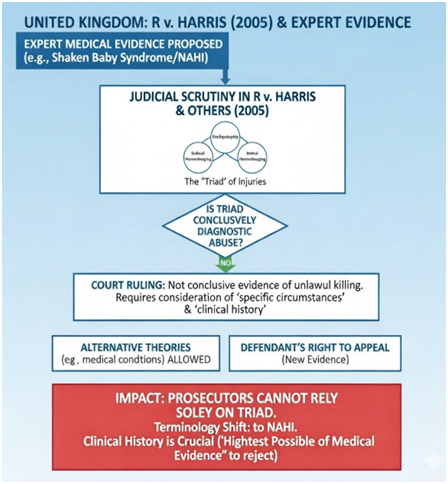
The case of R v. Harris & Others (2005) illustrates how courts scrutinize expert evidence even in established medical fields.
In this landmark ruling, the judge ruled on the admission and weight of medical evidence in "Shaken Baby Syndrome" (SBS) cases. The author of this article, a criminal defense solicitor, argues against the opinion that the "triad" of injuries (encephalopathy, subdural hemorrhaging, and retinal hemorrhaging) is an incontrovertible diagnostic indicator of abuse. While the triad is considered a "strong indicator" of Non-Accidental Head Injury (NAHI), the court found that it does not by itself or on its own constitute evidence of unlawful killing or violent trauma.
The court found that the triad theory was insufficient to support a conviction without considering the specific circumstances surrounding each child´s injury. The court concluded that it was not unreasonable to have alternative theories about how those injuries could have happened (such as different medical conditions) and granted the ability for a defendant to appeal based on new evidence being provided which indicates alternative causes for the injuries. As a result, prosecutors are no longer able to rely solely on the triad theory to argue that if a caregiver claims they did not cause an injury, this means they must be lying; therefore, the terminology used changed from Shaken Baby Syndrome to Non-Accidental Head Injury.
Lastly, the Court's explanation about the importance of clinical history is worth noting. The court's judgment warned people not to routinely dismiss the account of patients/caregivers in favour of medical hypotheses, stating that in order to reject the clinical history a person must provide the "highest possible level of medical evidence". The judgment further states that "medical science provides little, if any, absolute. Thus, the legal standard for determining whether there is safety concerning the conclusion about guilt based on the triad is not conclusively diagnostic."
Conclusion
Forensic evidence has become central to criminal justice across India, the United States, and the United Kingdom, yet the legal frameworks governing its use reflect distinct constitutional traditions, evidentiary philosophies, and institutional designs. India's approach emphasizes statutory procedure and constitutional constraint, requiring that forensic evidence collection respect Article 20(3) protections and fundamental rights while facilitating investigative necessity through carefully calibrated provisions like Sections 53, 53A, and 54 of the CrPC. The United States' Daubert standard creates a flexible, reliability-focused gatekeeping mechanism that has proven adaptable to emerging forensic technologies while leaving significant room for judicial discretion and circuit-level variation.
The United Kingdom's regulatory approach, centered on the Forensic Science Regulator, provides a middle path that emphasizes professional validation and standardization while preserving judicial discretion in individual cases. All three systems have demonstrated willingness to reconsider the admissibility of forensic techniques once considered reliable, as illustrated by judicial skepticism regarding ear print evidence in the UK and shaken baby syndrome diagnosis, and India's constitutional constraints on intrusive investigative techniques.
Going forward, the three jurisdictions may benefit from greater alignment on baseline standards for forensic evidence handling and examiner qualification while preserving flexibility in judicial assessment of admissibility. The Kattavellai guidelines in India, the ongoing evolution of Daubert jurisprudence in the US, and the UK's development of FSR-based standards reflect growing recognition that forensic evidence reliability requires both procedural rigor and substantive judicial scrutiny. As forensic technologies continue to advance, understanding how different jurisdictions balance evidentiary utility against constitutional protection and scientific reliability will remain essential for ensuring that justice systems appropriately integrate scientific findings while protecting fundamental rights.
FAQs
Q1. How do Indian courts assess the admissibility of expert and forensic evidence?
Indian courts focus on the substantive reliability and relevance of expert evidence rather than rigid gatekeeping tests. Admissibility under Section 45 of the Indian Evidence Act depends on the expert’s specialized knowledge and is mainly tested through cross-examination and judicial scrutiny. Judgments like Selvi emphasize scientific validity, constitutional safeguards, and voluntary consent, reflecting a human- rights oriented approach to admissibility.
Q2. How does US federal law regulate discovery and preservation of forensic evidence?
Under Federal Rule of Criminal Procedure 16, prosecutors must disclose forensic reports, test results, and related materials that are relevant to the defense or intended for use at trial.
Discovery extends beyond conclusions to include laboratory protocols, quality assurance records, accreditation, and proficiency testing, enabling effective cross-examination.
While training and quality standards are guided by bodies like the FBI and ASCLD/LAB, the absence of a single national forensic regulator results in decentralized and variable oversight across jurisdictions.
Q3. What is the significance of R v. Harris in assessing the reliability of expert medical evidence?
The court held that the “triad” associated with Shaken Baby Syndrome is not conclusive proof of abuse or unlawful killing on its own. It emphasized the need to consider alternative medical explanations and the specific circumstances of each case, allowing appeals based on new evidence. The judgment reinforced that medical science is rarely absolute and that rejecting clinical history requires the highest level of medical evidence, underscoring cautious judicial evaluation of expert testimony
Join LAWyersClubIndia's network for daily News Updates, Judgment Summaries, Articles, Forum Threads, Online Law Courses, and MUCH MORE!!"


Tags :others