
INDEX OF HEADINGS
•Introduction
•Meaning of Breach of Contract
- 2.1 Definition under the Indian Contract Act, 1872
- 2.2 Essential Elements of a Breach
•Types of Breach of Contract
•Effects of Breach of Contract
- 4.1 Discharge of the Contract
- 4.2 Loss and Damage to the Aggrieved Party
•Rights of the Aggrieved Party
•Case Laws on Breach of Contract
- Hadley v. Baxendale (1854)
- Hochster v. De La Tour (1853)
- Fateh Chand v. Balkishan Dass (1963)
•Comparative Perspective: English and Indian Law
•Contemporary Challenges and Need for Reform
- Force Majeure and Impossibility Defences
- Limited Access to Summary Procedures
•Conclusion
•FAQs
1. Introduction
One important aspect of all business and personal dealings is the notion of the sanctity of a contract; when two or more parties enter into a contract; they are agreeing that each will perform their respective obligations. Under the law, each party is understood to be entering into a legally enforceable contract to perform duties according to the terms of the contract. During a typical business transaction, the likelihood of either party breaching the contract may be viewed at the outset as an event which would have a negative impact on all parties. The legal framework for breaches is primarily contained within the Indian Contract Act, 1872 and the Specific Relief Act, 1963 and has produced an extensive body of case law governing the potential for breaches, as well as the various types of remedies available to those who have been harmed as a result of a breach.
A full understanding of how breach of contract occurs provides the basis for commercial certainty, protection for both contracting parties and provides the means by which businesses may resolve disputes in a manner that does not erode business relations. Moreover, an understanding of how anticipatory or actual breaches of contract differ and a clear understanding of the different types of remedies available for breach as well as principles for determining damages is crucial for legal advisors, businesspersons and scholars alike.
The article will review the legislative framework under which breach of contract occurs, review existing case law that has created established principles for the determination of damages for breach of contract, identify practical problems related to asserting rights to obtain or seek remedies for breach of contract and compare the principles of Remedy Options in Indian Contract Law to similar principles in English Common Law; the basis from which the Indian Contract Law was created.
2. Meaning of Breach of Contract
Under the provisions of Section 37 of the Indian Contract Act, every contract is expected to consist of two binding obligations; that is, the duties associated to each party must either be satisfied in their entirety, or offered to be satisfied in their entirety, unless one of the parties receiving the offer takes some action to excuse the other party, or unless the contract expressly indicates that the obligations of the contract will cease to exist under the circumstances prescribed within the contract.
A breach of contract occurs whenever one party fails to comply with any provision of the contract. Additionally, a party has committed a breach of contract if they complete their obligations in a manner contrary to the terms and conditions set forth in the contract. Breach of contract does not only occur when a party refuses to perform an obligation under a contract, but also when the performance is complete, but not done in a timely manner, as well as when performance is executed in a defective manner.
In relation to liability, it is important to understand that the Indian Contract Act does not require intent or willfulness for an individual to be held liable for the breach that occurred. Both intentional and unintentional violations of performance requirements under the contract will result in liability as long as the obligation to perform was legally binding and not subject to the supervening impossibility, or any other legal defense allowed by the law is not available to the breaching party. The strict liability rule states that it is unnecessary to prove the party's intent or degree of negligence in order to establish that a breach occurred.
2.1 Definition Under the Indian Contract Act, 1872
Breach of contract means failing to fulfil a contractual obligation. Under the Indian Contract Act, one party has a duty to perform his promises in full. The breach may not simply be a refusal to perform, but can also be part performance, defective performance, or delayed performance without a legal justification. The Indian Contract Act specifically does not require that a person breached a contract intentionally (i.e., wilfully). Breaches of the Indian Contract Act arise from either negligent or intentional actions provided that the failure to perform was not excused by supervening impossibility or other valid defences. In essence, the Indian Contract Act imposes strict liability for breaches of contract subject to specific reasons for permitting an exception. Intent and degree of negligence are often not relevant to whether or not a contract has been breached.

2.2 Essential Elements of a Breach
For a claimant to successfully establish breach of contract, two foundational elements must be present:
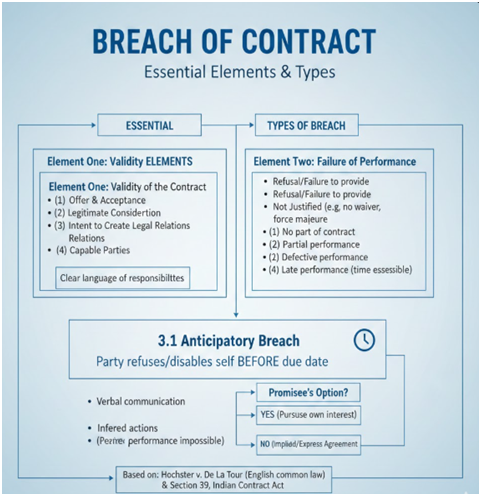
Element One: Validity of the Contract
There must be a contract that is enforceable by law. The necessary components for this are (1) offer and acceptance, (2) legitimate consideration, (3) the desire to establish legal relations, and (4) parties who are able to enter into a contract. Clear language outlining each party's responsibilities must be included in the contract. Although they may make it more difficult to determine what constitutes performance or breach, ambiguous contractual provisions by themselves do not render a contract invalid.
Element Two: Failure of Performance
To establish a breach of contract, it is imperative to prove that a party has refused or failed to provide what was promised under the terms of the agreement. It is also necessary to substantiate that such refusal or failure was not justified; that is, it was not warranted by the terms of the contract itself (e.g. by a waiver clause), nor was it due to an exceptional circumstance outside of the control of the party or force majeure. Additionally, an inability to perform caused by an external situation beyond the party's control can still result in a breach if the party has invoked a force majeure provision.
There are numerous methods in which a party can fail to perform its obligations: (1) failure to perform any part of a contract, (2) providing only part of the performance called for in a contract, (3) providing a defective or inferior form of performance required by the contract, or (4) performing at a different time than required when time is essential to the performance under the terms of the contract.
3. Types of Breach of Contract
3.1 Anticipatory Breach
Contracts are created when two or more parties agree to fulfill each other's expectations. A party may breach a contract by failing to perform the promises they made. A breaching theory is defined as anticipation of the breach. The Indian Contract Act Section 39 explains the definition of anticipatory breach. If a promise made by a promisor has been refused or the promissor has disabled himself/herself from performing what he/she has agreed to perform, than the promisee has an option to terminate the contract and go after his/her own interest unless the promisee agrees in some manner i.e. express or implied agreement, that the promissor will continue to fulfill his promise.
A promissor who has made it clear that he/she will not perform an obligation, prior to the due date for such performance, is said to have committed an act of anticipatory breach. The non-performance may have been verbally communicated; however, it may also be inferred from actions taken by the promissor which make performance impossible.
Anticipatory breach is a concept that was developed from English common law as a result of a case referred to as Hochster v. De La Tour, which is the leading decision on this point. Anticipatory breach was included in Section 39 of the Indian Contract Act, thereby making it an important principle of Indian contract law. Anticipatory breach allows parties to avoid being in a state of uncertainty about whether or not the other party will perform their part of a contract, and incurring losses in the interim.
Modes of Anticipatory Breach
Anticipatory breach manifests through two distinct modes:
Express Repudiation
Repudiation is the act of a party to refuse to perform their obligations under a contract. The refusal must be clear, unequivocal and made directly to the other party (the promisee) or their agent. Refusal may come in written form, orally through telephone or in person. The repudiation must relate to a core obligation and not a secondary obligation of the contract, and the refusal must be unconditional. Statements expressing doubt about performing or that it would be difficult to perform do not qualify as express repudiations. A reasonable person in the promisee's position, as interpreted by the Indian Courts, would consider it to be obvious and unquestionable that the other party had repudiated their obligations under a contract.
Implied Repudiation
As per Advocate Rupesh Geete, an implied repudiation of a contract results from the actions or conduct of one of the parties making it apparent that performance will not be made as per the terms of the contract. Examples of this form of repudiation include:
- Transferring property subject to the contract to a third person (in cases of specific goods or land).
- Executing a conflicting contract with another party preventing the completion of the first contract.
- Making oneself physically incapable of performing on the contract (such as placing oneself in a position of physical impairment).
- Taking voluntary actions to interfere with performance on the contract. Rights of Promisee in Anticipatory Breach
Section 39 of the Indian Contract Act confers upon the promisee (innocent party) a remarkable right: the ability to elect immediate relief without awaiting the performance date. The promisee has two pathways:
Option One: Immediate Rescission
The promisee may treat the contract as terminated immediately upon repudiation. This election discharges the promisee from further obligations and permits immediate pursuit of remedies for breach particularly damages. The promisee need not wait for the performance date to pass; the breach is complete upon the repudiation itself. This doctrine prevents the unnecessary accumulation of damages and protects the promisee from incurring wasteful preparatory expenses.
Option Two: Continued Performance
The promisee can communicate their acceptance of the preservation of the contract by expressing that acceptance either verbally or through their actions, or they can wait until the contract's date of performance to see if anything has changed regarding the breach, and to also gather evidence concerning the breach prior to signifying their decision. Once the promisee has accepted the continuation of the contract, the promisee may not subsequently decide to rescind the contract. However, if the promisor does not perform on the promised contract date, then the promisee is entitled to remedy for the actual breach.
The promisee must elect to either accept or reject within a reasonable time period after being notified of the breach. If there is an extended delay on the part of the promisee to make such an election to accept or reject, then it is implied that the promisee has accepted continued performance.
3.2 Actual Breach
Meaning and Nature
Actual breach occurs when a party fails to perform their contractual obligations at the time performance becomes due, or performs incompletely or defectively. Unlike anticipatory breach, actual breach involves non-performance when the performance itself was due. This is the most frequently encountered category of breach in commercial litigation.
Actual Breach at the Time of Performance
If one of the parties to a contract takes absolutely no action or steps to carry out their end of the agreement, this would be regarded as the most straightforward example of a material breach of a contract. Nothing occurs under the contract; there is no indication that one of the parties to has done anything as they agreed to do. A material breach exists as of the date on which the contract requires the contracting party to perform under the terms and conditions of the contract. In Bishamber Nath Agarwal v. Kishan Chand (A.I.R. 1989), the Court established that where a written contract prescribed a method and/or date of performance, the parties were bound by that same method and/or date, and were precluded from altering the timing/method of their contractual performance. The Court further ruled that deviation from the contractually prescribed performance schedule constitutes a breach of the contract.
Actual Breach During Performance
A party can breach a contract at any time throughout the duration of their performance on that contract, regardless of whether the performance of the contract is to take place on an ongoing basis or in stages. If the performing party stops performing there to complete their obligations under the contract, or if they perform their obligations improperly, then they have breached the contract continuously from the date they initially breached it to the date that they completed their obligations under the contract.
In Haryana Telecom Limited v. Union of India, the Supreme Court reaffirmed that the contract language related to the timing of performance does not remove the breaching parties from being liable for the penalties for performance. The Supreme Court determined that time was a material term of the contract and timely performance was therefore a material obligation of the parties to the contract.
4. Effects of Breach of Contract
4.1 Discharge of the Contract
The immediate legal consequence of a material breach is that the contract becomes voidable at the instance of the aggrieved party. Where the breach is fundamental (affecting the core purpose), the promisee gains the right to rescind the contract—to treat it as terminated and discharged. This discharge releases the promisee from further performance obligations.
However, discharge does not extinguish pre-existing rights. The promisee retains all accrued rights and remedies for the breach that has occurred. The party committing the breach cannot benefit from their own wrongful conduct; discharge simply prevents the innocent party from being further compelled to perform under a broken contract.
4.2 Loss and Damage to the Aggrieved Party
The aggrieved party suffers an economic loss, which can take multiple forms, including lost profits, decreased value of the damaged property, money spent on mitigation, harm to reputation and consequential damages due to the breach. Since some forms of economic harm will occur regularly due to a breach while others are more speculative, the law does differentiate between these forms of damage.
The Indian Contract Act defines how to determine the nature of damages assessed and limited under Section 73, which states that recovery of damages will only occur for those damages "which naturally were to happen as a result of the breach, or which the parties had knowledge of at the time they entered into the contract that would likely to happen as a result of the breach." By limiting recovery for economic loss per the above provision, there is no unlimited liability and liability for damages is based upon the concept of fairness, thereby allowing for any losses that were not present at the time of the contract to be excluded from any recovery.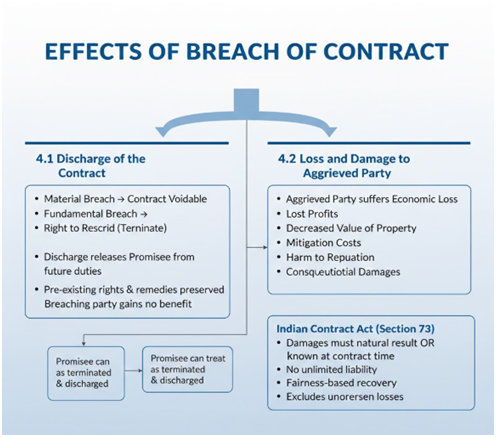
5. Rights of the Aggrieved Party
5.1 Right to Claim Damages
General Principle
In cases of breach of contract, the primary remedy is to provide financial compensation ("damages") to the injured party to put them in the same position as they would have been had the contract been performed correctly. In India, Section 73 of the Indian Contract Act provides the legal basis for damages for breach of contract: "When a contract has been broken, the party suffering from the breach is entitled to compensation for the loss or damage resulting from that breach that occurred naturally and in the ordinary course of events, as well as for any loss or damage that was contemplated by both parties at the time of entering into the contract."
Indian law also incorporates the foreseeability doctrine established in Hadley v. Baxendale which limits the claim for damages to only those losses that would naturally arise or would be reasonably foreseeable by the parties when entering into the contract. This provides a balance between providing compensation for actual losses and not placing the breaching party in a situation where they could be held liable for any unforeseen or unforeseen consequences from the breach.
Categories of Damages
Ordinary Damages (General Damages)
Ordinary damages represent losses that naturally and directly flow from the breach itself. These are foreseeable by both parties from the nature of the contract, even without special communication. For instance, if a supplier breaches a contract to deliver goods, the buyer's loss of resale profit (where the goods were purchased for resale) constitutes ordinary damages.
The calculation of ordinary damages proceeds on the assumption that the breaching party should have foreseen such losses. The injured party need not provide exceptional proof; the remoteness principle simply limits recovery to foreseeable consequences.
Type of Damages Characteristics Proof Required Recoverable Amount
Ordinary Damages Flow naturally from breach; foreseeable by both parties Not required to prove actual loss Generally presumed; limited by contract
Special Damages Based on special circumstances communicated to breaching party Actual proof of special circumstances required Only to extent contemplated
Exemplary Damages Punitive in nature; rare in contract law Extraordinary circumstances; violation of rights Strictly limited; subject to public policy
Nominal Damages Awarded where breach proved but no actual loss Only requirement of proving breach Nominal sum (traditionally Re. 1)
Special Damages (Consequential Damages)
Losses experienced by the injured party during contract breach that arise from specific circumstances that were not previously known to the breaching party, but which the injured party has indicated were important to the breaching party, are called special damages. To establish liability for special damages, the injured party must demonstrate to the breaching party, before or when the contract was formed, that any loss resulting from a breach would be attributable to those special circumstances.
In Hadley v. Baxendale, a significant case that has been cited as the basis for determining the liability for special damages, Hadley was a mill owner who contracted for Baxendale to transport a damaged crankshaft for repair. When Baxendale failed to deliver the repaired crankshaft to Hadley in a timely fashion, Hadley was forced to shut down the mill for a period of time, and he lost money as a result of the shutdown. After Hadley sued Baxendale for the lost profits, the court found that Baxendale was not liable for those lost profits. The court based its decision on the fact that Hadley did not provide Baxendale with any prior knowledge that the crankshaft needed to be returned to him on time in order to resume operation of the mill.
Holding breaching parties liable for losses arising from special circumstances that they could not reasonably foresee is an important principle of contract law. An injured party can either communicate to the breaching party special circumstances, or the injured party will have to accept the loss caused by those circumstances.
Exemplary Damages (Punitive Damages)
Exemplary damages are very rarely awarded in cases of breach of contract under Indian law. The idea of exemplary damages was introduced in principle but, to date, has been consistently rejected by Indian Courts as being applicable in the normal course of breach of contract cases.
Unlike the United States, where it is common for exemplary damages to be imposed, in India, exemplary damages are only permitted in cases where there is a breach of constitutional rights by a public authority, or other gross misconduct has occurred, in addition to the breach of contract. Exemplary damages are a secondary type of damage that only comes into play when it is apparent to the Court that a Court's award of general damages is not an adequate expression of the Court's disapproval of a party's conduct.
Nominal Damages
The Principle of Foreseeability
Under Section 73 of the Indian Contract Act, damages are recoverable only if they either: (1) naturally arise in the usual course from the breach, or (2) the parties knew when making the contract that such loss would likely result. This principle of foreseeability derives from Hadley v. Baxendale and has been thoroughly adopted by Indian courts.
The foreseeability test operates on an objective standard whether a reasonable, prudent person possessing the information available to the breaching party would foresee the loss as a probable consequence of breach.
The Doctrine of Remoteness
Remoteness describes losses so distant causally or temporally from the breach that they should not be attributed to it. Indian courts following the modern interpretation require that the defendant establish remoteness as a defense, bearing the burden of proof. The shift in burden reflects principles of fairness the injured party should not be required to anticipate and rebut all conceivable remoteness arguments.
The Causation Requirement
A direct causal link must exist between the breach and the loss claimed. If intervening acts or omissions by third parties or the injured party themselves break the chain of causation, damages may be unavailable for the remote loss. Courts examine whether the loss would have occurred but for the breach, or whether other factors were determinative.
5.2 Right to Specific Performance
Specific performance represents an equitable remedy compelling the breaching party to perform their contractual obligations as promised, rather than merely compensating the injured party with damages. The Specific Relief Act, 1963, governs this remedy.
Section 10 of the Specific Relief Act provides that specific performance may be granted when there is no standard for ascertaining actual damage (as where the contract involves unique property or services that cannot be replicated), or where the breach has caused harm that monetary compensation cannot adequately remedy.
The 2018 amendment to the Specific Relief Act fundamentally shifted the framework. Prior to amendment, specific performance was discretionary, granted only upon demonstrating that damages were inadequate. The amended Section 10 now provides that "unless and until the contrary is proved, the court shall presume" that specific performance is adequate relief.
This represents a significant shift specific performance is now the presumptive remedy, with the burden on the defaulting party to establish that damages are the appropriate remedy. This aligns Indian law more closely with the principle that parties' genuine intentions should be honoured when feasible.
Specific performance is typically available for:
- Contracts for sale of immovable property (land)
- Contracts for transfer of unique chattels
- Contracts for services where personal performance is not essential (though employment contracts are excluded)
- Where damages would be an inadequate substitute for performance
Specific performance is not available where:
- The contract involves personal services or requires trust and confidenc
- The contract is too vague to be specifically enforced
- Specific performance cannot be adequately supervised by the court
- The contract has been substantially performed or time has become un-essential
5.3 Right to Injunction
An injunction is an order of court forbidding a threatened wrongful act, forbidding continuation of ongoing wrong, or commanding restoration of status quo. Section 36 of the Specific Relief Act defines injunctions, which are governed by Sections 36-42 of that Act.
Preventive Injunctions forbid commission of a threatened wrong (before it occurs) or continuation of an ongoing breach. These are the most common form in contractual breaches preventing a party from violating the contract.
Mandatory Injunctions command affirmative action—restoration of the previous state or performance of specific acts. These are used more sparingly, typically when preventing action is insufficient.
Injunctions may be temporary (pendente lite—during litigation) or permanent (granted in the final decree). Temporary injunctions preserve status quo pending full trial. Permanent injunctions become part of the final decree.
Injunctions are particularly valuable where:
- The breaching party threatens violation of negative covenants (e.g., non-compete clauses)
- Preventing breach is necessary to prevent multiplicity of proceedings
- Damages would be inadequate to prevent irreparable harm
- The court has discretion to award damages in addition to or instead of injunction
5.4 Right to Rescission of Contract
Rescission represents the right to cancel the contract and be freed from further obligations. It differs from discharge through performance; rescission is the voluntary termination by one party due to the other's breach or misrepresentation.
Upon rescission, the contract is treated as void ab initio (from the beginning). However, rescission does not extinguish accrued rights—the party committing breach remains liable for damages or compensation for the period during which the contract operated.
The right to rescind is available:
- Upon material breach discharging the contract
- Where the contract is voidable (e.g., misrepresentation, fraud
- Where rescission is a recognized remedy under the contract itself
Significantly, a party cannot rescind a contract and simultaneously claim specific performance of the same contract. The remedies are alternative, not concurrent. However, a party rescinding may pursue damages in addition to rescission.
Section 75 of the Indian Contract Act provides that "a person who rightfully rescinds a contract is entitled to compensation for any damage which he has sustained through the non-fulfillment of the contract." This ensures that rescission does not prevent recovery of damages for losses incurred prior to rescission.
5.5 Right to Quantum Meruit
Quantum meruit, Latin for "as much as is merited," is a quasi-contractual remedy permitting recovery of compensation proportional to work done or value provided, even where the original contract has been discharged or becomes void.
The remedy applies where:
- One party has performed part of a divisible contract
- The other party has breached, preventing completion
- The performing party has not itself breached
- The non-breaching party has enjoyed the benefit of partial performance
Quantum meruit is not based on the original contract price but on the reasonable value of work performed. It represents recovery based on unjust enrichment—preventing the non-performing party from retaining benefits without compensation.
Example: A contractor begins construction of a building under a lump-sum contract but is wrongfully prevented from continuing. The contractor can claim quantum meruit for the value of work completed, rather than being bound by the fixed contract price (which becomes irrelevant upon discharge).
Limitations: Quantum meruit does not apply where:
- The contract is indivisible (cannot be severed into distinct performances)
- A contract explicitly specifies liquidated damages (Section 74 governs, not quantum meruit)
- The performing party themselves committed breach
The Supreme Court in Kailash Nath Associates v. DDA firmly established that quantum meruit claims cannot coexist with contractual provisions specifying liquidated damages. The contract governs compensation in such cases.
6. Case Laws on Breach of Contract
6.1 Leading Indian Case Laws
1. Hadley v. Baxendale (1854) - The Foreseeability Doctrine
While an English case, Hadley v. Baxendale has been seamlessly integrated into Indian contract law jurisprudence, particularly through Section 73 of the Indian Contract Act. The case remains foundational to understanding damage limitations.
Facts: Hadley, a mill operator, engaged Baxendale, a carrier, to transport a broken crankshaft to a repair facility and return it. Baxendale delayed the return, causing the mill to remain non-operational and Hadley to lose profits.
Issue: Whether Baxendale could be held liable for Hadley's lost profits, damages Hadley claimed as compensation for breach.
Judgment: The Court of Exchequer, led by Baron Alderson, ruled that Baxendale was liable for breach but only for ordinary damages. The lost profits were not recoverable because they were not naturally foreseeable consequences of delayed shipment of a generic crankshaft.
Baxendale had no knowledge that the crankshaft's timely return was essential to mill operations. The court established the celebrated principle:
"Where two parties have made a contract which one of them has broken, the damages which the other party ought to receive in respect of such breach of contract should be such as may fairly and reasonably be considered either arising naturally, i.e., in the ordinary course of things, from such breach of contract itself, or such as may reasonably be supposed to have been in the contemplation of both parties, at the time they made the contract, as the probable result of the breach of it."
Application in Indian Law: Section 73 of the Indian Contract Act replicates this principle. Indian courts have consistently applied Hadley to limit damages to foreseeable losses. The principle protects breaching parties from astronomical liability while ensuring injured parties recover genuine losses.
2. Hochster v. De La Tour (1853) - Anticipatory Breach Doctrine
Hochster v. De La Tour stands as the foundational authority for anticipatory breach, incorporated into Section 39 of the Indian Contract Act.
Facts: In April 1852, De La Tour employed Hochster as a courier for a three-month European tour commencing June 1, 1852. On May 11, 1852—three weeks before the start date—De La Tour wrote stating Hochster was no longer needed. Hochster sued immediately on May 22, 1852, before the June 1 start date.
Issue: Whether the innocent party could sue for breach before the performance date had arrived. De La Tour argued Hochster remained under obligation to remain ready and willing until the performance date, precluding premature legal action.
Judgment: Lord Campbell held decisively for Hochster. The court recognized that requiring Hochster to wait until June 1 would be unreasonable and unfair. Once the repudiation was communicated, the contract was breached. The innocent party should not be compelled to incur wasteful preparatory expenses or remain in limbo awaiting non-performance.
The judgment established that:
- Repudiation of a contract before the performance date constitutes actionable breach
- The innocent party need not wait for the performance date to sue
- The innocent party may elect to treat the contract as terminated immediately
- Damages may be claimed immediately upon clear repudiation
Application in Indian Law: Section 39 of the Indian Contract Act codifies this principle. Indian courts have thoroughly embraced the doctrine, recognizing that parties should not be compelled to remain in contractual limbo when the other party has signaled clear intention not to perform.
3. Fateh Chand v. Balkishan Dass (1963) - Liquidated Damages and Penalties
This Supreme Court landmark governs the treatment of pre-agreed damages under Section 74 of the Indian Contract Act, distinguishing between genuine liquidated damages and unenforceable penalties.
Facts: Fateh Chand and Balkishan Dass entered into a sale agreement for leasehold property. Dass paid Rs. 25,000 as part consideration. A dispute arose regarding boundary demarcation and land measurement. Dass claimed breach and alleged forfeiture of Rs. 25,000; Fateh Chand claimed the entire Rs. 25,000 as earnest money forfeited due to Dass's breach.
Procedural History:
- Trial Court: Found Dass committed breach; allowed Fateh Chand to retain Rs. 25,000 and directed possession and mesne profits
- High Court (Appeal): Modified the decree, allowing retention of Rs. 11,250 as reasonable compensation with mesne profits at Rs. 265 per month
- Supreme Court: Further modified, limiting retention to Rs. 1,000 as earnest money, with mesne profits at Rs. 140 per month
Legal Issue: How to apply Section 74 of the Indian Contract Act governing "compensation for breach where penalty stipulated." Specifically, whether the full Rs. 25,000 was earnest money (forfeitable) or a penalty clause (subject to reasonableness).
Judgment: The Supreme Court articulated the authoritative interpretation of Section 74:
"When a contract has been broken, if a sum is named in the contract as the amount to be paid in case of such breach, or if the contract contains any other stipulation by way of penalty, the party complaining of the breach is entitled, whether or not actual damage or loss is proved to have been caused thereby, to receive from the party who has broken the contract reasonable compensation not exceeding the amount so named or, as the case maybe, the penalty stipulated for."
The Court held that:
- Section 74 does not distinguish between liquidated damages and penalties; both are governed by the same principle of "reasonable compensation"
- Compensation need not be based on proof of actual loss; the statutory language dispenses with such proof
- However, "reasonable compensation" requires that some loss has resulted from the breach; compensation cannot be awarded when no legal injury has occurred
- The court may award less than the stipulated amount but cannot exceed it
- Earnest money paid prior to contract formation is treated differently from penalties stipulated in the contract
This judgment fundamentally shaped Indian damages jurisprudence, establishing that courts have discretion to moderate excessive penalty clauses while respecting genuine pre-estimates of loss.
6.2 Judicial Interpretation and Analysis
Indian courts have developed sophisticated jurisprudence addressing the practical challenges of breach claims. Several overarching principles emerge from contemporary case law:
Principle One: Protection of Contractual Certainty
Recent Delhi High Court decisions in Simplex Concrete Piles (India) Ltd. v. Union of India and MBL Infrastructures v. DMRC Ltd. have firmly established that contractual clauses attempting to deprive parties of damage remedies are void and unenforceable. The courts recognized that the right to claim compensation for breach is fundamental to contract law and cannot be contracted away.
Principle Two: Burden of Proof Allocation
Contemporary jurisprudence has shifted the burden of proving remoteness to the defendant. In English jurisprudence reflected in recent cases, courts have recognized that fairness and efficiency justify requiring the breaching party to establish remoteness as a defense, rather than requiring the injured party to anticipate and rebut remoteness arguments.
Principle Three: Loss of Profit in Construction Contracts
The Supreme Court in A.T. Brij Paul Singh v. State of Gujarat recognized that in works contracts, where the employer breaches, the contractor is entitled to claim damages for lost profit even without direct proof. Courts award damages as a percentage of uncompleted work (typically 10-15%), reflecting reasonable profit expectations.
Principle Four: Evolution of Specific Performance
The 2018 amendment to the Specific Relief Act, shifting the presumption in favor of specific performance, has generated substantial case law. In Rajesh Gupta v. Ram Gopal (2024), the Supreme Court clarified that the amended framework places the burden on the defendant to prove inadequacy of specific performance.
7. Comparative Perspective: English and Indian Law
English Common Law Framework
English contract law, from which Indian law derives, has developed distinct principles that diverge in meaningful ways from Indian jurisprudence:
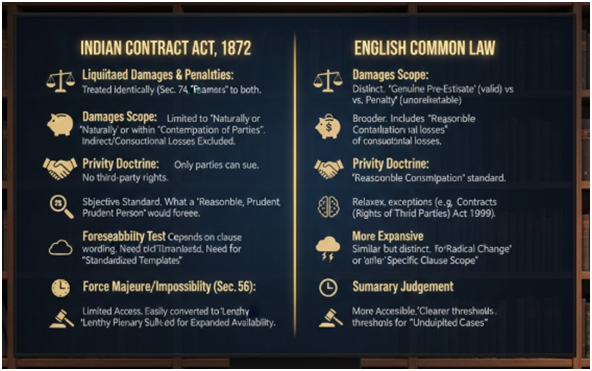
Damages Principles: English law recognizes broader categories of recoverable damages. Beyond ordinary and special damages (similar to Indian law), English jurisprudence recognizes "consequential damages" and broader "economic loss" recovery where the loss flows directly from breach, even if indirect.
Liquidated Damages vs. Penalties: English law draws a sharp distinction. Liquidated damages clauses represent genuine pre-estimates of loss and are enforceable. Penalty clauses disproportionate amounts designed to deter are unenforceable and struck down. The test asks whether the clause was a "genuine pre-estimate" at contract formation.
Remoteness Doctrine: The English principle from The Wagon Mound (tort) parallels Hadley v. Baxendale (contract), limiting liability to foreseeable consequences. However, English law has grown more expansive in recognizing what constitutes foreseeable damage.
Privity of Contract: English law has developed exceptions to privity, permitting certain third-party beneficiaries to sue for breach. This represents a doctrinal evolution toward recognizing reliance interests beyond strict parties.
Indian Law Divergences
No Distinction Between Liquidated Damages and Penalties: Section 74 treats both liquidated damages and penalties identically, both termed "stipulation by way of penalty." The court applies reasonableness to both, not the English "genuine pre-estimate" test.
Narrower Damages Scope: Indian law restricts damages to those "naturally arising" or within "contemplation of parties." Indirect and consequential losses are generally excluded, creating a narrower damages framework than English law.
Strict Privity Doctrine: Indian law maintains that strangers to contracts cannot sue for breach. Only parties to the contract possess remedial rights. This reflects traditional contractual doctrine without the modern exceptions found in English law.
Foreseeability as Objective Test: While both systems employ foreseeability, Indian jurisprudence applies a more restrictive objective standard—what a reasonable, prudent person would foresee—as opposed to English law's somewhat more expansive "reasonable contemplation" standard.
Force Majeure and Impossibility Defenses
The interaction between breach of contract and defenses based on impossibility (Section 56) or force majeure clauses remains contested. Parties invoke force majeure to excuse performance for events beyond their control. However, drafting of force majeure clauses varies enormously, and courts must determine whether particular events (pandemics, governmental action, supply disruptions) fall within clause scope.
This uncertainty creates disputes around whether conduct constitutes breach or excused non-performance.
Reform Need: Standardized force majeure clause templates and clearer jurisprudence on triggering events would reduce ambiguity.
Limited Access to Summary Procedures
While summary suits exist for certain contract categories, they remain limited. Defendants can challenge summary suits, converting them into plenary proceedings, undermining efficiency advantages. Additionally, summary procedures are unavailable for many disputed contracts, forcing parties into lengthy full litigation.
Reform Need: Expanded availability of summary procedures for undisputed breaches, clear evidentiary thresholds for summary determination, and streamlined appellate review could enhance access.
9. Conclusion
Breach of contract represents a central concern of contract law jurisprudence. The Indian legal framework, through the Indian Contract Act, 1872, and the Specific Relief Act, 1963, provides a comprehensive remedial architecture addressing both anticipatory and actual breaches. The distinction between these categories allowing immediate relief upon anticipatory breach rather than requiring the innocent party to await the performance date—represents a significant jurisprudential evolution protecting parties from unnecessary loss.
The doctrine of damages, grounded in principles of foreseeability derived from Hadley v. Baxendale and refined through extensive Indian jurisprudence, balances compensating genuine losses against imposing unlimited liability for unforeseen consequences. The statutory framework, Sections 73-75 of the Indian Contract Act—provides clear guidance on damages calculation, distinguishing between unliquidated and liquidated damages.
The menu of remedies available to aggrieved parties damages, specific performance, injunctions, rescission, and quantum meruit provides flexibility to tailor relief to the particular breach and contract context. The 2018 amendments to the Specific Relief Act, shifting the presumption in favor of specific performance, reflect evolving recognition that parties' intentions should be honored when performance remains feasible.
However, practical challenges persist. Litigation delays, burdensome proof requirements, difficulties in quantifying damages, and the complexity of force majeure analysis create barriers to effective remedy enforcement. The Indian legal system would benefit from targeted reforms: expedited commercial procedures, standardized damages calculation methodologies, clarified force majeure frameworks, and improved arbitration accessibility.
The enforcement of contractual obligations remains foundational to commercial certainty and economic development. Parties must have confidence that breach will trigger meaningful remedies, not mere theoretical rights. The Indian legal framework provides this foundation; enhanced procedural efficiency and reformed implementation would strengthen its protective function. As India's commercial practice continues to sophisticate, contract law jurisprudence must evolve in parallel, balancing the interests of breaching parties against the legitimate expectations of injured parties seeking meaningful remedies for unjustified non-performance.
FAQs
1.What is meant by breach of contract under the Indian Contract Act, 1872?
A breach of contract occurs when a party fails to perform its contractual obligations fully, correctly, or within the stipulated time. It includes refusal to perform, delayed performance, or defective performance without lawful justification. Under the Indian Contract Act, liability arises regardless of intention, unless performance is excused by supervening impossibility or a valid legal defence.
2.What is anticipatory breach of contract under Indian law?
Anticipatory breach occurs when a party, before the due date of performance, clearly refuses or disables itself from performing its contractual obligation. Under Section 39 of the Indian Contract Act, such refusal may be express or implied through conduct making performance impossible. The promisee may either terminate the contract immediately and claim damages or choose to keep the contract alive until the date of performance.
3.What is the significance of leading case laws on breach of contract under Indian law?
Leading case laws such as Hadley v. Baxendale, Hochster v. De La Tour, and Fateh Chand v. Balkishan Dass have shaped core principles on damages, anticipatory breach, and liquidated damages under the Indian Contract Act. These cases clarify when damages are recoverable, when a party may sue before performance is due, and how penalty clauses are treated. Indian courts rely on these precedents to ensure fairness, foreseeability, and reasonableness in contractual remedies.
Join LAWyersClubIndia's network for daily News Updates, Judgment Summaries, Articles, Forum Threads, Online Law Courses, and MUCH MORE!!"


Tags :Others