
Index of Headings
1.Introduction
2.Meaning and Essentials of Offer
- 2.1 Definition of Offer under Section 2(a), Indian Contract Act, 1872
- 2.2 Intention to Create Legal Relations
- 2.3 Communication of Offer
- 2.4 Certainty and Definiteness of Offer
3.Types of Offers Recognised under Law
4.Legal Rules Governing a Valid Offer
- 4.1 Distinction between Offer and Invitation to Offer
- 4.2 Exceptions Where Advertisements Constitute Offers
- 4.3 Requirement of Communication of Offer
5.Acceptance: Meaning and Essential Requirements
6.Modes of Acceptance
- 6.1 Express Acceptance
- 6.2 Implied Acceptance
- 6.3 Acceptance by Conduct
- 6.4 Acceptance through Electronic Communication
7.Communication of Offer and Acceptance
8.Revocation of Offer and Acceptance
9.Lapse of Offer under Section 6
10.Judicial Interpretation and Analysis
11.Conclusion
12.Suggestions and Scope for Further Research
13.Frequently Asked Questions (FAQs)
1. Introduction
Concept of Contract under Indian Contract Act, 1872
"Contract" under Laws of India is defined by Section (2)(h) of "Indian Contract Act 1872" and is a means by which we define the relationship between parties that create obligations between one another. As stated in Section (2)(a)- Contract is an agreement which can be enforced by a Court of Law (i.e. has the force of Law). Offer is defined by section (2)(a)- as an indication of readiness to make a legally binding agreement and acceptance by Section (2)(b)- indicates that the parties have consented to the conditions outlined in the Offer. Therefore, the basis upon which all enforceable Contracts are established are Offer and Acceptance and there is no legal basis to form a valid contract without them. The intentions of each of the parties are not relevant unless they comply with the law regarding Offer and Acceptance.
Contract formation is based on the principle of consensus ad idem, which is defined as a "meeting of minds" between the offeror and the offeree on terms that are identical. The Indian legislature established this principle as the basis for moral and liquidated damage rules under the Indian Contract Act, 1872, and recognised that clarity in offer and acceptance creates the foundation for certainty and enforceability of contractual relationships. This structure facilitates predictability and safeguards parties against the risk of being subject to ambiguous or unilateral obligations in business transactions.
Scope and Objective of the Research Paper
This article undertakes a systematic examination of offer and acceptance within the Indian Contract Act framework, tracing their definitions, essential elements, legal variations, and jurisprudential development. The paper synthesizes statutory provisions with landmark judicial interpretations to provide a comprehensive understanding of how contracts are validly formed in India. T
2. Meaning and Essentials of Offer
Definition of Offer (Section 2(a), ICA, 1872)
Section 2(a) of The Indian Contract Act presents the statutory definition of an offer: "A proposal is defined as when one person indicates, to another, his or her willingness to either do or abstain from doing something with the intention of acquiring from that other person assent to the conduct or abstention." The terms "Offer" and "Proposal" are used interchangeably in the context of contract law.
The definition of offer stated above contains several important attributes. First, it requires evidence of intent through a communication or action that displays the willingness of the party making the offer. Simply deciding in one's mind to make an offer is not sufficient; parties must communicate their offer in some way. Second, the definition of offer includes the right to create (do something) and the ability to create otherwise. Thirdly, this definition emphasizes the need for an intention of the party making an offer in obtaining the consent of the other party, which separates true offers from casual comments, opinions, and requests for further discussion. The Supreme Court has always held that a party making an offer must show a definite willingness to create a legally binding relationship.
The Supreme Court has consistently held that an offer must demonstrate a clear intent by the offeror to create a binding legal obligation. In Bhagwandas Goverdhandas Kedia v. M/s. Girdharilal Parshottamdas & Co. (1966), the Court observed that for a contract to be formed there must be some form of communication between the parties that shows both their mutual consent or agreement to the contract. Thus, for contracts made through "instantaneous" methods of communication (for example, telephone), both parties agree at the time when the offeror receives the notice of the acceptance.
Essential Elements of a Valid Offer
Expression of Willingness
An offer indicates the intent of the person making the offer (the “offeror”) to be legally bound by certain terms or conditions. A person's objective behavior or act/statement will establish that they intend to be legally bound. In the case of Carlill v. Carbolic Smoke Ball Co., an English Court of Appeal determined that a company's advertising of a reward of £100 for any person who became ill with the flu after using the product according to the instructions was not mere puffery or a sales gimmick; the company had also placed the amount of £1,000 in a bank account (the Alliance Bank) as security for its promise to pay, thereby evidencing its intention to be legally bound by the advertisement and offer to the public.
The decision in the Carlill case has since been accepted and adopted into Indian jurisprudence. For example, in Lalman Shukla v. Gauri Dutt, the plaintiff's action against the defendant for the reward for finding the defendant's nephew was rejected because the plaintiff did not know about or properly accept that reward; however, the defendant's announcement of the reward to the public was held to be an offer.
A widely cited case in Indian courts, Balfour v. Balfour [1919], involved a husband who made a promise to pay his wife support for separation. The court wrote in this case: "There is no offer capable of acceptance because there was no intention by either party that legal consequences would arise from their actions." The court held that a promise cannot be an offer to make a contract, unless the offer is sufficiently specific for a legally enforceable contract to arise on acceptance, and unless the terms of the contract are clear to both parties.
Communication of Offer
Unless the offeree becomes aware that a previously accepted agreement has been made (i.e., acceptance), then the contract will not become enforceable. Section 4 of the ICA states that an offer will be deemed to have been delivered only after receipt by the offeree, and such delivery is complete either when the offeree has received the fine offer, or has received notice thereof from the offeror in accordance with section 4. Communications may be implied (through actions or circumstances that would lead one to reasonably infer they are so informed) or expressly (through the use of written words).
Offer Must Not Be Vague or Conditional
An offer should include clearly defined terms that communicate the exact meaning of the proposal. Conditional offers, where a condition precedes the agreement, are acceptable as long as the conditions are clearly stated and can be fulfilled as required. However, if an offer depends on two independent variables or has unfeasible terms, this may create uncertainty regarding the offer's validity. An offer contingent upon getting a license, completing an inspection, or obtaining funding can also be validated if there exists an objective method to ascertain whether or when those conditions are met.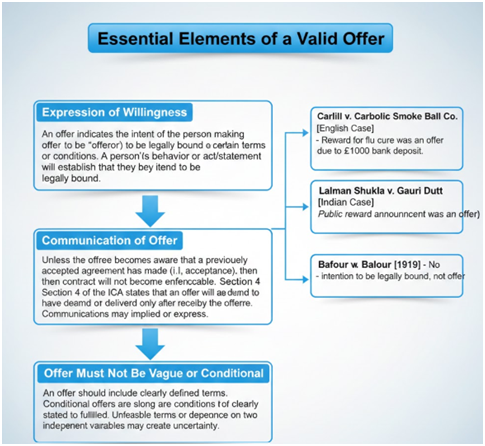
3. Types of Offers
The law recognizes several distinct categories of offers, each carrying specific legal consequences for formation of contract.
General Offer
In this case the court held that general offer is a type of offer made by advertisements from companies that promise to reward anyone who has the influenza or cold virus by contracting the disease. Mrs. Carlill had purchased the product, used it as directed in the advertisement, contracted the disease and was then entitled to receive a reward of £100 from Mr. Cowell. The advertisement's legal status and the surrounding circumstances relating to Mrs. Carlill's use of the product constituted a valid offer based on legal principles rather than a mere advertising campaign that did not create a legal relationship between Mrs. Carlill and Carbolic Smoke Ball Company.
This argument was not upheld by the Court of Appeal. In the Court of Appeal's Reasons for Judgment, Judge Lord Justice Bowen was of the view that the company's deposit of £1000 into the bank signified that it intended to bind its customers to the acceptance of the offer. There was a unilateral offer made by the company to the entire public, and therefore once the appropriate steps were taken by an individual, i.e. purchasing the product (as instructed in the advertisement), using the product (as instructed in the advertisement), and becoming a successful beneficiary of the offer by contracting the disease, the individual, by those actions, accepted the offer.
The offer did not need to be communicated other than at the time of the sale; however, the company was only interested in those who performed what was stated in the Advertisement.

Within the jurisprudence of India, there are several well-known cases which use similar principles, but in relation to offers made in the domestic context; and the example used was Lalman Shukla v. Gauri Dutt (1913). The plaintiff was a servant of the master (defendant), and it was the master who made the public declaration regarding a reward for finding the missing nephew of the master. The plaintiff ultimately found the missing nephew, however, the Allahabad High Court dismissed the claim for the reward on the basis that the plaintiff performed the act of finding the nephew in his capacity as a servant, and without knowledge of the reward being offered.
Specific Offer
A specific offer is directed to a particular identified person or determinate group. Only that specific person or member of the specified group can accept the offer; any other person lacks capacity to accept. This reflects the principle established in Boulton v. Jones, where the defendant had ordered from a specific business owner with whom he had prior dealings. When the business changed ownership without the defendant's knowledge, the new owner sought to enforce the contract. The court held that the defendant had intended to contract with a specific person; the new owner could not unilaterally insert himself into that relationship.
Specific offers are binding on the proposer upon acceptance by the designated offeree. The proposer cannot revoke a specific offer after acceptance, though the offer remains revocable up to the moment of acceptance. Specific offers are common in commercial practice for example, a landlord's offer to lease property to a specific tenant, or a vendor's offer to sell particular goods to an identified buyer.
Cross Offer
A cross offer occurs when two parties simultaneously and independently make identical offers to each other, each unaware of the other's offer. The basic attributes of cross offers are: (1) both parties have submitted equivalent offers to one another; (2) both offers relate to identical subject matter and terms, and (3) neither party had knowledge of the other party's offer at the time that they were making their respective offers.
In Tinn v. Hoffman, (1873), the defendant sent a letter to the plaintiff in which he offered to sell 800 tons of iron at 69 shillings per ton, with a request for the plaintiff to reply to him by post. Simultaneously, and without knowing about the defendant's letter, the plaintiff sent a letter to the defendant in which he made an offer to purchase the same quantity of iron at the same price. The court determined that no contract had been created. The court held that the letter sent by the plaintiff was a cross offer rather than an acceptance, since the letter was sent without knowledge of the existence of the defendant's offer. Therefore, cross offers that are made concurrently and without knowledge of the other do not create mutual acceptance since neither party has accepted the offer from the other. Each party has made an offer to the other party.
The legal significance is that cross offers create no binding contract. For a contract to form, one party must make an offer and the other must accept it—not merely respond with an identical offer. The rationale underlying this rule relates to the absence of true consensus: neither party assented to the other's proposal; each merely proposed identical term. Subsequent correspondence, however, might convert one of the cross offers into an acceptance if one party clearly indicates assent to the other's terms.
Counter Offer
The offeree makes a counter-offer if they accept the original offer, but only on the basis of a qualified acceptance (such as adding or modifying some term, or deleting some term from the agreement). The counter-offer cancels out the original offer and therefore creates a new obligation on behalf of the offeree to perform according to its terms. In Hyde v Wrench, the defendant made an offer to sell a farm for £1000. The plaintiff rejected the original offer and made a counter-offer of £950. The defendant rejected the counter-offer. The plaintiff later attempted to accept the original offer of £1000; however, the court held that no contract was formed because the counter-offer had already terminated the original offer. The plaintiff could not later accept the original offer.
The "mirror image" rule flows from this principle: an acceptance must reflect the offer precisely. Any deviation constitutes a counter offer. In Bhagwandas Goverdhandas Kedia, the Supreme Court observed that acceptance must be absolute and unconditional; any attempt to introduce new terms or conditions transforms acceptance into a counter offer. This rule protects offerors from involuntary modification of their proposed terms.
Standing or Continuing Offer
A "standing offer" is any type of offer that will remain 'open' for a defined amount of time. A Standing Offer for supply contracts is an example. In Percival Ltd v London County Council Asylums and Mental Deficiency Committee, the respondent supplied a tender, which was an offer to supply specified products to the respondent over a twelve-month period. The ruling of the court in this case recognized the tender as a "standing offer" which could be accepted multiple times during the twelve-month period. Any and all of the ten (10) purchases or orders made by the respondent during the twelve-month period were a separate acceptance and the formation of a separate contract, but all were separate contracts based upon the original standing offer. Once an order has been made by the buyer on an existing standing offer, the seller (the offeror) may not rescind or otherwise eliminate the standing offer regarding the order made.
4. Legal Rules Governing a Valid Offer
Mere Invitation to Offer vs Offer
This distinction has proven critical in contractual jurisprudence. An invitation to offer (or "invitation to treat") is a communication inviting the other party to make an offer, not itself an offer. The party issuing an invitation to treat commits to neither buy nor sell; they merely invite proposals.
The seminal authority is Partridge v. Crittenden (1968). The defendant advertised wild birds for sale in a magazine, contrary to statutory prohibition on offering wild birds for sale. The defendant contended the advertisement was a mere invitation to treat, not an offer. The Divisional Court agreed. Lord Parker CJ reasoned that treating advertisements as offers would impose impractical obligations on advertisers. If supply were limited and demand exceeded supply, an advertiser would be contractually bound to supply all respondents an untenable position. Rather, advertisements generally constitute invitations to treat; potential buyers make offers to purchase, and the seller accepts or rejects those offers.
The distinction between advertisements (invitations to treat) and offers was emphasized in English precedent but has influenced Indian jurisprudence. Price lists, catalogues, and shop displays similarly constitute invitations to treat. When a customer selects goods and presents them for purchase, the customer makes an offer to buy; the shopkeeper's act of ringing up the sale constitutes acceptance of that offer.
However, the rule is not absolute. Advertisements may constitute offers when: (1) the language is unequivocally indicative of intention to contract; (2) the offer is expressly made to the public; and (3) the subject matter is ascertainable and feasible. Carlill v. Carbolic Smoke Ball Co. represents precisely such an exceptional case where an advertisement, despite addressing the public, constituted a binding offer due to the clarity of language and the company's demonstrated intention through the bank deposit.
Offer Must Be Communicated to the Offeree
An offer has no legal effect unless communicated to the person intended to accept it. Communication must be deliberate and effective; mere mental resolve by the proposer, however sincere, creates no legal consequence. The offeree must possess actual or constructive knowledge of the offer before acceptance becomes possible.
In Lalman Shukla v. Gauri Dutt, the plaintiff servant found his master's missing nephew and returned him, but was unaware of any reward offer. The master later claimed he had offered a reward, but the court held no valid contract was formed because the essential act (finding and returning the nephew) was performed in ignorance of the offer. The servant could not accept an offer of which he lacked knowledge.
Communication may be express (through explicit transmission) or implied (through circumstances permitting reasonable inference). For example, if a shopkeeper places goods in a window display with visible price tags, communication of an invitation to treat occurs through this conduct, though no words are explicitly spoken.
5. Acceptance: Meaning and Essentials
Definition of Acceptance (Section 2(b), ICA, 1872)
Section 2(b) of the Indian Contract Act defines acceptance: "When the person to whom the proposal is made signifies his assent thereto, the proposal is said to be accepted. A proposal, when accepted, becomes a promise." This definition establishes that acceptance is the counter-manifestation of will by the offeree, signifying their assent to the proposer's terms.
The definition contains several critical elements. First, acceptance must be made by "the person to whom the proposal is made" the designated offeree. Only the person to whom an offer is specifically directed can accept it, though any member of the public may accept a general offer if they satisfy its conditions. Second, acceptance must constitute a "signification of assent" an external manifestation indicating the offeree's agreement. Third, acceptance must be to the proposal "as made" absolute and unconditional. Any qualified response constitutes a counter offer, not an acceptance. Fourth, acceptance transforms a proposal into a promise creating legal obligation binding on the proposer.
The Supreme Court has consistently held that acceptance must be communicated to the proposer for a contract to be formed. In Powell v. Lee, a case frequently cited with approval in Indian courts, the plaintiff accepted a job offer through a letter, but the defendant employer, unaware of the acceptance, hired another candidate. The court held no contract was formed because the acceptance was not communicated to the employer before he made the hiring decision. The offeree's internal acceptance or reliance on the offer is insufficient; objective communication is essential.
Essential Conditions of a Valid Acceptance
Absolute and Unconditional Acceptance
An acceptance must be absolute the offeree must accept all terms of the offer without modification. Any attempt to introduce new terms, eliminate existing terms, or qualify the acceptance transforms it into a counter offer. This principle, rooted in the "mirror image rule," ensures that the offeror's terms are not unilaterally altered by the offeree.
In Hyde v. Wrench, the plaintiff's counter proposal of £950 (when the offer was for £1,000) constituted a new offer, terminating the original offer. The plaintiff's subsequent attempt to accept the original terms was ineffective because the original offer had been rejected through the counter proposal.
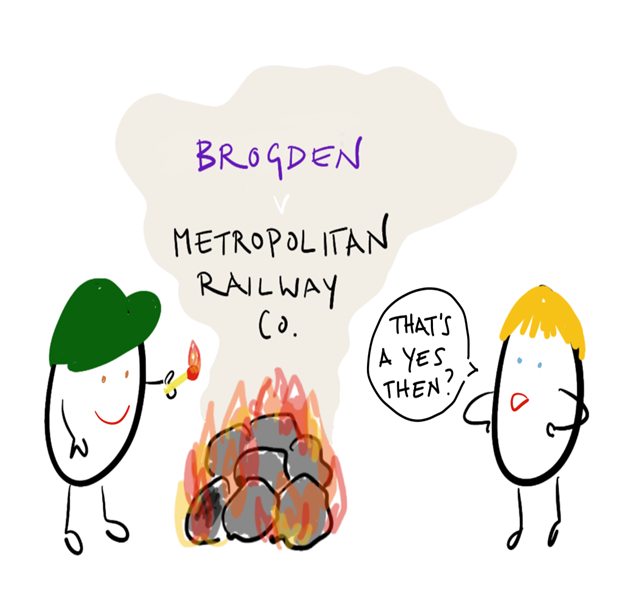
Acceptance Must Be Communicated
An acceptance has no contractual effect unless communicated to the proposer. Section 4 of the ICA prescribes when communication of acceptance is complete. The principle of consensus ad idem requires that both parties understand themselves to be bound; this understanding cannot emerge unless each party communicates their assent to the other.
In Felthouse v. Bindley, the uncle, by his silence following the nephew's letter expressing willingness to purchase a horse, did not thereby accept the nephew's offer. The court held that silence cannot constitute acceptance; the offeror must take some positive action—speaking, writing, or conducting themselves to manifest assent. Mere failure to reject an offer does not constitute acceptance.
Acceptance Must Be According to the Prescribed Mode
If the proposer prescribes a specific mode in which acceptance must be communicated—whether by post, email, fax, or other means the acceptance must be made in that manner to be valid. Section 7(2) of the ICA provides that if the mode of acceptance is prescribed, acceptance in that mode is essential; if no mode is prescribed, acceptance may be in any reasonable and usual manner.
If the proposer has prescribed that acceptance must be by post, acceptance by telephone is not valid unless the proposer subsequently ratifies the telephonic acceptance. However, the principle is not absolute: in Tinn v. Hoffman, the court noted that if the proposer prescribes post as the mode of acceptance but the offeree accepts by an equally expeditious or faster method (such as telegram or verbal communication), courts may deem this valid, provided it does not prejudice the proposer.
Acceptance Within Reasonable Time
Acceptance must be communicated within the time specified in the offer, or if no time is specified, within a reasonable time having regard to the nature of the subject matter and the circumstances of the case. If the offeree delays beyond a reasonable period, the offer may lapse and become incapable of acceptance.
What constitutes a "reasonable time" depends upon context. For perishable goods or time-sensitive matters (such as share prices), a shorter period is reasonable. For real property or goods of enduring value, a longer period may be reasonable. Courts examine the totality of circumstances to determine reasonableness.
6. Modes of Acceptance
Express Acceptance
Express acceptance occurs when the offeree explicitly communicates acceptance through words, spoken or written. The offeree might telephone the proposer stating "I accept your offer to purchase the machinery for the quoted price" or might send a letter expressing identical sentiments. Express acceptance is definite and unambiguous.
The advantage of express acceptance is its clarity; no inference or deduction is required. The parties' intentions are explicitly stated, reducing disputes regarding whether acceptance actually occurred. In commercial transactions, express acceptance is common and preferred because it creates an objective record of the parties' agreement.
Implied Acceptance
Implied acceptance occurs when the offeree's conduct reasonably indicates acceptance, though explicit words are absent. The offeree might accept through actions that are consistent with acceptance and inconsistent with rejection. In Carlill v. Carbolic Smoke Ball Co., the plaintiff's act of purchasing the smoke ball and using it according to prescribed instructions constituted acceptance of the offer through performance. No explicit letter or communication of acceptance was required; the conduct was sufficiently indicative of acceptance.
Acceptance by Conduct
Acceptance by conduct represents a specialized category within implied acceptance. Here, the offeree manifests acceptance through performance of the act contemplated by the offer, particularly in unilateral contracts where performance constitutes the consideration and acceptance simultaneously.
In unilateral contract cases such as Carlill, the offeree accepts by performing the specified act. The law recognizes that requiring explicit communication of acceptance would be impractical; the performance of the conditions itself serves as both consideration and acceptance. The offeror, having made the offer to the public, impliedly waives the need for explicit acceptance through communication; performance itself suffices.
Acceptance through Electronic Communication
With the proliferation of electronic commerce, the modes of acceptance have expanded to include email, online forms, SMS, WhatsApp, and other digital means. Section 10A of the Information Technology Act, 2000 provides statutory recognition to electronically executed contracts, stating that contracts formed through electronic communication shall not be deemed unenforceable solely on the ground that electronic means were used.
In cases involving email acceptance, courts have held that unconditional acceptance communicated via email constitutes valid acceptance provided it demonstrates clear assent to the proposer's terms. In Bhagwandas Goverdhandas Kedia, principles applicable to telephone contracts (instantaneous communication) may be analogously applied to email, which exhibits comparable characteristics of speed and immediacy, though not absolute instantaneity.
7. Communication of Offer and Acceptance
Rules Regarding Communication (Section 4, ICA, 1872)
Section 4 of the Indian Contract Act establishes critical rules regarding when communication of proposals and acceptances is complete. The rules differ depending on whether communication is against the proposer or against the acceptor, reflecting an asymmetry introduced by the Act's draftsman to accommodate postal communication—the predominant long-distance communication method in 1872.
The section provides:
"The communication of a proposal is complete when it comes to the knowledge of the person to whom it is made."
"The communication of an acceptance is complete—as against the person who makes the proposal, when it is put in a course of transmission to him, so as to be out of the power of the person making it; and as against the person who accepts, when it comes to the knowledge of the proposer."
Completion of Communication of Offer
An offer's communication to the proposer becomes complete when the proposer becomes aware of it. This reflects the objective principle that a proposer cannot be bound by terms of which they remain ignorant. The proposer must possess actual or constructive knowledge of the offer for it to have legal effect.
If a proposer makes an offer verbally to an offeree in-person or via telephone, communication is complete when the offeree hears and understands the offer. If the offer is transmitted via postal service, communication is complete when the offeree receives and reads the letter. Electronic offers are complete when received by the offeree, or in the case of instantaneous communication (email, chat), generally upon receipt and opening of the message.
Completion of Communication of Acceptance
Acceptance's communication is complete at different points for the proposer and acceptor. As against the proposer, acceptance is complete when put in the course of transmission to him so as to be out of the acceptor's power which, in the postal context, means when the acceptor posts the letter. As against the acceptor, acceptance is complete when it comes to the proposer's knowledge.
This asymmetry means that once an offeree posts a letter of acceptance by post, the contract is formed and the offeree is bound, even if the letter is subsequently lost and never reaches the proposer, or if the proposer revokes their offer after the letter is posted but before it is received. The proposer, by making the offer without excluding postal acceptance, is deemed to have accepted the burden of postal transmission.
Postal Rule and its Applicability
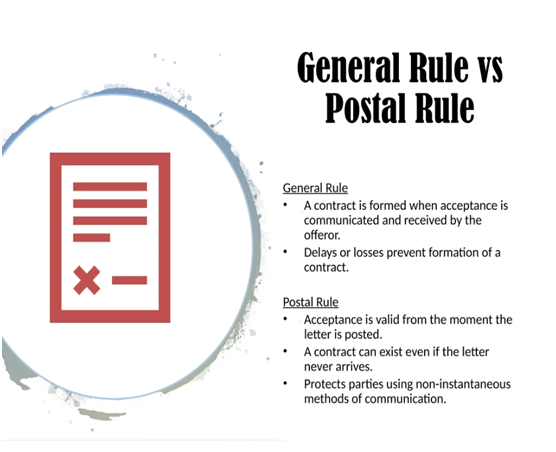
The postal rule, also termed the "dispatch rule," establishes that acceptance by post is effective upon posting (dispatching), not upon receipt by the proposer. This exception to the general principle that communication is complete upon receipt derives from commercial necessity: when postal communication was the primary long-distance method, acceptance would be delayed indefinitely if effectiveness depended upon actual receipt, which was uncertain and subject to delays beyond the parties' control.
In Adams v. Lindsell, the defendant offered to sell wool to the plaintiff. The plaintiff posted an acceptance by return mail. However, due to postal delays and an error in the defendant's address on the offer, the acceptance was received days after the defendant had sold the goods to another buyer. The court held that the contract was formed when the acceptance was posted, not when received, establishing the postal rule.
In Household Fire Insurance v. Grant, the plaintiff applied for fire insurance. The company posted a policy document and subsequently posted a letter confirming issuance. The plaintiff posted a letter of acceptance, which was lost in the mail. The court held that the contract was formed when the plaintiff posted the acceptance, despite the letter never reaching the company.
The postal rule applies only when: (1) the use of post is a reasonable means of communication between the parties; (2) the acceptance is properly addressed, stamped, and posted; and (3) the proposer has not expressly or impliedly excluded the postal rule by prescribing a different mode of communication or indicating that communication must be received to be effective. If the proposer states "acceptance must be received by [date]," the postal rule is excluded and acceptance is effective only upon receipt.
Communication through Modern Means
The postal rule was developed when postal communication was standard. Modern instantaneous means of communication telephone, telex, fax, email present different circumstances. In Bhagwandas Goverdhandas Kedia v. Girdharilal Parshottamdas, the Supreme Court distinguished between instantaneous and non-instantaneous communication. For instantaneous communication such as telephone, the Court held that acceptance is complete when the proposer receives (hears and understands) the acceptance, not when the acceptor speaks. The contract is formed at the place where acceptance is heard, not where it is spoken.
The reasoning reflects the instantaneous nature of telephonic conversation: unlike postal communication, where the acceptor loses control of the letter upon posting and cannot subsequently revoke it, in telephonic conversation the acceptor maintains control until the proposer actually receives the message. If the line goes dead or words are not heard, the acceptor can attempt retransmission. Thus, the general rule of receipt applies rather than the dispatch rule.
8. Revocation of Offer and Acceptance
Meaning of Revocation
Revocation signifies the withdrawal of an offer or acceptance before it attains legal effect. A revoked offer or acceptance has no contractual consequence; it is as though it was never made. Revocation must be distinguished from rejection (where the offeree rejects an offer, terminating the proposer's power to form contract through later attempted acceptance) and lapse (where an offer terminates through passage of time or operation of law without any party's deliberate act).
Revocation of Offer (Section 5, ICA, 1872)
Section 5 provides: "A proposal may be revoked at any time before the communication of its acceptance is complete as against the proposer, but not afterwards."
This provision establishes that an offer remains revocable until acceptance is complete as against the proposer. "Complete as against the proposer" has specific meaning under Section 4: for postal communication, it occurs when the acceptance is put in the course of transmission (posted); for other communication, when it comes to the proposer's knowledge.
The principle protects the proposer's interests: until the proposer receives assurance that acceptance is on its way or has occurred, the proposer remains free to revoke the offer. However, once acceptance is in the course of transmission (as with posted letters) or has been received by the proposer, revocation is impossible.
In Nutakki Sesharatnam v. Sub Collector (AIR 1992 SC 131), the landowner offered land for acquisition by the government. Before the acquisition officer could prepare the award of acceptance, the landowner attempted to revoke the offer. The court held that revocation was valid and effective because it reached the offeree before acceptance was communicated.
Revocation requires communication to the offeree; a secret decision by the proposer to revoke, unknown to the offeree, has no legal effect. The offeree, unaware of revocation, remains entitled to accept the offer.
Revocation of Acceptance
An acceptance, once communicated, is generally irrevocable. However, Section 5 provides a narrow exception: an acceptance may be revoked "at any time before the communication of the acceptance is complete as against the acceptor, but not afterwards."
In postal communication, acceptance is complete against the acceptor when it comes to the proposer's knowledge (is received). Before that moment, if the acceptor sends a revocation that reaches the proposer before or simultaneously with the acceptance, the revocation may be effective. However, once the proposer receives the acceptance, revocation is impossible.
This asymmetry reflects the postal rule's operation: an acceptor loses control of their letter upon posting (cannot revoke after posting), but retains ability to revoke before the proposer receives the acceptance by sending a faster message (such as telegraph) that reaches the proposer first.
Time and Manner of Revocation
Revocation of an offer must be communicated to the offeree; revocation takes effect upon communication. An offer made to a specific individual is revoked by communication to that individual. A general offer made to the public is revoked by communication to the public through similar means to those through which the offer was made. However, complete communication of revocation to every person who might potentially accept is often impractical; revocation is effective if made by the same public means (e.g., if a general offer was published in a newspaper, revocation in the same newspaper is effective revocation of the public offer).
9. Section 6: Lapse of Offer
An offer lapses becomes incapable of acceptance upon occurrence of specified events, even without the proposer's deliberate revocation.
Lapse by Expiry of Time
If a time period is specified in the offer for acceptance, the offer lapses upon expiration of that period without acceptance. If no time period is specified, the offer lapses after a reasonable time has elapsed. Reasonableness depends on the nature of the subject matter, the circumstances of the case, and mercantile understanding in analogous situations.
For rapidly fluctuating commodities (such as shares, currencies, or perishable goods), a short period is reasonable. For real property or long-term obligations, a longer period is reasonable. Courts determine reasonableness objectively, examining practice in the particular trade or industry.
Lapse by Non-Fulfilment of Conditions
If the offer is conditional upon fulfillment of certain conditions precedent by the offeree, and the offeree fails to fulfill those conditions within the prescribed time or at all, the offer lapses. For example, an offer to sell property "if you obtain planning permission within sixty days" lapses if the offeree fails to obtain permission by the deadline.
Lapse by Rejection or Counter Offer
When an offeree rejects an offer (explicitly stating non-acceptance) or makes a counter offer (proposing different terms), the original offer lapses and becomes incapable of subsequent acceptance. The offeree cannot thereafter revive the original offer; only the proposer can revive it by renewing the offer.
In Hyde v. Wrench, the plaintiff's counter offer of £950 to the defendant's offer of £1,000 was a rejection of the original offer. The original offer was extinguished; the plaintiff's later attempt to accept at £1,000 could not revive it.
Lapse by Death or Insanity
Section 6(4) of the ICA provides that an offer lapses "by the death or insanity of the proposer, if the fact of his death or insanity comes to the knowledge of the acceptor before acceptance."
Death or insanity terminates the proposer's capacity to enter contracts and extinguishes the offer. However, the lapse is not automatic; it occurs only when the acceptor comes to know of the death or insanity. If the acceptor, unaware of the proposer's death or insanity, communicates acceptance before learning of the death or insanity, a contract is formed because the acceptor acted in ignorance of the terminating event.
Lapse by Change in Law
If the subject matter of the offer becomes illegal or impossible due to change in law prior to acceptance, the offer lapses. For example, if an offer to sell tobacco becomes subject to government prohibition before acceptance, the offer lapses because performance has become impossible and illegal.
10. Judicial Interpretation and Analysis
Courts occupy a critical role in interpreting and adjudicating disputes regarding offer and acceptance. The court's function is to determine objectively, from the parties' objective manifestations (words, conduct, circumstances), whether a valid offer and acceptance have occurred. Courts do not probe subjective intentions; they examine what a reasonable person would understand from the objective circumstances.
In contractual interpretation, courts apply the doctrine of "consensus ad idem"—there must be a meeting of minds as evidenced by objective conduct. The Supreme Court in Bhagwandas Goverdhandas Kedia emphasized that the essential requirement is communication of acceptance to the proposer; place of contract formation, jurisdiction, and other consequences follow from the point where acceptance is received by the proposer.
Courts have established several interpretive principles:
- The Objective Test: Offers and acceptances are evaluated objectively. A party cannot argue that they did not intend to be bound by words or conduct they exhibited; what matters is what a reasonable person would understand from those manifestations.
- The Entire Contract Doctrine: Courts examine the complete communication between parties rather than isolated phrases. An ambiguous statement may be clarified through subsequent communications or conduct.
- Trade Usage and Custom: In commercial transactions, accepted trade usage and mercantile custom inform interpretation. Parties are presumed to contract with reference to established trade practices.
- Contra Proferentem: When ambiguity exists in an offer, the ambiguity is construed against the proposer (the party who drafted the terms). This reflects the principle that the person who drafts terms bears responsibility for clarity.
- Presumption of Legality: Contracts are presumed to contemplate legal purposes unless manifestly impossible. Courts will not infer that parties intended illegal performance unless the language is unambiguous.
Modern courts have extended these principles to electronic contracts. The principles governing offer and acceptance in traditional contexts apply to electronic offers and acceptances; the medium of communication does not alter the fundamental requirements. Courts have held that clicking "I Accept" on a website constitutes valid acceptance if the prior display of terms constitutes valid offer. Electronic signatures and authentication methods are recognized as valid communications of acceptance under both the Indian Contract Act and the Information Technology Act, 2000.
11. Conclusion
Offer and acceptance represent the dual pillars of contract formation under Indian law. An offer is a manifestation of willingness to enter binding relations, made with intent that acceptance will create contractual obligation. A valid offer must be express or capable of reasonable inference, must manifest intent to create legal relations, and must be communicated to the offeree with sufficient definiteness to enable performance.
Acceptance is the counter-manifestation of assent by the offeree to the proposer's terms. Valid acceptance must be absolute and unconditional, must be communicated to the proposer, and must occur before the offer lapses or is revoked. The offeree must possess knowledge of the offer to accept it validly; acceptance in ignorance of the offer fails fundamentally because consensus ad idem is absent.
The Indian Contract Act codifies complex common law principles regarding offer and acceptance. The statutory framework distinguishes between invitations to treat (which invite offers rather than constituting offers themselves) and genuine offers. Courts have developed nuanced doctrines regarding cross offers (which create no contract), counter offers (which reject original offers), and general offers (which bind the proposer to all who fulfill prescribed conditions).
Communication occupies paramount importance. Offers must be communicated to the offeree; acceptances must be communicated to the proposer. The postal rule accommodates the practical necessity of postal communication by deeming acceptance effective upon posting rather than receipt. However, for instantaneous modes of communication (telephone, email), acceptance is effective upon receipt by the proposer, reflecting the different temporal and control characteristics of such communication.
Suggestions and Scope for Further Research
On a conversation with Advocate Priya Dangat, she elaborated about the law of offer and acceptance, that while being extensively codified and judicially developed, continue to evolve in response to commercial innovation. Several areas merit further research:
- Electronic Contracts and Artificial Intelligence: As artificial intelligence systems generate offers and acceptances, uncertainty exists regarding the capacity of AI entities to enter contracts and the moment at which AI-generated acceptances become effective. Whether an AI system's response constitutes genuine acceptance or merely algorithmic output remains unresolved in Indian jurisprudence.
- Cross-Border Electronic Transactions: International e-commerce raises questions regarding which country's law governs offer and acceptance, particularly when electronic communications cross multiple jurisdictions instantaneously. Harmonization of rules regarding the place and time of contract formation in cross-border transactions requires further development.
- Clickwrap and Browsewrap Agreements: Courts continue to develop doctrine regarding whether display of terms on websites followed by user action (clicking "Agree" or continued browsing) constitutes acceptance of terms, particularly when users claim not to have read terms. The extent of offerees' duty to review terms before acceptance requires clarification.
FAQs
Q. What is the difference between an offer and an invitation to offer (invitation to treat) under contract law?
An offer shows a clear intention to be legally bound upon acceptance, whereas an invitation to offer merely invites others to make offers. Advertisements, price lists, and shop displays are generally invitations to treat, as held in Partridge v. Crittenden. However, an advertisement may amount to an offer if it clearly indicates intent to contract, as seen in Carlill v. Carbolic Smoke Ball Co.
Q. Why is communication of an offer essential for a valid contract?
An offer has no legal effect unless it is communicated to the offeree, as acceptance is impossible without knowledge of the offer. Mere intention or mental resolve does not create legal obligations. In Lalman Shukla v. Gauri Dutt, the court held that acts done in ignorance of an offer cannot amount to valid acceptance.
Q. When is communication of acceptance considered complete under Section 4 of the Indian Contract Act, 1872?
Communication of acceptance is complete against the proposer when it is put in the course of transmission and goes beyond the acceptor’s control, such as posting a letter. Against the acceptor, it is complete only when the acceptance comes to the knowledge of the proposer. This rule reflects the statutory recognition of the postal rule.
Join LAWyersClubIndia's network for daily News Updates, Judgment Summaries, Articles, Forum Threads, Online Law Courses, and MUCH MORE!!"


Tags :others