
Introduction
The criminal process in India is naturally anchored in the guarantee of fairness. Article 21 of the Constitution does n't simply enjoin arbitrary privation of life and particular liberty but imposes an affirmative obligation on the State to ensure that criminal adjudication proceeds through procedures that are just, reasonable, and humane. Over the decades, the Supreme Court has constantly clarified that a criminal trial is n't a mechanical ritual of substantiation collection but a structured process meant to discover verity while conserving the quality and rights of the indicted.
The decision of the Delhi High Court in Ram Swaroop Gupta & Ors. v. State( NCT of Delhi), rendered on 21 January 2026 by Justice Girish Kathpalia, revisits this foundational understanding. The judgment addresses a recreating procedural practice where indicted persons are impelled to cross-examine prosecution substantiations in the absence of legal representation and are latterly denied any farther occasion on the ground that a formal chance had formerly been granted. The Court held that such a course of action does n't simply beget prejudice but strikes at the root of a fair trial, thereby vitiating the proceedings.
This Article undertakes a doctrinal analysis of the judgment, examining the indigenous foundations of the right to fair trial, the part of legal representation in criminal adjudication, the significance of cross-examination, the compass of Section 311 of the Code of Criminal Procedure and its successor provision under the Bharatiya Nagarik Suraksha Sanhita, and the High Court’s essential governance to intermediate against interlocutory orders that yield grave injustice.
The analysis demonstrates that the Delhi High Court’s logic is forcefully predicated in established Supreme Court justice and serves as an important memorial to inferior courts of their indigenous liabilities.
Factual Background and Procedural Setting
The factual matrix of Ram Swaroop Gupta is not very complicated but fairly consequential. During the pendency of a criminal trial, the prosecution examined Jagmohan Gupta as PW- 1. On the date fixed for hiscross-examination, the indicted were present before the trial court, but their defence counsel failed to appear. There was no makeshift counsel and no arrangement for legal aid.
Despite this, the trial court directed the indicted to cross-examine the substantiation. Being laypersons strange with legal fashion, rules of substantiation, and forensic examineing, the indicted were unfit to conduct any meaningful cross-examination. The trial court later closed the cross-examination, recording that the occasion had been granted and not profited.
The indicted latterly moved an operation under Section 311 of the Code of Criminal Procedure seeking recall of PW- 1 for cross-examination through counsel. The operation explained the circumstances that led to the absence of the defence advocate. The trial court dismissed the operation, holding that no sufficient cause was shown and that the occasion had formerly been exhausted.
Aggrieved by this turndown, the indicted approached the Delhi High Court invoking its essential governance. The central issue before the Court was whether forcing an indicted tocross-examine a prosecution substantiation without legal backing, and also denying recall, constituted a bare procedural lapse or a violation serious enough to vitiate the trial.
Fair Trial As A Necessity
The doctrine of fair trial is an important component of Article 21. The Supreme Court, beginning with Maneka Gandhi v. Union of India, held that any procedure affecting life or liberty must be fair, just, and reasonable. This interpretation converted Article 21 from a narrow procedural guarantee into a substantial safeguard governing all State action in criminal matters.
In the criminal law environment, the Supreme Court has constantly emphasised that fairness must percolate every stage of the trial. In Zahira Habibullah Sheikh v. State of Gujarat, the Court held that a fair trial is one in which the indicted, the victim, and society can all repose confidence in the process. The Court clarified that denial of a fair occasion to defend undermines not only the rights of the indicted but also the legality of the justice system itself.
The Delhi High Court’s judgment reflects this indigenous gospel. Justice Kathpalia treated fairness not as a supplemental consideration but as the axis around which the entire criminal process revolves. The Court recognised that when a prosecution substantiation’s evidence goes untested due to lack of legal representation, the trial ceases to be a genuine adjudicatory exercise.
The Centrality of Cross-Examination in Criminal Trials
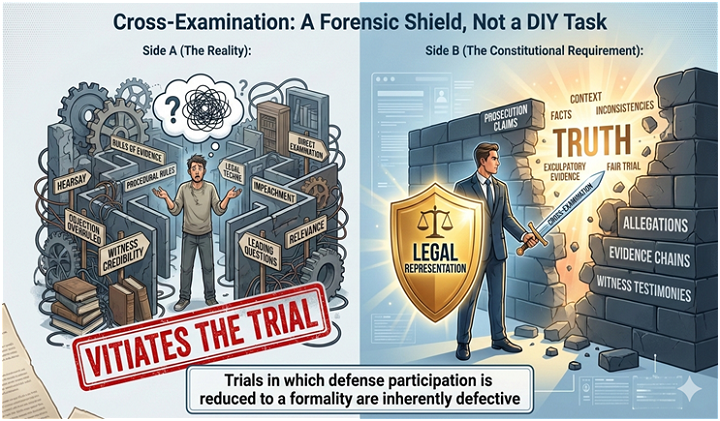
Cross-examination is the top medium through which the inimical system tests the credibility and trustability of evidence. It's through cross-examination that inconsistencies are exposed, magnifications corrected, and lies revealed. The right to cross-examine is thus not a specialized honor but a substantial safeguard essential to verity- finding.
The Supreme Court has constantly affirmed this position. In State of Punjab v. Gurmit Singh, the Court observed that cross-examination is an inestimable right and a foundation of fair trial. The Court noted that evidence which has not been subordinated to effective cross-examination can not be reckoned upon without caution, particularly where the substantiation plays a central part in the prosecution case.
In the case of Zahira Habibullah Sheikh, the Supreme Court further held that denial of effective cross-examination strikes at the root of the inimical process. The Court advised that trials in which defence participation is reduced to a formality are unnaturally defective.
The Delhi High Court erected upon this justice by recognising that cross-examination conducted by an unrepresented indicted is frequently cross-examination in form alone. Justice Kathpalia observed that compelling such an exercise creates an vision of occasion while denying its substance. The Court made it clear that the detriment caused isn't limited to the indicted but extends to the integrity of the trial itself.
Right to Legal Representation as an Element of Fair Trial
The right to legal representation is naturally rooted. Article 22(1) guarantees the right to consult and be defended by a legal guru, while Article 39A obligates the State to ensure that justice is n't denied due to profitable or other disabilities. Together, these vittles emphasize the centrality of legal backing in criminal adjudication.
In Hussainara Khatoon v. State of Bihar, the Supreme Court held that free legal aid is an essential component of a fair, just, and reasonable procedure under Article 21. The Court recognised that for utmost indicted persons, particularly those who are poor or uninstructed, legal representation is the only means through which procedural rights can be meaningfully exercised.
The principle was corroborated in Suk Das v. Union Territory of Arunachal Pradesh, where the Supreme Court held that failure to give legal aid to an penurious indicted vitiates the trial anyhow of whether factual prejudice is shown. The Court reasoned that denial of legal representation undermines the structural fairness of the process itself.
Justice Kathpalia’s logic in Ram Swaroop Gupta is harmonious with this line of authority. The Court treated legal representation as an necessary prerequisite for effective participation in the trial. It recognised thatcross-examination is a specialised forensic exercise and that awaiting an untrained indicted to perform it's innately illegal.
Section 311 CrPC and the Court’s Role
Section 311 of the Code of Criminal Procedure empowers courts to summon, examine, recall, or rethink any substantiation at any stage of the trial if similar action appears essential to the just decision of the case. The breadth of this provision reflects the council’s intent to prioritise substantial justice over procedural severity.
The Supreme Court has constantly interpreted Section 311 as a remedial provision. In Mohanlal Shamji Soni v. Union of India, the Court held that the power exists to enable the court to amend crimes and deletions that may else affect in confinement of justice. The focus, the Court emphasised, isn't on which party benefits but on whether the verity can be more effectively discovered.
In Rajendra Prasad v. Narcotic Cell, the Supreme Court clarified that indeed careless setbacks by a party do n't bar recall of a substantiation if turndown would affect in failure of justice. The Court advised against an exorbitantly specialized approach that elevates procedural discipline over substantial fairness.
The Delhi High Court’s logic glasses this understanding. Justice Kathpalia observed that indeed if the trial court was undecided by the explanation offered for the absence of defence counsel, it retained the power to recall the substantiation suo motu. Where turndown to do so would affect in an illegal trial, exercise of the power under Section 311 becomes a duty rather than a discretion.
Expeditious Trial and Its Limits
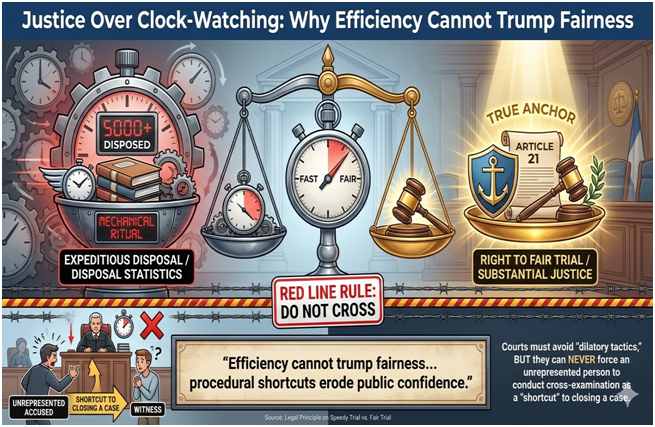
The pressure on criminal courts to dispose of cases expeditiously is inarguable. The right to a speedy trial has itself been recognised as a hand of Article 21. still, the Supreme Court has constantly held that speed can not be pursued at the cost of fairness.
In P. Ramachandra Rao v. State of Karnataka, the Supreme Court advised against mechanical asseveration on timelines, advising that such an approach risks converting criminal trials into empty rituals. The Court held that the right to speedy trial must be balanced against the inversely important right to a fair trial.
Justice Kathpalia echoed this caution. The Court observed that fairness can not be allowed to come a casualty in the name of ready disposal. Where a trial court apprehends sluggish tactics, legal druthers live, including appointment of amicus curiae or engagement of legal aid counsel. sandbagging an unrepresented indicted to cross-examine a substantiation is n't one of them.
Essential Powers of the High Court and Interlocutory Orders
A significant doctrinal dimension of the judgment in Ram Swaroop Gupta lies in its engagement with the limits and purpose of the High Court’s essential powers when brazened with interlocutory orders. naturally, criminal procedure discourages appellate or revisional hindrance at interlocutory stages, recognising that inordinate intervention may scrap trials and detention justice.
Section 397( 2) of the Code of Criminal Procedure expressly bars modification against interlocutory orders, and the Supreme Court has constantly advised that essential powers under Section 482 can not be used as a cover for barred remedies.
Still, Indian criminal justice has noway treated this bar as absolute. In Madhu Limaye v. State of Maharashtra, the Supreme Court sculpted out a principled exception, holding that where an interlocutory order results in abuse of process or causes grave injustice, the High Court retains the power, and indeed the responsibility, to intermediate. The Court clarified that the bar on modification does n't extinguish the High Court’s indigenous part as a protection of fair procedure.
Justice Girish Kathpalia’s logic fits exactly within this doctrinal frame. The judgment does n't adulterate the general rule against hindrance with interlocutory orders. rather, it identifies a specific order of cases wherenon-interference would itself amount to judicial adoption.
The turndown to recall a prosecution substantiation, when the original cross-examination was rendered illusory due to absence of legal representation, was n't treated as a routine procedural determination. It was characterised as an order that had the effect of vitiating the trial itself.
The High Court’s analysis is careful and subdued. It acknowledges that what's expressly barred can not naturally be granted through the aft door of essential powers. Yet it contemporaneously affirms that essential powers aren't cosmetic.
They live to ensure that criminal procedure does n't deteriorate into a mechanical process disassociated from justice. Where an interlocutory order produces a trial that's structurally illegal, the High Court is n't simply permitted to intermediate but is duty- bound to do so. This articulation reinforces the idea that procedural bars can not be allowed to shield substantial injustice.
Duties of Trial Courts In Ensuring Fairness
Perhaps the most institutionally important aspect of the judgment is its articulation of the duties of trial courts in securing fairness. Justice Kathpalia emphatically rejects the notion that trial courts serve simply as unresistant judges who record substantiation and rule on operations placed before them. rather, the judgment situates trial courts as custodians of the integrity of the criminal process.
The Court makes it clear that when an accused appears without legal support, the responsibility to ensure fairness doesn't dissipate. On the negative, it intensifies. Criminal trials involve complex rules of substantiation, procedure, and advocacy. awaiting an unrepresented indicted to navigate cross-examination effectively is n't simply unrealistic but unnaturally illegal. The judgment recognises that such a situation undermines the inimical balance that's essential for verity- finding.
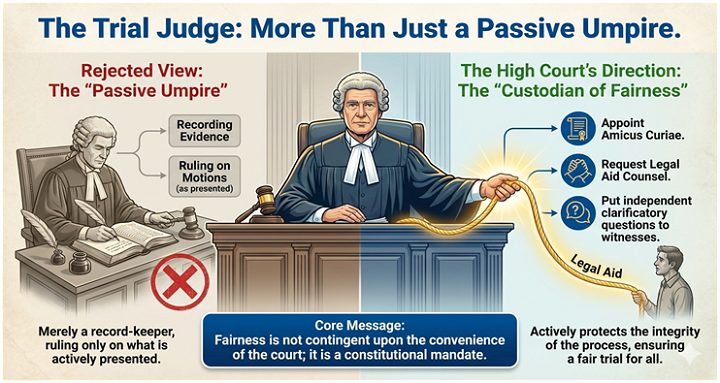
Justice Kathpalia outlines legal and naturally sound alternatives available to trial courts when faced with perceived sluggish tactics or absence of defence counsel. These include appointment of an amicus curiae, requesting legal aid counsel through the Legal Services Authority, or regulating proceedings in a manner that preserves both effectiveness and fairness. Importantly, the judgment clarifies that compelling an indicted to conduct cross-examination tête-à-tête isn't a admissible volition under any circumstances.
The Court also underscores the trial judge’s independent part in icing that substantiation is duly tested. Indeed beyond the appointment of counsel, trial courts retain the power to put clarificatory questions to substantiations in order to arrive at the verity. This observation aligns with the broader principle that criminal trials are n't contests of specialized skill alone but judicial inquiries aimed at discovering verity through fair means.
By framing these scores as matters of duty rather than discretion, the judgment sends a clear signal to the inferior bar. Fairness is n't contingent upon the industriousness of counsel or the convenience of the court. It's a indigenous accreditation that must guide judicial conduct at every stage of the trial.
Directions Issued and Systemic Counteraccusations
The remedial directions issued by the Delhi High Court emphasize the systemic significance of the ruling. Allowing the solicitation, the Court set aside the order refusing recall of PW- 1 and directed the trial court to grant a fresh occasion to the indicted to cross-question the substantiation through counsel. This relief directly addressed the immediate prejudice suffered by the indicted and restored procedural balance in the trial.
Still, the Court went beyond individual relief. By directing that a copy of the judgment be circulated to all Principle District and Sessions Judges in Delhi, the High Court conceded that the issue before it wasn't an insulated aberration but a recreating procedural failure. This directive transforms the judgment from a case-specific correction into an institutional intervention.
The rotation order serves a binary purpose. First, it functions as a exemplary instruction to trial courts, reminding them that procedural lanes that compromise fairness won't be countenanced. Second, it operates as a form of judicial guidance, clarifying stylish practices when indicted persons appear unrepresented at critical stages of the trial.
The systemic recrimination of this directive is significant. It reinforces a culture of fairness within the inferior bar and seeks to help reiteration of practices that undermine trial legality. By institutionalising the principle articulated in the judgment, the High Court strengthens the normative frame governing criminal trials and reaffirms the bar’s collaborative responsibility to uphold indigenous values.
Industry Perspective
Speaking to LCI, Advocate Sanjeev Tiwari stated that “Anyone who has actually done criminal trials knows this happens more often than it should. A witness is present, the court wants to move ahead, and the accused is told to cross-examine even though there’s no lawyer. On paper, it looks like an opportunity was given but in reality, it’s meaningless. Cross-examination is not common sense questioning, it’s a skill that comes from training and experience. What the Delhi High Court has said is basically this that ‘you can’t say a trial is fair just because the procedure was followed in form.’ If the defence never had a real chance to test the evidence, the fairness of the trial itself is compromised. That reminder was necessary, especially for trial courts under constant pressure to clear dockets.”
Conclusion
The judgment in Ram Swaroop Gupta & Ors. v. State (NCT of Delhi) reaffirms a fundamental truth of criminal jurisprudence: fairness is the lifeblood of legitimacy. By holding that compelling an accused to cross-examine a prosecution witness without legal representation vitiates the trial, the Delhi High Court has reinforced the constitutional promise that justice will be administered through procedures that respect dignity, equality, and reason.
The decision serves as a reminder that efficiency cannot trump fairness and that procedural shortcuts erode public confidence in the justice system. Rooted in settled Supreme Court doctrine, the judgment strengthens the moral and constitutional foundations of Indian criminal procedure.
Join LAWyersClubIndia's network for daily News Updates, Judgment Summaries, Articles, Forum Threads, Online Law Courses, and MUCH MORE!!"


Tags :Others