
SYNOPSIS
- Introduction
- Meaning of Performance
- Types of Performance
- Who Can Demand Performance
- Time and Place of Performance
- Discharge by Performance
- Discharge by Agreement
- Discharge by Impossibility
- Discharge by Operation of Law
- Conclusion
INTRODUCTION
Contract law is one of the most essential parts of the legal system as through it agreements which are not only commercial but also personal can be made legally binding and thus be enforceable. A contract, if valid, creates binding rights and obligations between the parties; hence it is very important to decide what procedures are to be followed for the performance of these obligations and how they may cease.
Here enters the concept of performance and discharge of contracts. A performance is simply the completion or execution of contractual promises, whereas a discharge means the legal termination of contract obligations, thereby releasing the parties from being bound forever.
The Indian Contract Act, 1872 is a major legislation which not only govern contract performance but also provide different grounds for the discharge of contracts. Sections 37-67 of the Act have rules and regulations about the person who is bound to perform the contract, the mode, time, and place of performance, as well as the legal consequences of non-performance. Besides that, the Act permits various ways of discharging a contract such as discharge by performance, mutual agreement, impossibility and operation of law. The Indian judiciary has played a pivotal role in shaping the contract law principles by judiciously interpreting the law and at the same time, balancing the absolute enforcement of contractual obligations with the provision of equitable relief under exceptional circumstances.
MEANING OF PERFORMANCE (Statutory Provision – Section 37)
Section 37 of the Indian Contract Act, 1872 enunciates the basic principle relating to contract performance. It lays down that the parties to a contract must perform their respective promise or at least offer to perform, unless such performance is waived or excused by the provisions of the Act. This section elevates performance to a mandatory legal obligation status and not a matter of choice after a valid contract has been made.
The provision also recognises that there are situations where performance may be excused by law, such as impossibility, waiver, novation, or other modes of discharge which are recognized under the Act. Therefore, Section 37 is the base of the law about performance and discharge of contracts.
Performance basically consists of:
- Carrying out the promise with the delivery of goods, the payment of money, the provision of services, etc. as examples.
- Not doing what one has promised not to do, for example a covenant restraining a party from carrying on a competing business.
- Duties under a contract are performed in the manner agreed without any variation unless the other party consents.
Illustration:
A sells 50 bags of wheat to B to be delivered at a certain date. Delivering these 50 bags exactly on that date is the performance. Delivering fewer bags or delivering them late would not be proper performance.
ESSENTIAL REQUIREMENTS OF A VALID PERFORMANCE
Legally valid and effective performance requires fulfilling these essential requirements:
1. Performance Must Be Exact and Complete
Performance must be in full accordance with the contract terms. Only the contract can be discharged by the promisee if they accept a partial or defective performance.
Case Law: In Re Moore & Landauer Ltd., the court found that even a minor departure from the terms of a contract was non-performance where the contract demanded strict compliance.
2. Performance Must Be by the Proper Person
According to Section 40 of the Act, the performance must generally be made by the promisor himself. However, if the contract does not involve personal skill or trust, it can be performed by the promisor's agent or legal representative.
Case Law: In Robinson v. Davison, the court ruled that contracts which entail personal skill are considered discharged in the event of the promisor's death or incapacity.
3. Performance Must Be at the Proper Time and Place
The performance must be done when and where the parties have agreed or as provided for in Sections 46 to 50 of the Act.
In Behari Lal v. Rajendra Nath, the court had taken the view that if time was basically the essence of the contract, then performing after the due date would impinge the contract barely, making it even voidable on the part of the plaintiff.
4. Performance Must Be in the Manner Prescribed by the Contract
The performance should be in the mode stipulated by the contract. If there is a change in performance degree without the other party's consent, it is a violation.
Example: A agrees to pay B in cash. Payment by cheque would not be a good performance unless B agrees to accept the payment by cheque.
JUDICIAL INTERPRETATION OF PERFORMANCE
The Supreme Court in State of Rajasthan v. Shamsher Singh held that the performance should strictly follow the agreed terms and that no party can at his own discretion change the mode or extent of performance. The Court pointed out that it is not only the right of the parties to their contract, but also their legal duty, that the contract should be performed, except in cases where, under the Act, performance is lawfully excused.
On the other hand, it was held in Hochster v. De La Tour that if a person does not or will not perform his contractual obligations, a breach results from this, which is an important principle of the law of contracts.
TYPES OF PERFORMANCE
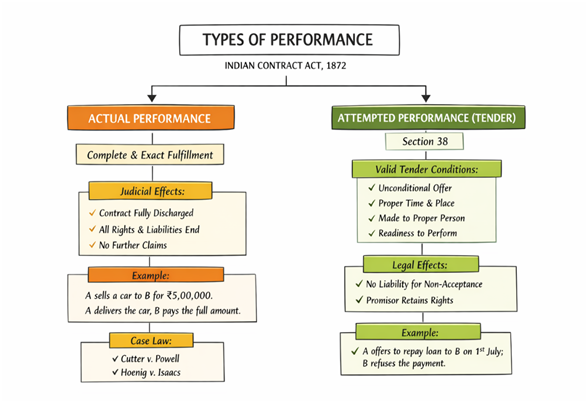
In the Indian Contract Act, 1872, performance is divided broadly into two categories: Actual Performance, on the one hand, and Attempted Performance (Tender of Performance) which is the other side of the same coin. This categorization is instrumental in finding out if the parties have completely discharged their contractual duties or if liability is still there notwithstanding the fact that one party has offered his performance.
1. Actual Performance
When actual performance happens, a situation arises where both parties to the contract have exactly and completely carried out their respective parts in the contract, and this is as per the terms stipulated in the contract. It is the best and straightforward method of contract discharge since the contract naturally ceases once it has been fully performed.
Judicial Effect of Actual Performance
- The contract is fully discharged
- All rights and liabilities arising from the contract are extinguished
- Neither party can raise further claims arising out of the contract
Illustration
A agrees to sell a car to B for ₹5,00,000. On the fixed day A delivers the car to B and B pays the full price. They have both discharged their contractual obligations and so their contract is discharged by actual performance.
In Cutter v. Powell, the court noted that when a contract is entire, a party must completely perform before being entitled to the benefits under the contract, hence stressing the importance of actual performance.
Likewise, in Hoenig v. Isaacs, the court ruled that substantial performance might be enough in some cases but defects might lead to a damage claim and not a discharge.
2. Attempted Performance (Tender of Performance) Statutory Provision - Section 38
If the promisor offers to perform his obligation, but the promisee refuses to accept such performance, the promisor is said to have made an attempted performance. The law in such situations safeguards the promisor from the consequences of non-performance, where the offer was genuinely made.
Conditions for a Valid Tender
A tender of performance will only be regarded as valid in law if the following conditions are met:
- Unconditional Offer: The offer does not in any way introduce new conditions or modifications to the original contract.
- Proper Time and Place: The tender is made at the time and place agreed to in the contract.
- Made to Proper Person: The tender is made to the promisee or a person authorised by the promisee.
- Readiness and Willingness: At the time when the tender is made, the promisor must be able to perform the whole obligation.
Legal Effect
- The promisor will not be accountable for non-performance
- The promisor retains all contractual rights
- The promisee might lose the right to get damages for non-performance
Illustration
A agrees to repay the loan to B by 1st July. A offers the full amount to B on the day, but B rejects the offer. Since A has made a valid tender, he is not in breach of the agreement.
In Startup v. Macdonald, the court has determined that a refusal to accept a valid tender of performance releases the promisor from further liability, even if the contract itself may not have been terminated.
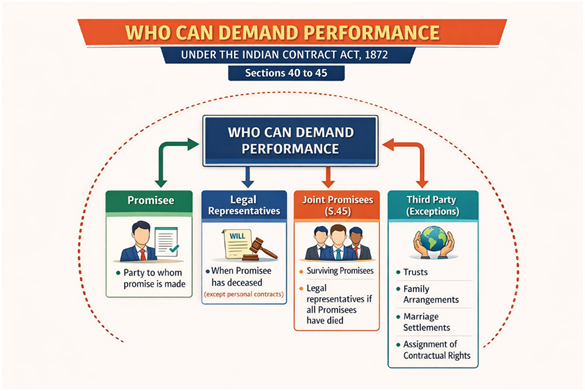
WHO CAN DEMAND PERFORMANCE (Statutory Provisions – Sections 40 to 45)
The Indian Contract Act clearly identifies the persons who are legally entitled to demand performance of a contract. As a general rule, only the parties to a contract can demand performance, but the Act recognises certain exceptions depending on the nature of the contract and the relationship between the parties.
The Indian Contract Act describes the people who can legally ask for the performance of a contract.
1. Promisee
The promisee is the person to whom the promise is made and thus typically the one who has the primary right to ask for the fulfilment of the promise.
2. Legal Representatives
When the promisee is no more, the legal representatives of the promisee may ask for the performance of the contract except when the contract is of a personal nature involving personal skills, trust, or confidence.
In Robinson v. Davison, it was held by the court that if a contract requires certain personal qualifications or skills of the promisor, the contract will be discharged on his/her death or incapacity.
3. Joint Promisees (Statutory Provision – Section 45)
In the case of joint promisees:
- All joint promisees should demand performance collectively
- On the death of one promisee, the surviving promisees can demand the performance
- In a situation where all promisees have died, their legal representatives may ask for the performance
4. Third Party (Exceptions to Doctrine of Privity)
Though the main principle is that only parties to a contract are rightfully able to sue for its performance, i.e. enforcements, Indian law allows certain exceptions where a third party may even demand performance through:
- Trusts
- Family arrangements
- Marriage settlements
- Assignment of contractual rights
Case Law
In the case of Khwaja Muhammad Khan v. Husaini Begum, the Privy Council ruled a beneficiary under a family arrangement could enforce the contract even if he was not the party to it.
TIME AND PLACE OF PERFORMANCE (Statutory Provisions – Sections 46 to 50)
The Act specifies the standards according to which the time of performance is decided.
- When there is No Stipulation of Time If under the contract no time had been fixed for the performance of the obligation, the performance must be made within a reasonable time depending upon the nature of the thing to be done.
- When Time has been Mentioned or Stipulated Performance must be at the time agreed upon or fixed by the contract.
- When Time Is of the Essence If the promisor fails to perform the contract on time, the promisee has the right to rescind the contract.
Illustration
A contract to deliver perishable goods on a certain day. If the delivery is delayed, it will upset the whole purpose of the contract. So, in such a case, the deadline will be regarded as 'time of the essence'.
Case Law
The court in Behari Lal v. Rajendra Nath ruled that time is not usually treated as an essential element in contracts for the sale of immovable property unless it has been specifically agreed to be so.
Place of Performance
The place of performance can be found out from the following considerations:
- Place Mentioned in the Contract
- Place Not Mentioned If the promisor wants to make the performance at some place, he should first obtain the consent of the promisee or apply to him to fix a reasonable place.
- Performance at the Application Performance should be made as the promisee may be directed.
Example
It was agreed by A to supply goods to B, but the location was not indicated. In such a case, A should inquire B to indicate a reasonable place for the delivery.
DISCHARGE BY PERFORMANCE
When the parties undertake to perform and actually perform their respective obligations as per the contract the contract gets automatically terminated. The concept of discharge by performance is in line with the basic contract law principle that contracts need to be performed and after their performance, the contractual relationship between the parties ceases.
Under the Indian Contract Act, 1872, the primary provisions that govern discharge by performance are Sections 37 and 38 which relate to the actual performance and the tender of performance respectively.
Meaning and Scope
A contract is said to be discharged by performance where:
- Both parties completely fulfil their promises, or
- One party makes a lawful offer of performance but the other party refuses to accept it.
In both cases, the promisor is relieved of any further obligations under the contract, and the contractual relationship is terminated.
1. Discharge by Actual Performance
Actual performance is when each party has done exactly what they promised to their counterpart under the contract. No rights can now be claimed by either party, nor further obligations of the contract be enforced, if the contract is fully performed through actual performance.
Legal Effect
- The contract is considered fully performed and therefore exhausted.
- There is an end to all the rights and liabilities of the parties.
- No one can bring an action against the other one for non-performance.
Case Law
In Cutter v. Powell the court ruled that if a contract is entire, then it is necessary to have complete performance to claim the contractual benefit. This case emphasizes that actual performance must be complete and precise to give rise to discharge.
Similarly, Hoenig v. Isaacs noted that if substantial performance has been made, the contract can be considered as discharged even if the aggrieved party can still sue for damages for minor defects.
2. Discharge by Attempted Performance (Tender of Performance) Statutory Provision: Section 38
Section 38 states that if a promisor makes a valid offer to perform and the promisee refuses to accept it, then the promisor is not liable for non-performance and does not lose the rights that he had under the contract.
Consequently, even if in fact, the contract is not totally executed, the law considers the promisor as having discharged his obligation.
Example
A has taken a loan of ₹1,00,000 from B and agreed to repay the same on 10th July at B’s residence. A on the due date comes to B’s house with the full amount, but B turns down the money. Hence A has made valid performance
Distinction Between Actual Performance and Attempted Performance
| Basis | Actual Performance | Attempted Performance |
| Nature | Complete fulfilment of obligations | Offer to perform refused by promisee |
| Execution | Contract fully executed | Contract not executed due to refusal |
| Liability | Ends completely | Promisor not liable for non-performance |
| Rights | No further rights remain | Promisor retains contractual rights |
Case Law
In Startup v. Macdonald, the ruling was that the discharge of the promisor from further liability will follow if the promisee refuses to accept a valid tender of performance. Therefore, the promisor cannot be held responsible for non-performance if he was, in fact, ready and willing to perform his obligation.
In the case of State of Kerala v. Cochin Chemical Refineries Ltd., the Supreme Court restated the principle that a lawful tender is a defence to a claim for non-performance.
DISCHARGE BY AGREEMENT (STATUTORY PROVISION – SECTION 62)
The contract can be discharged if there is a mutual agreement between the parties. This basically means that the agreement that binds the parties can also be used to terminate the agreement.
Modes of Discharge by Agreement
1. Novation which means replacing the old contract with a new one, or replacing the original parties with new ones
Case Law: In Lata Construction v. Dr. Rameshchandra Ramniklal Shah, the Supreme Court noted that novation involves total replacement of the obligations so that the old contract is entirely extinguished.
2. Rescission
Rescission means that the parties to the contract have mutually agreed to cancel the contract thus neither of them becoming liable to the other for the former obligations.
3. Alteration
Alteration means that the parties have agreed to introduce a material change in the terms of the contract after they have mutually assented to the original terms of the contract.
4. Remission (Statutory Provision – Section 63)
Remission takes place when the promisee accepts a performance which is less in quantity or quality than that agreed upon in the contract.
5. Waiver
It is the intentional giving up of a known contractual right, either expressly or impliedly.
DISCHARGE BY IMPOSSIBILITY (Statutory Provision – Section 56)
Section 56 of the law states:
- An agreement to do an impossible act is void ab initio
- A contract becomes void when performance becomes impossible or unlawful after its formation
Kinds of Impossibility
1. Initial Impossibility
If at the time the agree to do an act the act is impossible, then the agreement is considered to have never been valid.
Example:
Agreement to find hidden treasure when there is none.
2. Supervening Impossibility
Comes after contract formation and is caused by:
- Change in law
- Destruction of subject matter
- Death or incapacity of a party
- Outbreak of war
Case Law: In Satyabrata Ghose v. Mugneeram Bangur,the Supreme Court interpreted that impossibility also covers cases when performance becomes so difficult that it is virtually impossible or that the original purpose of the contract is totally frustrated.
Limitations of the Doctrine
The doctrine does not apply:
- Performance merely becomes difficult or expensive
- Impossibility is due to self-induction
Case Law: In Alopi Parshad v. Union of India, the Supreme Court decided that mere commercial hardship is not frustration.
DISCHARGE BY OPERATION OF LAW
A contract can be terminated without the consent of the parties due to the operation of law in the following cases:
- Death – In personal skill contracts
- Insolvency – An insolvent party is considered to have no contractual liabilities
- Merger– The lesser right is absorbed by the superior right
- Material Alteration – The contract becomes void if altered without authorization
- Lapse of Time – The contract is discharged when the limitation period expires
PRACTISING ADVOCATE’S OPINION
From a practising advocate's perspective practising at Delhi High Court, says that the law regarding performance and discharge of contracts under the Indian Contract Act, 1872 seems to have struck a fine balance between the sanctity of contract and practical justice. To a large extent, Sections 37 to 67 serve as the real instruments of contract enforcement in the everyday litigation and advisory scenario. The judiciary in its various pronouncements has emphasized the rule of exact and strict performance, especially in commercial transactions, thus cementing predictability and certainty which is an essential ingredient for trade and investment.
However, the law also gives due recognition to discharge by agreement, impossibility, and operation of law thus showing the legislature’s care for the changes in circumstances. The doctrine of frustration as contained in Section 56 and interpreted by the courts is of paramount importance when dealing with today’s disputes which are often caused by force majeure events, regulatory changes, and unforeseen disruptions.
In reality, disagreements mainly arise due to the improper tender, delay, or deviation in the mode of performance rather than non-performance in itself. Generally speaking, the scheme of rules for performance and discharge is a smart blend of contractual discipline and the exercise of the court’s equitable jurisdiction where strict enforcement might cause hardship. Hence the law stays both commercially viable and socially sensitive.
CONCLUSION
The notions of performance and discharge of contracts are greatly instrumental to the concept of contract law in India under the Contract Act, 1872. A contract is merely a tool through which parties achieve, communicate and agree on their lawful objects. Performance is one way of ensuring the fulfilment of these lawful objects translating promises into action while a discharge provides the parties with methods recognized by law to bring the contractual obligations to an end. In fact, the two go hand in hand as they can be used to make the contractual relationships enforceable and at the same time, both parties are aware of the length of the agreement.
The legal provisions in Sections 37 to 67 of the Act adequately cater for the conduct, time, place, and people concerned with the performance of contracts, thus securing a feeling of safety and anticipation from the parties in contractual dealings. Not less important are the various ways of discharge such as discharge by performance, agreement, impossibility, and operation of law, which acknowledge that strict contract enforcement in every situation may cause harm.
To sum up, the rules of performance and discharge of contracts ensure that the parties’ commitments are not enforced at will and thus the enforcement is just and timely. In fact, with the help of clear-cut standards and precisely outlined exceptions the Indian Contract Act, 1872 remains at the discretion of the parties for negotiation, compromises and agreements harmonizing the interests of all parties involved i.e. legal certainty, commercial efficiency and equitable justice.
Join LAWyersClubIndia's network for daily News Updates, Judgment Summaries, Articles, Forum Threads, Online Law Courses, and MUCH MORE!!"


Tags :Others