
SYNOPSIS
1.Abstract
1.1 Keywords
2.Introduction
3.Methodology
4.Background and Legal Context
5.Overview of the EU Artificial Intelligence Act
6.Core Substantive Provisions
- Unacceptable-Risk Prohibitions
- High-Risk AI Obligations
- Transparency and Information Obligations
- Governance and Enforcement Mechanism
7.Interaction with GDPR and Other EU Laws
8.Practical Implications and Compliance Challenges
9.Comparative Perspective
10.Criticisms, Gaps and Open Issues
11.Recommendations
12.Conclusion
13.References and Backlinks
ABSTRACT
The EU Artificial Intelligence Regulation Act 2024/1689. This research paper examines the EU Artificial Intelligence Act, the world's first comprehensive AI regulation. The study uses a doctrinal and policy-based approach to examine the Act’s risk-based structure. This structure imposes strict obligations on high-risk AI systems, sets transparency rules for generative and general-purpose AI, and bans certain inappropriate uses of AI. The paper also examines the enforcement mechanisms designed to ensure safe and reliable AI development, as well as how the Act interacts with existing EU laws, such as the GDPR. It discusses practical challenges for businesses, effects on innovation, and objections from experts. Ultimately, it provides recommendations for enhanced international alignment and implementation. The analysis reveals that, while the EU AI Act represents a significant step forward, several challenges remain.
KEYWORDS -: EU AI Act, Artificial Intelligence Regulation, High-Risk AI, Unacceptable AI Practices, Transparency Obligations, General-Purpose AI, EU Technology Law
INTRODUCTION
Artificial Intelligence (AI) has experienced rapid growth in recent years and now impacts nearly every aspect of modern life. Healthcare utilizes AI for diagnostics, banks employ it for credit evaluation, recruitment utilizes AI for candidate selection, and transportation leverages AI for self-driving vehicles. The Internet relies on AI to deliver personalized content. AI’s benefits include increased speed, precision, lower operating costs, and improved critical thinking. However, new risks come with AI’s growth. AI can monitor people without their knowledge, violate privacy, manipulate users, make biased decisions, misuse personal data, and threaten human rights. As AI becomes more sophisticated, the imperative for comprehensive, legally established frameworks to regulate this technology continues to grow.
To address the challenges of AI, the European Union became the first region in the world to create a broad, legally binding framework for regulating AI. In 2024, the EU passed the Artificial Intelligence Act (Regulation (EU) 2024/1689) after it was published on the EUR-Lex website. The EU AI Act marks a major change in global technology policy. The Act’s development on risk-based regulation. The EU chose to control AI based on the possible harm these systems could cause to people or society.
A cursory overview of the European Union AI Act’s key sectionizes key sections is as follows:
AI Systems classified with an unacceptable risk level are strictly prohibited. This category comprises systems that perform social scoring (rating individuals’ social behaviour and trustworthiness), manipulate individuals through deceitful means, and utilize unsafe biometric categories (such as emotion recognition through biometric data without consent).
AI systems classed as high risk can be used in the EU if strict rules are followed. Examples include:
These include systems used in medical devices, employment, education, law enforcement, transportation, and other public services. Developers must utilize high-quality data, provide human oversight, ensure transparency, and continuously monitor these products.
- 1.Low-risk AI systems include chatbots, emotion recognition software, and deep fakes. These systems must inform users when they interact with AI or when content is generated by AI.
- 2.Low-risk AI systems, such as spam filters and video games, are subject to minimal or no regulatory oversight.
- 3.The new Acts set forth Guidelines on Generative AI Models, which are AI systems. capable of generating text, graphics and/or other forms of content, as well as General Purpose AI (GPAI). Companies developing or using these models must abide by safety, documentation. The European Commission notes that they are responding to the phenomenon of cutting-edge, general-purpose Purpose.AI tools, which can be applied across various industries.
This research paper will focus on how the EUAI Act governs artificial intelligence systems and how the EU has approached the governance of the evolution of AI Systems.
METHODOLOGY
Using both a doctrinal and a legal analytical approach, this paper analyses the European Union (EU) and its Artificial Intelligence (AI) Act. The study will primarily focus on the official text of the EUAI Act (Regulation (EU) 2024/1689) published on EUR-Lex, as well as relevant EU legislation.
regulations, delegated acts issued by the European Union, and any guidance materials issued by the European Commission. Secondary sources for the study include policy papers and articles. Published in legal journals or law reviews, EU institutional reports, and commentaries from legal experts, among other things. In addition to examining the EU AI Act, sources from non-EU- European states, such as the USA and China, need to understand how the EU approaches the AI Act. Differ from other countries in the world. The study will primarily focus on the legal structure and scope of the EUAI Act, as well as all legal obligations up to the start of 2025, and any subsequent developments. Developments and/or clarifications, or guidance materials. To examine the legal obligations and risks that are established by the EUAI Act and their potential impacts, all sources will be examined in detail.
BACKGROUND AND LEGAL CONTEXT
The European Union has sought to regulate digital technologies in order to protect users and ensure fair markets. It does this by ensuring that fundamental rights are respected.
Fundamental rights are adhered to. Before the adoption of the EUAI Act, there had already been two main pieces of legislation regulating digital technology: the Digital Services Act (DSA) and
The DMA targets large digital platforms and aims to prevent them from abusing their market power. The DSA sets rules for online platforms about illegal content, transparency, and user trust. Both laws aim to promote competition and user safety. However, neither was designed to address the new and unique risks that AI brings.
AI technology includes automated decision-making, machine learning, biometrics, and other systems. These technologies affect human rights, fairness, and public trust. As a result, AI requires a distinct regulatory framework. Other technologies which impact human rights, fairness, public trust, etc. Therefore, it requires a different type of regulatory framework. One of the main forces behind the campaign for specific AI regulation was the European. Parliament. It acknowledged that sophisticated AI systems, such as facial recognition, algorithmic scoring, generative AI, and high-risk automated decision-making, were beyond the scope of current legislation. Additionally, the Parliament emphasized that AI had to be transparent, reliable, and consistent with European principles.
The GDPR already governs the collection and use of personal data, including in AI systems. However, the GDPR does not regulate the design of AI systems, risk levels, human monitoring, safety tests, or risks to fundamental rights outside of data processing. It mainly focuses on data protection and privacy. The EU needed a broader legal framework because AI can do harm even when data laws are followed processing instead, it focuses primarily on data protection and privacy. The EU requires a more comprehensive legal framework, as AI can be harmful even when data regulations are in place. respected. Therefore, rather than replacing the GDPR, the AI Act complements it. Additionally, a number of industry-specific EU legislations governs financial services, medical devices, transportation, and product safety. The AI Act and the applicable sectoral regulations must be adhered to when using AI in certain industries. This unified regulatory strategy guarantees AI's continued safety, accountability, and transparency across all sectors.
OVERVIEW OF THE EU AI ACT
The first complete legal framework for artificial intelligence in the world is found in the
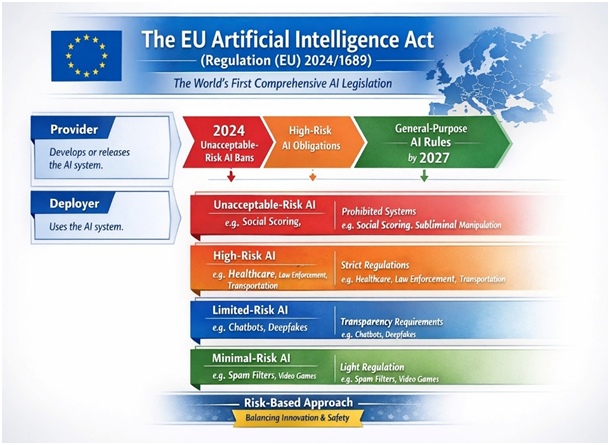
The European Union Artificial Intelligence Act (Regulation (EU) 2024/1689) is the world's first comprehensive legal framework for artificial intelligence. It took effect in 2024 after being adopted and published on the EUR-Lex website. The Act is introduced in phases. First, unacceptable-risk AI bans apply. Then, obligations for high-risk systems begin. Lastly, rules for general-purpose AI (GPAI) and full enforcement are scheduled to be rolled out by 2027. This schedule provides organizations, businesses, and governments with sufficient time to prepare for compliance.
Regardless of whether the developer is based in the EU or not, the Act covers the majority of AI systems used within the EU or put on the EU market. The Act defines several key terms to ensure clarity. A machine-based system with varied degrees of autonomy that may produce outputs, like suggestions, forecasts, or judgments, are referred to as artificial intelligence (AI)
A deployer is the individual or organization that actually uses the AI system, whereas a provider refers to any individual or organization that creates or releases an AI system onto the market. The EUAI Act's risk-based approach, which was developed in accordance with the EU's Digital Strategy to strike a balance between innovation and safety, is a key component. The Act classifies it into four danger categories. Systems deemed to pose a significant risk to human safety, such as social scoring or AI that uses subliminal methods to alter behaviour, are classified as unacceptable-risk AI. It is strictly forbidden to use these systems. Technologies utilized in delicate industries like healthcare, employment, law enforcement, transportation, and vital public functions are considered high-risk AI applications. These systems can be employed, but they are subject to strict legal requirements. Transparency is essential for low-risk AI systems, such as chatbots and deepfakes, to inform consumers when they are interacting with AI or receiving information generated by AI. Lastly, there is little regulation of low-risk AI applications, such as spam filters and video games.
CORE SUBSTANTIVE PROVISIONS
Unacceptable-Risk Prohibitions
Certain AI systems are deemed too dangerous to be permitted in the European Union under the EUAI Act. These regulations adhere to the Digital Strategy of the European Commission, which places a high priority on defending fundamental rights. A system that employs social scoring, in which governments or private entities rank people according to their traits or behaviours, is prohibited by the Act. Additionally, it forbids the use of subliminal or manipulative AI approaches that have the potential to negatively alter human behaviour. Furthermore, it is explicitly prohibited for AI systems to exploit the weaknesses of particular individuals, populations, such as children, the elderly, or anyone with disabilities. Because of worries about widespread surveillance and privacy abuses, law enforcement's use of remote biometric identification equipment in public areas is likewise severely prohibited
High-Risk AI Obligations
Because they operate in delicate areas with significant social impact, high-risk AI systems are permitted but subject to the toughest regulations. Before these systems are utilized or sold, a thorough conformity review is required, according to artificialintelligenceact.eu. Technical documentation must be kept up to date, high-quality training data must be guaranteed, and a risk. A management system must be established, and human monitoring must be implemented. Throughout their existence, these systems must also be reliable, precise, and safe. For transparency, high-risk AI must also be listed in an EU database. Applications in healthcare diagnostics, credit scoring, hiring, border security, transportation safety, and vital public services are a few examples. Employers who use high-risk AI also have responsibilities, including reporting issues, monitoring performance, and ensuring human oversight.
Transparency and Information Obligations
Systems that communicate with people directly or produce media content must be transparent, according to the AI Act. According to artificial intelligence act. EU, chatbots, emotion-recognition software, and deepfakes are examples of AI systems that must clearly indicate to users that the interaction or content is AI-generated. Additionally, deepfake producers are required to reveal
any artificial production or manipulation of audio, video, or images. The Act also establishes new guidelines for General-Purpose AI (GPAI), including generative AI models that can generate. code, graphics, or text. PAI providers are required to provide system capabilities, training data summaries, documentation, and risk-mitigation measures. Transparency regulations for Sophisticated generative AI models are further clarified by new EU guidelines. Preventing the dissemination of false information, safeguarding user autonomy, and promoting responsible innovation are the primary objectives of these transparency obligations.
Governance and Enforcement
To guarantee efficient enforcement, the EUAI Act creates a robust governance framework. To oversee AI operations, each Member State must appoint national competent authorities. General-purpose AI regulations are overseen by the EU AI Office, which also facilitates cross-border activities. oversight. Consistent implementation throughout the EU is supported by an AI Board comprising representatives from each Member State. The Act also establishes stringent reporting. requirements for major occurrences and market surveillance measures. Depending on the seriousness and nature of the infraction can result in fines for non-compliance amounting to several million euros. This governance structure ensures that AI developers and deployers comply with legal requirements, safeguard users, and uphold strict safety and accountability standards.
INTERACTION WITH GDPR AND OTHER LAWS
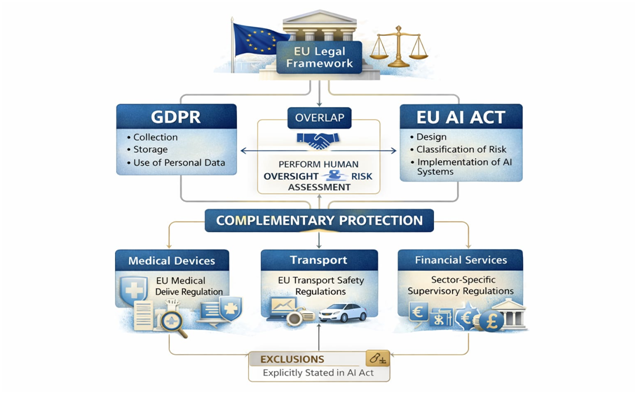
The EUAI Act is an additional regulation to the existing EU legal framework, or laws, such as the General Data Protection Regulation (GDPR). Although both legislations provide protection for individuals, the manner in which each provides that protection is different. The GDPR governs the collection, storage, and use of personal data, and the AI Act governs the design. In the development, classification of risk, and implementation of AI systems that process personal data, there is considerable overlap and direct correspondence between the AI Act and GDPR, and the two legislations provide complementary layers of protection. One example of this overlap includes, but is not limited to, the requirement of performing Data Protection Impact Assessments (DPIAs) when generating high-risk AI systems, per GDPR recommendation, and the AI Act includes a directive providing for similar requirements for risk assessment, transparency, and human oversight. The AI Act also interacts with numerous defined sectoral EU regulations. For example, AI used in medical devices must comply with the AI Act and the EU Medical Device Regulation.
DevicesRegulation.AI used in transport, such as automated driving systems, must comply with EU Transport Safety Regulations. Additionally, AI used in Financial Services must be in compliance with sector-specific supervisory regulations. The Act also contains exclusions as to the applicability of the Act. It is expressly stated in the text of the AI Act.
PRACTICAL IMPLICATIONS & COMPLIANCE CHALLENGES
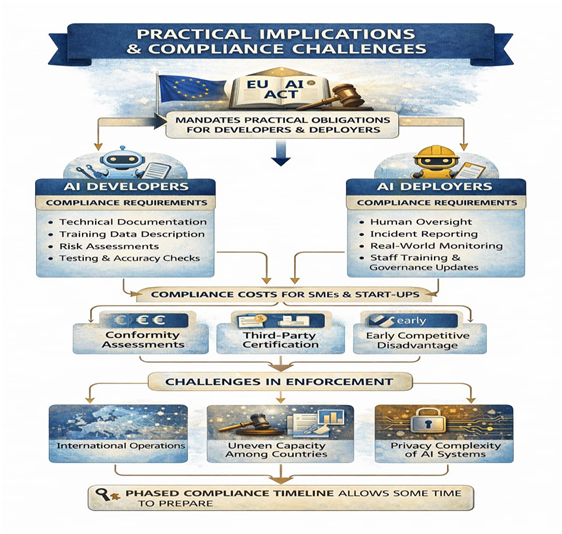
"TheEUAIActmandatesthatAIproviders(developers)andAIdeployers(users)have significant practical obligations require providers to meet multiple documentation requirements, including the creation of technical files, a thorough description of the training data, risk assessments, and monitoring logs. To attain technical compliance, an AI developer must test their AI system, perform accuracy checks, and evaluate the security of the system, as well as provide a means for understanding its output(explainability). Each of these will increase the operational demands of the AI system. In addition, the deployer has several requirements, including proper human oversight of the AI system, incident reporting, and real-world. Performance monitoring. Due to these obligations, deployers often have to perform staff training, develop and implement updated governance systems, and create long-term maintenance plans. The Act imposes a range of compliance obligations on small and medium-sized enterprises (SMEs) and start-ups. The timeline for complying with the Regulations is staggered, which allows some time for companies to prepare, but there are still many challenges associated with complying with the regulations. Cost-wise, start-ups and SMEs will likely struggle with the cost of the Regulations, including Conformity Assessment and Third-Party Certification. Reasonably speaking, these costs should put smaller businesses at a competitive disadvantage early in their venture. Phased compliance should give start-ups and small businesses some time to prepare. This presents real challenges AI systems often operate Internationally, so countries throughout the EU will require very close cooperation to achieve uniform enforcement of the Regulations. The reality is that some countries are not equipped to effectively monitor or enforce the compliance of their AI systems due to a lack of resources or regulatory capacity. The encryption or privacy complexity of many AI systems will only create additional problems for regulators in verifying compliance with the Regulations."
COMPARATIVE PERSPECTIVE
The AI Act in the EU adopts a cautious and risk-based approach, which means that AI systems should be heavily safeguarded prior to their implementation. This is in contrast to the United States, which adopts a more sectoral approach. The U.S. does not use a single law to enforce rules; instead, it allows different industries to be subject to different rules, including those related to health, finance, or transportation. The U.S. is generally more liberal in innovation-first policies. China had a different model: state-based, where the government has significant control over AI development and implementation. The Chinese rules are about algorithmic governance, content regulation, and national security-oriented, which is a symptom of its centralized regulatory mechanism. The EU, the U.S., and China have core values of fundamental rights, innovation and market freedom, state oversight, and social management, respectively, as pointed out in WIRED and other commentaries. These dissimilarities exhibit three clear international outlooks regarding the Regulation of AI.
CRITICISMS, GAPS AND OPEN ISSUES
Despite being the most comprehensive AI regulation in the world, the EU AI Act has several criticisms and open questions. One major problem is legal ambiguity: definitions of "AI system", "high-risk", and "general-purpose AI" may still be interpreted differently across Member States, leading to inconsistent enforcement. Another concern is regulatory capacity: many authorities may lack the necessary technical expertise or resources to effectively supervise complex AI systems. Some critics point out that the Act could give rise to an innovation-regulation trade-off, particularly among SMEs facing high compliance costs. Others point out loopholes, such as companies misclassifying systems to avoid more stringent controls. Further clarity is needed on the rules governing general-purpose AI, particularly regarding the transparency of training data and the assessment of systemic risk and Children's rights, advocates also argue that the Act does not fully protect minors from manipulative AI or harmful digital content. Questions remain about how the AI Act interacts with the DSA and DMA, particularly regarding platform accountability and the prevention of misinformation. As indicated in analyses on artificial intelligence.eu, the effectiveness with which this Act addresses the gaps will be determined by future guidance, delegated acts, and enforcement practice.
RECOMMENDATIONS
Law makers and regulators should focus on improving the efficacy off the EU AI Act and fostering innovation through clearer guidance, targeted support, and increased enforcement capacity to this end, the EU should: Provide specific directions to developer general- purpose AI (GPAI) (i.e. Defining GPAI, what documentation they need to provide as they develop, create programs that will allow small and medium-sized enterprises (SMEs) to develop and market products that utilize GPAI (e.g., providing financial support for conformity assessments, creating streamlined certification processes, and providing toolkits and templates. Investing in the infrastructure for monitoring and supporting Member States by building up Technical Expertise (e.g., funding Technical Teams, creating Shared Laboratories, and establishing a Central EUAI Office Helpdesk) to ensure cross-border enforcement is done consistently. Create an environment that supports innovation while ensuring safety through the use of Regulatory Sandboxes and providing Public Procurement Incentives to enable suppliers to test the models of compliance in "real-world" conditions. Ensure that there is consistency in how GDPR is interpreted and regulated across all Member States with Existing Laws (GDPR, Medical Devices Regulation, and Digital Services Act and Digital Market Act) through the establishment of Joint Guidance documents and Coordinated Supervisory Actions to limit Legal Uncertainty to SMEs. Work on developing a framework for International Cooperation and Alignment with respect to Standards and Testing Procedures to limit Fragmentation and Promote Global Trade. ImplementmechanismsforenforcingAccountabilitythroughthetransparentReportingof Major Incidents and Publishing Anonymised Enforcement Outcomes in order to create a Market Learning Environment.
CONCLUSION
The Artificial Intelligence Act establishes an innovative, risk-based regulatory framework that aims to strike a balance between advancing new technologies and protecting citizens' fundamental rights. The Act outlines several clear legal obligations for companies that provide AI products and systems, which includes banning all forms of ‘unacceptable’ use of AI products, implementing very strict requirements for users of AI products considered 'high risk', requiring transparency of certain types of AI tools and' General Purpose Artificial Intelligence (GPAI)'used by companies, etc. The strengths of the Act lie in its ability to protect rights and lead globally in governance of AI. There are, however, several challenges that still need to be addressed, including the definition of key terms, limited enforcement resources, the significant costs associated with compliance for small businesses, and unanswered questions.
Regarding protections for children's rights in relation to the Act to be a success, detailed delegated acts must be established, practically guided, developed, and extensive capacity building will need to take place to ensure these obligations are enforceable. Once these issues Having been addressed and support established for global coordination, the EU's AI Act can serve as a sustainable template to replicate for all countries that want to establish responsible AI, while allowing room for innovation and enabling new AI systems to remain safer.
Join LAWyersClubIndia's network for daily News Updates, Judgment Summaries, Articles, Forum Threads, Online Law Courses, and MUCH MORE!!"


Tags :Others