
Rape prosecution in India has always been a tricky task with the survivors often undergoing intimidation, social stigma, and trauma that can turn them hostile as witnesses. Moreover, in most cases, there are no independent eyewitnesses, and the case details are often prone to being forgotten or get distorted with the passage of time.
Now in such situation, the forensic evidence comes to use as it provides solid, objective and logical backing for establishing the legality and legitimacy of the offence and the complaint. Biological traces, medical signs, and other material evidence can resist both time and human fallibility and can often form the backbone of a criminal case.
The law relating to rape in India has changed to the Bharatiya Nyaya Sanhita. Sections 63, 64, and 65 enumerate rape and its aggravated varieties while Section 70 provides for gang rape.
Although most of the landmark judgments have taken place under the previous Indian Penal Code, the ratio of those judgments would be applicable under the new legal dispensation. The statutes are full of detailed investigation, and the forensic sciences are deemed an essential aid to meet the statutory mandate.
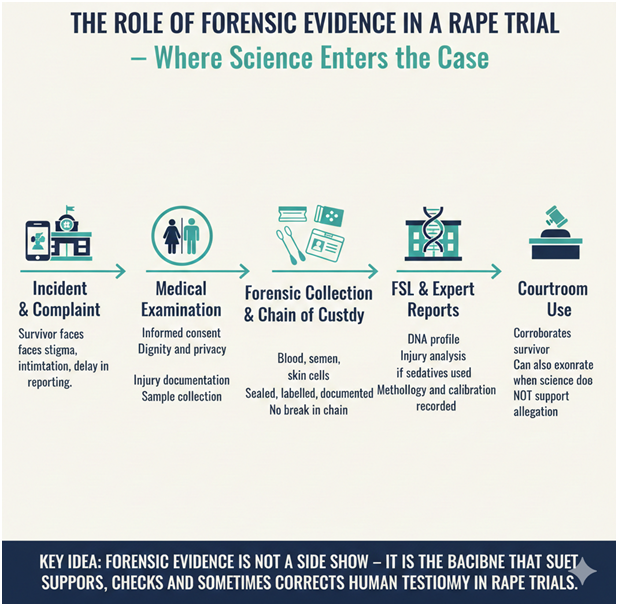
Forensic evidence plays a multitude of roles in rape trials, providing objective corroborations for survivor testimony, especially when trauma or social pressure affects the consistency of statements and it allows investigators to establish the identity of perpetrators, especially in cases involving multiple accused.
Such biological and medical findings are important in reconstructing the events to aid the courts to understand the manner, time, and circumstances under which the assault took place.
Further, scientific evidence can exonerate the innocent by showing discrepancies in the prosecution's case due to errors in collection or analysis. When collecting forensic evidence, it should be ensured that a precise chain of custody is established and to avoid its degradation, biological samples such as blood, semen, or skin cells must be obtained as soon as possible and should be preserved.
They have to be delivered to labs under controlled conditions, securely sealed, and meticulously documented. Evidence may become inadmissible or lose credibility if there is even one break in the chain of custody.
It should be mentioned that the laboratories are required to provide comprehensive methodology, maintain calibrated instruments, and adhere to established procedures. The testimony of forensic experts is persuasive in direct relation to clear records showing how evidence was collected, handled, and analysed. Even the most up-to-date scientific analysis can be invalidated by poor sample handling or a failure to maintain proper procedures.
The courts have recognised that the principal potential value of forensic evidence lies in its careful collection and handling. The reliance by the judiciary on scientific evidence is directly related to the reliability of the evidence and integrity in the processes surrounding such evidence.
Where such evidence is properly obtained, it may corroborate the account of a victim, identify a defendant, and enhance the prosecution's case. Where procedural defects occur, the same evidence might be susceptible to attack and may lose credibility.
Medical and legal processes should guarantee that the victim's dignity is upheld and that informed consent must be there. Medical evaluations, damage recording, and sample collection all require specialised skill and sensitivity. Poor handling will not only affect the scientific value of evidence but will undermine survivor cooperation, impacting the case outcome.
As such, forensic evidence must be seen to form part of a greater evidentiary whole. It brings an objective immutability to those situations in which human memory, emotion, or social pressures make it difficult for testimony to be clear-cut. If properly gathered and analyzed, it permits the judiciary to pass sentences more appropriately and confidently, knowing well that convictions or dismissals are based upon dependable and verifiable facts.
The next sections debate how the courts have applied these standards in real-life rape trials in India. They show how forensic evidence has impacted verdicts where it has strengthened prosecutions and where procedural failures have impacted judicial reasoning.
How Indian Courts Have Relied on Forensic Evidence in Rape Trials
The rape jurisprudence of our country are filled with those moments when forensic evidence played the decisive factor. These judgments reveal how courts evaluate scientific evidence, what relying they place on them, and how they correlate those with medical findings, testimonies, and circumstantial evidence.
One of the most discussed cases in modern criminal law remains Mukesh v State NCT of Delhi, commonly referred to as the Nirbhaya case. It was prosecuted under the earlier IPC, but has otherwise been considered one of the most comprehensive forensic investigations into a rape ever pursued in India. The Supreme Court placed great reliance on DNA material retrieved from the body and clothes of the victim and from the bus where the offense was committed. These had been matched by the Central Forensic Science
Laboratory with DNA profiles of the accused. Notably, the biological traces, including semen and blood mixtures, were found in positions that corresponded with the prosecution's reconstruction of events. Most importantly, the fact that recovery of such a large amount of biological material at the scene could not have been planted or manipulated itself proved the DNA link between the accused and the crime to be beyond doubt.
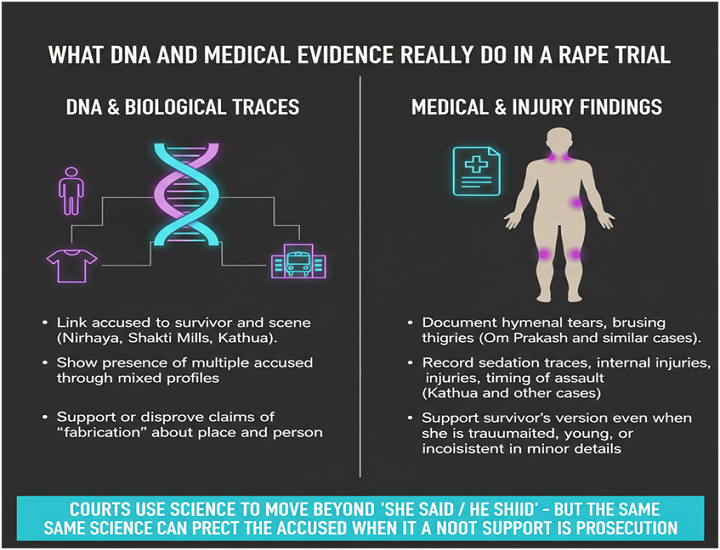
The forensic pathologists also documented the extensive injuries suffered by the victim. Detailed analysis of internal injuries, bite marks, blunt force trauma, and the rupturing caused by the iron rod inserted into the victim is contained in the judgment. These corroborated the prosecution's story of continued assault and extreme violence. The medical findings corresponded to the statement made by the victim in her dying declaration.
The Supreme Court said the forensic record stood independently from the statement of the victim and was sufficient to establish guilt even if her declaration was not available. This case indicated an unequivocal affirmation that forensic science can stand as the backbone of a prosecution in a case of rape, capable of standing the test of scrutiny at times when the incident is shocking and there are plural voices of testimony with conflicting statements.
Another landmark case is that of State of Maharashtra v Vijay Mohan Jadhav and popularly known as the Shakti Mills gang rape case. The Bombay High Court, and later the Supreme Court, drew heavily upon DNA profiling to establish the involvement of the accused men. In this case, the victim was a photojournalist who was attacked inside an abandoned mill compound.
The accused presented several defences, including coercion into confession and inconsistencies in statements made by the victim. However, forensic evidence of semen stains and other biological samples independently established on the victim's clothes were matched with profiles of the accused. While holding thus, the court explained that since DNA profiling is scientifically accepted, it would constitute high probative value.
Further, recovery of soil samples, debris, and vegetation from the clothing of the victim helped identify the exact place where the assault took place and further negated the contention raised by the accused persons that the police had fabricated the place. The judgment in the Shakti Mills case is now cited in almost all cases when the courts discuss the evidentiary weight of DNA profiling in cases of rape.
Another important case is the Kathua rape incident involving a murder case as well. The case involved the assault and killing of an eight year old girl after abduction. The forensic evidence included the DNA examination of hair strands, vaginal swabs, and bloodstains, along with the forensic reconstruction of movement patterns inside the temple where the victim was confined.
Not only did the lab reports establish rape, but also the involvement of multiple accused since biological material from a number of persons was recovered. The court held that the recovery of fingerprints, blood traces, and strands of hair inside the temple matched the narrative that supported the girl having been kept inside the temple for several days.
The presence of sedative traces in the victim's body further corroborated the statement by some witnesses regarding the drugging of the child repeatedly. Another accused tried to plead juvenility. Forensic dental examination and ossification tests were relied upon to determine age beyond doubt.
Another important case is State of Karnataka v Farooqui, wherein the Delhi High Court tried the allegations of rape against a well known artist. The case ended in acquittal for want of sufficient evidence to prove guilt, but the trial brought out the importance of forensic reports with respect to determining no or presence of penetration, patterns of injury, and biological transfer.
The forensic report could not confirm the prosecution's case, and this absence contributed to reasonable doubt. This is another example that forensic science is impartial. While it strengthens prosecutions when evidence is available, equally it protects the accuse when the scientific material does not corroborate the accusation.
The courts depend on forensic evidence not because it always proves one's case but because it offers neutrality and resistance to emotional influence. Perhaps one of the most clear examples of forensic evidence shaping the rape trials can be seen in the case of Om Prakash v State of UP wherein the SC reinstated the conviction of a man accused of raping a minor. The prosecution case initially collapsed because the trial court found discrepancies in witness statements. However, the Supreme Court pointed out that the medical examination revealed definite signs of sexual assault.
The hymenal tear, the presence of dry blood near the private parts, and the injuries on the thighs were all scientifically recorded. The court held that such medical findings could not be ignored and that minor inconsistencies in testimony are expected, especially from a traumatised minor. Again, it was science providing the stabilising element to keep the case anchored to objective facts.
These cases show the depth of forensic influence on rape trials in India. How courts use forensic science to corroborate events, identify assailants, strengthen testimony, and sometimes even safeguard against wrongful convictions is evident in these cases. Each case reinstate the perception that scientific evidence has become indispensable for modern criminal adjudication in offences which involve trauma, social pressures, and absence of eye witnesses.
How Indian Courts Evaluate Forensic Reports in Cases of Rape Narratives
Indian Courts are not known to accept forensic science reports blindly. The notion that a DNA report or a medical certificate renders a guilt verdict irreversibel is grossly inadequate. The trial courts as well as appeal courts usually dissect every aspect of the forensic evidence chain before arriving at a conclusion.
The interesting part of this series of cases has been that no direct verdict has been derived from an expert opinion. The courts make an effort to assess how reliable this evidence has been, to what extent it can be determined that a sample has been dealt with in a proper manner, and also to what extent it has otherwise fitted into the prosecution narrative.
The Nirbhaya verdict represents a most exemplary instance where a court has given due consideration to forensic science. While it was not merely the grotesque nature of this crime that determined this verdict. The DNA profiling done in the Central Forensic Science Laboratory established a connection between the biological matter found on the victim’s body as well as that of the bus with all of the accused.
The Supreme Court has pointed out that all of these were consistent, documented, and also supported by medical evidence. That which gave this verdict of guilt any credence, of course, was that it established a chain of custody that was traceable, with stamps, signatures, and dates that were all verifiable. This established a precedent for how all courts started referring to forensic evidence in any case in years to come.
This can also be witnessed in the case of Shakti Mills. The trial court examined every forensic evidence in great detail, from the soils to the fibers of the clothes that matched with the abandoned area. The court accepted that the survival experience of the victim must have impacted her description of what all happened, but it was hard to deny where it occurred and who did it from the forensic evidence.
The prosecution in this case brought in a number of lab analyses that matched with the forensic setting of where it all occurred. This further proves that forensic science can only work in court when it aligns with all other evidence.
Another example of this can be seen in the Kathua verdict, where it has been shown that even in cases in which certain facts are beyond the realm of oral evidence, forensic matters help in filling in those gaps. The test results that proved the availability of sedatives in the body of the victim matched the prosecution story of the child being administered drugs. This match of the forensic result in support of the prosecution story further consolidated the series of events for which the accused were charged with kidnapping and assault.
Another significant example would be that of Om Prakash v State of UP, where the verdict was related to medical and forensic evidence. Here, the court allowed the medical officer’s report on hymenal injuries, swelling consistent with recent rape, and other proof of rape.
Again, it was important that it synchronised with the statement of the rape victim as to when the rape occurred and with what force. A court would never like a rape victim to give her description in a manner that of a trained observer. Instead, a general compatibility between what a rape victim has to say and what a medical report has to say would work in favor of accepting the prosecution’s stand.
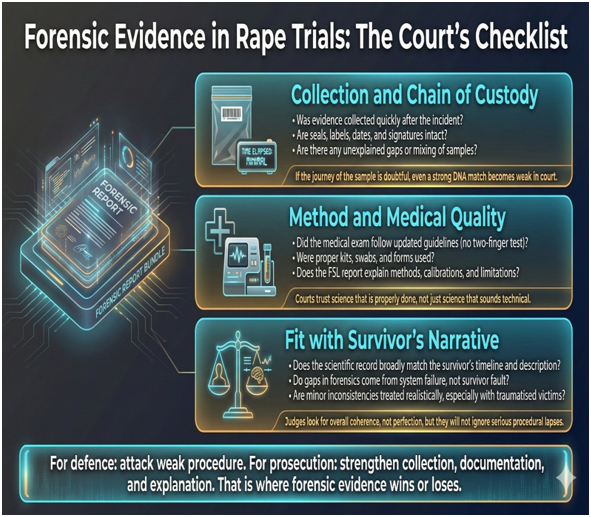
Judicial reasoning in rape cases hinges on how effectively a DNA sample has been taken in custody. There are cases in which DNA evidence has been deemed unreliable due to ambiguous sample transfer. This would point to situations where there were broken seals, where sample designations did not correspond, or where the transmission memo was not comprehensive.
In these circumstances, judges would contend that scientific evidence must not rest upon wobbly procedural grounds. This would indicate procedural considerations as means of maintaining a balance between scientific evidence and traditional notions of evidence validity.
A precise DNA match will make no difference if a court cannot confirm that this DNA was taken from a rape victim when it mattered. Forensic evidence is persuasive in Indian rape cases as it meets a judicial demand for objectivity. The Indian judiciary does not perceive science as being superior, as it appears complicated. Their appeal to science is due to the fact that it offers solutions for questions that evidences in person cannot. While science brings about certainty in regards to where, when, how, and with whom certain individuals are involved.
This puzzle comes together, and then all those components are utilized by the court to validate or dispute all other claims that are being placed before it. This verdict is in no way a product of technology. In all these cases, it has been emphasized by the judiciary that forensic science cannot make up for a flawed investigation.
An excellent DNA result cannot salvage a prosecution that has not accounted for their tardiness in taking samples as well as forurchins that were not properly encapsulated. This udence of caution exercised by the judiciary ensures that forensic evidence is used for a responsible, as opposed to a definitive, purpose.
Even in cases with airtight forensic results, a proper documentation and a corresponding explanation for how forensic evidence arrived in the forensic lab in the first place are demanded by courts. Thus, present day rape trials in India incorporate a blended model of evidence. While evidence from the rape victim plays a pivotal role, courts strive to identify scientific anchors that help consolidate the prosecution narrative.
Forensic evidence plays this role of consolidation. It Either confirms, denies, or explains human narratives that are presented in a court of law. Forensic evidence, when deployed effectively, becomes the most potent part of a rape case since it remains unshaken even when faced with pressures, presumptions, and cross-examinations. This explains why contemporary rape jurisprudence in India has been constructed around enhanced reliance on science in pursuit of truth.
The Gap Between Forensic Expectations and Real Outcomes in Rape Trials
The central tension in India’s rape trial framework is that the law increasingly depends on forensic science, while the system responsible for producing that science remains uneven and often deeply unreliable. The shift toward forensic centred investigation was deliberate. After the 2013 reforms, courts across the country began to treat DNA evidence, biological traces, injury analysis, and careful chain of custody documentation as the backbone of sexual offence prosecutions.
The new definition of rape in Section 63 of the Bharatiya Nyaya Sanhita widened the nature of prohibited acts, which made forensic corroboration even more important because the acts involved may not always leave visible physical injuries. In principle, this created a more survivor friendly framework. In practice, it exposed how dependent convictions had become on laboratories and hospital procedures that do not consistently meet national standards.
The biggest recurring issue is the delay in processing forensic samples. The Comptroller and Auditor General, in multiple state audits, has recorded long pendency periods in DNA labs, with some samples lying untested for several months.
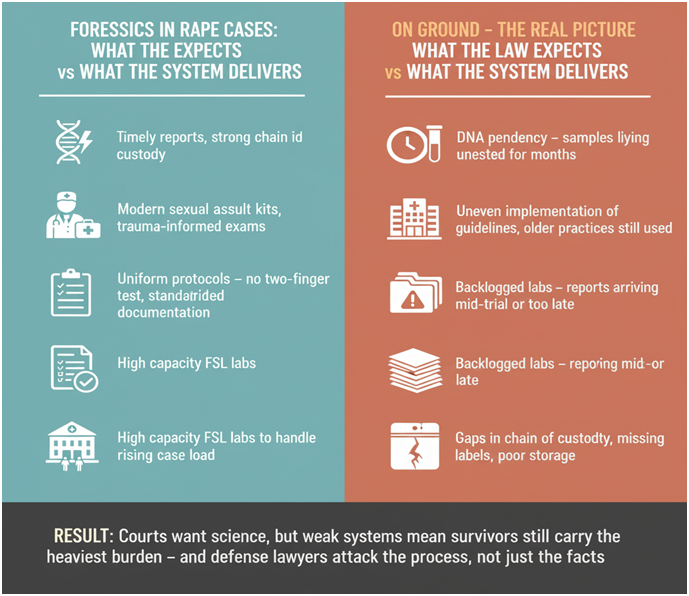
In rape cases, such delays weaken the evidentiary value of biological material, create gaps in the chain of custody, and give the defence more room to challenge the integrity of samples. The Parliamentary Standing Committee report from 2023 acknowledged that India needs at least five times its current forensic capacity to meet global standards.
Medical examinations continue to show inconsistency as well. Despite the clear ruling of the Supreme Court in Lillu v. State of Haryana, which held that the two finger test has no scientific value and violates dignity, the test has not disappeared uniformly across districts. Field studies by Human Rights Watch in 2017 found that many hospitals remained unaware of the updated guidelines or lacked trained personnel to carry out modern sexual assault forensic examinations.
These lapses directly affect the evidentiary strength of the prosecution because courts often lean heavily on the medical officer’s testimony to understand timing, injury patterns, and consistency with the survivor’s account.
Courts have attempted to adjust to these gaps. In Dharmraj v. State of Chhattisgarh, the Supreme Court held that investigative lapses should not be allowed to overshadow the core testimony of a survivor when her account is consistent and credible. Yet, trial courts do not uniformly apply this standard. Many judges still hesitate to convict when forensic reports are delayed or incomplete, even though the law does not require physical injury or biological residue to prove non consensual sexual activity.
This uneven judicial approach is partly rooted in older ideas that linked rape primarily with violent resistance and visible injury. The Supreme Court rejected such reasoning long ago in State of Himachal Pradesh v. Raghubir Singh in, holding that delayed reporting or lack of injury cannot be used to doubt allegations of rape. However, remnants of this thinking still influence trial outcomes, especially when forensic quality is low.
The future of rape trials in India depends on reducing this gap between what forensic science is expected to deliver and what the system actually produces. India has the legislative framework, but it does not yet have the uniformly trained medical workforce, standardised forensic protocols or laboratory capacity needed to support that framework. Until the country strengthens these pillars, rape prosecutions will continue to depend more on the resilience of survivors than on the reliability of the investigative process.
The Real Problem With Using Forensics in Rape Trials
Speaking With LawyersClubIndia, Advocate Sanjeev Kumar Tiwari said that “If you spend enough years in criminal courts, you stop romanticising forensic science. On paper, it sounds like the perfect solution. DNA fixes everything. A clean medical report seals the case. Chain of custody creates an airtight wall against doubts. step inside an actual courtroom and you realise how fragile this entire structure really is. The problem is not the science at all. It is the system trying to use that science with limited capacity, outdated habits and inconsistent training.”
He further said that “The average rape case in India does not fail because the survivor spoke late or changed small details. It fails because the evidence that should have supported her never reached its full strength. I have seen samples collected and then kept for days before being sealed. I have seen hospitals that still do not have a standard kit for sexual assault exams. I have seen forensic labs so backlogged that reports come out long after the trial is halfway done. These are not rare incidents. They are routine.”
Speaking about the court craft and forensic science “Once the case reaches court, the defence knows exactly where to press. They go after the chain of custody first. Who handled the samples. When were they sealed. Where were they kept. Then they shift to the timeline. Why did the lab take eight months. Why did the doctor forget to record an internal injury. Why is the swab missing one label. A judge hears all this and becomes cautious because criminal law demands certainty. The survivor’s testimony, no matter how firm, suddenly feels too lonely to carry the entire case.
Until India fixes the ground level problems in sample collection, medical training and laboratory capacity, forensic evidence will continue to be powerful in theory and unreliable in practice. The survivor will continue carrying the weight that the system should be holding. And that, for any lawyer who has seen enough rape trials, is the part that hurts the most.”
Call to Action
Handling sexual offence cases in India is tough. The law is complex, survivors are vulnerable, and every detail matters. If you’ve ever felt unsure reading an FSL report, struggled to make sense of DNA evidence, or hesitated during cross examination because the science sounded over your head, you are not alone. Most lawyers face this. The difference between a shaky case and a strong one often comes down to how well you understand the forensic evidence.
This is where proper training makes all the difference. You don’t just need theory—you need practical skills that you can use in court tomorrow. Understanding how DNA links the accused to the crime, how to read medical reports, how injury patterns tell a story, and how to challenge or support forensic findings without getting lost in jargon. That knowledge can be the difference between an acquittal and a conviction.
LawyersClubIndia’s Complete Training on Forensics in Sexual Offence Cases is designed for exactly this. It gives you hands-on exposure to FSL procedures, medical reports, DNA interpretation, and courtroom strategies that actually work. The course is focused, practical, and grounded in real Indian cases. You’ll learn to read the evidence, question it intelligently, and use it to build a convincing argument in court.
If you want to take your skills seriously and handle cases confidently, this is the course to invest in. The knowledge you gain here can save months of guesswork, and give you the confidence to handle the toughest sexual offence trials.
Join LAWyersClubIndia's network for daily News Updates, Judgment Summaries, Articles, Forum Threads, Online Law Courses, and MUCH MORE!!"


Tags :Others