
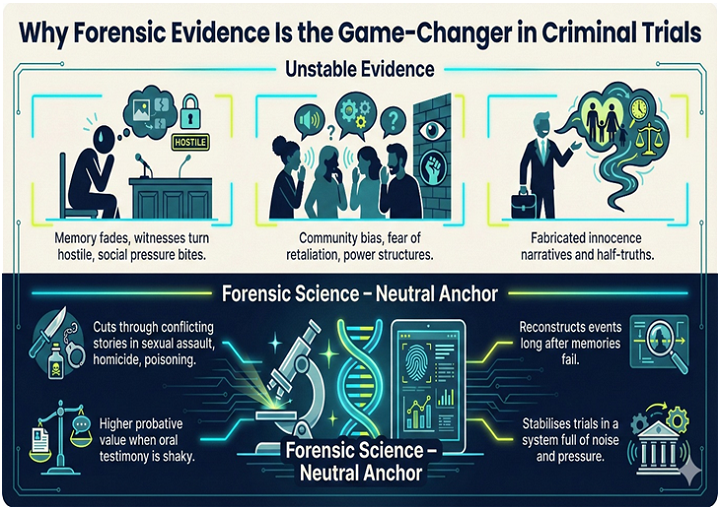
Our criminal justice system often functions in an environment which is saturated with social pressure, hostile witnesses, community bias, fear of retaliation, and deeply filed power structures. This makes many prosecutions vulnerable to collapse even before they have begun. Oral testimonies may often be inconsistent, memory fades, witnesses turn hostile, and fabricated innocence narratives surface confidently.
Forensic evidence enters this landscape not as some kind of dramatic plot device but rather as a neutral factual anchor that constrains the boundaries of possible stories. In cases involving sexual assault, homicide, poisoning, and suspicious injuries, science has time and again proved to be the turning point. It bars the survival of false exculpatory theories under scrutiny and enables courts to reconstruct events long after accuracy in memory and testimony becomes impossible.
In our courts, for the last two decades, a marked trend has been that scientific evidence possesses greater probative value and, at times, overrides a shaky chain of oral testimony. In this article, a look is made at how forensic science has changed verdicts in landmark cases across various offence categories and why courts increasingly use it as a stabilizing force.
Forensic DNA And Its Use in Sexual Assault Prosecutions
The trials of sexual assault in India involve the testimony of the survivor as the lead evidence and much of the case hinges on and revolves around how consistently and confidently she can restates her version in the courtroom.
This creates a structural vulnerability, where it is often part of the suspect's legal defense to discredit her memory or highlight discrepancies in recollection or take advantage of hostile environments that push her to water down her testimony or not delve into detail regarding the crime. It is here that scientific evidence shifts attention from moral debates and disputes over credibility and roots the story in biological fact.
The most clear example of this shift in recent history was the prosecution after the 2012 Delhi gangrape and murder. In the case of Mukesh And Another v State of NCT, when the case came up to the court, the prosecution did not rely exclusively on testimonies by the victim or her friend.
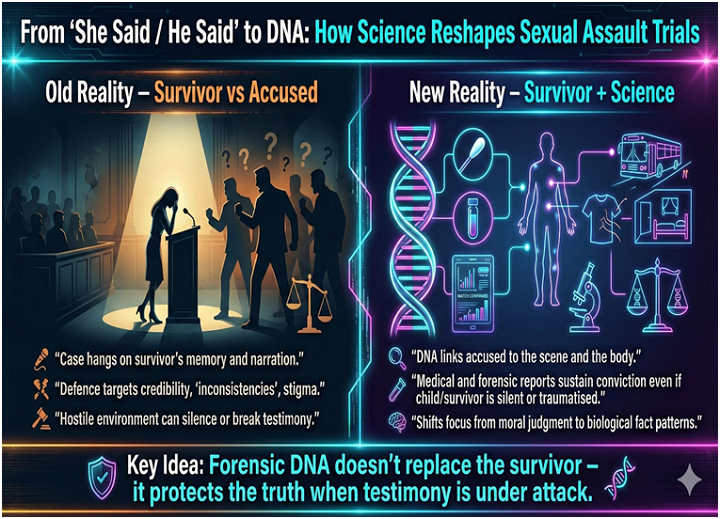
The Central Forensic Science Laboratory presented a comprehensive DNA profile that matched the accused across biological samples taken from the victim’s body, her clothes, and the bus where the assault was committed.
The judgment by the Delhi High Court relies expressly on these findings to uphold the conviction. The court has reproduced portions of the DNA report and then considered it as clinching evidence to establish that the appellants were in the bus when the offence was committed and, therefore, there is no room for chances. In this regard, the forensic report is referred by the court in its electronic record.
In State of Rajasthan v. Chatra, the Supreme Court restored the trial court’s conviction for the sexual assault of a minor after the Rajasthan High Court had acquitted the accused solely because the child remained silent and shed tears during her examination.
The Supreme Court held that a traumatised child’s silence or emotional response cannot automatically defeat the prosecution where medical and other corroborative evidence supports the charge. The court emphasised that child testimony must be assessed with care and that physical and circumstantial evidence may properly sustain a conviction even when the child cannot narrate events fully in court
Such cases are examples of how DNA enables the court to reconstruct events even when human testimony falters. More importantly, it shifts sexual assault prosecutions from moral narratives to evidentiary fact patterns. This removes some of the structural biases that earlier harmed survivors and helps ensure that the truth about physical contact cannot be destroyed by intimidation or stigma. Forensic science thus becomes a stabiliser that protects the credibility of the legal process.
Bloodstain Patterns, Injury Mapping and the Reconstruction of Homicide
Homicide investigations often consist of competing stories. The accused may claim accident, natural death, or suicide. When such explanations are at variance with physical evidence, forensic pathology and reconstruction become important tools for the court. A dramatic example is the case of Madhu v State of Karnataka, in which the death of a woman was explained by the accused as the result of accidental burns caused while cooking.
Forensic analysis, however, pointed in a very different direction. According to the forensic expert testifying, the pattern indicated pouring of kerosene rather than an accidental igniting flame. According to his testimony, there was no soot in the respiratory tract; hence, at the moment the burns occurred, the victim did not inhale the smoke. With this, and also kerosene residue on clothing, the prosecution established a controlled burn rather than an accident.
The Supreme Court accepted this reasoning, treating the scientific evidence as decisive in rejecting the accidental explanation.
Other examples include the more controversial outcome of the Aarushi Talwar and Hemraj double murder case. The investigation initially was marred by procedural lapses. However, later forensic reconstruction of events was done in a more accurate manner.
Interpretation of bloodstain pattern, assessment of weapon impact, and matching of dental cast were used to check if the crime scene matched the statements of possible suspects.
Although the Allahabad High Court finally acquitted the parents, the judgment contains extensive discussion about which forensic findings were reliable and which inconsistent, and about how scientific interpretation influenced the court’s evaluation of competing theories. The High Court’s detailed record shows how forensic evidence shapes judicial reasoning, even if not always in support of the prosecution.
A similar transformation in evidence has taken place in the Nithari killings, where skeletal remains found near the residence of the accused made the determination of identity or cause of death impossible. Forensic anthropologists, DNA laboratories, and ostological experts pieced together the narrative.
DNA profiling identified victims based on a comparison of bone samples with biological relatives. Specific cut marks and dismemberment patterns established the acts as homicidal in nature. Absent such scientific reconstruction, individualised evidence necessary for charging the accused with particular murders would not have been available to the prosecution. Such methods are confirmed through official press releases issued by the Central
Bureau of Investigation.
These cases illustrate that homicide trials increasingly depend on scientific reconstruction rather than narrative persuasion. Where the defendant advances an alternative story, forensic evidence tests its plausibility against objective physical facts.
Once a court recognizes that an accidental or suicidal explanation cannot be reconciled with the results of bloodstain pattern analysis, movement analysis, or injury mapping, it is the scientific reconstruction that forms the more credible account. This technique minimizes the area for misleading or fabricated defenses and increases the reliability of homicide prosecutions.
Toxicology as the Turning Point in Poisoning Trials
The cases of poisoning are very unique in nature, as they usually do not have eyewitnesses, symptoms resemble natural illnesses, death may occur hours after ingestion, and the accused can be a trusted family member. Thus, toxicology becomes the only reliable way to determine what happened. One of the most revealing Indian examples is the Kerala cyanide homicide series committed by Jolly Joseph.
A series of sudden deaths within the extended family were considered natural or accidental for some years. Only when authorities restarted the inquiry from a forensic standpoint did toxicological tests uncover the presence of cyanide in the victims. The post-mortem investigation and chemical tests performed on preserved materials revealed a common toxic profile that linked previously unrelated events.
The detailed accounts of how cyanide was traced come through media reporting and police disclosures. The forensic finding shifted the presumed course of events from a string of tragic deaths to that of a serial pattern of premeditated murders. Courts have long held that toxicology holds the highest probative value in poisoning cases because chemical detection is not subject to manipulation or subjective interpretation.

This would form a direct factual contradiction to any natural death theory when a toxic substance is found in blood, gastric lavage, or organ tissue. In fact, many times, the case rests on the strength of toxicology reports alone, though all other circumstantial evidence may be weak.
Another important example can be the case of Udayan Das in Madhya Pradesh, where the victim's body was hidden in a cemented structure. This case demonstrates how forensic toxicologists found evidence of sedatives and toxic chemicals in preserved tissues when they investigated decomposing remains.
The accused's attempt to present the death as voluntary and accidental was refuted by the forensic findings. The prosecution was able to disprove any interpretation of the events and prove the deliberate delivery of hazardous chemicals thanks to these results. Corroborating information is provided by public reporting.
As the forensic toxicology provides an answer to the crucial question of whether the cause of death was homicidal or natural, it frequently becomes the single most significant component in court decisions.
Once science answers this question, the narrative space for the defence shrinks dramatically. The courts have held time and again that poison leaves behind a chemical trail even if everything else in the case is supported by weak or hostile witnesses. That's why toxicology is the backbone of poisoning prosecutions and, more often than not, the point on which such prosecutions turn.
Injury Analysis and Medical Forensics in Assault and Suspicious Death Cases
Injury analysis has emerged as one of the most decisive tools for courts when confronted with cleverly constructed theories of accident, self-inflicted harm, or sudden unexplained trauma. The reason lies in the simple but powerful principle that the human body records the truth even when the surrounding witnesses fail to.
Every bruise tells a story of force, every fracture carries the signature of its direction, and every abrasion has a distinct pattern that reflects the surface which caused it. Medical forensics converts these physical traces into a coherent narrative that can be measured, quantified and explained in the courtroom.
Courts rely on such evidence because it creates a foundation of objective reality that human testimony cannot always match. It is particularly helpful in cases where the defence relies on vague phrases like sudden fall, accidental impact or self-inflicted laceration, which are easy to assert but difficult to reconcile with injury morphology.
A clear demonstration of this lies in Hari Om v State of Uttar Pradesh, where the accused attempted to reduce the alleged murder into a minor scuffle that resulted in an accidental fall. The post mortem report contradicted this version by showing deep muscle contusions, multiple fractures and well-defined abrasion patterns.
The injuries reflected repeated force and not the single point impact that a fall would cause. The Supreme Court analysed the medical evidence to show that the force causing these injuries was deliberate. Without the forensic insights, the accused’s narrative could have appeared plausible in isolation.
Instead, the court relied on scientific mapping of injuries to strip away the misleading version and reveal the sequence of blows.
An equally illustrative example is the Soumya Vishwanathan murder case, where defensive arguments tried to portray the fatal gunshot as an unfortunate accident rather than a deliberate act during a robbery.
Forensic ballistic experts examined the wound channel, the entry and exit points and the angle at which the projectile passed through tissue. These assessments demonstrated that the firearm was discharged from a moving vehicle at a predictable trajectory. This contradicted any explanation that suggested accidental firing or ricochet.
The presence of this scientific clarity helped the court separate fabricated defences from the physical reality of how a bullet behaves when discharged under particular conditions.
Injury forensics is not limited to bruises or gunshots. Courts often rely on dental impressions in bite mark cases, ligament damage to assess attempted strangulation and patterned injuries to identify specific weapons.
For instance, in several domestic violence related homicides, the marks left by the blunt side of agricultural tools or the ridged surface of wooden sticks have been reconstructed to show sustained assault rather than a sudden loss of control. The geometry of these injuries allows forensic surgeons to reconstruct the approximate shape and dimensions of the weapon used. The reconstruction helps police recover the weapon and strengthen the chain of evidence. These steps directly influence judicial findings because they enable courts to link weapons to injuries with scientific precision.
Another vital area is the forensic distinction between ante mortem and post mortem injuries. Many homicide accused attempt to disguise the true cause of death by inflicting superficial injuries after the victim has died or by describing fatal wounds as accidental. Medical examiners identify whether bleeding, inflammation, tissue reaction or cellular response occurred before death.
This helps courts decide whether the injuries were part of the attack or created later in an attempt to mislead the investigation. In suspicious burn cases especially, the distinction between burns caused while alive and burns inflicted after death becomes decisive. Forensic doctors examine soot in the respiratory tract, carbon monoxide saturation in the bloodstream and the presence of blistering to determine whether the victim inhaled smoke.
The pattern of heat damage becomes a scientific tool that exposes whether the burning was accidental or staged to conceal murder.
These forensic principles have reshaped how courts evaluate competing narratives. If the accused claims that the victim slipped, but the injury pattern reflects multiple impact points, the fall theory collapses.
If the defence states that a wound was self-inflicted, but the angle and depth require an impossible posture, the claim becomes untenable. If the accused asserts sudden provocation, but injuries reveal long duration assault, the defence loses credibility. In all these situations, the scientific mapping of the body becomes the decisive witness whose testimony cannot be manipulated, intimidated or coached.
Injury forensics influences judicial outcomes because it brings a level of clarity to questions that would otherwise remain obscured by self-serving theories. Courts prefer this form of evidence because it transforms ambiguity into measurable facts and exposes the anatomy of violence in a manner that surpasses subjective recollections.
The shift toward forensic reasoning is therefore not merely a procedural convenience but a structural enhancement that improves the accuracy of adjudication in crimes involving physical force.
Why Courts Treat Forensic Evidence as a Stabilising Influence
The increasing judicial reliance on forensic evidence in India is not a trend driven by fashion but by structural necessity. Courts operate in an adversarial system where witnesses may be forgetful, hostile or intimidated. Police testimonies may be doubted because of past investigative failures.
Social bias may distort how events are narrated. Forensic science enters this uneven landscape as the rare component of evidence that neither favours the prosecution nor the defence. It simply reflects what can be scientifically verified. This neutrality gives it structural power. Courts treat scientific findings as a stabilising force because they create an objective spine around which the rest of the case can be evaluated.
Indian law already reflects this preference through statutory provisions. Section 45 of the Indian Evidence Act explicitly recognises expert opinion in science, medicine and identification. Section 293 of the Code of Criminal Procedure permits courts to rely on forensic reports without summoning the expert, unless the defence raises a substantial challenge requiring cross examination. This legislative trust gives scientific findings a privileged position in the courtroom. More importantly, the judiciary has repeatedly stated that expert evidence becomes decisive when it contradicts improbable human testimony.
One of the core reasons forensic evidence stabilises trials is its replicability. A DNA profile, once generated, can be examined by another laboratory and the outcome will be identical, provided proper procedure is followed. This distinguishes forensic science from witness testimony, which may change with time, emotion or pressure.
Courts factor this replicability into their reasoning because it reduces the uncertainty inherent in criminal adjudication. For instance, in sexual assault trials, the Supreme Court has acknowledged that survivors may hesitate or falter under hostile cross examination. DNA evidence therefore helps shift the centre of gravity from the survivor’s psychological endurance to material facts about physical contact.
Forensic science also resists intimidation. Witnesses, especially in rural and semi urban settings, may retract statements under social pressure. Scientific evidence, however, cannot be threatened or induced. It does not change with time unless mishandled. This makes it the safest form of evidence for courts to rely upon in cases involving influential accused persons or socially vulnerable victims.
Poisoning cases offer the clearest illustration. Toxicology findings on stomach contents or tissue samples remain valid even after suspects attempt to manipulate the narrative. When cyanide is detected in internal organs, no amount of witness intimidation can change the chemical signature. This is why courts treat toxicology as a central beacon in such trials.
Another reason forensic evidence stabilises the adjudicatory process is its capacity to limit the narrative freedom of the defence. Criminal accused often assert alternative theories of events that are logically possible but physically improbable. For example, an accused may claim that the victim’s head injury occurred during a fall. Without scientific input, the story may seem plausible. Injury mapping exposes whether the wound reflects single point impact or repeated force.
Bloodstain analysis reveals whether the victim was upright, lying down or moving at the time of impact. These assessments shrink the available narrative space. Courts use them to filter out imaginative defences and retain only those explanations that are consistent with physical reality.
The stability offered by forensic science also improves appellate review. Oral testimony often becomes difficult to re evaluate at the appellate stage because the appellate court did not observe the witness firsthand. Scientific evidence, however, sits permanently in the record.
When the Supreme Court or a High Court examines an appeal, forensic reports remain as objective markers that transcend the limitations of human memory. This helps higher courts verify whether the trial court’s findings were grounded in reliable material. In homicide appeals especially, forensic reconstruction allows the appellate court to see whether the trial judge relied on scientifically plausible interpretations.
Courts also view forensic evidence as stabilising because it reduces the risk of wrongful conviction. When forensic proof supports guilt, courts proceed with greater confidence. When forensic proof contradicts the prosecution’s theory, courts have a firm basis to acquit. This balance strengthens the fairness of the system.
A clear example is the Aarushi Talwar case, where the High Court examined forensic inconsistencies to justify acquittal. The judgment shows that forensic science protects both sides by preventing convictions based solely on suspicion and preventing acquittals based solely on emotional narratives.
The stabilising influence of forensic science therefore lies in its independence. It does not require belief, memory or courage. It requires only proper procedure. Courts recognise this and increasingly treat forensic evidence as the backbone of criminal adjudication. This shift is not a temporary phase but a structural evolution.
As laboratories improve, methodologies standardise, and case law deepens the courts’ trust in science, forensic evidence will continue to play the role of the quiet but decisive force holding the criminal justice system in balance.
FSL Report and The Courtroom Craft
Speaking to the contend head of LawyersClubIndia, Advocate Ashesh Amrit Mahapatra said that "If you’re trying to break down an FSL report in cross, the trick is not to attack the science in the abstract but to look for the small, boring details that labs often mess up". He further stated that "Most lawyers flip to the last page and start arguing with the conclusion. That’s the weakest strategy. I usually tell young lawyers to start with how the sample even reached the lab. If the seals weren’t intact, if the handwriting doesn’t match, if there’s a time gap that nobody explains, you already have something real to work with. The report loses weight if the sample’s journey itself is messy."
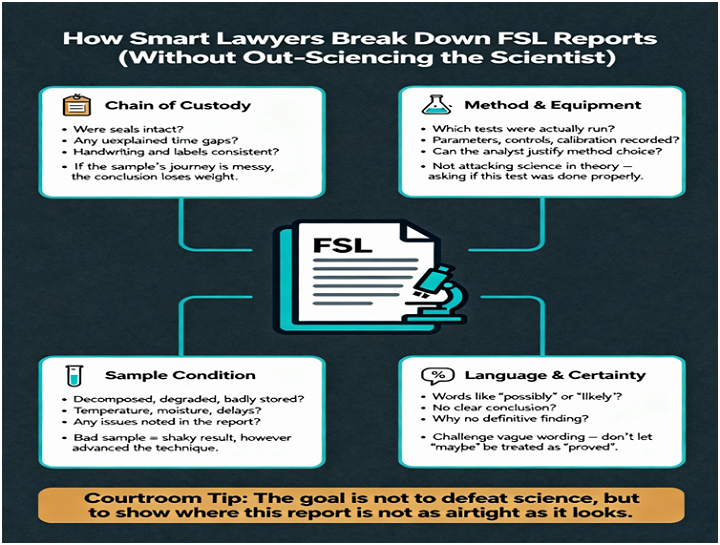
Emphasising upon doing the due diligence of the report, the advocate said that "Another thing I always look at is whether the report actually describes what tests were run. Many reports just mention a fancy technique without explaining settings, controls, or calibration. If the analyst can’t explain why that method was chosen or whether the equipment was functioning properly that day, the confidence in the result drops. It’s not about attacking the science; it’s about asking whether it was done properly this time."
Going more indepth upon the details, Mr Mahapatra expanded by saying that "The condition of the sample is another soft corner. Important details, like if something was stored badly or was already in a decomposed or a rather degraded shape from before even it reached the lab, can change everything. Ask simple questions about temperature, moisture, the state of the seal. Analysts sometimes admit things that people overlook because everyone is too busy quoting scientific terms.
And then read the language carefully. Make sure to see that if the report uses words like “possibly,” “likely,” or “suggestive,” don’t treat that as certainty. Push them on why they couldn’t reach a clear finding. Most FSL reports have enough cracks if you know where to tap. The point of cross is not to out-science the scientist, but to show the court where the report isn’t as airtight as it looks."
Call to Action
If this topic interests you even a little, it’s worth taking the next step. Forensic science is no longer something only experts handle. The lawyers who understand the basics including DNA reports, injury patterns, toxicology, digital traces and end up asking better questions and building stronger cases.
If you want a simple, practical way to learn this without getting lost in jargon, you can browse the forensic courses on the LawyersClubIndia platform. They’re easy to follow, made for actual courtroom use, and help you get comfortable with the science behind the evidence.
Conclusion
Forensic evidence has quietly transformed criminal adjudication in India. It stabilises trials that would otherwise collapse under social pressure, recantation, or fabricated defences. Scientific evidence does not replace witnesses but prevents distortions in human storytelling from corrupting the truth. Sexual assault prosecutions gain factual certainty through DNA profiling.
Homicide investigations gain narrative coherence through reconstruction and injury mapping. Poisoning cases become prosecutable through chemical detection. Suspicious injury cases gain clarity through medical analysis that reveals patterns hidden beneath the surface. Courts increasingly rely on scientific inputs because they narrow the boundaries of possible narratives and reinforce the integrity of the justice process.
FAQS
Q: What exactly is an FSL report and why does it matter so much in court?
A: An FSL report is the written record of all forensic testing done on the exhibits collected in a case. Courts rely on it because it turns physical traces — blood, hair, digital data, injuries, chemical residues — into structured scientific findings. It matters because it often speaks where witnesses hesitate or forget. If the report is solid, it can hold a case together. If it has gaps, those gaps become important lines of defence.
Q: Are forensic reports always correct?
A: No, and that’s exactly why lawyers cross-examine the analyst. Labs deal with huge workloads, overused instruments and the occasional sloppy chain of custody. A report is only as good as the process behind it, and the process can go wrong in small ways that create big doubts. Courts have repeatedly said that forensic evidence needs careful scrutiny, not blind acceptance.
Q: Can an accused be convicted on forensic evidence alone?
A: It depends on the type of case and the strength of the evidence. DNA is considered highly reliable when the sample quality is good and the chain of custody is clean. Fingerprints, handwriting and bite marks are treated more cautiously. Many judgments say scientific evidence should be read along with the rest of the case, not in isolation. When the science is airtight, it can carry the weight. When it isn’t, it can’t.
Q: What is the most common weakness in an FSL report?
A: The chain of custody. A missing seal number, a broken packet, a time gap in movement, or a mismatch in signatures can throw the entire report off balance. Most lawyers underestimate how often these small lapses happen. Courts don’t ignore them when they appear in cross-examination.
Q: Can a defence lawyer challenge the expertise of the forensic analyst?
A: Yes. If the analyst doesn’t have proper qualifications, has not performed the test themselves, or cannot explain the scientific steps in plain terms, it weakens the weight of the report. The courtroom is not impressed with jargon; it wants clarity. If the expert cannot provide that clarity, their opinion loses strength.
Q: Why do some forensic reports use vague language like “may,” “likely,” or “suggestive”?
A: Because not every scientific test leads to a neat yes-or-no answer. Sometimes the sample is degraded, the method has limits, or multiple explanations are possible. These words are not weaknesses by themselves, but they show uncertainty. A good cross-examination explores what caused that uncertainty and whether it affects the final conclusion.
Q: Are digital forensics handled differently from physical forensics?
A: The principles are similar, but digital forensics has its own vulnerabilities. The integrity of devices, the way data was extracted, the presence of metadata, and the possibility of tampering all play a major role. Courts look for clear documentation showing that the digital trail is authentic and untouched.
Q: Why should young lawyers bother learning forensic basics?
A: Because modern litigation runs on documents and scientific reports more than dramatic witness testimony. If you know how to read an FSL report, you stop being dependent on others, and you start seeing strengths and weaknesses in a case that are invisible to most people. It genuinely changes the way you prepare and argue.
Join LAWyersClubIndia's network for daily News Updates, Judgment Summaries, Articles, Forum Threads, Online Law Courses, and MUCH MORE!!"


Tags :others