
Understanding the Concept of Negligence
Negligence refers to the failure to exercise the care which a reasonable person would have taken under similar circumstances, leading to causing harm to another. It stems from the principle that every person owes a duty to act with due care towards others, and the said duty is breached it gives rise to a liability.
The earliest development of negligence as an independent tort began in English common law, where it was recognised that even without a contractual relationship, an individual could be held responsible for careless acts that cause foreseeable harm.
In India, though there is no codified law on the law of torts but the courts have borrowed to a considerable extent from English precedents. The elements required to establish negligence include a duty owed by the defendant, a breach of that duty, and resultant damage caused because of the breach. The court has also got to consider the foreseeability of the harm and as to whether a reasonable man placed in the position of the defendant could have prevented it by ordinary prudence.
The landmark English case, Donoghue v Stevenson {1932 AC 562 HL} gave us the modern understanding of the law surrounding negligance and its concept. In this case, there was one Mrs Donoghue who fell ill after consuming ginger beer containing a decomposed snail. She had sued the manufacture industry for damages for negligence. Now, though she had not directly purchased the bottle, the House of Lords held that the manufacturer owed a duty of care to the ultimate consumer.
Lord Atkin gave the neighbour principle and held that a person is obliged to take reasonable care to avoid acts or omissions which could reasonably foreseeably injure one’s neighbour, that is, the persons directly affected by one's actions. This remains as one of the important foundations of negligence law and continues to influence courts.
The Essential Elements of Negligence
To ascertain the acts of negligence, three elements must be satisfied: a legal duty of care, breach of that duty, and damage as a consequence of such breach. Each element must be established by facts and evidence to show how the defendant’s conduct has fallen short of the expected standard. Duty of care signifies a legal obligation to avoid causing harm to others. A breach occurs when the conduct of the defendant fails to meet the standards of a reasonably prudent person. Damage indicates the actual harm suffered, in many ways-physical, financial, or even psychological. The foreseeability of the type of harm caused is often used by courts to determine liability.
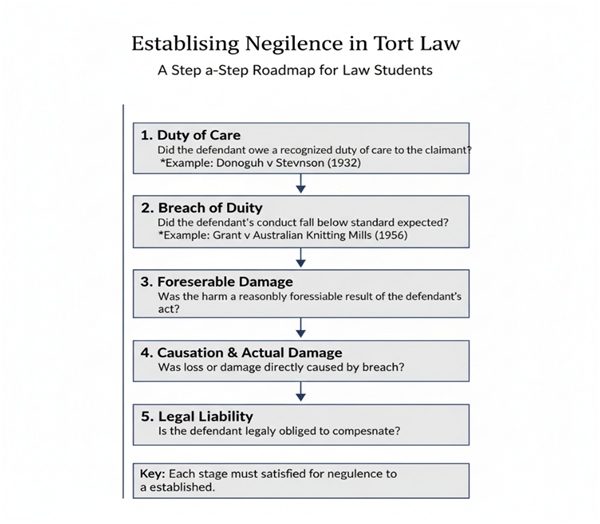
In Grant v. Australian Knitting Mills (1936) AC 85, the Privy Council applied the neighbour principle to a manufacturer of woollen underwear containing sulphite residues which had caused dermatitis. In this case, the court held that the manufacturer is liable for failing to ensure safety in its product for consumer use.
Duty of Care in Indian Context
In India, the principle of a duty of care first found articulation in Municipal Corporation of Delhi v. Subhagwanti [AIR 1966 SC 1750], in which a 100-year-old clock tower, maintained by the municipal authority, fell down and killed several people.

The Supreme Court held the Corporation to be liable on the view that a continuing duty exists to maintain public structures safely. The case thus crystallized the position that government bodies cannot escape liability arising from any element of negligence on their part in maintaining public property since they owe a duty of care to citizens using public amenities.
An identical view was extended in Municipal Corporation of Delhi v. Sushila Devi [AIR 1999 SC 1929], where a pedestrian died due to negligence in maintenance of drainage. The Court held that it is the statutory duty as well as moral obligation of municipalities to maintain public infrastructure. These decisions underpin that the duty of care extends beyond private individuals to the state authorities and public institutions.
The Supreme Court in Jacob Mathew v. State of Punjab [(2005) 6 SCC 1] addressed the duty of care within the medical profession. The case involved the death of a patient allegedly due to a doctor’s negligence in providing an oxygen cylinder. The Court held that medical negligence must be judged against the standard of an ordinary competent professional exercising reasonable care.
It drew a distinction between an error of judgment and negligence, noting that a professional may not be held liable merely for a mistake if due care and skill were exercised. Paragraph 48 of the judgment clarified that for criminal negligence, the degree of negligence must be gross or of a very high degree, while civil negligence requires proof of breach of reasonable duty causing damage. This case remains one of the most cited authorities for establishing professional duty of care in India.
Fault Liability and Its Role in Tort Law
Fault is the cornerstone of negligence. Fault denotes a culpable state of mind or a falling short of a reasonable standard of conduct. The law of torts charges only for those injuries that are due to a failure to exercise the standard of care manifested by a reasonably prudent person. Fault liability serves, therefore, as a balancing factor between individual liberty and social accountability.
In Rajkot Municipal Corporation v. Manjulben Jayantilal Nakum [(1997) 9 SCC 552], the Supreme Court examined the theory of fault in administrative negligence. The deceased man fell into an open manhole. The Court found the Corporation liable, explaining that fault lay in the omission of the authority to perform its statutory duty. It held that the public authorities cannot escape from liability by raising administrative burden when their inaction results in foreseeable damage.
The principle was also applied in State of Haryana v. Santra [(2000) 5 SCC 182], where a government doctor negligently performed sterilisation surgery, resulting in unwanted pregnancy. The Supreme Court held the State vicariously liable, observing that negligence in performing statutory or medical duties constitutes actionable fault. Paragraph 18 of the judgment observed that failure to perform a duty of care owed to the public amounts to breach of the legal standard of reasonableness.
Development of Duty of Care in Indian Jurisprudence
Indian courts have progressively widened the ambit of duty of care to encompass medical, municipal, educational, and administrative negligence. The growth of this principle in itself demonstrates that the courts have become quite sensitive to the safety and well-being of the citizens. Courts have applied a rule of foreseeability, proximity, and reasonableness for finding out whether a duty existed or not.
In Poonam Verma v. Ashwin Patelv [(1996) 4 SCC 332], the Supreme Court held a homeopathic doctor liable for negligence when he administered allopathic medicines to the patient. The Court explained that practicing in a system of medicine for which one is not qualified amounts to gross negligence, since that will be against the expected standard of care.
Similarly, in the case of K Balasubramanian v State of Tamil Nadu 1994 2 SCC 448, the court held that the State was liable for negligence when a school building collapsed and as a result several students were killed. The Court ruled that such educational institutions have a continuing duty to ensure infrastructural safety in schools and further maintained that the government owes a duty of care for the protection of children within its institutions.
Strict Liability and Its Concept
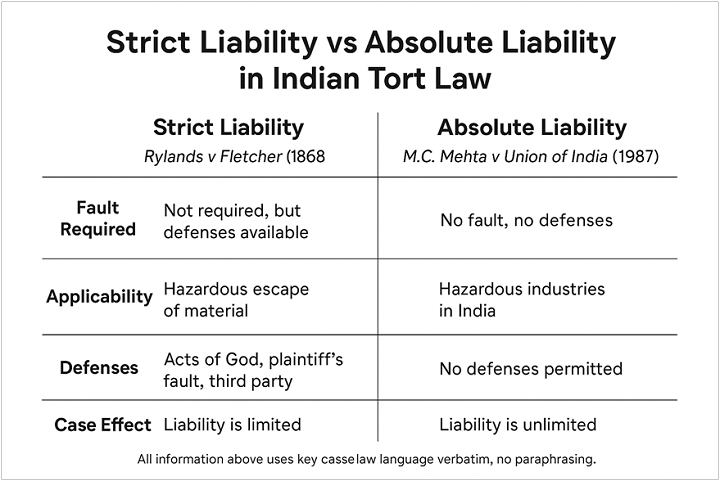
This is one of the most significant shifts in the evolution of tort law, changing a basically fault-based system into an objective and socially oriented doctrine. Traditional negligence depended upon proof that the defendant owed a duty of care, breached the same, and thereby caused foreseeable harm.
This model became increasingly inadequate with the growing complexity of industrial society: individuals were frequently injured in accidents in factories, mines, and power plants without any negligence on the part of their owners or operators being demonstrable. This tension between justice and evidence led to the formulation of the principles of strict and absolute liability.
The concept of strict liability stems from the landmark case of Rylands v Fletcher 1868 LR 3 HL 330, where the House of Lords held that a person who, for his own purposes, brings onto his land anything likely to do mischief if it escapes, must keep it at its own gurantee that no harm would be caused because of the same. If it escapes and causes damage, he is prima facie liable, notwithstanding lack of fault.
This principle marked the departure from fault-based liability, introducing a form of no-fault responsibility. This placed the burden of risk upon the person who controlled the potentially dangerous thing, recognizing that with that control comes an enhanced duty of care to society.
Rylands v. Fletcher was first adopted in India by the courts in several cases, including Madras Railway Co. v. Zamindar of Carvatenagarum (AIR 1944 Mad 492), but the real transformation actually came in the Supreme Court’s decision in M.C. Mehta v. Union of India (Oleum Gas Leak Case)v (1987) 1 SCC 395.
The Supreme Court declined to operate the English rule of strict liability following a gas leak at the Shriram Food and Fertilizers factory in Delhi causing serious injury and loss of life. Justice P.N. Bhagwati held that the Rylands principle had become outdated in an industrial society, where, though such hazardous operations become necessarily to be undertaken, yet the obligation to carry the risk cannot be escaped.
He formulated the doctrine of absolute liability, and held that an enterprise which is engaged in an inherently dangerous or hazardous activity owes an absolute, non-delegable duty to ensure that no harm results.
If damage is caused, the enterprise is strictly liable to compensate all the affected, without any exception or defence. The Court rejected the conventional exceptions like “act of God” or “act of stranger,” on the ground that creation of risk was sufficient to impose the social cost on industries. The judgment held that Indian tort law no longer needed proof of fault when industrial or environmental hurt arises.
This particular holding had two rationales, first was to protect victims in an unequal contest between individuals and large corporations and second was to make sure the cost of industrial hazards is internalized by the enterprise that profits from the activity.
The decision in M.C. Mehta also laid the foundation for environmental jurisprudence in India by connecting the right to a safe environment to Article 21 of the Constitution. This linking of tort law with fundamental rights helped deepen the moral dimension of liability, making it not merely a private wrong but a breach of constitutional duty.
Subsequent decisions have confirmed this view and applied it further. In Indian Council for Enviro-Legal Action v. Union of India (1996) 3 SCC 212, the Supreme Court ordered chemical industries that polluted the village of Bichhri in Rajasthan to pay the cost required to restore the environment. The Court explained that the “polluter pays” principle logically follows from the doctrine of absolute liability.
In Vellore Citizens Welfare Forum v. Union of India (1996) 5 SCC 647, it reiterated that industries engaged in hazardous activities must compensate for any harm irrespective of intent or negligence. Thus, the Indian approach evolved from Rylands v. Fletcher's limited rule to a uniquely indigenous model of social justice through absolute liability.
In other words, the emergence of no-fault liability is a transition from blame on an individual to systemic responsibility. The law has felt that in modern industrial society, the vastness of the operation requires an absolute undertaking. The courts today evaluate justice not by intent but by consequence, so that no individual is made to bear the loss for another person's venture. This shift also reinstates the role of the State in regulating and scrutinizing industries, thereby coupling tort principles with the wider administrative and environmental apparatus that defines governance in India.
Foreseeability and Proximity as the Basis of Duty
Modern negligence law is squarely based on these two founding principles of foreseeability and proximity. These principles define when a duty of care arises and when a defendant may be held liable in damages. The question is not simply whether one party has caused harm to another, but whether a reasonable man could have foreseen that it might occur, and whether there was a sufficiently close relationship between the parties to justify imposing the duty.

The concept of foreseeability was first discussed in the landmark case of Donoghue v. Stevenson 1932 AC 562, wherein the bench comprising of Lord Atkin gave us the “neighbour principle.” This basically meant that one must take reasonable care to avoid acts or omissions which one can reasonably foresee would be likely to injure one's neighbour. Thus, the word “neighbour” was held to be anyone who is so closely and directly affected by one's act that one ought reasonably to have them in contemplation.
This reasoning has been repeatedly adhered to by the Indian judiciary while developing its own jurisprudence on duty of care. In State of Rajasthan v. Vidyawati (AIR 1962 SC 933) the Supreme Court applied vicarious liability upon the government for the death of a pedestrian caused by a state employee driving a jeep for official duties negligently. The Court held that public authorities are under the same duty of care as private individuals.
It was foreseeable that careless driving by a servant of the state could cause injury to citizens; similarly, proximity exists because the conduct of the employee bears direct relation to the injury caused to the victim.
The jurisprudence around foreseeability helps in ensuring that only reasonably predictable harm is compensable. Howe the concept of proximity adds a deeper technicality. It deals with the closeness of the relationship between the particula of the wrongdoer and the injury suffered by the victim.
For example, in the case of Caparo Industries plc v. Dickman 199 AC 605, the House of Lords developed a threefold test which comprised of foreseeability of harm, proximity between th parties, and whether it is fair, just, and reasonable to impose a duty. Indian courts often apply this balanced approach w expanding or limiting the scope of negligence claims.
Application of these principles is seen in Municipal Corporation of Delhi v. Subhagwanti, where the falling of a clock tower caused destruction of life. The Court held the corporation liable as the danger was foreseeable and could have been prevented: the structure was old, visibly unsafe, and its fall directly endangered the public using it every day.
The injury and the concurrent failure to maintain by the authority were sufficiently proximate to each other. In Poonam Verma v. Ashwin Patel (1996) 4 SCC 332, the Supreme Court held that a homeopathic doctor who prescribed an allopathic treatment has been held to be negligent per se as injury by such treatment was foreseeable and proximity was established by the relationship of doctor and patient, and as such, the duty of care would be properly and clearly ascertained.
Foreseeability and proximity also define the limits of liability, saving the law from being an instrument of infinite responsibility. In Bourhill v. Young (1943 AC 92), a Scottish case often cited in Indian judgments, the court refused recovery to a bystander who suffered shock in their case after viewing a road accident. The damage was not foreseeable to the motorcycle in relation to the claimant, nor could proximity be established. Such restraint ensures that the principles of negligence do not go off kilter and always remain fair without overreach.
Indian courts have also applied these tests in the context of public authorities. In Kasturi Lal Ralia Ram Jain v. State of UP, the Supreme Court refused compensation when gold seized by police was lost due to negligence, holding that the act was independent in nature and the state cant be held liable for the same.
However, later cases such as Nilabati Behera v. State of Orissa, the court had shifted this view to hold that on issues of negligence, the State's duty to protect life under Article 21 overrides sovereign immunity.
The injury to Nilabati Behera was both foreseeable and directly occasioned by the police inaction, establishing proximity and thus compensation. Today, the principles of foreseeability and proximity are essential tools for courts in their determined efforts to balance justice and practicality.
Conclusion
Negligence is the most practical and evolving part of tort law. It explains how responsibility is fixed when someone fails to act with reasonable care. The entire subject revolves around three core elements: duty, breach, and damage. Once a duty of care is established, the next step is to see if that duty was breached and whether the breach caused foreseeable harm. If these three parts are clear in your mind, you can handle almost any question on negligence.
The development of negligence has been shaped by landmark cases that every student should know. Donoghue v. Stevenson introduced the neighbour principle, showing that people must avoid actions that could harm those closely affected by them. Grant v. Australian Knitting Mills reinforced this rule for manufacturers. In India, State of Rajasthan v. Vidyawati confirmed that even the government can be held liable for negligent acts of its employees. Jacob Mathew v. State of Punjab clarified the standard of care for medical professionals, and M.C. Mehta v. Union of India established absolute liability for hazardous industries.
Together, these cases show how the law of negligence protects individuals and society by demanding a basic standard of care from everyone. When preparing for exams, focus on the logic behind each element rather than memorising definitions. Explain how the duty arose, how it was breached, and how the damage followed. Support each step with a suitable case.
Remember that negligence is not about perfection but about reasonableness. It is about preventing harm that can be avoided with ordinary care. Understanding negligence means understanding how the law turns moral responsibility into legal accountability, and that is what makes it one of the most relevant and relatable parts of tort law.
Join LAWyersClubIndia's network for daily News Updates, Judgment Summaries, Articles, Forum Threads, Online Law Courses, and MUCH MORE!!"


Tags :Others