
1.INTRODUCTION
Tort law has traditionally been based on three main pillars: compensation, deterrence, and corrective justice. Basically, tort law is about compensating the victims by giving them what they lost because of the wrong. At the same time, it is also about discouraging the wrongdoers from doing things that harm others and keeping the society safe from unreasonable behaviour. Initially, the concept of tortious liability was centered on single personalised wrongs: a driver who was negligent, a doctor who was careless, or a trespasser whose acts caused harm.
However, the scope of liability has changed substantially during the last century. We live in an era where the majority of harms we face are industrial-technological in nature: pollution of the environment, which is the common denominator of whole communities; globally defective products; and the spread of digital defamation via the internet, which is both instant and global. Here, harm and blame are intertwined. Harm is all over the place, and it is very difficult to even locate a single one who is responsible.
The aforementioned elements making the above challenging is the result of the combination of globalisation, technological development, rise of online platforms, and the medical industrialization of healthcare. It is hard to point to one person whom is responsible when supply chains spread across different countries, algorithmic decisions are made without human involvement, and online communications become the source for reputational and privacy-related harm. Here, it is noticeable that traditional fault-based models are inadequate when the sources are diffuse and the technology platforms.
Therefore, tort law in its ever-changing forms through such innovative doctrines like strict and absolute liability, enterprise liability, and even expanded forms of vicarious liability coupled with digital intermediaries need to keep abreast of the new realities. When societies face the new injuries that are unheard, the modern law of torts will have to be innovative with principles, judicial creativity, and the regulation ensure holding the complex contemporary life accountable to the level it deserves.
2. ENVIRONMENTAL TORTS
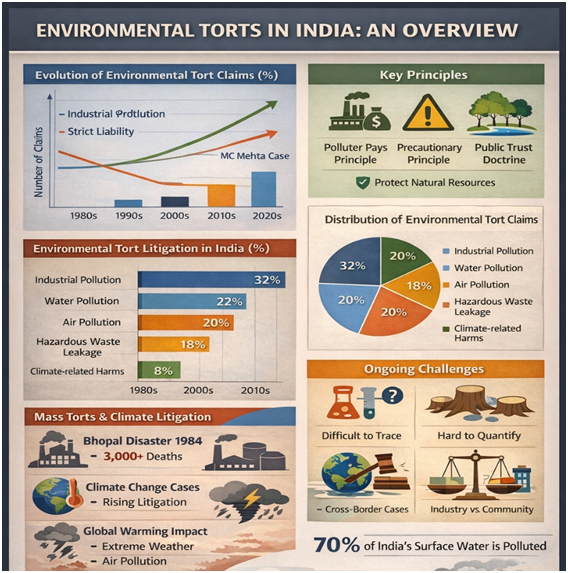
Environmental torts signify a big and socially important expansion of modern tort law. In the past, the courts used to address the question of liability for environmental harms through the traditional doctrines of nuisance, trespass, negligence, and the rule in Rylands v. Fletcher. The magnitude and complexity of today's ecological destruction, however, have effectively compelled the courts, particularly the ones in India, to not only reinterpret their doctrines but also sometimes to radically change them in order to fit the modern times. Examples of such devastations include pollution by industries, leakage of hazardous wastes, release of toxic substances, and large-scale environmental catastrophes.
2.1 Evolution and Conceptual Foundation
Environmental torts happen when the actions, usually of an industrial, commercial, or infrastructural nature, cause damage to the natural environment, endanger the health of the people, or harm the common areas. The damages caused in this way are very peculiar since they are scattered over a wide area, are the result of accumulation, and thus, most of the time, they cannot be reversed. Unlike traditional torts, where the victim and the perpetrator can be identified, environmental wrongs mostly entail a great number of people, cause-effect relationships being unknown, and systemic issues. The complexity of the subject matter has made it necessary for the courts to abandon the narrow individualistic approaches and to develop the concepts of collective and risk-based liability instead.
India's courts have become leaders in the world by making use of tort law principles alongside the constitutional obligations imposed by Article 21 (Right to Life), thus allowing clean air, safe water, and a healthy environment to become necessary components of human dignity. The constitutionalisation of tort law has empowered the courts to come up with more effective solutions to the problems of ecological harm.
2.2 Doctrinal Innovations in Indian Environmental Jurisprudence
One of the most significant judgments of the Supreme Court was its decision in MC Mehta v. Union of India (Oleum Gas Leak Case, 1987). Through this verdict, the Court changed the entire concept of environmental liability. Instead of merely following the English rule of strict liability which provided for exceptions such as act of God or third-party interventions the Court thus formulated the doctrine of Absolute Liability. Enterprises conducting hazardous operations are deemed to be liable under this doctrine irrespective of fault and without any exceptions, which is in line with the notion of those who receive from dangerous operations and thus should be the ones bearing the cost of accidents.
Other principles underpinning environmental tort law are:
- Polluter Pays Principle: This principle essentially forces the polluter to bear the cost of cleaning up the pollution and compensating those who have been affected.
- Precautionary Principle: A preventive measure is the solution even when there is a lack of complete scientific evidence as to whether a threat exists or not.
- Public Trust Doctrine: This doctrine recognises that natural resources are public assets that the state must hold in trust and preserve for the public.
These principles collectively compose a robust normative basis that shifts the liability from victims to businesses, thus, aligning tort law with environmental justice.
2.3 Mass Torts, Climate Harms, and Emerging Litigation
It became clear after the Bhopal Gas Tragedy (1984) that traditional tort mechanisms were ill-equipped to handle mass environmental injuries, which prompted a call for statutory changes and corporate accountability. Nowadays, environmental torts are closely related to climate change litigation, the court cases in which plaintiffs demand compensation for damages caused by global warming, such as extreme weather events, air pollution, etc. In different parts of the world, the courts increasingly recognise the concepts of intergenerational equity and the government’s obligation to future generations in terms of the care of the environment.
2.4 Continuing Dilemmas
Although there have been doctrinal developments, environmental tort law is still confronted with a number of difficulties.
- Proving causation is a major issue when there are more than one pollutant and/or the effects have come about through prolonged exposure.
- It is a difficult task to measure ecological damage which is often neither immediately evident nor easily quantifiable.
- Due to the emergence of cross-border pollution and multinational corporate structures, determining jurisdiction has become more complicated.
- There is an imbalance of force whereby polluting industries have greater resources than the communities affected by pollution.
Nonetheless, environmental torts continue to evolve as courts and lawmakers grapple with the pressing need to balance development with sustainability.
3. CYBER TORTS AND DIGITAL DEFAMATION
The era of cyber has fundamentally changed the ways in which a person can be a victim of a civil wrong. In fact, it even led to the emergence of a new complex category called cyber torts. Such torts are the result of harmful behaviour that the electronic networks conduct and where no physical contact takes place yet the victims instinctively suffer from the psychological, reputational, or financial consequences. Since people are increasingly relying on digital platforms for their interactions, the law of tort needs to address the issues of harms that come without the consent of the victim, that could be committed by faceless abusers, and that do not stop at the boundaries of geo-political countries.
3.1 What Are Cyber Torts?
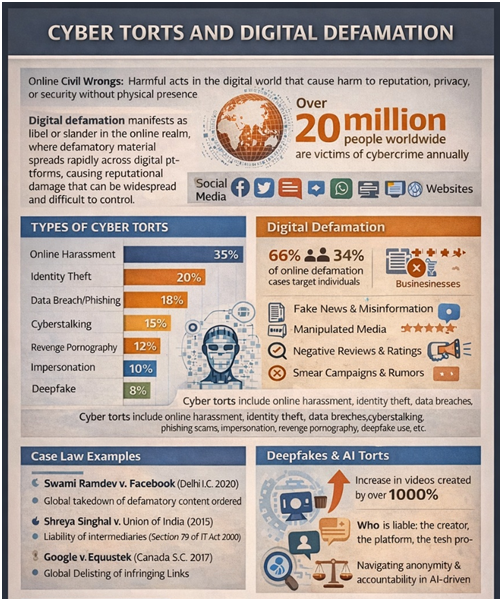
In fact, cyber torts cover fresh categories of misconducts that happen in the online world, which violate various personal rights, security, privacy, and even reputation. Among the well-known examples are online harassment, cyberstalking, identity theft, data breaches, scams through phishing, revenge pornography, impersonation, and deepfake. They are the manifestations of the idea of “tortious harm without physical presence” as the injury is done on the patients through digital interfaces, but they may heavily impact their life in the real world.
Tort law’s traditional value system that consists of the elements of duty, breach, and causation is being challenged by cyber harms since the perpetrators may be faceless, robotized, or out of the country. As the internet keeps on opening new horizons, it has also changed the traditional reputation-based torts, especially defamation, in that it now gives the abusers limitless opportunities to be heard instantly. To date, a defamatory statement was able to reach only a handful of the audience, now, the same statement can be shared with the whole world within seconds, going across the borders of continents and resulting in irreversible damage even before the legal process begins. This development has driven the judiciary to reevaluate established doctrines in the light of digital realities.
3.2 Digital Defamation
Digital defamation is a libel or slander type of defamation when the defamatory material is published through the online-speaking media platforms and hence is different from traditional defamation in several notable respects. First, reputational harm takes just a flash of a second due to the information’s rapid spread and the amplification that the online world provides. Second, the defectors can employ the virality to blast their defamatory statements to millions very frequently by using sharing algorithms that are automated. Third, faceless abusers do not let a notion out of their heads that they can hide behind pseudonyms or encrypted messaging, which make them very challenging to be uncovered. Ultimately, the worldwide availability of online content determines that rather complicated jurisdictional problems arise.
The liability of intermediaries such as Facebook, YouTube, or WhatsApp in India is determined by Section 79 of the Information Technology Act, 2000, which grants them a "safe harbour" if they only provide the platform and comply with due diligence requirements. The Supreme Court of India in its judgment in Shreya Singhal v. Union of India (2015) held that intermediaries should take down content only after receiving court orders or government notifications, leaving private complaints aside. This way, user rights and free speech are balanced.
Digital defamation adopts its new forms such as posting false/negative reviews, launching smear campaigns, producing manipulated media, or spreading targeted misinformation - all of which may cause both reputational and financial damage.
3.3 Case Law Examples
Courts across the globe are increasingly filled with cases involving digital defamation. For instance, the case Swami Ramdev v. Facebook (2020) witnessed the Delhi High Court issuing global takedown orders whereby the platforms had not only to remove defamatory content in India but the rest of the world as well. The Indian judiciary has been dealing with issues where WhatsApp forwards caused harm. Sometimes group admins are held responsible when they have editorial control or don't stop defamatory messages from spreading.
While the Supreme Court of Canada in Google v. Equustek (2017) supported a global delisting order against Google, it thereby reinforced the understanding of digital defamation being an international problem needing international solutions. The discussions on Twitter's intermediary liability go on, a major concern being the presence of harmful posts even after the user has notified them of the content.
3.4 Deepfakes and AI Torts
Deepfake technology as a tool for creating digital torture has brought new challenges in terms of legal responsibility. Physically, deepfakes harm reputation, violate privacy and disempower the victim in terms of the consent issue. Suffering may be manifested through emotional distress, professional disadvantage, or social rejection.
Besides, generative AI systems do not only mean a template for accurate works but also one for misinforming people and conveying offensive contents. The essential dilemma is who should be held responsible - the creator, the engine, or the user? The nascent legal theorizing advocates for a scenario whereby platforms get charged with a duty-of-care, especially in cases where the algorithms guide or increase people's access to defamatory or harmful content.
3.5 Challenges
Cyber torts bring about a number of tough and ongoing issues. One of these issues is the lack of clear jurisdiction. The problem is that a single post can be viewed worldwide, so that suppliers can multiply their complaints in different courts. Authorities have to find a way how to protect people’s good name without limiting their freedom of speech, for example, in the case of political or journalistic articles. The biggest problems, however, are to identify the anonymous reasons of the attack, which always means that one has to do a technical analysis or have the agreement of intermediaries to be able to solve that problem.
Certainly, cyber torts demonstrate a pressing matter of how tort law needs to catch up with the digital architectures that not only eliminate borders but also change people’s ways of interaction.
4. PRODUCT LIABILITY AND CONSUMER PROTECTION
The contemporary market, which is basically based on the principles of mass production, global supply chains, and e-commerce platforms, has fundamentally changed the way producers and consumers relate to each other. Within such a market, merely focusing on defendants’ negligence in tort cases becomes insufficient. For this reason, product liability has risen to be a crucial branch of tort law that works to make manufacturers, sellers, and service providers account for unsafe or defective products that have been introduced into the market. As consumers dealings are getting rid of not only geographic but also physical barriers and made complicated by technologically advanced products, the necessity for stringent legal protections is most urgent.
4.1 Conceptual Foundations
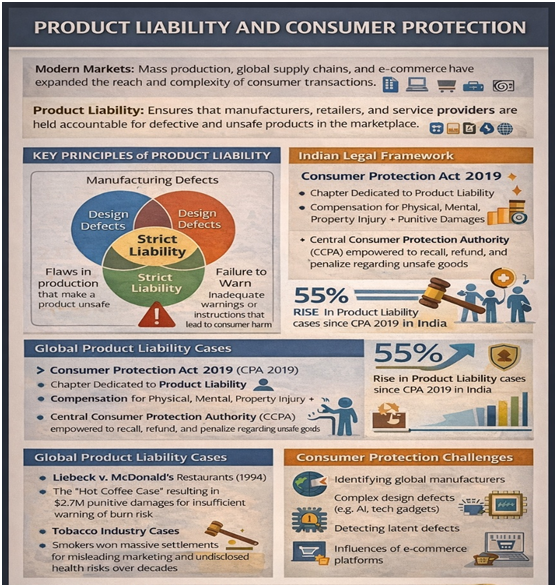
Product liability is about a manufacturer, retailer, and distributor legally responsible for harm caused by the defective products. The doctrine initially arose from the principles of negligence but went on to include strict liability when accepting that consumers usually do not have the knowledge or power to understand defects or to negotiate safety standards. The main idea is risk-allocation as the one who benefits from the product has the greatest incentive to safeguard them and take on the burden of accidents.
4.2 Indian Legal Framework
India witnessed a substantial change with the Consumer Protection Act, 2019 (CPA 2019), which for the first time clearly dedicated a chapter on product liability. The Act thereby not only started to hold manufacturers liable but also service providers and sellers accountable. Major bases for liability are:
- •Manufacturing defects (like mistakes at the production stage which lead to the creation of an unsafe product).
- •Design defects (the inherent weaknesses which render the whole product line unsafe).
- •Failure to warn through inadequate instructions.
- •Breach of express as well as implied warranties.
The CPA 2019 provides that a consumer may claim a compensation for physical injury, mental pain, property damage and in aggravated cases even punitive damages. The Central Consumer Protection Authority (CCPA) has also been established to facilitate the enforcement through recalling, refunding, and penalizing for the sale of unsafe goods as well as misleading advertisements.
4.3 Global Cases
These international cases have greatly contributed to setting up the global discussion of product liability:
Liebeck v. McDonald’s Restaurants (1994) the well-known “hot coffee case” was an illustration of the role of punitive damages in the discouragement of corporate negligence.
Tobacco cases were instrumental in revealing a long period of misleading advertising and hidden health risks.
Johnson & Johnson talcum powder lawsuits have in celebrated the issues of long-term exposure and scientific uncertainty.
The meltdown of the Takata airbag recall, the biggest incident of its kind in history, brought to light the worldwide consequences of defective design in widely used parts.
These cases demonstrate the development of consumer expectations towards corporate accountability in the markets.
5. MEDICAL NEGLIGENCE
Medical negligence is a particularly complicated and delicate area of law, that lies at the confluence of law, medical ethics, professional autonomy, and patients’ rights. Healthcare providers commit medical negligence if they do not meet the applicable standard of care that one can reasonably expect in the circumstances, thus, producing a patient’s injury. Although the contact between the doctor and the patient creates a duty of care, not every unfavourable medical condition is due to negligence. The courts attentively differentiate between a mere error of judgment, which is not subject to an action, and negligent behaviour that significantly deviates from the standard of care.
The yardstick for medical negligence was set in Bolam v. Friern Hospital Management Committee (1957), where it was stated that a medical professional is not negligent if their behavior is consistent with a practice accepted by a responsible body of medical opinion. Indian judiciary has also accepted this doctrine and has incorporated it in Jacob Mathew v. State of Punjab (2005) case, specifying that criminal liability can be invoked only on the basis of gross negligence.
Medical negligence can be the result of incorrect diagnosis, errors in surgery, mistakes in the administration of drugs, failure to obtain informed consent, negligent post-operative care or acquiring hospital infections. The Supreme Court in Indian Medical Association v. V.P. Shantha (1995) brought medical services under the purview of the consumer protection law, thus, giving a patient the facility to file a complaint through consumer forums for getting compensation. On the other hand, Kusum Sharma v. Batra Hospital (2010) has pointed out that courts should not excessively impose liability so that doctors would not be discouraged from carrying out such risky but at the same time necessary medical operations.
Practising Advocate's Opinion
The perspective of a practising advocate Pratham Kindra says the Indian tort law as a system that no longer limits itself to dealing with isolated cases of negligence. The resulting harms from various industries, including those from digital platforms and mass consumer markets, compel a liability regime that is not just expanded but capable of addressing the complex situation. In cases related to the environment, the judiciary's move towards absolute liability and the polluter pays principle has been instrumental in securing that the burden of ecological damages is laid on the ones profiting from the operation of the hazardous activities. However, the helplessness derived from inappropriate execution and lack of legal assistance to the affected commoners still provoke.
Cyber torts and digital defamation are two examples of how traditional legal ideas are challenged. Harm to one's reputation through the internet is something that can happen very fast and involve all the world at the same time, but it often comes from an anonymous source, so it is difficult and slow to get justice. Courts have rightly championed free speech, but there is a need for the implementation of more robust accountability measures for digital intermediaries.
The Consumer Protection Act of 2019 is a step forward in the advancement of strict product liability, thereby enhancing the safety of consumers. In general, tort law needs to be a constant not a once in a while phenomenon in its evolution to ensure it remains a powerful gatekeeper of human rights, accountability, and social justice in an era of rapid technological development.
CONCLUSION
Globalisation is one of the most significant factors that has changed tort law. It led to the emergence of transnational harms that cover several countries. There are global supply chains whereby products are designed, manufactured, assembled, and sold in different countries. Thus, when people are harmed, it is difficult to determine who is responsible. Besides, digital markets and e-commerce have given rise to consumer vulnerability when, for example, a fraudulent seller is based in a foreign jurisdiction.
AI and autonomous systems present a number of high-level challenges to tort law. For instance, decision-making by machines that hardly involve human intervention makes negligence standards obsolete. In the same manner, data breaches, surveillance, and illegal use of personal data have resulted in new types of harm. The right to privacy was constitutionally recognized in India in case K.S. Puttaswamy v. Union of India (2017). Liability frameworks were also questioned during the COVID-19 pandemic when issues such as public health responsibility and immunity came up.
Since the distinctions between real and virtual worlds get more and more indistinguishable, the law of torts that governs personal injuries needs to be constantly dynamic, adaptable, and even proactive. The path ahead lies in the main strengthening of the regulatory frameworks, support or development of consumer and data protection procedures, and the promotion of international cooperation to combat cross-border offences. In fact, the core purpose of tort law that has been its compensation, deterrence, and corrective justice, still remains the same, only the means have to change. As a result, if tort law keeps pace with the developments and contemporary challenges, it will be able to protect individual rights and thus, serve social welfare in the modern time.
Join LAWyersClubIndia's network for daily News Updates, Judgment Summaries, Articles, Forum Threads, Online Law Courses, and MUCH MORE!!"


Tags :Others