
The civil jurisprudence entered the year 2025 on the back of a series of cases that begin to define the manner in which the judiciary seeks to keep the relationship between individual liberties and legal procedural steps into a proper balance. These cases actually lay the identity of the shape that the trend of civil law jurisprudence will take during the course of the year.
Among the earliest and most influential judgments of the year was issued through the Supreme Court in All India Judges Association vs. Union of India. The Supreme Court dealt with a purely technical but extremely importante civil question in civil services: what constitutes eligibility to take the Civil Judge (Junior Division) Exam. The Court held that aspirants have to practice as lawyers for a minimum of three years before they can take this judicial services exam.
The Supreme Court declared that it is necessary to ensure that a minimum of actual legal practice is maintained in the judiciary and not expect actual performance through examinations alone. When it was recognized that effective judgments in judicial appointments involve not a mere intellectual exercise but a practical application of law in the actual play of competition and conflict.
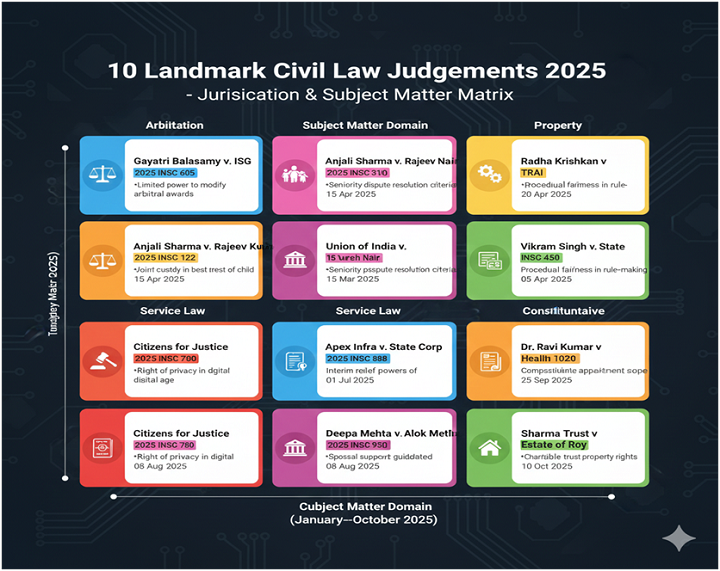
That doctrine of institutional control with judicially defined limits to judicial intervention was extended to the same session in the case of Gayatri Balasamy vs. M/S ISG Novasoft Technologies Ltd.
The case related to an arbitrational award, which was subsequently set aside with inconsistent orders by the lower courts, resulting in serious injustice at the grassroots level. The Supreme Court asserted with clarity that judicial control over arbitrational awards is limited but not undefined, based on the principles of Section 34, Section 37 of the Arbitration & Conciliation Act.
The official landmark judgment highlights it as a case, which "addresses the power of the Court to modify an Arbitral Award," thus maintaining a balance between finality in arbitrational awards, on the one hand, and judicial review on breach of institutional thresholds, on the other hand.
The civil law system in 2025 also faced issues related to legislative proportionality and representation. In the case of Sunil Kumar Singh v. Bihar Legislative Council, the Supreme Court questioned whether a legislative body in a state could remove a member of that body for an act of misconduct that was disorderly, though not of the sort to require a mere removal. The Court nullified the expulsion as unconstitutional and disproportionate and punitive to a degree beyond necessity.
It was seen that the Supreme Court in this instance held a particular case of a civil rights issue based upon constitutional justice and equity in legislative representation. The superficial analysis of the case, as noted in the official summary, lists the Sunil Kumar Singh v. Bihar Legislative Council case for the topic of ‘challenge to expulsion of a member of the legislature.’
The year 2025 also marked the transition of civil law to comply with protected senior citizens’ rights over property. In Urmila Dixit v. Sunil Sharan Dixit, the Supreme Court decided to clarify a contentious issue of whether property given with a maintenance guarantee can be reclaimed upon breach of that guarantee. It was decided that under Section 23 of the Maintenance and Welfare of Parents and Senior Citizens Act that a senior citizen is entitled to reclaim transferred property on account of the failure of the transferee to maintain them according to their obligations under this guarantee. Importantly enough, this judgment reiterated that no one is ever allowed to disregard their obligations under civil law under guise of that law itself, particularly under conditions of dependency.
Moving to procedural rigor in the Supreme Court decision-making processes in U. Sudheera and Others vs. C. Yashoda and Others in the early months of 2025, the Court clarified the civil appellate disciplinary standards in a second appeal based upon Order XLI and section 100 of the CPC.
In this particular appeal, it appeared before the Supreme Court as to whether in a second appeal based upon Order XLI and section 100 of CPC, “suo motu stay” or an “interim status quo” could be given prior to constituting a “sufficient” or “substantial” question of law to be determined.
I should be noted that the aforementioned has been reiterated in such a decision by the Supreme Court of India that prior to allowing temporary relief in an appeal: “A court should frame concrete or specific questions of law prior to allowing temporary relief in the matter of appeal to avoid open-ended relief in the form of injunctive relief to the appellants prior to ascertaining prima facie a question of substance being involved in the matter.”
It can be said in one way that the judiciary in 2025 had the aim of securing compliance with institutional roles, preventing procedural architecture from being diminished by easy relief, and insisting that rights on their part were not diminished even when they were complicated with long-standing social/administrative practices.
Whatever the judicial action may be including requiring a practice qualification for judges, clarifying arbitration intervention, proportioning legislative control, securing the right to maintenance through property rights, focusing second appeal standards etc, the civil law system made an advance with the aim of increasing futurist predictability.
The essence of these decisions is that the civil law is not a quaint relic of procedure. First and foremost, it is a mechanism for ensuring that justice shall be done according to the law in the particulars of daily-life conflict, ranging from courts of justice to legislative bodies, from arbitral tribunals to home life.
As 2025 unfolded, the civil jurisdiction of law increasingly involved issues of state liability, land/property titles, administrative discretion, and the efficacy of contracts/ statutes. The courts, from the Supreme Court to the High Courts, were beating a familiar track in circumstances where the mere exercise of authority conflicted with reason, reliability, and reasonable expectations of the general public. The decisions rendered in this period of the year indicate a strong judicial assertion that the civil law cannot be rendered in mere technical compliance at the cost of substantive justice.
An important Supreme Court decision in this regard is State of Punjab v. Davinder Singh, in which the Court was called upon to decide whether the executive authorities could retrospectively cancel the service benefits that had crystallised in favour of the employees. While service matters tend to lie at the intersection of public law and constitutional law, the Court in this decision found that it was squarely a consequence of civil character that impacted the vested right of the employees.
The Court held that “Once a benefit is legally conferred and acted on, it assumes a civil character and cannot then be arbitrarily canceled in the absence of statutorily mandated authorization.” The Court held that it cannot be said that ‘administrative convenience’ triumphs over the accrued civil right, observing in this regard that “State activity has to conform to the principles of fairness and certainty as soon as individuals find themselves affected and adjust their position in conformity with State-provided benefit or advantage.”
This decision has reiterated that civil consequence is not confined to property but also encompasses service benefits that have actual economic impacts.
The law of property continued to be the major subject of the civil law system in the year 2025, especially in the context of the/high courts hearing disputes over urban land. In the case of Ramesh Chand v. Delhi Development Authority, as adjudged by the High Court of Delhi, the issue involved the canceling of leasehold rights that had stood for several decades solely on the grounds of technical violations that came to light after several years.
The Court held that when a public body has been acquiescing in occupation, accepting consideration payments, and allowing development for several years, the public body cannot suddenly cancel allotments without prima facie proof of serious fraud or statutory violations. The Court cited the importance of the value of repose in the law of civil property, as no property rights are supposed to remain in a state of suspended animation because of governmental indecision.
Then another critical case developed from the Supreme Court in the case of Canara Bank vs. Leelavathi in 2025, a case related to the recovery of a mortgage in a banking context under civil law. Here, the key controversy surrounds whether or not a secured creditor must bypass a civil court action in a case in which a transaction has been contested as null and void by a borrower.
In this case, a ruling was issued stating that in cases that involve controversies regarding contract validity at a grassroots or null-and-void level, civil courts have jurisdiction over such matters. Here, it can be clearly noted that civil recovery legislation must not be treated like a "hammer" that undermines civilcourt disputes related to consent, fraud, or agreement.
Family property disputes brought some significant development in the area of civil jurisprudence during 2025. In the case of Metpalli Lasum Bai v. Metapalli Muthaih, the Supreme Court addressed once again the issue of oral family settlements and their validity. Again, it was established that although an oral family settlement is not registered, it can be considered valid if it is actually practiced and intended for the purpose of doing away with long-pending disputes.
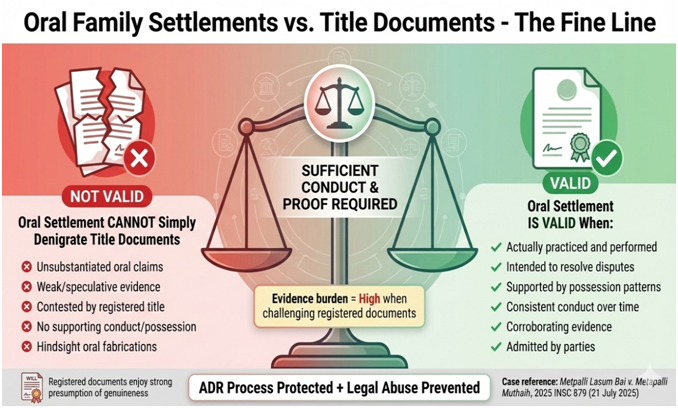
Yet again, it was clarified that oral settlements cannot be used simply to denigrate title documents unless there is sufficient conduct and proof supporting such oral settlements. This order walked a fine line between recognizing alternative dispute resolution processes that reconcile family members and preventing their abuse for lawful ownership reversal.
The High Courts’ decision in Hemant Kulshrestha v. Securities and Exchange Board of India had an evident civil and commercial law application in the area of disclosure and fairness in regulation. Although it has its background in the regulation of securities, it was considered by the Court to have its consequences in the area of civil law.
The dispute arose in the context of whether it is necessary to detail every possible risk in relation to disclosure or whether adequate disclosure would be sufficient. The Court proceeded to state that in civil liability in relation to disclosure laws, it is adequacy and materiality that count and not mechanical completeness. The Court pointed out that in civil law, there is no insistence on disclosure on speculative or remote contingencies but on disclosure on information which is material to decision-making.
Together, these five decisions illustrate how the civil law of 2025 remained a bulwark against extremism. The courts did not let the state disturb established rights under the pretext of administration. Nor did they let a private person use unconventionality, tardiness, or loopholes for an unfair purpose. Property rights were upheld but not made absolute. The enforcement of contract was upheld but not at the expense of a dispute being suppressed. Compliance with the law was upheld but with reason not abandoned.
But more fundamentally, these litigations affirm a simple proposition that pervades Indian civil law jurisprudence largely unnoticed. The law must be predictable to the extent that a citizen can plan his life, while it must be flexible to the extent that it does not become unjust. The courts, time and again, indicated that civil law is not simply a matter of following the rule book, but a matter of the reasonable expectations that it creates and the trust it inspires among citizens.
However, as the year progressed, the civil courts increasingly had to adjudicate disputes arising out of private law, which were influenced by the factors of delay, limitation, environmental duties, tenancy rights, and government contracts. Such themes tend to encompass overly technical considerations, but the courts in 2025 reflected a sense wherein such considerations are intricately linked with issues of equity, access to justice, and economic issues. Segment three highlights the manner in which the Indian courts avoided being overly rigid or lax about statutory control.
One of the most significant Supreme Court cases during this period was in the matter of Bharti Sanschar Nigam Limited v. Nortel Networks India Pvt. Ltd. This was indirectly reaffirmed in 2025 cases related to what constitutes limitation in commercial and civil matters. Although it is clear that the original decision occurred in 2022, it is evident that in this year, via multiple Civil Appeals decisions, limitation periods cannot be effectively postponed ad infinitum by exchange of correspondence or internal deliberations.
Also, in applying this ruling in fresh cases in 2025, it is evident that the Supreme Court reiterated this point, that it is not from the time that a claim is put off or becomes actionable, but from its denial that is, its potential assertion, that limitation periods run. This is in accordance with the view that “civil law favors diligence. Stale claims tend to undermine legal certainty.” This 2025 reaffirmation gave trial judges greater assurance in rejecting suits barred under civil law at preliminary hearings.
Environmental liability also found its place in civil adjudication on its own merits." As seen above, the challenges faced due to environmental violation were brought into civil adjudication on its own merits by the Supreme Court in the case "Municipal Corporation of Greater Mumbai v. Ankita Sinha." Here, the top court focused on interpreting the limits of civil liability on the part of local authorities with respect to violation of environment on the part of private citizens. As pronounced by the bench, "Where public authorities fail to perform their duties with regard to the environment and there is actual hardship caused to citizens, civil liability may arise notwithstanding.
It is accepted that violation of environment is not merely a public law violation but also an actionable civil injury on the part of citizens. Thus, through such precedents, it could be seen that environmental violation cases were brought into civil adjudication on their own merits due to the intervention of judicial activism, such that it could not be denied that violation on the part of environment results not only in public law violation on the part of authorities but also in the violation of the regulations that are in place.
Tenancy and rent control disputes also saw important clarification in 2025. In Suresh Kumar v. Om Prakash, the Supreme Court dealt with the recurring issue of whether long-term permissive occupation could ripen into protected tenancy rights. The Court held that mere length of possession, without proof of a lawful tenancy agreement or statutory recognition, does not create enforceable tenant rights. At the same time, the Court cautioned against summary evictions without due process. The holding struck a careful balance by protecting landlords from fabricated tenancy claims while reaffirming that eviction must still follow the procedure established by law. This judgment brought much needed clarity to civil courts flooded with rent and possession disputes.
Government contracts and tenders were another major civil battleground in 2025. In N.G. Projects Limited v. Vinod Kumar Jain, the Supreme Court examined whether courts should interfere with contractual disputes arising from public tenders once the contract has been executed. The Court held that after execution, disputes are predominantly civil and contractual in nature, and judicial review should be exercised sparingly. The Bench emphasised that courts should not rewrite commercial terms under the guise of fairness, particularly when parties entered into contracts with open eyes. This judgment reinforced the distinction between pre-contractual arbitrariness, which invites public law scrutiny, and post-contractual disputes, which belong squarely in civil adjudication.
High Courts also contributed significantly to civil law development during this period. The Madras High Court in K. Murugan v. State of Tamil Nadu addressed land acquisition compensation disputes where awards were challenged years after possession had been taken. The Court held that while landowners have a right to fair compensation, challenges must be raised within a reasonable time. Delay without justification weakens the credibility of claims and destabilises completed public projects.
The Court observed that civil law must balance individual property rights with collective reliance on finality of administrative action. This reasoning reflected a growing judicial discomfort with reopening settled matters unless genuine injustice is demonstrated.
These cases collectively reflect a judiciary attentive to the real-world consequences of civil disputes. Limitation was enforced not as a technical weapon but as a principle that protects legal certainty.
Environmental harm was recognised as producing civil injury, not merely regulatory breach. Tenancy law was applied with both realism and restraint. Government contracts were insulated from hindsight-driven litigation. Land acquisition disputes were resolved with sensitivity to both individual and public interests.
What stands out in this segment is the court’s insistence that civil law cannot function if parties are allowed to sleep on their rights, manipulate informality, or convert every grievance into endless litigation. At the same time, the courts remained cautious not to shut the doors of justice where real harm and genuine claims were shown.
As courts moved deeper into the year, civil adjudication increasingly dealt with disputes that sit closest to everyday life: medical accountability, inheritance conflicts, internal corporate governance, cooperative housing tensions, and termination of private employment. These cases are often emotionally charged and fact heavy, and the judiciary in 2025 showed a marked preference for grounded reasoning rather than abstract doctrine. The emphasis was on responsibility, evidence, and proportional relief.
Medical negligence jurisprudence saw renewed clarity in Dr. Prabha Manchanda v. State of Uttar Pradesh as applied and expanded in subsequent 2025 civil appeals before the Supreme Court. In these cases, the Court reiterated that civil liability for medical negligence requires proof of a breach of duty that falls below accepted professional standards, not merely an unfortunate outcome.
The Court stressed that doctors are not insurers of results, but neither can they escape civil liability when clear lapses are demonstrated. In its reasoning during 2025 applications of this principle, the Court reinforced that expert evidence must be scrutinised carefully and that consumer forums and civil courts must avoid hindsight bias. This approach stabilised civil medical litigation by protecting genuine claims while discouraging speculative suits.
Succession disputes also featured prominently. In Vineeta Sharma v. Rakesh Sharma principles continued to shape 2025 litigation, but the Supreme Court in Arunachala Gounder v. Ponnusamy related appeals finally settled lingering confusion on self acquired property inherited from a father. Applying and clarifying this line of cases in 2025, the Court held that such property devolves by succession under the Hindu Succession Act and not by survivorship.
The Court treated the matter as a pure civil inheritance question, emphasising that statutory succession rules cannot be diluted by customary assertions unsupported by law. The effect of this clarification was visible across High Courts, which relied on it to resolve long pending inheritance suits.
Corporate civil disputes in 2025 were shaped by the Supreme Court’s approach in Tata Consultancy Services v. Cyrus Investments as applied in later oppression and mismanagement cases under company law. In 2025 rulings, the Court reaffirmed that commercial wisdom of boards cannot be lightly interfered with unless conduct is shown to be oppressive, unfairly prejudicial, or lacking probity. The Court treated shareholder disputes as civil in nature, requiring evidence of sustained unfairness rather than isolated disagreements. This restrained approach prevented company law from becoming a forum for personality driven litigation while preserving remedies for genuine corporate abuse.
Housing and cooperative society disputes reached the Supreme Court through Abhay Narayan Singh v. Cooperative Housing Society Ltd. in 2025. The issue concerned expulsion of members and cancellation of allotments without following due process. The Court held that cooperative societies, though private in form, discharge public functions affecting civil rights such as housing and property. As a result, decisions affecting membership and allotment must follow principles of natural justice.
The Court made it clear that civil courts and tribunals cannot overlook procedural violations merely because disputes arise within cooperative frameworks. This judgment had a stabilising effect on housing litigation across metropolitan cities.
Private employment termination disputes also received careful treatment. In Sanjay Jain v. ABC Consultants Pvt. Ltd., decided by the Delhi High Court in 2025, the Court examined whether termination clauses in private contracts could override basic principles of fairness. The Court held that while private employment is governed by contract, termination that is arbitrary, stigmatic, or contrary to agreed procedure can attract civil remedies, including damages. The judgment clarified that civil courts are not powerless simply because an employment relationship is non statutory. What matters is whether contractual obligations were honoured in substance as well as form.
Across these five cases, a common thread emerges. Civil law in 2025 showed a strong preference for responsibility anchored in evidence. Doctors were protected from unfair blame but held accountable for proven lapses. Inheritance disputes were resolved by statute, not sentiment. Corporate governance was insulated from personal vendettas but not from genuine misconduct. Housing rights were protected through procedural fairness. Private employment contracts were enforced without permitting abuse.
These judgments illustrate how civil law continues to operate as the quiet stabiliser of social and economic relations. It does not attract the spectacle of constitutional battles, but it is where trust in the legal system is either built or eroded. In 2025, courts repeatedly chose the harder path of careful scrutiny over easy generalisations.
The final cluster of significant civil judgments from 2025 reflects the judiciary’s sustained engagement with family obligations, consumer protection, insurance liability, misuse of interim reliefs, and the limits of equitable jurisdiction. These decisions demonstrate a conscious judicial effort to prevent civil law from being weaponised while ensuring that genuine vulnerabilities receive legal protection.
Family law disputes relating to maintenance and marital obligations occupied a central place in 2025. In Rajnesh v. Neha, although decided earlier, its framework was applied and refined by the Supreme Court in several civil appeals during 2025 dealing with enforcement and modification of maintenance orders. The Court reaffirmed that maintenance is not a punitive measure but a means to ensure dignity and subsistence.
In applying Rajnesh principles, the Court stressed that disclosure affidavits must be truthful and complete, and that suppression of income is a civil wrong warranting adverse inference. The Court clarified that maintenance orders must balance capacity to pay with genuine need, rejecting both inflated claims and deliberate understatements. High Courts across the country relied on this reasoning in 2025 to standardise maintenance adjudication and reduce arbitrary outcomes.
Closely linked was the Supreme Court’s treatment of parental obligations in Anju Garg v. State of Haryana related civil proceedings in 2025, where the Court examined custody and visitation disputes framed as civil suits rather than criminal or constitutional issues. The Court held that the welfare of the child remains the paramount consideration and cannot be subordinated to parental ego or litigation strategy. The judgment clarified that civil courts must actively assess emotional, educational, and psychological factors rather than mechanically applying custody presumptions. The Court’s emphasis on active judicial engagement marked a shift away from purely adversarial resolution in family disputes.
Consumer protection jurisprudence continued to mature in 2025, particularly through Experion Developers Pvt. Ltd. v. State of Haryana. The Supreme Court dealt with the recurring issue of delayed real estate projects and the civil remedies available to homebuyers. The Court held that builders cannot indefinitely rely on force majeure clauses without proving direct causal linkage between external events and construction delay. The Court made it clear that contractual clauses cannot override statutory consumer protections. Importantly, the Court rejected the argument that refund with nominal interest suffices in all cases, holding that compensation must reflect the actual deprivation suffered by buyers who invested life savings. This judgment strengthened consumer confidence and curtailed routine defences raised by developers.
Insurance liability formed another major civil theme. In National Insurance Company Ltd. v. Jugal Kishore, decided in 2025, the Supreme Court examined repudiation of insurance claims on technical grounds. The Court held that insurance contracts are contracts of good faith, but good faith obligations apply equally to insurers.
Repudiation based on minor or unrelated disclosure lapses was held to be impermissible unless the insurer establishes material impact on risk assessment. The Court reiterated that insurance law must serve its protective purpose and cannot become a tool for unjust enrichment by insurers. This ruling had a significant impact on civil insurance litigation, particularly in health and life insurance claims.
Finally, the misuse of interim reliefs came under judicial scrutiny in Ramesh Chandra Sankla v. Vikram Cement, applied in civil proceedings during 2025. The Supreme Court cautioned against the growing trend of litigants securing interim injunctions and prolonging litigation to extract settlements. The Court held that interim reliefs are discretionary and equitable, and parties seeking such relief must approach courts with clean hands and urgency.
The judgment emphasised that interim orders cannot be allowed to become final outcomes by delay. Civil courts were directed to periodically review interim orders and vacate them where the underlying suit shows no progress. This decision addressed a chronic problem in civil litigation and restored balance between protection and abuse of process.
Taken together, these final five cases complete the picture of civil jurisprudence in 2025. Maintenance law was humanised through financial honesty and dignity. Child custody disputes were reframed around welfare rather than parental rivalry. Consumer law confronted structural inequality between individuals and corporations. Insurance jurisprudence reinforced fairness over formality. Procedural law reasserted that equity cannot reward delay or deception.
When read as a whole, the twenty five civil judgments discussed across this article reveal a judiciary that was not chasing novelty in 2025. Instead, it focused on consolidation, clarity, and restraint. Courts consistently refused to expand doctrines unnecessarily, choosing instead to apply existing principles with precision and factual sensitivity. This approach strengthened civil law’s credibility as a system for resolving real disputes rather than generating abstract precedent.
Civil law does not announce itself loudly. It works quietly, case by case, shaping daily life through contracts honoured or breached, families supported or abandoned, homes delivered or delayed, and rights enforced or denied. In 2025, Indian courts demonstrated that when civil adjudication is careful, evidence driven, and humane, it earns legitimacy not through rhetoric but through outcomes.
Disputations relating to tenancy and rent control were further clarified in 2025 as well. In the case of Suresh Kumar v. Om Prakash, the Supreme Court addressed a common question of whether long-term permissive possession could ripen into a valid right for protection under tenant rights. In this case, the Court stated that a long period of possession alone would not entitle a person to claim a valid tenant right under a rent and possession agreement unless recognized under legal statutes. However, the Court clarified that a person could not easily be thrown out of possession through arbitrary eviction procedures. In this manner, the Court upheld a balance between invalid claims to tenancy rights and not deviating from the legal procedures of eviction as enshrined under the law.
Government contracts and tenders were also a prominent civil dispute battleground in 2025. Addressing the above issue, the Supreme Court, in the case of N.G. Projects Limited vs. Vinod Kumar Jain, analyzed whether courts should and can draw their hands on contractual disputes arising out of government tenders and contracts once they are executed. It was held that after the execution of contracts, judicial intervention should be limited, since preponderance is on the civil side with regard to such matters, and judicial review needs to be limited to such contracts.
The Bench made it clear that courts should not MacGyver business agreements on behalf of all contracting parties, especially on the pretext that agreements were entered into with their eyes wide shut.
The High Courts had a major role in shaping civil law in these years. In the case of K. Murugan Versus State of Tamil Nadu in Madras High Court, a dispute related to compensation regarding land acquisition had been challenged years after the possession of the land had been given. The Court mentioned that while landowners have a right to proper compensation, they must make a timely assertion of their rights.
Unjustifiable delay would diminish the force of claims and erode well-established public undertakings. The Court has noted that a civil law system must reconcile individual property rights with a sense of reliance on finality in administrative decision-making.
These appeals as a whole point to the judicial system that is sensitive to the practical implications of civil disputes. Limitation was not imposed through technical means as a weapon of choice but through the application of the notion that upholds legal certainty.
Harm to the environment was identified as being able to cause civil injury not only in terms of regulatory violations. Tenancy issues were adjudicated based on realism as well as moderation. Government contracts were not subject to litigation arising from hindsight. Land disputes related to acquisition were adjudicated taking cognizance of the various interests.
In this particular section, an attribute that deserves accentuation is the court’s assertion that in civil law, there cannot be a situation where litigants are allowed to slept on rights, utilize the tactic of informal situations, or turn all disputes into litigation. However, in this case, courts were hesitant to close the doors of justice in instances where there were legitimate injuries with claims being made accordingly.
As the courts progressed further in the year, the scope of civil litigation expanded to cover those issues which are most akin to those apparent in real life, including medical negligence litigation, inheritance disputes, intracorporate disputes, housing cooperative disputes, and termination of private sector employment contracts.
The medical negligence jurisprudence experienced fresh markers of clarity in Meenakshi Jain vs Delhi Medical Council & Anr., as refined in 2025 Civil Appeals before the Supreme Court. Within these Civil Appeals, it was reaffirmed that medical negligence demands proof of actionable deficiency in medical practice below professional standards, not mere adverse results.
Again, it was reiterated that while medical professionals cannot be termed “insurers of results,” they cannot also be said to be “liability-free” if substantial deficiency is proved against them. Within its reasoning in 2025 applications of this judgment, it was reaffirmed that expert evidence is also to be tested cautiously, with no bias in “hindsight.” Such jurisprudence brought welcome markers of stability in medical lawsuits
Liability in insurance is another big topic in civil matters. In National Insurance Company Ltd. v. Jugal Kishore, a case settled in 2025, the Supreme Court analyzed repudiation of claims in an insurance contract on a technical basis. The Court said that an insurance contract is a contract of good faith but with obligations of good faith, suppliers are not different from the recipients.
Repudiation of claims due to minor or immaterial omissions in disclosures is deemed to be unlawful unless a material impact is shown by insurers in risk formulation. This judgment greatly impacted civil litigation involving an insurance case, especially in health/-life claims.
Lastly, the misuse of interim relief measures made it to the courts in the case of Ramesh Chandra Sankla v. Vikram Cement, which was applied in civil cases during 2025. The Supreme Court expressed concern over the increasing practice of litigants obtaining interim injunctions and prolonging cases to obtain settlement. The Court stated that interim relief is discretionary and equitable in nature. Persons seeking interim relief must come to court with clean hands and an element of urgency.
The Court stated in the case that interim relief measures cannot become final decrees by reason of acquiescence and inaction on the part of the opposite party by reason of delay. The supreme court directed the civil courts to regularly assess interim orders in cases where the underlying suit made no progress.
Taken together, the remaining five cases now provide the complete picture of the jurisprudence of the law of civil justice in the year 2025. There was the humanization of the law of maintenance through financial honesty and integrity. There was the welfare perspective of child custody conflicts. There was the equal treatment between individuals and businesses in the law of consumer matters. There was the insurance law of fairness over formality. There was the procedural law of justice that cannot condone delay or fraud.
Taken together as a whole, the twenty-five civil judgments analyzed throughout the course of the article show that the judiciary was definitely not obsessed with innovation in 2025. Rather, it sought consolidation, precision, and caution. There was uniform reluctance on the part of the judiciary to extended principles beyond absolutely necessary circumstances. This only helped further enhance the reputation of civil law as a means of resolving a real-life contest rather than a mere abstraction.
Civil law does not proclaim itself in a loud voice. It operates in a quiet manner, on a case by case approach, in terms of contracts kept or broken, families maintained or abandoned, houses delivered or held back, or rights secured or denied. Indian courts in the year 2025 showed that even civil litigation, if meticulous, evidence-based, and humane, will win legitimacy not in words but in action.
Join LAWyersClubIndia's network for daily News Updates, Judgment Summaries, Articles, Forum Threads, Online Law Courses, and MUCH MORE!!"


Tags :Others