
A. Constitutional and Doctrinal Status of Reputation and Personal Liberty as Protected Interests
In the Indian tort law system, an individual's reputation and personal liberty are recognised as legal interests to be protected by the law. This foundational concept is based on common law principles and constitutional developments to date in India. An individual as a legal entity is afforded multi-faceted protection for their reputation through tort law remedies under private law; criminal law statutes regarding wrongful behaviour; and constitutional protections found in the Indian Constitution of 1950.
Historically, the right to a good name was not regarded as a fundamental right (as part of life and freedom) under the Indian Constitution. In 1947, when the Constitution was adopted, this right was not explicitly guaranteed; however, it has become increasingly clear over the years that a person's honour and reputation form part of their existence and ability to develop as a person. In fact, in the case of Subramanian swamy v. Union of India, the Supreme Court made it quite clear that an individual has a fundamental constitutional right to a good reputation: "A good reputation is an element of personal security and is protected by the Constitution." As such, the right to a good name is not simply a matter of property or social recognition, but is protected under the Constitution; thus, it is also required of the State to take constitutional measures to protect reputation by passing laws which create criminal offences for acts that significantly harm someone's honour and reputation.
Article 19(1)(a) guarantees freedom of speech and expression, while Article 21 grants each citizen the right to a good name. Therefore, the constitutional relationship between Article 19(1)(a) and Article 21 presents a tension, as both are recognised as fundamental rights, but neither of them are absolute. The Constitution has expressly allowed for the making of reasonable restrictions by Parliament on free speech and expression, including restrictions on defamation, as established by Article 19(2).
In addition, any restrictions that are placed on freedom of speech must comply with the requirements of reasonable restrictions as mandated by the Constitution: (1) the restrictions must be prescribed by law; (2) the restrictions must pursue a legitimate purpose; and (3) restrictions must be proportionate to the purpose for which they are imposed.
B. The Rationale for Legal Remedies Against Misuse of Judicial Process
In addition to the protection of a person's reputation, the law provides a number of broad remedies to deter the improper use of the courts and investigative processes. These remedies include:
- Torts for Malicious Prosecution.
- Torts for Abuse of Process.
- Statutory Prohibitions Against Frivolous Lawsuits/Complaints.
These remedies do not just provide compensation to a person who has been injured. They are also designed to protect the integrity and reliability of the entire judicial system.
Key Case laws
Ram Jethmalani v Subramanium Swamy 2001
This case involves a Senior Advocate or a very experienced lawyer, who was appearing before a body called a Commission of Inquiry. This Senior Advocate, who is the plaintiff, was allegedly defamed by the defendant. Defamation means making false statements that harm someone's reputation. The allegedly defamatory statements were written down in documents called written submissions that the defendant gave to the Commission. The core accusation in these statements was that the plaintiff, the Senior Advocate, received money from an organization called the LTTE (Liberation Tigers of Tamil Eelam) through his son's bank account. Because of these accusations, the plaintiff filed a suit for damages or a claim for money against the defendant in the Court.
Held –
Justice Pradeep Nandrajog delivered a comprehensive judgment holding the defendant liable for defamation with the following key holdings:
- The offending statements were published when Swamy presented them as concluding written submissions before the Commission and read them out in open proceedings. Expunction of the statements from the Commission's records did not negate their prior factual existence or publication.
- The protection under Section 6 of the Commissions of Inquiry Act, 1952 did not apply because the defamatory statements were contained in Swamy's concluding arguments (not his deposition evidence), were not made in reply to a Commission-directed question, and were not relevant to the inquiry's subject matter.
- The court held that proceedings before a Commission of Inquiry, being fact-finding bodies rather than courts of law still do not attract absolute privilege comparable to judicial proceedings. The statements went beyond the scope of the inquiry and evidenced malice.
- Even if qualified privilege existed, the plaintiff established active malice by proving the defendant failed to substantiate his assertions and made them with reckless disregard for truth.
Defamation Established: The allegations made against Jethmalani about receiving funds from a banned organization were held to be defamatory on their face and without legal justification
R. Rajagopal Alias R.R. Gopal And Another v. State Of T.N And Others
The petitioners, comprising the editor, printer, publisher, and associate editor of the Tamil magazine "Nakkheeran," planned to publish a 300-page serialized autobiography of Gauri Shankar, also known as "Auto Shankar," a condemned prisoner. On June 15, 1994, the Inspector-General of Prisons (Respondent 2) issued a letter denying the manuscript's authenticity and warning that the continuation of the publication could lead to "legal action for blackmailing." This prompted the petitioners to file a writ petition under Article 32 of the Constitution, requesting the Supreme Court to prevent the State of Tamil Nadu and prison authorities from obstructing the publication. Previously, a similar petition had been dismissed by the Madras High Court, leading the Supreme Court to consider the current petition as a special leave application against that dismissal.
Held-
The Court's decision in this case was primarily focused on the inability to clarify disputed facts regarding the authorship and authorization of a manuscript under Article 32. Therefore, it operated under the assumption that Auto Shankar had neither written nor given permission for the publication, a premise established solely to address constitutional issues. In its analysis, the Court utilized perspectives from Indian, U.K., and U.S. jurisprudence to delineate the dual nature of the right to privacy, which it characterized as both a tortious protection against private intrusions and as a constitutional safeguard against state actions, now implied within Article 21 (the Right to Life and Personal Liberty).
In its examination of privacy rights, the Court emphasized the pressing and fundamental role of the press in society under Article 19(1)(a) (Freedom of Speech and Expression). It remarked that any prior restraint on publication is, by principle, unconstitutional and lacks support from Indian legislation. To balance the competing interests of privacy and freedom of expression, the Court articulated six guiding principles:
- Citizens possess a "right to be let alone," whereby any publication of sensitive personal data without consent constitutes a violation of privacy, except when the individual has voluntarily involved themselves in a public controversy.
- Once information becomes part of the public domain, the right to privacy ceases to apply, barring a decency exception for cases like sexual assault victims.
- Public figures cannot claim privacy rights or regular defamation protections for activities related to their official roles unless they can demonstrate a reckless disregard for the truth; a reasonable verification process is adequate for the press to follow.
- Government entities are precluded from initiating defamation lawsuits.
- These principles are inapplicable where the Official Secrets Act or similar legislative frameworks exist.
- No legal framework empowers the State or its representatives to impose prior restraint on journalism.
C. Research Objectives and Doctrinal Scope
This analysis provides a detailed review of the doctrinal framework, constitutional implications, and current application of four primary torts protecting one's personal freedom and reputation: (1) Defamation (Civil and Criminal); (2) Malicious Prosecution; (3) Abuse of Process; and (4) False Imprisonment.
The analysis will be completed using the following Framework of Analysis:
At the first stage, the elements of each tort's cause of action will be identified and defined by reference to significant authoritative decisions from courts and statutes. The second stage will specify the proper burdens of proof and their respective standards. The third stage will provide an overview of the defences and the characteristics required for a defence. The fourth stage will analyse the constitutional implications, namely the relationship to Articles 19 & 21 of the Constitution. The fifth stage will analyse case law on each of the torts in order to demonstrate the development and application of the law. The final analytical stage will analyse comparative common law on the torts.
Finally, the analysis will discuss contemporary challenges and possible reform.
II. DEFAMATION: LIBEL AND SLANDER: DOCTRINAL FOUNDATIONS AND ELEMENTS
1. Definition in Civil and Criminal Law
Defamation is the term for the civil tort that allows an injured party to seek damages if the defendant has published false information that injures the reputation of the plaintiff. Defamation is based on principles that developed as a part of common law and were brought over through the colonisation of India, and eventually incorporated into the Constitution of India after Independence.
Criminal defamation, which is primarily defined under Sections 499 and 500 of the Indian Penal Code (also known as Section 356 of the Bharatiya Nyaya Sanhita), is an offence that affects both victims and society. Section 499 defines criminal defamation in detail as follows:
> "Anyone who, by means of spoken or written words, signs, pictures, or otherwise, insults or injures a person, willfully or with reason to believe that the person will suffer injury to their reputation, has defamed that person, except in the following situations."
2. Distinction Between Libel and Slander
Under the common law system, the difference between slander and libel is based on two factors: Permanence and Medium or Method of Disseminating the Defamation.
Libel as defined under the law was originally defined as any defamatory statements that were distributed or published in a "Permanent" form, i.e., in a medium capable of being re-read and widely disseminated, usually written or printed. On the other hand, Slander is an oral or otherwise temporary expression(s), which have limited duration and audience reach.
Throughout the history of this distinction, the consequences of this distinction have been significant. Libel's very nature (the ability to permanently write or print something and widely distribute it) leads us to conclude that when a person publishes something which is defamatory, there has been a presumed injury to their reputation. When a person claims to be defamed by a publication in libelous form, it is unnecessary for them to provide proof of special damages related to this claim; it is sufficient to simply show that the claim was published. Because slander's very nature does not provide the defendant with a presumption of damage (except in very limited situations), the plaintiff must provide proof of Special Damages in order to establish that the slander has caused them to suffer as a result.
The exceptions to the rule that slander requires proof of special damages have been traditionally enumerated: slander becomes actionable per se (without proof of special damages) when the statement imputes criminal conduct, unchastity, unfitness in professional calling, or loathsome disease.
B. Essential Elements of the Tort of Defamation
The tort of defamation, both in its civil and criminal manifestations, comprises distinct elements which must be severally proven. The absence of any single element precludes recovery or prosecution. Contemporary Indian jurisprudence identifies four fundamental elements: (1) an imputation; (2) publication; (3) reference to the plaintiff; and (4) harm to reputation.
1. Imputation: Requisite Elements and Definitional Boundaries
The essential component of every defamatory lawsuit is an allegation of "imputation." Imputation expresses a variety of assertions against a certain person or entity (also called the “plaintiff”) that would impair their reputation in a community or otherwise give them a lower status in that community, if the assertion was true. Negative statements about another person do not always mean that the person being defamed is subject to an "imputation"; in order to be construed as such, a negative statement must refer to something specific about the plaintiff.
Thus, the difference between imputation versus the other forms of statement is significant in determining the range of liability for defamation. The terms "opinion," "preference," "hyperbole," "insult," and "offensive" do not constitute an "imputation" or other means of liability for defamation. Statements such as "X was rude to his or her employer" and "I like X's music" do not generally result in a potential for liability for defamation. Rather, these types of statements are subjective opinions made by an individual and do not imply anything factual about the plaintiff.
On the other hand, statements alleging that "X has committed a crime," "X is untrustworthy," or "X is under investigation" constitute "imputations" because such statements assert facts about the plaintiff. Likewise, statements that allege a crime or other misconduct, a significant loss of reputation due to immoral acts, having an infectious disease, lacking the abilities needed to perform a certain job or professions, or any other deterioration would qualify as an "imputation."
Critically, the imputation need not be stated explicitly or directly. Section 356 Explanation 3 of BNS provides: "An imputation in the form of an alternative or expressed ironically may amount to defamation." This provision reflects doctrinal recognition that defamatory meaning may be conveyed through innuendo, insinuation, or implication. The question becomes whether reasonable readers, understanding the context and possessing ordinary knowledge of the circumstances, would understand the statement as conveying a defamatory imputation.
2. Publication: Dissemination to Third Parties and Sufficiency of Audience
Defamation refers to the act of communicating a damaging statement about someone, and it protects an individual's reputation in society. To be defamatory, there must be some form of communication with the public, with how many people actually receive the defamatory statement influencing how much financial damage they suffer due to loss of reputation (i.e., reputation). Generally, the more individuals that receive the defamatory statement, the more likely they will suffer a loss of reputation due to that.
The publication of a defamatory statement is the first step in proving a defamation case; therefore, publication is an important element of proving a defamation case. An individual can publish a defamatory statement through any means, including, but not limited to, oral communications, written communications, text messages/electronic communications/social media, telephone calls, etc. So long as the defamatory statement has reached at least one person, it is likely to be considered a publication. Thus, the publication of a defamatory statement is an easy hurdle to overcome.
3. Reference to Plaintiff: Identification and Contextual Recognition
The plaintiff must be 'referenced' in the defamatory statement; that is, the defamatory statement must be identifiable to the plaintiff. A plaintiff does not have to be directly identified by name in the statement as in the reference to the plaintiff must be clear to readers who, in the context and without intimate knowledge of the details, would identify the plaintiff as the individual indicated in the statement.
A major caveat to the reference part of this statement is when statements about a group are made. General statements about categories of people do not typically defame any one person. As the Supreme Court opined in Khushboo v Kanniammal (2010)5 SCC 600, when making statements about women in general, those statements could not defame any particular woman or group of women who could be identified readily. The Supreme Court stated that the number of women is so large and their nature is so ambiguous that readers could not reasonably interpret those statements as referencing any specific woman.
Nevertheless, if the group referenced in the statement is sufficiently specific and identifiable, the group may suffer from defamations for the individual members of that group.
4. Harm to Reputation: Objective Standard and Injury to Social Standing
It is important to note that the defamatory imputation must likely lower the plaintiff's standing in the eyes of others; i.e., it must harm their reputation. This requirement reflects the intention of the law of defamation, which is to protect a person's reputation (i.e., the general perception of one's place in society) from false and/or damaging statements made about that individual.

There are several ways that a defamatory statement causes harm to an individual's reputation. These categories include: (1) damage to an individual's moral or intellectual character; (2) damage to a person's professional standing; (3) damage to an individual’s creditworthiness; (4) damage resulting from being characterized as having despicable or disgraceful attributes. Each of these categories is intended to represent just a few of the many different types of reputational harm that can occur as a result of a defamatory statement.
Additionally, it is important to recognize that reputational harm includes both immediate and future loss of status within one's community. For example, a statement that questions a person's professional experience or financial reliability would damage a person's reputation by negatively affecting their potential for developing positive business relationships in the future. As long as a statement creates a potential for the person to be considered in a less favorable manner by others, reputational harm exists, even if the person has not yet lost any specific opportunity as a result of that statement.
III. MALICIOUS PROSECUTION: DOCTRINAL ELEMENTS AND CONSTITUTIONAL DIMENSION
1. Essential Definition and Jurisprudential Articulation
Malicious prosecution is a tort that arises where a defendant brings or continues a judicial action against a plaintiff, either criminally or civilly. In bringing or continuing judicial proceedings against another person, the defendant does so maliciously and without a reasonable and probable foundation for doing so, and as a result, the defendant injures the plaintiff's reputation, freedom, or monetary interest. The tort also provides a legal remedy for the wrongful use of judicial means.
In the West Bengal State Electricity Board v. Dilip Kumar Ray case the Supreme Court held: “Malicious prosecution consists of a judicial process taken by one person against another, for an improper or wrongful motive, and based on no probable cause supporting the action.” This statement generally encompasses the main elements of malicious prosecution; establishment of a legal action, failure to have a probable cause or justification for the legal action, and the existence of an improper or malicious intent on behalf of the person who initiated the legal action.
2. Malice: Mental Element and Motivational Framework
The term malice is defined somewhat differently, in the context of malicious prosecution, than one might think, especially since malicious prosecution typically has nothing to do with personal dislike or hatred towards someone. Also, when talking about malice in the context of malicious prosecution, it can refer to several things, including:
- The defendant had actual knowledge that there was no reasonable basis for prosecuting the plaintiff; and/or the defendant acted with reckless indifference to whether there was a reasonable basis.
- The defendant's primary purpose for bringing the suit was to harm the plaintiff and not to pursue a legitimate right of either the plaintiff or defendant.
- The defendant acted with either knowledge that his claims were false, or he acted with reckless disregard for the truth, i.e., he knew or should have known that he had no basis for making the claims he was making.
Some courts believe that the above conditions need not be proved directly but that proof may be inferred from circumstances surrounding the events in question. For instance, if a defendant initiated the suit when he knew that it would have an adverse effect on the plaintiff (e.g., just prior to an important business deal), then malice could be inferred from that fact alone. Further, if the background of the defendant and plaintiff indicates a relationship of antagonism, and/or if the defendant has had previous disagreements/contests with the plaintiff, then it may be inferred that he was motivated by malice to bring this current action.
3. Injury or Damage Suffered by Plaintiff
Courts acknowledge that malicious prosecution inevitably causes harm: regardless of whether specific, measurable financial losses are demonstrated, being the target of prosecution, especially criminal prosecution, carries inherent reputational harm. Even if the accusations are eventually proven false, the prosecution itself as in the public start of legal proceedings causes harm to reputation by making the public aware of the accusations.
IV. ABUSE OF PROCESS: DOCTRINAL BOUNDARIES AND REMEDIAL MECHANISMS
1. Definition and Essential Characteristics
The perversion of an otherwise legitimate legal proceeding to achieve goals not permitted by law is the fundamental feature of abuse of process, not the lack of reasonable cause for the proceeding. A defendant may abuse the process by using it to achieve collateral goals unrelated to the merits of the claim, even though they may have a legitimate reason for starting the proceedings and pursue them in good faith.
2. Distinction from Malicious Prosecution
The perversion of an otherwise legitimate legal proceeding to achieve goals not permitted by law is the fundamental feature of abuse of process, not the lack of reasonable cause for the proceeding. A defendant may abuse the process by using it to achieve collateral goals unrelated to the merits of the claim, even though they may have a legitimate reason for starting the proceedings and pursue them in good faith.
B. Manifestations and Categorization of Process Abuse
1. Frivolous and Vexatious Complaints
Whereas a vexatious complaint can be deemed to include a legitimate cause of action, its purpose in filing it is to annoy, harass, or injure the party against whom the complaint was made instead of pursuing legitimate requests for relief or protecting public interest by way of vindicating a legal right(s) or interest(s) of the person making the complaint. For example, if the complaint is filed with the intent of causing distress, annoyance, or load on the party it was directed towards, it is a vexatious complaint.
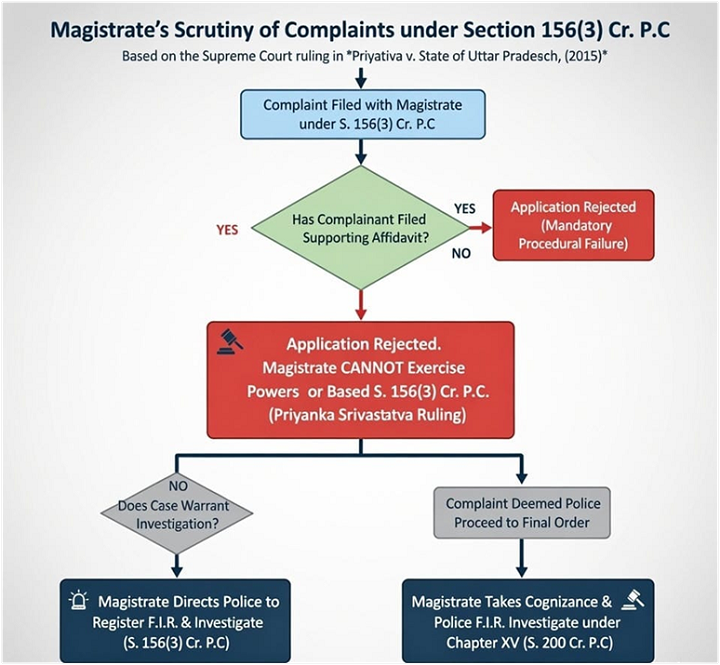
The Supreme Court, in Priyanka Srivastava v. State of Uttar Pradesh, (2015) determined that "A Magistrate cannot exercise his powers under section 156(3) Cr. P.C. on a frivolous application or upon an application based on invalid or insufficient information." Where a complaint is frivolous or lacks legitimacy, then the Magistrate cannot grant the complainant any relief, regardless if an affidavit is filed to show the evidence in support of the legitimacy of the complaint/declaration.
VII. COMPARATIVE JURISPRUDENCE AND INTERNATIONAL PERSPECTIVES
A. United Kingdom Approach
While the UK’s law of defamation is the foundation for the development of India’s own laws, UK defamation law was built on a system that provided complete and unconditional liability against the publisher when sufficiently basic elements of defamation are established. While defenses can provide an additional layer of protection for the defendant, the general principle is that the publisher is liable even in the absence of a defense.
Changes to the defamation laws in the UK (the Defamation Act 2013) have resulted in some movement towards increased freedom of speech; specifically, by creating a single publication rule that provides greater clarity regarding continuous liability, allowing online publishers a measure of safe harbor from litigation; and limiting the presumption of damages.
B. United States Approach: First Amendment Protections
The First Amendment and US judicial decisions, such as the case of New York Times Co. v. Sullivan, have resulted in a much wider range of protected speech than other countries. In Sullivan, the US Supreme Court defined the criteria that an individual must meet to qualify as "public official" or a "public figure." As a result, individuals that fall under this definition must establish that a defamatory statement was made with "actual" malice (i.e., knowledge of the falsehood) or reckless disregard for its truthfulness in order to be awarded damages. This standard reflects a belief that adequate protection of free speech is required, even when that speech includes a certain amount of untrue content, so that society can continue to engage in vigorous discussions about significant issues of public importance.
For private individuals (now sometimes referred to as "private figures"), the burden of proof is lighter (and varies from state to state), but many jurisdictions require the private figure to establish "actual" malice in order to qualify for presumed damages as well. Thus, the result is that the United States has a very strong preference for the protection of free expression over the protection of reputational interests based upon the belief that a democratic government relies upon free and open discourse among citizens.
VIII. CONTEMPORARY CHALLENGES AND REFORM CONSIDERATIONS
A. Abuse of Legal Process in the Digital Age
In this respect, Advocate Priya Dangat notes that - defamatory statements can be spread quickly and widely without limitation as a result of their viral nature. Traditional defamation doctrine was developed during a time when communication was slower and more deliberate; however, the impact of rapidly spreading defamatory statements on a person's reputation may not be adequately addressed under current laws of defamation.
The issues faced by plaintiffs bringing defamation claims against the original author of a defamatory statement and, therefore, the way that money damages or other remedies may be sought through civil courts include the following: (1) Identification of the original source of the statement; (2) Obtaining an effective remedy from the party that caused the statement to be made is often impossible due to the fact that by the time a remedy is retrieved, millions of people have already seen the harmful statement; (3) The apparent transience of posts on social media is negated by their continued existence on various forms of archival storage (e.g., screenshots); and (4) Statements made by one person can be represented in many different ways after they are amplified by others sharing the statement and commenting on it.
B. Platform Accountability and Intermediary Liability
Pursuant to Section 79 of the Information Technology Act, 2000, intermediaries are exempt from liability for any user-generated content unless they fail to promptly remove that content upon being notified of an infringement. However, it is still unclear what qualifies as "actual knowledge" and what constitutes an "expeditious" removal of the content. The case law regarding these definitions continues to evolve.
CONCLUSION
The dual approach to the tort remedy system (as both a civil and criminal remedy) i.e., through tort law and through statutes that create criminal defamation is established as a part of the underlying reconciliation framework of the Constitution. Individuals who claim defamation may pursue civil remedies against the offending party under tort law, and/or seek criminal prosecution of the offending party to obtain punitive punishment, and/or both. The bifurcated approach provides the ability to protect an individual's reputation through a nuanced approach while allowing for a number of different types of remedial measures based on the individual circumstances and types of grievances.
The developments related to defamation under Subramanian Swamy are of paramount importance because they have evolved from being viewed as simply a restriction of a person's fundamental rights, to being considered as being part of the expression of the values inherent in the Constitution. The Supreme Court has interpreted that defamation is a fundamental obligation to respect an individual's dignity, as well as an obligation to maintain social cohesion within the framework of a democracy.
While the ruling did help to clarify the law, it’s still open to public debate. Human rights organisations, as well as the media advocacy group, have expressed concerns about the chilling effect of criminal defamation laws, especially in cases of investigative journalism and political discourse, as the Court's approach is, in theory, intended to provide clarity between the two types of speech but has continued to receive criticisms concerning the effectiveness of the court's procedural safeguards in protecting against the misuse of defamation laws as a means of stifling legitimate dissent and speech.
FAQs
1. What is the core reason for having legal remedies against the misuse of judicial processes?
The law provides remedies like malicious prosecution and abuse of process not just to compensate an injured person, but critically to protect the integrity and reliability of the entire judicial system.
2. How do the United Kingdom and United States approach to defamation law differ, especially regarding freedom of speech
The ways that the Defamation Laws of the UK and USA affect Free Speech Rights are significantly different. The UK has historically treated nearly every publisher as if they were liable for a defamatory statement once certain basic elements have been met; however, other recent developments in the law such as The Defamation Act 2013 and The Single Publication Rule provide some degree of protection for free speech against liability for defamation.
Conversely, due to the First Amendment and decisions from cases such as New York Times Co. v. Sullivan, the USA offers a much broader amount of protected speech and allows "Public Officials" and "Public Figures" to receive any damages for defamation upon proof of "Actual Malice" (knowledge of the truth or disregard for the truth).
Join LAWyersClubIndia's network for daily News Updates, Judgment Summaries, Articles, Forum Threads, Online Law Courses, and MUCH MORE!!"


Tags :Others