
SYNOPSIS
- Introduction
- Main Features of the New Rent Rules 2025
- Need for the 2025 Reforms
- Guidelines for Tenants
- Guidelines for Landlords
- Challenges and Caveats
- Who Benefits From the Reforms
- Practising Advocate’s Opinion
- Conclusion
INTRODUCTION
The following year, India’s leasing system will be changing significantly with the New Rent Rules 2025, a formalized framework of standards whose main purpose is to change the way tenancy agreements are created, monitored, and enforced, was introduced. These regulations signify a transition from typically informal rental-related transactions that have been going on for years to a transparent, digitized, and legally uniform system. If before, people would trust on verbal arrangements, handwritten contracts, or excessive deposits, the new rules set a standardised framework for tenancy that co-relates and helps the parties understand the rights, duties, and obligations of both tenants and landlords.
The 2025 regulations include a variety of tenant-specific reforms that aim to make the rental process more efficient. The new rules require digitally stamped and online-registered rent agreements, security deposits of a limited amount, rent payment methods, and times together with the optional rent increase and provision of clear and unambiguous rules for the entry, inspection, repairs, maintenance, eviction. Also, by specifying the exact time, the necessity of the letter, and the standard for the documents, the rules reduce the possibility of misunderstanding and make it easier for those involved in the act to comply with the rules.
The alterations target the India rent market and the problems that have long existed there, e.g. unregulated deposits, rent hikes that are difficult to forecast, absence of agreements in writing, privacy issues, and court cases that take too long. The 2025 Rules aim to make the rental market more predictable and responsible by way of providing clear contract conditions, defined procedures, digital documentation, and legally enforceable rights.
This article is a detailed, rule-by-rule breakdown of the New Rent Rules 2025, providing an explanation of each component of the reforms, the functionality of the rules in practice, and what tenants and landlords can expect under the new regulatory framework.
Master The Transfer of Property Law: Theory, Practice and Procedure by Adv. Roma Bhagat. Enroll Now!
MAIN FEATURES IN BRIEF OF THE NEW RENT RULES 2025
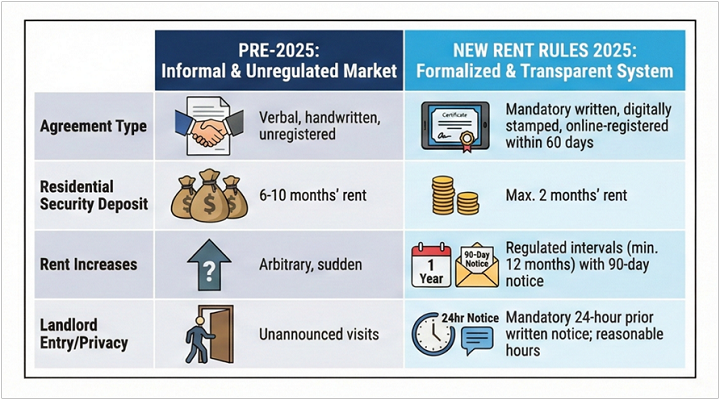
1.Mandatory Written, Digitally Stamped & Online-Registered Agreements
According to the 2025 framework, any rental contract has been mandatory to be in writing, whether it relates to the residential properties, commercial spaces, or the shared accommodations. The agreement also has to be digitally stamped and registered online within a fixed time, i.e., generally within 60 days (two months) of signing.
The idea behind the digital registration is to generate a physically non-reproducible, electronically verifiable, and legally valid record of the tenancy, accessible to the parties, to avoid fake agreements, duplicates, or forgeries. As the registration of handwritten, unregistered contracts has been a source of disputes, the problem of the latter is expected to be solved to some extent by this regulation.
A fine will be charged in case the rental contract is not registered within the set time (in some locations, starting at ₹5,000).
2.Capping of Security Deposit: A Relief for Tenants
The most talked feature of the new regulation: The security deposit for house rentals is limited to a maximum of two months' rent. For commercial or non-residential properties, the security deposit limit is six months' rent.
The idea behind this limitation is to help tenants with their upfront financial costs. So, the tenants who move for education or jobs will be relieved of the high deposit demands for which the previous limit was 6–10 months' rent.
3.Regulated Rent Hikes and Notice Periods
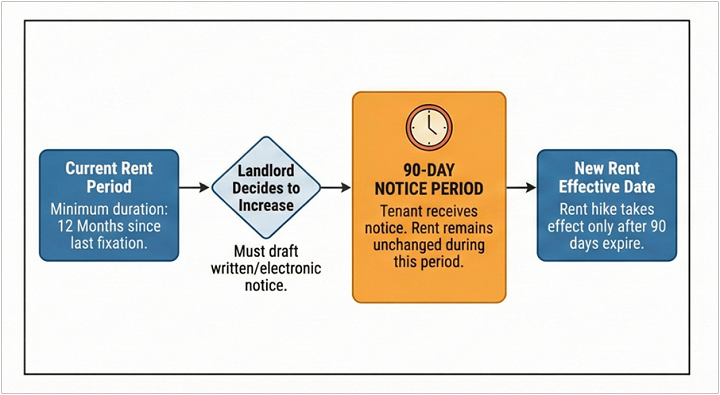
The new regulations restrict rental increases to specified intervals only that are generally twelve months apart.
Besides that, landlords have to send a note to tenants indicating the coming of a rent increase at least 90 days before the memorandum takes effect.
The idea is to stop the practice of sudden rent hikes to take tenants by surprise and leave them with no option but to comply.
4.Defined Entry, Inspection, Repair and Eviction Protocols
If landlords (or property managers) want to have a look at or come into the property that has been rented, they need to give a written/electronic notice of at least 24 hours before. In addition, the visit has to be done at a reasonable hour (not before the first ray of light and not after the sunset).
By way of essential repair for example, those concerning the structure, wiring, or plumbing of a house, etc. it is very clear that they fall under the landlord’s umbrella of responsibility. Minor maintenance may be with the tenant. If the landlord does not repair the property that is not fit for living even after the notice, the tenant may have the right to move out or deduct the repair costs.
Evictions, if any, should be the result of due legal procedures only and immediate lock-outs, abrupt disconnections or forceful evictions are not allowed.
5.Digital Payments & Rent Receipts / Documentation Standardisation
The reforms are meant to digitalize rent payments, especially those above certain thresholds as they provide a traceable payment history that is advantageous to the tenant, the landlord and other users like tax authorities, rent proof, etc.
Receipt issue, fixed formats, openness - all serve to professionalize tenancy agreements, reduce conflicts, and make rentals legally sound.
6.Protection for Both Tenants and Landlords: A Balanced Approach
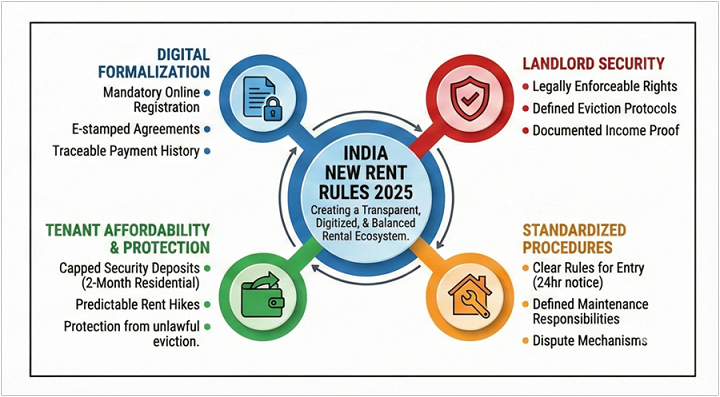
While tenants are afforded such protections as having a low deposit, price-controlled rent increases, documented tenancy, safeguards against eviction and the right to have repairs carried out; landlords also have advantages: a clear legal framework, defined procedures for eviction (in case of non-payment or breach), formal registration, documented rent receipts, and protection against illegal occupancies or misuse.
The idea is to bring about the formalisation of relationships, cut down on grey-area rental practices, and provide legal certainty to both sides thus lowering the number of long-drawn civil lawsuits and ambiguous disputes.
REASON WHY REFORMS IN 2025 ARE ESSENTIAL AND WHAT ISSUES THEY QUANTIFY
India tenants and landlords had for a long time to endure systemic problems that kept reappearing in the same manner:
- The tenants were obliged to give the landlords a security deposit that was extremely high (sometimes the deposit was between 6 and 10 times the monthly rent), which represented an obstacle of very high financial power especially for migrants, students, and young professionals.
- The agreements were mostly informal: people made a handwritten contract or gave each other a verbal assurance hence, conflicts frequently arose in rent amount, duration, deposit, eviction, repairs, and even the legality of tenancy.
- People were complaining of sudden or unjustified rent increases as well as unanticipated evictions and violations of their privacy (for example, landlords entering without prior notice) quite frequently.
- The payments were mostly in cash, which also meant that no rent receipts were issued, and no proper records were kept; in the case of tenants, it meant they had no proof of what they had paid, and for landlords, it meant unaccounted rental income.
- Informal disputes usually led to very long civil court cases involving considerable expenses, time, and uncertainty.
With the 2025 reforms, the government is addressing each of those problems and planning to establish a renting system that would be transparent, regulated, predictable, and fair. Tenants will have fewer upfront costs, namely, documented rights and protection. On the other hand, landlords will know for sure their rights are legally enforceable, will receive documented income and have access to a structured procedure for eviction or dispute resolution, i.e., arbitration.
Such changes mean a lot to city dwellers who rent a flat: students, workers, migrants, etc. As well as it means a lot to cities with heavy demand like Mumbai, Bengaluru, Delhi, Pune, Tamil Nadu and Hyderabad. If carried out properly, these changes could assure less stress and anxiety in the process of looking for a place to stay and thus making life easier.
WHAT ONE SHOULD DO AS A TENANT / LANDLORD: HOW TO ADAPT & BENEFIT
Are you thinking of renting a place now (or are you already a tenant)? Here is how to benefit from the New Rent Rules 2025 or have a plan in place when they come into force:
- First of all, your rent agreement has to be written. It also needs to be digitally stamped and registered online within 60 days from the date of signing. So, landlord/tenant, do not forget to give me the registration confirmation as a proof.
- In the case of residential rentals, the security deposit should not be more than two months’ rent. If you happen to know that someone is asking for more, then you should ask for an explanation.
- For example, a deposit cap for a commercial space is much higher (six months) but still regulated under the new framework (less than that of the previous unofficial demands).
- Continue to save all of your documents i.e. rent receipts, digital payment proofs, registration copies, and agreement copies in order to have proper documentation for the future (eviction, disputes, deposit refund, etc.).
- In case a rent increase is suggested by the landlord, first of all, find out that the increase is not less than 12 months, and in addition, you should have got at least 90 days' written notice.
- If a landlord wants to inspect the property or do some repairs there, then don't forget that you have to be informed before (24-hours) in writing, and make sure that the landlord comes during the usual and comfortable hours.
- When the repair work is to be done, correct the understanding about the person responsible for the work (structural vs minor repairs) and in your agreement, write down the terms to prevent future conflicts.
- If you are involved in a dispute (such as eviction, deposit refund, damages, rent hike), then find the 2025 rules as your refuge with a documented agreement & registered tenancy, it will be much easier for you to assert your rights.
HOW LANDLORDS BENEFIT & WHAT THEY SHOULD KNOW
- Landlords are advised to confirm tenancies through digitally signed and registered agreements in order to safeguard themselves from future disagreements, illegal occupancy, or ambiguous claims of tenancy.
- Online legal documentation and registration make it less likely that fraudulent contracts will be created which will be a great advantage if the property is sold or transferred later on.
- The deposit cap (2-month for residential / 6-month for commercial) is aimed at ensuring that the situation is fair. Landlords can still be provided with security through reasonable deposit limits in combination with documented agreements, while at the same time tenancy is made more accessible to decent tenants.
- Having a set of rules for rent hikes, eviction, inspection, and repairs that is understood by both parties brings trust and certainty and hence not many landlord-tenant conflicts of an arbitrary nature which land in court will arise.
- Digital rent payments along with receipts facilitate proof of income, tax compliance, and provide a documented rental income.
WHAT IS THE “CATCH” and WHAT READERS SHOULD CHECK:
- Several articles describe the 2025 framework as "the law," but what is actually in place at the moment is the model framework, and its adoption depends on state-level enactments.
- For the changes to be fully effective, states must either amend their tenancy laws or agree to the template. Until then, it is possible that old rent-control laws will still be in force depending on your state or city.
- The execution will be dependent on sound digital facilities such as online portals, e-stamping, registration departments (like Rent Authorities), and so forth. Those who are without these may find the change from informal to formal rentals uncomfortable at first.
- Knowledge of new rules among landlords and tenants will matter a lot as many of them may not be aware of the new regulations, especially in smaller towns or rental markets that are not formalized, where old ways of doing things (handwritten contracts, high deposits, cash payments) may continue.
- With regard to existing tenancies (signed before 2025), the use of new regulations may be vague and the understanding will be based on the way the state law dictates the transition/grandfathering, thus there might be legal/administrative confusion.
WHO WOULD GET THE BEST ADVANTAGES AND WHY THE CHANGE IS IMPORTANT
The 2025 rent reforms, in their proper functioning, are a major step forward and thus, have few significant beneficiaries of the changes, they may be probably these ones:
- Students, migrants, and working professionals: since security deposit is lower, tenancy is documented, registration is online - all make renting more convenient, cheaper and safer from a legal perspective.
- Young families and first-time renters: as a result of transparent agreements, clearly defined deposits, rent-hike protections, and eviction safeguards - holding stability and security become possible.
- Landlords with legal intentions: Due to formalisation, they receive more clarity, rental income becomes documented, they may easily resolve any disputes and are better protected against informal disputes or illegal occupancy.
- Urban rental markets with high mobility: metropolises like Delhi, Mumbai, Bengaluru, Pune, Hyderabad - that are full of tenants moving frequently - can substantially benefit from standardized, predictable renting norms.
- Legal aid, tenant-rights and civil-society groups: As new rules define more clearly tenant–landlord relations, justice-oriented actors get more time and resources to assist tenants in disputes or unfair practices.
The reforms can potentially be a great turning point for the Indian rental housing to move from a chaotic type of informal economy to a more regulated, fair and modern housing ecosystem if they are embraced by wide audience.
Frequently Asked Questions (FAQ)
1.Is it mandatory to register every rent agreement under the New Rent Rules 2025?
Yes. Digitally stamped and registered online are the requirements for all tenancy agreements within the given timeframe, whether they are residential or commercial. This step is necessary for legal validity, avoiding conflicts, and establishing a record that can be referred to if needed.
2. What is the maximum-security deposit allowed under the 2025 Rules?
The security deposit for a residential unit should not be more than two months’ rent. As for a commercial unit, the maximum deposit is six months’ rent. Introducing these limits is part of the intentions that landlords will take less financial benefits and tenants will be relieved of the traditional burden while they are still in the same ratio of rental relationships.
3. Can landlords increase the rent whenever they want?
No, they cannot. An increase in rent is only allowed once in twelve months and thus the landlord should notify in writing 90 days in advance the date from which the new rental will be in effect.
4. Are landlords allowed to enter a rented property without informing the tenant?
Negative. Landlords are required to provide more time than 24 hours’ written or electronic notice of their intention to enter the premises. In addition, visits should be carried out during normal hours so that the tenant's privacy is not invaded.
5. What happens if a landlord or tenant violates the New Rent Rules 2025?
Non-compliance such as failure to register an agreement, charging an excessive deposit, evicting without cause, or refusing to carry out essential repairs may result in sanctions, court cases, or different types of acts of enforcement through the rent authority or tribunal that has been assigned. The extent of state involvement decides the exact place where these matters will be handled.
Adv Pratham Kindra : a practising advocate’s opinion on this is: “In my experience, which is often handling landlord-tenant litigation, I view the New Rent Rules 2025 as a reform that was overdue for a long time. The move to compulsory written agreements, digitally registered, and rents with capped deposits will, by a great margin, be the cases that will hardly be disputes, hence conflicts arising from informal dealings will be eliminated. Clear and punctual times for rent hikes, notice requirements, inspection protocols, and digital payment norms give back to both sides the fairness and trust they have been lacking. Therefore, unnecessary litigation will be very few if States implement these rules effectively, and renting in India will become more transparent, accountable, and legally secure.”
CONCLUSION
The New Rent Rules 2025 represent a decisive move toward modernising India’s rental ecosystem. By introducing uniform standards for agreement execution, deposit limits, rent revision, inspections, repairs, and eviction procedures, the framework lays the foundation for a rental market that is both predictable and transparent. The reforms address long-standing gaps in landlord-tenant relations by emphasising documentation, digitalisation, accountability, and fairness.
If these rules are adopted and implemented effectively across states, India could witness a transformative shift from informal, high-risk renting practices to a structured and rights-based system. Tenants benefit from reduced financial burden, documented protection, and clarity of obligations, while landlords gain stronger legal enforceability, clearer procedures in case of breach, and protection from misuse or unlawful occupation.
As 2025 unfolds, the real test will lie in the speed and consistency with which states operationalise these reforms through digital portals, authorised registration mechanisms, awareness drives, and accessible dispute-resolution systems. If executed well, the New Rent Rules 2025 have the potential to make renting in India not just easier, but genuinely secure, standardised, and just.

This Property Law course by Adv. Roma Bhagat is designed as a complete, practical toolkit—combining deep bare-act understanding, landmark judgments, and real case experiences from her 15+ years in the field.
It prepares law students, practicing lawyers, aspiring judges, teachers, and even litigating parties, offering clarity on complex areas like mortgages, fraud, agricultural land, evidence, prosecution/defence strategy, and procedural liaisoning.
With recorded lectures, notes, major judgments, and interactive Q&A sessions, it promises a once-in-a-lifetime learning experience guided by one of LCI’s most respected trainers.
Join LAWyersClubIndia's network for daily News Updates, Judgment Summaries, Articles, Forum Threads, Online Law Courses, and MUCH MORE!!"


Tags :others