
Index of Headings
- Introduction
- Article 22 and the Right to Know the Grounds of Arrest
- The Supreme Court's Ruling: Written Grounds Now Mandatory
- Key Highlights from the Judgement
- The Legal Steps While Arresting an Individual and the Procedure That Must Follow
- What Happens During the Remand Process?
- Rights of the Accused Under the Law
- Consequences of Violating These Rights
- A Legal Practitioner’s Perspective: Step-by-Step Through Arrest and Production Before the Magistrate
- Conclusion
- FAQs
Introduction
The petitioner, Mihir Rajesh Shah, was arrested in the case who afterwards claimed that he was not informed in writing of the reasons for his arrest, which he deemed to be a violation of his Constitutional rights.
Initially, the Bombay High Court engaged with the issue and recognized (i) there indeed was procedural impropriety related to providing the petitioner with written information about his reasons for the detention, but the High Court refused to call the arrest illegal, given the gravity of the offense and evidence to support that the petitioner had attempted to flee.
After failing to have the arrest declared illegal, Shah appealed to the Supreme Court providing an important framing question to the tribunal, “Is the right to be informed, of the reason for arrest, in writing, absolutely necessary, and if it is not followed, what are the legal consequences?”
The Supreme Court while hearing the case, decided that the main issue was the writing down of the arrest grounds in case of ordinary laws like the Indian Penal Code (IPC) and its replacement, the Bharatiya Nyaya Sanhita (BNS). Prior to this ruling, written grounds were required only in certain special laws, such as those pertaining to the Prevention of Money Laundering Act (PMLA) or the Unlawful Activities Prevention Act (UAPA).v
Article 22 and the Right to Know the Grounds of Arrest
In terms of Article 22(1), it is the duty of the police to inform an arrestee promptly about the reasons of arrest and to provide him/her with a lawyer. The provision in Article 22(2) stipulates that the individual must be taken to a magistrate within 24 hours, not counting the time taken for transport.
The Supreme Court's Ruling: Written Grounds Now Mandatory
The Supreme Court division bench of Chief Justice BR Gavai and Justice Augustine George Masih, held that:
"The requirement of informing the arrested person the grounds of arrest, in the light of and under Article 22(1) of the Constitution, is not a mere formality but a mandatory constitutional safeguard. If a person is not informed of the grounds of his arrest as soon as may be, it would amount to the violation of his fundamental rights and personal liberty under Article 21.”
Key Highlights from the Judgement
It was majorly stressed upon that:
It is important to recognize early access to legal counsel for the arrested individual so that he can prepare to have a defense and oppose the remand. Early access to legal representation is an essential objective to ensure the protection of the arrested person's personal liberty. This court in Suhas Chakma v. Union of India and others emphasized the necessity of pre-litigation assistance and directed that the National Legal Services Authority's "Guidelines on Early Access to Justice at Pre-arrest, Arrest and Remand Stage Framework" be implemented.
The guidelines provide for legal representation for the arrested person at the remand stage. The remand advocate shall meet with the arrested person to inform him of the allegations being made against him by the prosecution for remand. The guidelines also provide for the availability of translated documents to the arrested person in a language he/she understands.
The Legal Steps in while arresting an Individual and the Procedure that has to be followed next
Arrest in India is governed by the Bharatiya Nagarik Suraksha Sanhita, 2023 (BNSS), which is a replacement for the Code of Criminal Procedure (CrPC). The officer who arrests must identify himself and provide valid identification. The officer must provide an arrest memo that is signed by a witness and co-signed by the accused, and it must show the time, date and reasons for the arrests. The officer must inform a friend or family member of the person's detention. The person who is arrested will have to be medically tested to ensure that there has been no ill treatment.
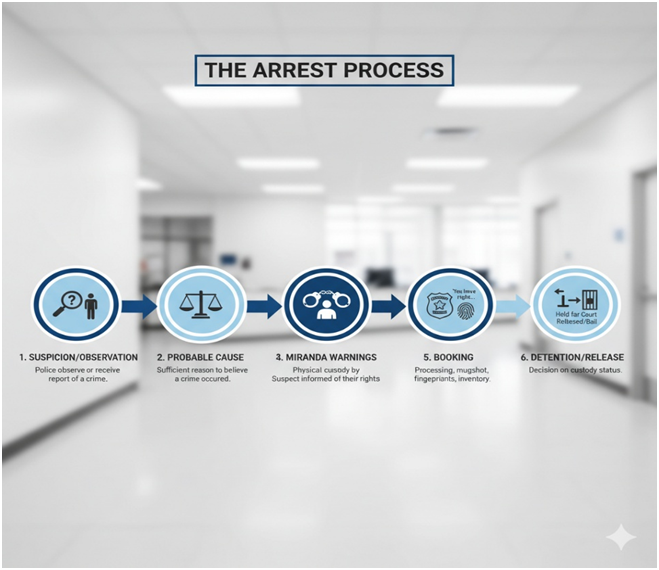
The accused must be produced before a magistrate within 24 hours, not including travel time, pursuant to Article 22(2) and Section 39 of the BNSS. Production before the magistrate serves many purposes. The magistrate must determine whether the arrest was lawful, whether the detention after arrest was lawful, whether there were valid grounds for arrest, and whether the grounds for arrest were in writing.
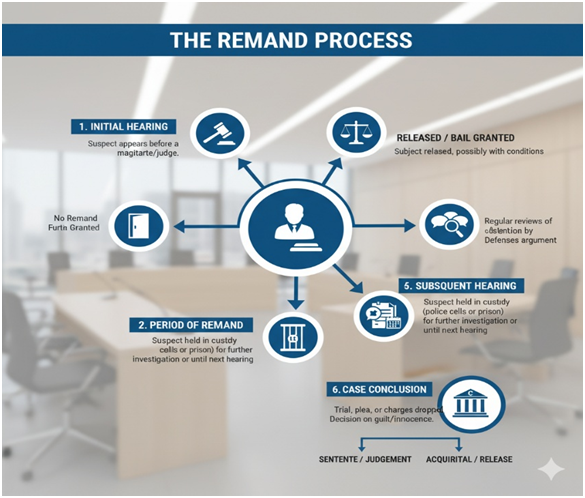
Police custody can only be granted for 15 days maximum before only judicial custody is permitted. Depending on the nature of the charge, Judicial custody can be extended to a maximum of 60 or 90 days.
What happens during the remand process?
The remand process is not a mechanical process and requires the magistrate to actively scrutinize the documents and grounds presented by the police. The magistrate must record satisfaction, in writing, that the detention is warranted based on the facts provided. If the grounds are insufficient or not properly communicated, the magistrate must refuse remand and release the accused.
As was seen in the case of - Arnesh Kumar v. State of Bihar ((2014) 8 SCC 273):
Arnesh Kumar was arrested without any prior inquiry or investigation by the police, under Section 498-A IPC (cruelty by husband/relatives) and Section 4 of the Dowry Prohibition Act, upon a complaint made by his wife that he demanded dowry (₹8 lakhs, a car, etc.). The police sought a remand for police custody for Arnesh Kumar, and the Magistrate granted remand mechanically without applying his judicial mind. The Supreme Court quashed the arrests and laid down binding guidelines to prevent arbitrary arrests with special reference to cases that are punishable to a maximum of 7 years’ imprisonment.
Rights of the Accused Under the Law
All individuals arrested in accordance with the existing laws in India are promised certain fundamental rights that serve to prohibit arbitrary action of the State. The right to be told in writing the reason for arrest is given preeminent status under Article 22(1) of the Constitution, and this position is also affirmed by section 47 of the Bharatiya Nagarik Suraksha Sanhita. In this case the apex court further held that the arresting police officer must provide the reason for the arrest in a language that the arrested person understands, and in any case, no less than two hours prior to the arrested person being produced before the magistrate.
If this is not done, the arrest and subsequent remand is illegal per se. Under Article 22(2) of the Constitution and Section 55 of the Bharatiya Nagarik Suraksha Sanhita, there is also a mandate to produce the arrested person, excluding travel time, before the nearest magistrate of the nearest magistrate within 24 hours of arrest. This is a very important safeguard, since it prohibits indefinite detention without a judicial check (Khatri v. State of Bihar ((1981) 1 SCC 627)).
Consequences of Violating These Rights
If the procedures are not followed, such as failure to supply the written grounds of arrest in a language the arrestee understands, the entire process of arrest and remand will be considered illegal. The arrested individual must be released, and the police authorities can face civil or disciplinary actions, including compensation claims under Articles 32 or 226 of the Constitution.
A Legal Practitioner's Perspective: Step-by-Step Through Arrest and Production Before the Magistrate
Advocate Sejal Kaul, an advocate explains the entire process from the perspective of a legal professional.
"The process of arrest and appearance before a judge is among the most rigorously protected aspects of Indian criminal law," she explained. "When police officers arrest someone, their first duty is to tell the arrested person, in a language he or she understands, the grounds for arrest. Now, the Supreme Court's latest ruling says this has to be done in writing. Therefore, if the police officer fails to do the written arrest memorandum, it is no longer a mere technicality, it directly goes in tandem with the person's constitutional rights."
The grounds for arrest recorded by the authorised officer, as per Section 19(1) PMLA, would be personal to the arrested individual and there would usually be no possibility of sensitive information coming from there and compromising the sanctity and integrity of the investigation. If there was a sensitive information included in the grounds for arrest recorded by the authorised officer, he could simply remove such sensitive details from the document and provide the associated person with an edited copy of the grounds for arrest to protect the secrecy of the investigation.
Now by dealing with the mode of communication of the grounds of arrest so as to achieve the intended purpose of the constitutional mandate that the language of Article 22(1) and of Article 22(5) dealing with the communication of the grounds is inescapably the same and that, therefore, the interpretation of Article 22(5) shall necessarily apply to Article 22(1).
In order to meet the true intended purpose of Article 22(1), the grounds of arrest must be given in writing. At this stage, in the context of the right of a detainee to be informed of the grounds of arrest, it has been held that this should be provided in a language which he understands and in a script which he can read, if he is literate.
Conclusion
This ruling reinforces that individual liberty is not based on the severity of the crime, or the seriousness of the allegation, but is instead a basic constitutional right that must be vigilantly protected through careful adherence to the procedural safeguards. Ultimately, the ruling serves as a reminder that the rule of law is measured, not only by how properly the State seeks criminal justice but, by how faithfully it protects the constitutional rights of even those accused of committing serious crimes.
FAQs
Q:What are the legal steps an officer must follow while arresting an individual in India and what procedures follow after the arrest?
A:During an arrest under India’s BNSS 2023, the officer must identify themselves, issue an arrest memo, inform a relative, ensure a medical exam, and produce the accused before a magistrate within 24 hours, after which custody is regulated by strict limits (up to 15 days police custody, and 60–90 days judicial custody depending on the offence).
Q: What rights does an accused person have under Indian law during and after arrest?
A: An accused has the right to be informed in writing of the grounds of arrest in a language they understand, to be produced before a magistrate within 24 hours, and any violation of these safeguards renders the arrest illegal and may lead to release and action against the police.
Q: How does a legal practitioner describe the step-by-step process of arrest and production before a magistrate in India?
A: A legal practitioner explains that police must give written grounds of arrest in a language the person understands, produce them before a magistrate within 24 hours with all documents, and that the magistrate scrutinizes these strictly as any lapse can lead to immediate release and weakens the prosecution at the remand stage.
Join LAWyersClubIndia's network for daily News Updates, Judgment Summaries, Articles, Forum Threads, Online Law Courses, and MUCH MORE!!"


Tags :Others