
INTRODUCTION
Tort law is a branch of civil law that addresses civil wrongs that result in harm to people, property or reputation. Tort law differs from criminal law because tort law remedies the injured party for the wrongful act of another, while criminal law punishes offenders for wrongful acts against the State. Winfield explains that "Tortious liability arises from the breach of a duty primarily fixed by law; such duty is to persons generally and its breach is redressable by an action for unliquidated damages." In other words, if a person's legal right is violated without a lawful excuse, tort law provides for a remedy against the tortious act of another.
The significance of tort law is its ability to protect individual rights and promote social cohesion. Tort law remedies an infringement of one's right to life, property, or reputation. The aim of tort law as illustrated by Ratanlal & Dhirajlal, Law of Torts, does not focus on punishing the tortfeasor but rather to restore the injured party to the position lost as the result of the wrong. This compensatory principle can be seen as a mechanism of fairness and justice in society, as demonstrated by Ashby v. White (1703) 2 Ld Raym 938, which dealt with a plaintiff receiving an unjustifiable disenfranchisement despite not suffering any direct loss. The court concluded that if a right is wrongfully breached, an individual is entitled to some form of remedy offered by the law than he or she would have otherwise had. Hence, the right to a remedy can be summarized in the Latin maxim ubi jus ibi remedium (where there is a right, there is a remedy).
There is another significant aspect of tort that serves to promote social justice; it deters individuals and organizations from acting in a negligent or careless manner. In Donoghue v. Stevenson (1932) AC 562, the law surrounding negligence started to take shape. The principle established in the case is to take reasonable care to avoid acts or omissions which can "reasonably" be viewed as likely to cause injury or damage to others. Cases such as Donoghue v. Stevenson demonstrates how tort law promotes responsible behavior by members of society, and by creating legal obligations to maintain "duty of care," it gives effect to academia regarding tort law.
For these reasons, tort law is located so firmly beside personal justice and social justice, so no party suffers loss without a remedy. Tort law protects legal rights, provides compensation to victims, and invokes moral balance within society. Simply put, tort may be one of the most important facets of civil law.
2. HISTORICAL EVOLUTION OF TORT LAW
2.1 ORIGIN OF TORT LAW IN ENGLAND
The origins of tort law are based in the common law system of England, which was shaped by judicial decisions rather than written statutes. In the beginning, civil wrongs were dealt with under the "writ system" which was a formal process whereby individuals presented their pleas to the King's Court for a remedy for their wrongs. Only those wrongs in which a specific writ could be applied existed as remedies. Over time, judges started to interpret and expand the meaning of writs, and new principles were added, creating the early framework of torts or the law of torts. The word tort itself has its root in Latin "tortum," meaning twisted or wrong. The growth in this branch was gradual and highly dependent upon judicial creativity. Winfield characterized the development of tort as "a process of judicial legislation," where principles were created by courts to provide remedy for new concepts of wrongs, on a case-by-case basis. In the prominent case of Ashby v. White (1703) 2 Ld Raym 938, an important principle was established ubi jus ibi remedium (where there is a right, there is a remedy). The plaintiff in this instance was unlawfully denied his right to vote. The court concluded he had not suffered any pecuniary loss; yet, the principle affirms that if there is a breach of a legal right (irrespective of actual loss), there must be a remedy for that breach of right. This judgment formed one of the pillars that became recognized as tort law.
Another seminal case, Donoghue v. Stevenson (1932) AC 562, is recognized as the foundation of contemporary negligence law. In that case, Lord Atkin articulated the famous neighbourhood principle whereby one must take reasonable care not to do any act or omission that may foreseeably cause harm to his or her ‘neighbour’; a neighbour was one who was closely and directly affected by one’s actions. The principle certainly extended both the width and scope of tortious liability and became a ray of hope to many nation-states, including India.
In this way, English tort law emerged from a rigid system of procedural forms (under the writ system) to a flexible, dynamic system of principles founded on justice, fairness, and reasonableness. The evolution of the area of law was judge-made, thereby demonstrating the responsiveness of the common law system to accommodate the changing needs of society.
2.2 DEVELOPMENT OF TORT LAW IN INDIA
India's Law of Torts is basically derived from English common law. During the British period, the concepts of law taken from English law were slowly implemented in India mainly through the establishment of the Supreme Courts in the Presidency towns (Calcutta, Bombay, and Madras). Post the independence, the Indian judiciary still sticks to the principles of common law while deciding torts cases as there is no written law of torts in India.
The authors Ratanlal & Dhirajlal are of the opinion that the evolution of tort law in India has not been merely a derivation from English law, but it has been changed to adjust Indian social and constitutional realities. To date, Indian courts have been developing the tort theories to cope with the phenomena of environmental pollution, administrative negligence, and human rights violations, etc.
A prominent landmark case in Indian tort jurisprudence is M.C. Mehta v. Union of India (1987) AIR 1086 (Oleum Gas Leak Case), where the Supreme Court developed the doctrine of absolute liability. The Court ruled that an enterprise engaged in a hazardous or inherently dangerous activity shall be held absolutely liable for all damage caused, regardless of proof of negligence. This was held to be more specific than the well-known English principle of strict liability which was originally established in Rylands v. Fletcher (1868) LR 3 HL 330 and is a clear Indian development.
In the case of Rudal Shah v. State of Bihar (1983) AIR 1086, compensation was awarded for unlawful detention, and the Court recognized constitutional torts as state civil responsibilities under Article 21 for the neglect of fundamental rights. In Nilabati Behera v. State of Orissa (1993) AIR 1960, the Supreme Court reflected the same view that public authorities could incur public tort liability for custodial deaths and for misuse of their powers as public servants.
We also saw that the Indian judiciary took inspiration from Donoghue v. Stevenson with respect to negligence cases, especially as it related to the notion of "duty of care" and "foreseeability." Over the years, tort law principles and jurisprudence were applied for not just private justice but also public accountability.
Consequently, though India has not yet codified tort law, it has seen remarkable progress with respect to judicial innovation, and it continues to flourish. It has also evolved away from its English origins as the framers of torts law dealt with social realities in India with respect to justice, human rights, and environmental protection, and has led to a complete re-imagining of tort law in India. Today the Indian Law of Torts may be considered as a hybrid of its common law heritage and constitutional philosophy, advocating and embodying modern civil jurisprudences concepts of corrective and distributive justice.
3. DEFINITION AND NATURE OF TORT LAW
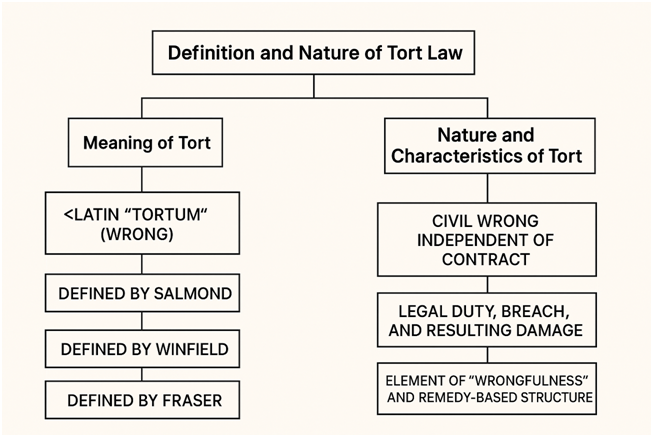
3.1 MEANING OF TORT
The word "tort" comes from the Latin "tortum," meaning twisted or wrong. In legal context it is an act or omission that violates a legal right of another party and the law gives a civil remedy, usually in the nature of damage compensation. Tort law therefore concerns itself with the remedy of private wrongs which are not based upon contract or trust but rather arise from the breach of a general legal duty prescribed by law. According to Salmond “a tort is a civil wrong for which the remedy is a common law action for unliquidated damages, and which is not exclusively the breach of a contract, trust, or other equitable obligation.”
Winfield has a broader definition of tort law - “a tortious liability arises from the breach of a duty that the law primarily fixes; that duty is towards persons at large, and the breach of duty is redressable by action for unliquidated damages.” Fraser explains it as “an infringement of a right in rem of a private individual giving a right to compensation at the suit of the injured party.”
3.2 NATURE AND CHARACTERISTICS OF TORT
Tort law is characterized by certain essential features that distinguish it from other branches of law:
1. Civil Wrong Not Derived from Contract:
A tort is a civil wrong, meaning it relates to private persons rather than to the community (as in the case of a crime). A tort differs from a breach of contract because a tort occurs without an agreement between the parties. For instance, a tort is when a person is injured while negligently driving their car and injures another person, even if there is no contractual relationship.
2. Legal Duty Created by Laws:
The duty in tort arises not from consent or promise, but from the law itself. There is a general duty to not intentionally or negligently create acts or omissions that will cause harm to others. One example is Donoghue v. Stevenson (1932), where the court established the “neighbour principle,” which creates a legal duty for someone to take reasonable care to prevent foreseeable harm.
3. Breach of Duty Causing Damage:
In order for tort to be found, there must be a breach of duty of care, which is a legal duty, causing injury or damage. The damage can be physical injury, mental injury, injury to reputation or economic loss. An example of injury to reputation that could be compensated for is Bhagwan Das v. Mohd. Arif (1988), which compensates for injury to reputation due to defamatory comments.
4.Aspect of Wrongfulness:
Each tort is wrongful - meaning that some legal right of another person has been violated. Actions taken with lawful justification are non-tortious. Therefore, wrongfulness is the aspect of conduct that creates a tort.
5.Remedy-Oriented Framework:
Tort law is a remedy-oriented system. The maxim ubi jus ibi remedium holds that wherever there is a right there is a remedy. The typical remedy is compensation; however, sometimes a court will issue an injunction or restitution. This underscores that tort law is intended to restore the injured victim, rather than to punish a tortfeasor.
FLOW CHART FOR BETTER UNDERSTANDING-:
4. OBJECTIVES AND FUNCTIONS OF TORT LAW
Tort law is among the most important branches of the civil law system and is intended to promote social order by striking a fair balance between individual rights and responsibilities. Tort law has a public interest component to it- according to Ratanlal & Dhirajlal's Law of Torts- the goals of tort law are not limited to compensating victims, but addressing some that stem from wrongful actions while promoting social justice in society.
1. compensation to a victim
The subject matter of tort law is about compensation for the individual who has actually suffered as a consequence of the wrongful act of another person. This brand of law is focused on the principle of ubi jus ibi remedium- "where there is a right, there is a remedy." The victim is then placed back to where they were, as far as money can do it- before the harmful act was committed.
Case Example: Livingstone v. Rawyards Coal Co. (1880) establishes the foundation of full compensation for loss incurred.
2. DETERRING FUTURE WRONGS
Another goal of tort law is to deter people and institutions from committing similar wrongs in the future. Liability is placed on people (financial liability) to send the signal that being negligent or harmful (intentionally) will lead to liability. This was echoed in M.C. Mehta v. Union of India (1987 AIR 1086), where the Supreme Court of India established the principle of absolute liability to deter industries engaging in hazardous activities. The court wanted to show industries that they would face consequences even if they acted carefully, but did not demonstrate caution in a public safety matter.
3. Distributive and Corrective Justice
Tort law, according to Winfield, is both corrective justice and distributive justice. Corrective justice is to ensure that the wrongdoer gives compensation back to the victim, which restores the moral balance, while distributive justice is focused on fairness in the allocation of burdens and benefits within society. Rylands v. Fletcher (1868) LR 3 HL 330 is a classic example of liability distribution in the interests of fairness, even with no negligence being shown.
5. THE MAXIM: UBI JUS IBI REMEDIUM
The Latin phrase Ubi jus ibi remedium can be rendered “where there is a right, there is a remedy.” This phrase is the foundation of the Law of Torts and of civil justice in general. It signifies that if someone has their legal right breached, the law must supply a means of remedying that breach. Ratanlal & Dhirajlal’s Law of Torts notes that a right without a remedy is a nullity in law.
5.1. Meaning and Essence
The phrase states that if a person has a legal right, by inference, others must have a corresponding legal duty to respect that right. When a legal duty is breached, the injured party must have access to some kind of legal remedy or remedy, usually in the form of a judgment for damages or an order to refrain from certain activity. Thus, tort law is a remedial system, put in place to remedy civil rights and, through law; justice is delivered.
5.2. Historical Formation and Significance
This principle has its roots in early English common law, whereby courts developed remedies for every breach of a civil right. This phrase was made famous by Chief Justice Holt in Ashby v. White (1703) 2 Ld Raym 938, a case which is highly regarded as one of the founding cases in tort law.
5.3. Case Laws
• Ashby v. White (1703)
The landmark case of Ashby v. White involved a plaintiff, Ashby, who was improperly prevented from voting in a parliamentary election by the defendant, a returning officer. The result of the election was not affected; however, the court held that the defendant's action had breached Ashby's legal right to vote, and he was entitled to a remedy. The Chief Justice Holt famously noted, "If the plaintiff has a right, he must of necessity have a means to vindicate and maintain it." This case established that legal rights could be actionable per se, even if no actual damage occurred; this case, therefore, established the tort of infringement of legal rights”.
• Bhagwandas v. Girdharilal & Co. (1966 AIR 543)
In Bhagwandas v. Girdharilal & Co., the Supreme Court of India faced a dispute involving an offer and acceptance made through telephone. The court applied the maxim by holding that when a party's right given under a contract was breached due to the other party's miscommunication, a remedy, therefore, must exist to achieve justice. Here it also reinforced the idea that the maxim attached to Indian jurisprudence more than just tort law extending it into the contract and constitutional law.
• Bhim Singh v. State of Jammu & Kashmir (1985) AIR 1285
Unlawfully arrested, a member of the legislative assembly Bhim Singh was held by the police and thereby prevented from attending the house session. The apex court held that such an act amounted to the infringement of a basic right and, therefore, it granted exemplary damages. This case is still very much alive as an instance of ubi jus ibi remedium showing how courts ensure the protection of personal freedom through remedial justice.
CONCLUSION
The maxim Ubi jus ibi remedium, which means there is no wrong without a remedy, still serves as a beacon of tort law, ensuring that no person is unjustly deprived of their legal rights. In decisions like Ashby v. White and Bhim Singh v. State of J&K, the courts reaffirmed the notion that a right without the benefit of a practical remedy has no value in a just legal system.
6. INJURIA SINE DAMNUM AND DAMNUM SINE INJURIA
6.1. Injuria Sine Damnum (Legal Injury Without Actual Damage)
The landmark case regarding this principle is Ashby v. White (1703) 2 Ld Raym 938, where Ashby, the plaintiff, who was a qualified voter, was prevented from voting by the defendant, a returning officer, in an election, in an unlawful manner. It was held that even though Ashby did not suffer any actual damage and the result of the election remained the same, Chief Justice Holt considered the defendant's refusal to let Ashby vote as an illegal act. Among other things, he said, "If the plaintiff has a right, he must necessarily have a way to assert and keep it."
This decision considered the wronging of a legal right actionable per se, or wrongful even if actual harm is not proved. This principle honors the inviolability of rights of the persons and affords a remedy under the law whenever a right is breached.
This principle has also been affirmed in India in Bhim Singh v. State of Jammu & Kashmir (AIR 1986 SC 494), where the petitioner, an MLA, was unlawfully detained by police and therefore prevented from participating in a legislative meeting. The Supreme Court found that the State violated his right to personal liberty. The Supreme Court awarded exemplary damages for this breach of right. This case reveals the behaviour of the judiciary in protecting legal rights using remedial justice.
6.2. Damnum Sine Injuria (Actual Damage Without Legal Injury)
Damnum Sine Injuria means "damage without injury." This term refers to a situation in which a person experiences a real loss or harm without an infringement of a legal right. Although harm may have occurred, it does not give rise to a cause of action because it is the result of the lawful exercise of the rights of another.
The key case is the Gloucester Grammar School Case (1410) Y.B. 11 Hen. IV 47; in this case, a teacher opened a rival school that interfered with the income of another teacher, and the courts determined that the defendant’s conduct was not actionable because it was lawful and no legal right was violated. The principle demonstrated in this case is that if there is no violation of a legal right, there is no actionable tort despite the fact that there may have been real economic loss.
Other examples are Mogul Steamship Co. v. McGregor Gow & Co. (1892) AC 25, where the courts found that competition that generated a financial loss was lawful; and Bradford Corporation v. Pickles (1895) AC 587, where a lawful use of one’s property caused inconvenience to another, which was not actionable as a tort.
7. Difference Between Tort, Crime, and Contract
7.1. Tort vs. Crime
| Aspect | Tort | Crime |
| Nature of Wrong | A tort is a private wrong that affects the rights of an individual. | A crime is a public wrong that affects society at large. |
| Parties Involved | The action is between one individual against another individual. | The action is between the State (prosecution) and the accused person. |
| Purpose | The primary aim is to compensate the victim for the harm suffered. | The main objective is to punish the wrongdoer and maintain public order. |
| Standard of Proof | Based on the balance of probabilities. | Requires proof beyond a reasonable doubt. |
| Legal Proceedings | Instituted by the injured party (plaintiff). | Initiated by the State or government authorities. |
| Remedies | Results in compensation or injunction for the aggrieved party. | Results in punishment such as imprisonment, fine, or both. |
| Example | Defamation, negligence, trespass. | Theft, murder, assault. |

7.2. Tort vs. Contract
| Aspect | Tort | Contract |
| Source of Duty | The duty is imposed by law regardless of the consent of parties. | The duty is created by agreement between parties. |
| Consent | No consent is required between the parties. | Consent is essential for the formation of a valid contract. |
| Intention | A tort may occur even without intention or agreement. | A contract always requires intention to create legal relations. |
| Type of Right | Infringes a right in rem (right against the world). | Involves a right in personam (right against a specific person). |
| Damages | Unliquidated damages—amount determined by the court. | Liquidated damages—pre-decided or specified in the contract. |
| Remedy | Compensation or injunction for the victim. | Specific performance, damages, or rescission of contract. |
| Example | Trespass, nuisance, defamation. | Breach of sale agreement, failure to deliver goods. |
8. RELEVANCE OF TORT LAW IN MODERN INDIA
Tort laws are instrumental in ensuring fairness and holding people responsible in the Indian society today. As a result, besides negligence and nuisance, tort law has been extended to cover consumer protection, environmental disasters, and even violations of constitutional rights.
For example, the Consumer Protection Act of 2019 is built on the foundations of tort law and identifies problems like negligence, unfair trade practices, and product liability, which eventually leads to consumers being protected from the malicious businesses that exploit the consumers by selling defective products or providing defective services. Moreover, the Indian law of torts has become part of environmental law where liable principles such as strict and absolute liability are directed toward those firms whose actions, though may be profitable, have caused harm to the public. A landmark case in which environmental law utilized tort-based remedies is the court ruling in M.C. Mehta v. Union of India (Oleum Gas Leak Case) where the Supreme Court imposed absolute liability on the industries that caused harm as a result of their toxic activities.
Besides private conflicts, the use of tort principles can be found in constitutional torts that refer to the State's responsibility for violations of the fundamental rights protected by Article 21 of the constitution. For instance, in Rudul Sah v. State of Bihar and Nilabati Behera v. State of Orissa, the court held that it was the State's infringement of these rights that called for the provision of compensation to people. The cases mentioned and many others demonstrate that in India, tort principles, among other things, have been incorporated into the framework of constitutional law which, in fact, is a landmark in terms of the state's accountability and social justice in the country.
Besides that, the introduction of Public Interest Litigation (PIL) transformed tort law from the arena of individual reparations into that of collective reparations. Courts have been utilizing their Public Interest Litigation (PIL) jurisdiction to deal with issues of mass wrongs that could have impacted a large part of the society in cases of environmental degradation, violation of human rights, and safety of the general public.
Interestingly, India lacks a formally codified law of torts despite the fact that this branch of law is one of the most vital in the country. This area urgently needs to be modernized and codified so that it can deliver the uniformity, clarity, and accessibility required. On one hand, a properly codified tort law would extend the whole legal system by giving people real solutions to their problems, and on the other hand, it would deepen the presence of justice and fairness in the society of today.
9. CONCLUSION
The law of torts, initially embedded in the English common law, has become a pivotal division of civil law fostering justice, fairness, and accountability. The historical journey from the writ-based principles of the Middle Ages England to the current situation in India reflects the adaptable and evolving character of tort. In India, although tort law is not codified, it is still very much alive and plays a crucial role in recognizing individual rights and thus advancing societal order.
Law of torts offers sufficient remedies for illegal behavior. As the maxim goes: ubi jus ibi remedium, for every legal right there is a legal remedy. Tort law is concerned with personal and public wrongs and includes negligence, nuisance, defamation, and strict liability. Besides these, the law has also evolved to include constitutional torts, consumer protection and environmental torts, thus making tort law very relevant to contemporary governance and society.
Tort law is instrumental in upholding justice in private and public spheres, as it does so by paying victims and discouraging wrongful conduct, at the same time, it strengthens the moral obligation that we are due to one another. The flexibility of tort law is still being extended by the judiciary, at the same time, it is still a monument of civil justice balancing individual rights and public good. Therefore tort law continues to constitute one of the indispensable elements of a just and equitable legal system.
Join LAWyersClubIndia's network for daily News Updates, Judgment Summaries, Articles, Forum Threads, Online Law Courses, and MUCH MORE!!"


Tags :others