
Meta Description
A detailed legal analysis of N.S. The spance case v. D.S. Kanagarajan on adverse possession as an alternative plea, a practical refutation of the inconsistent plea bar, and recent cases citing the spance case.
Introduction And Key Argument
The judgment of the Madras High Court in N.S. The spance case v. D.S. Kanagarajan( HEREIN Referred to as Spance), is central to the question whether a litigant may plead title under a document and, in the alternative, claim prescriptive title by adverse possession. The court’s practical holding is clear.
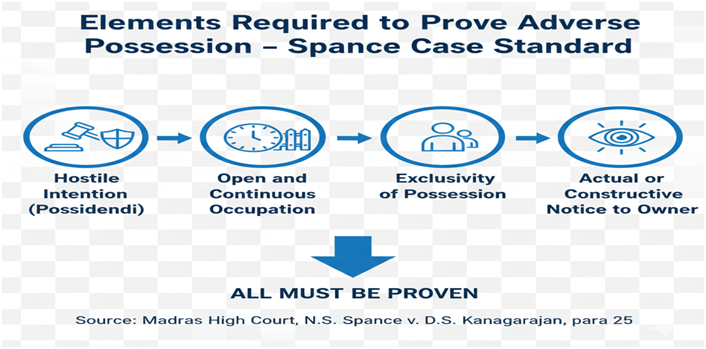
A litigant in possession may take an alternative plea of adverse possession. The rule against inconsistent pleas is not a rigid procedural sword to strike out every dual pleading. At the same time, the court insists on full proof of the classical elements of adverse possession, notably hostile intention or animus, open and continuous occupation, exclusivity and notice where relevant.
The proper legal posture for a claimant is therefore simple and disciplined. Plead both claims where facts warrant it, but particularise the adverse possession case and be ready to discharge the evidentiary burden.
The analysis that follows explains the facts of the spance case, identifies the paragraphs to cite in any record, explains the inconsistent plea bar opponents will press and how to dismantle it, and then places on record recent decisions citing the spance case with working links and practical notes on paragraph or holding citations.
The Facts Of The Spance Case And The Legal Issues
The disagreement in NS Spance v DS Kanagarajan resulted from a common pattern observed in property litigation in Tamil Nadu, where courts are left with overlapping chains of claims due to past transactions, unofficial agreements, and unrecorded changes in possession. The property was transferred to N. A. Perianna Chettiar by its original owner, DK Srinivasa Chettiar.
A family arrangement was placed on record by the plaintiff, who asserted that his possession flowed from this arrangement. According to the plaintiff, the family arrangement operated as the foundational act giving him control and enjoyment of the property. On this basis, he asserted his possessory title while also reciting his long and uninterrupted occupation beginning around.
The plaintiff fortified his claim by producing consistent municipal records of property tax payments made in his name. He also furnished evidence that he exercised the rights of a person treating the property as his own by leasing out portions to tenants, collecting rent, and maintaining the land over several years.
All this was in the presence and knowledge of the defendants, who were living adjacent to the suit property and were therefore in a position to observe his use.
The defendants' reply was one of outright denial. They assailed the legitimacy of the arrangement relied upon by the plaintiff and took the view that none of the acts relied upon could amount to hostile possession. The defendants argued that possession was not traceable to a legal right, and whatever possession existed was never accompanied by any assertion adverse to their title.
The trial court and the first appellate court accepted that the plaintiff had been in possession for a considerable period. However, both courts found that he had failed to establish the essential element of animus so as to turn his permissive or tolerated possession into hostile possession.
According to the lower courts, although the plaintiff acted like an owner, there was insufficient material to show that he had communicated or manifested any intention to exclude the true owner or to hold the land in open defiance of that owner’s rights. On that basis, they rejected the prescriptive plea.
When the matter went before the Madras High Court in second appeal, it had to consider two interlinked questions. The first was whether the plaintiff’s decision to assert title through the family arrangement while also pleading adverse possession as an alternative could be treated as impermissible inconsistency.
The defendants argued that the two pleas were mutually destructive. The High Court rejected this argument after analyzing precedent, including the Supreme Court decision in Rame Gowda v. Varadappa Naidu, that had already clarified the nature of possessory rights and the permissibility of alternative claims.
The High Court concluded that a person in possession is entitled to rely on more than one legal basis for protection of that possession, and that the law only bars pleas which cannot logically coexist.
A plea of title and a plea of adverse possession can coexist because one does not automatically negate the other at the stage of pleading. The second question was as to the burden of proof. Once a plea of adverse possession was entertained in principle, the court had to consider whether the claimant satisfied the strict evidentiary standard that the Supreme Court required.
The High Court explained that in adverse possession, the plaintiff had to establish continuous possession, open and hostile, for the statutory period, and that the onus rested entirely upon the person pleading it. It is incumbent upon the plaintiff to indicate when possession became hostile and how the true owner was excluded.
The plaintiff's actions demonstrated long possession, but the High Court determined that this did not prove the required animus. As a result, the ruling made clear both the plea's legal admissibility and the high bar needed to prove it.
What The Madras High Court Held And The Paragraphs To Cite
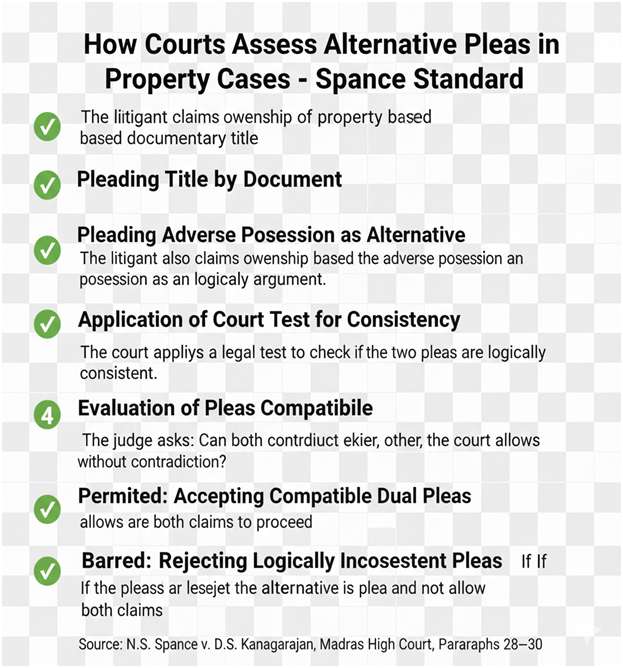
The judgment is best used selectively. For pleadability and the principle that alternative pleas are not automatically barred cite paragraph 28 and paragraph 29. For the evidentiary rule insisting on hostile animus and the quality of possession required, cite paragraph 25. For the court's concluding statement that alternative pleas are not impermissible in law, cite paragraph 30. These are the load bearing portions of the judgment and the passages subsequent case law most commonly references.
Paragraph 25 highlights that mere possession for the statutory period without proof of hostile intention is insufficient to establish prescriptive title, while paragraph 28 contains the express rejection by the court of the strict rule that adverse possession arises only when possession is without title, and paragraph 29 explains that inconsistent pleas cannot be entertained where they are genuinely contradictory but that alternative pleas remain available.
Paragraph 30 rounds out the holding by concluding that alternative pleas are not impermissible in law. Taken together, these paragraphs show the combined rule in a brief: plead both if facts allow but prove whichever route you ask the court to adopt.
The inconsistent plea bar the opponent will be trying to sell-explained. Opposing counsel generally urge an inconsistent plea bar on three bases. First, there is said to be logical inconsistency. If the claimant asserts title under a deed then claiming hostile possession against the same transferor or successors is logically inconsistent.
It relies secondly on higher authority or dicta, particularly Supreme Court observations insisting on particularisation and sometimes on renunciation or election, for the proposition that the prescriptive clock cannot be run alongside a deed based title claim. Thirdly, there are tactical remedies pressed. Application is made for an early strike out under Order 7 Rule 11 or prompt election so that the claimant is forced to choose and thereby risks losing on a weak route.
This triad of reasoning has force in some factual contexts but not as an across-the-board rule. The correct answer begins with the spance case itself. The Madras High Court recognized a distinction between genuinely inconsistent mutually destructive pleas on the one hand and permissible alternative pleas on the other.
A plea is truly inconsistent where acceptance of one narrative necessarily negates the other in a way that cannot be reconciled. By contrast a plaintiff may properly plead title by document and, in the alternative, set up facts showing hostile, exclusive, continuous possession, so that if the deed claim fails on documentary grounds the court can decide the adverse possession question on the evidence.
Crucially, the The spance case case does not relax any evidentiary requirement. The claimant still has to prove animus, continuity, exclusivity, and either outright notice to the true owner or acts so open and notorious that the owner is deemed to have constructive notice.
In short, there are two concrete points which answer the inconsistent plea bar. First, pleadability is distinct from proof. Secondly, where the right of adverse possession is particularised and supported by contemporaneous documents or robust witness evidence, procedural sanctions such as strike out are improper; the issue belongs to trial.
A practical pleadings response in court therefore has three parts. First, show that the pleadings particularise when and how possession began and the acts of ownership performed. Secondly, show that contemporaneous evidence such as tax receipts, mutation entries, rent receipts, repair bills and witness affidavits support the prescriptive case.
Finally, if the opponent cites binding Supreme Court dicta requiring particularisation, distinguish that authority on facts and show that the precise remedial posture in those decisions differs from the case at bar. If the court remains concerned about multiplicity of issues, concede that it has power to require election at a later stage, but insist that election is a case management tool and not a substitute for trial where the adverse possession pleading is adequate.
How The Spance Case Is Applied In Practice, The Usual Procedural Sequence
In courts following the spance case the same sequence will be seen by practitioners. Firstly, the court tests the pleadings for adequacy. If the prescriptive plea lacks particulars then the court will either direct amendment or strike for want of particulars.
Second, when particulars are adequate the court examines the evidence at trial with particular focus on animus, continuity and exclusivity. Third, if the two pleaded narratives are genuinely irreconcilable the court may ask for election as a trial management device.
The important practical consequence for the litigators is clear. Draft the plaint with chronological clarity, keep the deed claim and the prescriptive claim in separate paragraphs and include the best available dates, acts and documentary proof so that the court cannot equate alternative pleading with vagueness.
Recent Judgments Citing N. S. Spance v. D. S. Kanagarajan and How Each Court Used It
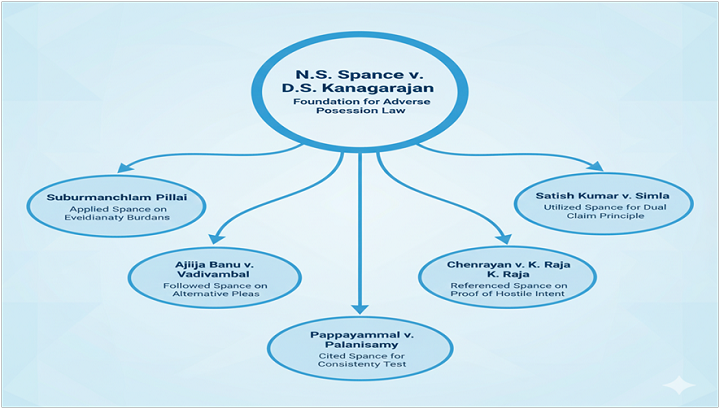
The influence of N. S. Spance v. D. S. Kanagarajan, turns on a precise legal issue. It clarified that pleas of title and adverse possession are not mutually destructive simply because they appear contradictory at first glance. The ratio accepted that a litigant in possession can plead both.
The only restriction is that the adverse possession plea must be properly pleaded and proved through clear evidence of hostile intention, continuous possession, and open assertion of rights. This principle has been repeatedly cited in later judgments.
Courts have used Space Case to reject objections that such pleas are inherently inconsistent. They have also used it to reaffirm that permissibility of alternative pleading does not dilute the strict evidentiary burden required for an adverse possession claim. What follows is a detailed evaluation of each judgment where Spance has been applied, with precise explanation of how courts invoked its principles.
The first significant application appears in the Madras High Court judgment in Subramaniyan and Others v. Venkatachalam Pillai and Another. The High Court directly cites the reasoning in Space Case and adopts its statements regarding animus and alternative pleas. The Space Case judgment, particularly its discussion around paragraph 25, required proof that possession must be accompanied by hostile intent and unequivocal acts.
The court in Subramaniyan notes this point and reproduces Space Case for the principle that mere long possession is not enough unless the possessor demonstrates clear animus. In addition, the court adopts the broader proposition from Space Case that a person in possession is entitled to raise an alternative plea that includes both a claim of title and a fallback claim of adverse possession.
The court explains that a litigant cannot be shut out at the threshold by describing such pleas as inconsistent because Space Case had already clarified that inconsistency does not arise at the mere level of pleading. The real test is factual proof. By applying these principles, the High Court in Subramaniyan carefully examined whether the defendants had established the required hostile intention.
While acknowledging the right to raise an alternative plea, the court ultimately held that the factual foundation for animus was not strong enough, and it scrutinised the evidence with the strictness suggested in Space Case. This case therefore stands as a close and faithful application of Space Case, both for alternative pleading and for the demanding threshold for proving adverse possession.
A second detailed application appears in Ajija Banu v. Vadivambal, decided by the Madras High Court. The central dispute revolved around the plaintiff's assertion of an oral gift creating her title, combined with an alternative plea of long, open, and hostile possession. The opposite side argued that both claims could not stand together. The High Court rejected this argument by citing Space Case.
The court specifically referred to the parts of Space Case which held that alternative pleas are permissible when a litigant seeks to protect their possession, and that such pleas cannot be dismissed for mere inconsistency.
The court then turned to the segment of Space Case that stressed the importance of animus, a principle taken from its paragraph 25 analysis. Using these passages, the court explained that the factual burden placed on a party claiming adverse possession remains stringent.
Even though the plaintiff was permitted to pursue both the oral gift and adverse possession claims, the High Court insisted that adverse possession requires a specific and detailed pleading of when possession became hostile, how it continued, and how the real owner was excluded. This approach demonstrates how the High Court used the Space Case case not as a mechanical formula as a guiding standard for both procedural fairness and substantive evaluation.
Another important judgment is Pappayammal v. Palanisamy and Others and in this case, the court directly quoted Space Case in paragraph 28 of its own reasoning, prominently referring to the passage in Space Case that declared a person in possession may adopt an alternative plea. The High Court in Pappayammal used Space Case to examine the defendant's claim that he had both a valid title emerging from a family arrangement and, alternatively, the benefit of adverse possession from continuous hostile occupation.
The High Court extracted from Space Case the principle that alternative pleas are not barred unless they are so contradictory that accepting one would legally destroy the other. In Space Case, the court had clarified that a claim of original title does not eliminate the ability to advance a claim of adverse possession if the evidence supports either route. The Pappayammal judgment also applied Space Case to evaluate whether the defendant had met the burden of proving animus.
As in Space Case, the existence of a documentary claim did not wipe out the possibility of proving hostile long possession. The High Court examined the documentary and oral evidence to assess whether the defendant had ever acknowledged the plaintiff's title or whether his possession was peaceful, open, and hostile for the statutory period.
The reasoning in M. Sundarraj v. P. Savithramma, decided by the Madras High Court, also incorporates Space Case. The core issue involved a defendant who raised adverse possession only in the alternative, after asserting a primary claim of right. The opposing counsel attempted to argue that the adverse possession plea was inherently destructive of the primary claim.
The High Court rejected this objection by relying on Space Case. The court took note of the passage in Space Case which clarified that a litigant cannot be prevented from maintaining an alternative plea simply because it presents a different factual route to success.
The High Court applied Space Case to emphasise that only mutually destructive pleas are barred. A plea of title and a plea of adverse possession can coexist because they do not legally destroy one another at the initial stage.
The court then applied Space Case’s requirement of strict proof to evaluate whether the adverse possession claim had been backed with dates, particulars, and evidence of hostile intention. In doing so, the High Court reaffirmed the Space Case doctrine that flexibility in pleading does not lead to flexibility in proof.
Another application appears in Chenrayan and Others v. K. Raja, decided by the Madras High Court. This case involved an attempt to reject the plaint under Order 7 Rule 11 of the Code of Civil Procedure on the ground that the plaintiff had pleaded both title and adverse possession. The defendants argued that these were contradictory. The High Court rejected the argument by citing Space Case.
The court observed that Space Case had already clarified that alternative pleas are legally permissible, and that courts must not strike down a plaint at the threshold solely on the basis of dual claims.
In this case, the court quoted Space Case to say that a litigant in possession cannot be faulted for adopting multiple legal routes for protection of their rights. After applying this reasoning, the court dismissed the objection and held that the matter must go to trial. Space Case therefore acted as a barrier against premature rejection.
The most recent application is in Sh. Satish Kumar and Others v. Smt. Simla and Others, decided by the Delhi High Court. In this case, the Delhi High Court explicitly cited Space Case while dealing with objections raised against alternative pleas by the defendants. The relevant discussion appears in paragraph 20 of the Delhi High Court judgment, where the court endorses the principle that ownership and adverse possession are not inherently inconsistent.
The court reproduces the Space Case reasoning that alternative pleas must be distinguished from mutually destructive pleas. The High Court then explains that while dual pleading is permissible, adverse possession requires unimpeachable evidence relating to actual hostile possession. This application again demonstrates how Space Case has shaped modern judicial thinking by protecting alternative pleadings while maintaining a rigorous approach to proof.
Together these cases show a consistent judicial trend. Courts rely on Space Case to uphold the permissibility of alternative pleas, and they rely on its detailed discussion of animus and continuity to measure the sufficiency of evidence in adverse possession claims. Each judgment uses Space Case not in a loose or formulaic way but as a structured analytical tool. Courts quote specific principles and apply them with careful attention to the evidentiary burden that Space Case requires.
Conclusion And An Expert’s View
For the record, rely on N.S. Spancev. D.S. Kanagarajan for the proposition that adverse possession may be pleaded as an alternative plea, and rely on paragraphs 25, 28, 29 and 30 in particular. Where an opponent presses the inconsistent plea bar, answer by separating pleadability from proof, by producing particulars and contemporaneous evidence, and by insisting that the remedy for overbroad adversarial pleading is amendment rather than automatic strike out.
While speaking to LCI, Advocate Sanjeev Tiwari said that I think its easy for people to overcomplicate this ruling, but the truth is pretty simple. The court basically reminded everyone that there's nothing wrong with saying "I have title" and in the same breath saying "and if you don't believe that, look at how long I've been living here like the owner." We've all made that argument in practice because real cases are never clean.
Opining upon the aforementioned judgement, Mr Tiwari said that “It should be kept in mind that the judgment also illustrates that judges are tired of people tossing in an adverse possession plea without any real story of how their possession turned hostile. If your case doesn't show that shift in attitude, if there's no moment where you stopped being a permissive occupant and started behaving like someone who isn't giving the land back, the plea collapses. So yes, this case helps on the pleadings, but it's a bit of a warning too. Bring proper proof or don't bother. Courts won't reward someone who remembers "adverse possession" only when their title starts to wobble. That's the honest takeaway.
FAQs
What is the core dispute in N. S. Spance v. D. S. Kanagarajan?
The dispute arose from competing claims over land originally owned by D. K. Srinivasa Chettiar. The plaintiff relied on a 1972 family arrangement and long possession beginning around 1970. The defendants denied both the arrangement and the hostile nature of possession. The courts had to determine whether long, open possession amounted to adverse possession and whether the plaintiff could plead title and adverse possession together.
Why was the family arrangement of 30 October 1972 important?
The plaintiff treated the arrangement as the documentary foundation of his title. It explained why he took possession, paid taxes, leased the property and acted as owner. The defendants challenged this arrangement as fabricated or ineffective, which forced the court to separately examine whether long possession itself could mature into adverse possession even if the arrangement failed.
Did the courts accept that the plaintiff was in possession?
Yes. Both the trial court and the first appellate court acknowledged that the plaintiff had been in long, open, continuous possession. Evidence like property tax receipts, rental arrangements and maintenance of the land supported this. The dispute was not about possession but about legal character of possession.
Why did the lower courts reject adverse possession?
They held that the plaintiff failed to prove animus, meaning a clear intention to hold the property against the true owner. Long possession alone was not enough; the courts required a clear point where possession became hostile. Since the plaintiff relied simultaneously on a family arrangement (which implies lawful entry), the lower courts felt hostility was not proven.
What legal questions did the Madras High Court address on second appeal?
The court decided two overlapping points:
- Whether pleading title and adverse possession together is an impermissible inconsistency.
- What level of proof is required for a person who advances such an alternative plea.
Did the High Court permit both pleas to be taken together?
Yes. The High Court held that a person in possession can advance both pleas. It relied on broader principles of pleadings and Supreme Court reasoning that alternative pleas are permissible unless they contradict each other in a way that makes them logically impossible to coexist. Claims of title and adverse possession are not inherently mutually destructive at the stage of pleading.
Was adverse possession ultimately upheld?
No. While permitting the plea in law, the High Court held that the plaintiff had not supplied clear and convincing evidence of hostility. His acts showed possession but did not show when or how he began to hold against the true owner.
Why is the decision frequently cited in later judgments?
Courts cite Spance when dealing with:
- Whether a claimant may advance title and adverse possession together.
- The evidentiary burden for proving animus.
- The distinction between long possession and legally adverse possession.
- Situations where municipal records, tax payments and tenancy arrangements exist but animus is missing.
Does the case change the law on adverse possession?
It does not change the law but clarifies it. It follows the Supreme Court’s position that adverse possession must be proved with strict evidence, especially hostility. The case fine-tunes the approach to alternative pleadings at the trial stage and has become a reference point for trial courts dealing with overlapping claims.
What practical guidance does the judgment offer?
It reminds litigants to establish the transition from peaceful or tolerated possession to hostile possession. It also emphasises the need for clear pleadings and clear evidence, since long possession without intent to exclude the true owner does not create a legal title.
Join LAWyersClubIndia's network for daily News Updates, Judgment Summaries, Articles, Forum Threads, Online Law Courses, and MUCH MORE!!"


Tags :Others