
Introduction
Legal education in India is not strictly an academic pursuit but an essential part of the justice delivery system and an important part of the constitutional promise of equality and access to law. Law schools, therefore, bear a twin burden of having to inculcate both theoretical knowledge as well as practical skills that prepare the student for the roles of an advocate, policymaker, or judge.
The regulatory framework governing legal education is diverse, and the same stems from the statutory instruments such as the Advocates Act, which are the rules framed by BCI that are oversighted from the UGC and judicial pronouncements which interpret these laws in the light of modern educational needs.
Thus, compliance by law schools with these rules is important, as it ensures the students are competent to practice law during their time in school, as per ethics and professional standards. Non-compliance will render the degrees invalid, the student being disqualified from enrolment, and will also damage the credibility of the institution and profession.
In the last few years, compliance has been fine-tuned in judgments emphasizing student welfare, holistic legal education, and experiential learning. The Delhi High Court decision in 2025 over attendance norms made sure that no student is unnecessarily debarred from appearing in the exams and included that institutions relax their policies with flexible and educationally sound measures after taking inspiration from the NEP.
The Statutory and Regulatory Framework Governing Law Schools
The legal basis of law school compliance thus lies in the Advocates Act. Section 7(1)(h) gives the BCI the powers to prescribe standards of legal education and to approve with universities on curriculum, faculty, and examinations. Similarly, Section 49(1)(af) empowers the BCI to
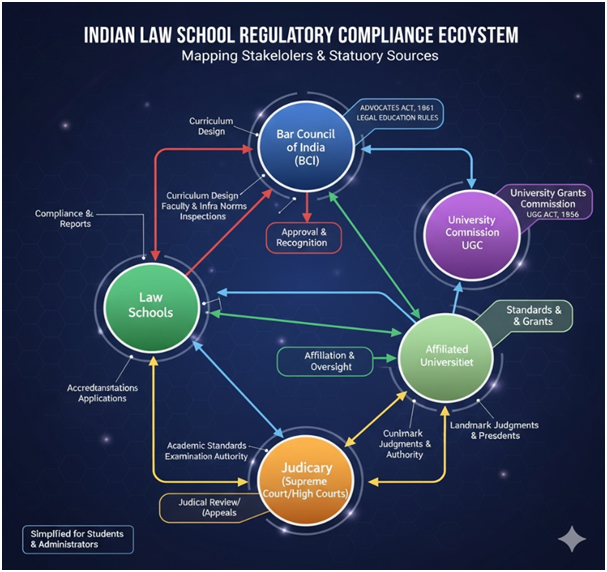
specify minimum qualifications for law degrees and standards of professional attainments for students seeking enrolment as advocates.
These statutory powers stem from the Legal Education Rules and Rule 11 of the same makes it essential that no institution can admit students to law programs without prior BCI approval.
Moreover, rule 14 gives power to the council to withdraw approval in cases of non compliance.
For instance, Rule 15(b) makes it mandatory that every law school must maintain classrooms of adequate size and the same shall be equipped with audio visual teaching aids, while Rule 15(e) requires a library with at least 30,000 books or access to digital legal databases. Faculty standards under Rule 15(g) require a minimum ratio of students to full-time teachers and prescribe qualifications that align with UGC norms.
The University Grants Commission supplements this with regulations under the UGC Act. Subsequently, the UGC laid down further academic standards on qualified faculty, coverage of the syllabus, and structured teaching hours through the UGC (Minimum Standards of Instruction for Grant of First Degree through Formal Education) Regulations, and the UGC (Minimum Qualifications for Appointment of Teachers and Other Academic Staff) Regulations. This thus fosters a dual compliance ecosystem where BCI ensures professional readiness and UGC maintains academic integrity.
The Supreme Court, on many occasions, has upheld the issuance of such statutory approvals as mandatory. In Bar Council of India v. Bonnie Foi Law College, the Court, at paragraph 22, said that degrees in law granted by such unrecognized institutions are not valid for enrolment as advocates.
The Court said that the requirement for approval was a mandatory one and that any institution which proceeds without the same degrades the professional and ethical standards in the legal profession.
Further, in the case of BCI v. Board of Management, Dayanand College of Law, in paras 19-20 explain that running law courses without approval by the BCI is a statutory violation which requires immediate remedial measures. Thus this rigorous regulatory and judicial framework ensures accountability on the part of law schools not just to students but also to the broader legal system.
Infrastructure, Faculty, and Curriculum Compliance
Infrastructure standards
Physical infrastructure is the base for any good legal education. Rule 15 of the BCI Legal Education Rules, 2008, prescribes that every law school should have proper classrooms, moot court halls, and libraries. Adequate physical facilities ensure that instead of students being passive recipients of knowledge, they are participants in experiential learning.
Classrooms, proportional to strength, should be well-equipped with modern teaching aids and designed in such a way as to facilitate interactive sessions. Moot court halls must simulate actual court environments where the students would be practicing advocacy, and in the legal aid clinics, students get a chance to interact with real-life clients under supervision.
In Bar Council of India v. Subhash Chandra Agarwal, paragraph 31, the Supreme Court held that inadequate infrastructure is a reflection of poor education quality and directly impacts the competency of the student. Colleges that compromise on infrastructure for financial expediency fail in their statutory duty.
The judgment called for periodic inspections, which would necessitate colleges maintaining records of classrooms, laboratories, and moot court facilities. This shows that infrastructure is not a static need; it must change with needs in the curriculum and needs of students.
Institutions have to upgrade infrastructure to meet the requirements of modern legal education. The judgment said that facilities such as moot courts for experiential learning and legal aid centers are equally essential as traditional classrooms. This is of practical consequence in modern law schools, where practical legal training is increasingly in focus in modern law schools inspired by BCI and NEP reforms.
Faculty Requirements
Quality legal education requires qualified and competent faculty. Rule 15(g) prescribes the ratio of full-time faculty in relation to student numbers and provides minimum qualifications consistent with UGC standards.
At least one-third of faculty should hold a doctorate or equivalent research degrees to ensure that there is a fair mix of teaching and research experience.
In Bar Council of India v. Rajesh Kumar, the Supreme Court, in paragraph 29, drew an inference on the quality of faculty being directly proportional to the professional preparedness of the students.
Well-qualified faculty can help train students in all subjects relating to advocacy, legal drafting, research methodology, and courtroom procedures; underqualified or part-time faculty cannot develop such professional, competent legal professionals and breach the mandate of compliance with the statute.
Faculty compliance also extends to ongoing professional development. Modern law schools are expected to provide continuous training and exposure to contemporary legal developments.
It was further observed in the Delhi High Court 2025 attendance ruling, paragraph 27, that such methodologies in teaching should be modern, considering current trends in legal education, including blended learning, online simulations, and collaborative research projects.
It therefore behooves faculty members not only to meet statutory qualifications but also to demonstrate such an ability to deliver innovative, student-centered pedagogy.
Curriculum Compliance
The curriculum compliance is also at the heart of statutory oversight. Rule 14 of the Legal Education Rules mandates a syllabus that is approved by BCI to be followed by law schools for theoretical and practical legal training uniformly across the country.
This entails courses in the core legal disciplines comprising constitutional law, criminal law, corporate law, and procedural law, and integrating skill-based components in the form of moot courts, drafting exercises, and client counselling.
Modern trends increasingly require experiential learning as part of curriculum compliance. Internships, clinical legal education, and legal aid programs are recognized as integral to the learning process.
Beyond that, curriculum compliance encompasses digital competency. NEP encourages the integration of technology-enabled learning, online research, and access to digital legal databases into the institutions.
This way, law schools will be assured that their graduates are not only well-versed in traditional legal knowledge but also trained in the modern way for a globally practiced legal profession.
Library and Research Resources
Access to comprehensive legal literature is a statutory requirement, one of the elements of compliance. Rule 15(e) requires at least 30,000 volumes or their digital equivalent in libraries. Adequate libraries support research, academic writing, and practical training.
In the case of Bar Council of India v. Bonnie Foi Law College, paragraph 26, it has been observed by the Supreme Court that inadequate libraries compromise the quality of legal education. The judgment thus held that libraries are not adjuncts to education but central for developing skills in independent research, critical thinking, and informed practice of law.
Digital Integration and Modern Learning Tools
The legal education landscape is changing day by day. Compliance now encompasses the integration of technology for research, online learning, and legal simulations. NEP 2020 lays emphasis on blended learning, online research collaborations, and interactive platforms that emulate real-world legal environments.
The Delhi High Court has stated in paragraph 19 that the modern pedagogic tools for which the law schools have to move forward would entail digital classrooms, virtual moot courts, access to legal databases online, and other facilities which are relevant for developing skills related to legal research, drafting, and advocacy in current practice.
Compliance with the integration of technology is not discretionary but indispensable for relevance and meeting professional standards.
Attendance and Evaluation, Student Welfare Compliance
Attendance Norms and Judicial Oversight
Attendance has traditionally been one of the most contentious issues in Indian legal education. The rigid requirements imposed by many institutions invariably led to penalty cases for minor shortfalls and exclusion on academic grounds. This changed with landmark judgments emphasizing student-friendly, educationally sound compliance.
Most relevant is the judgment of the Delhi High Court in 2025 on law school attendance, which dealt with the consequences of very stringent attendance requirements after the unfortunate incident of Sushant Rohilla. Para 27 of the judgment stated that no student can be debarred from appearing in examinations or continuing their studies based solely on attendance shortages.
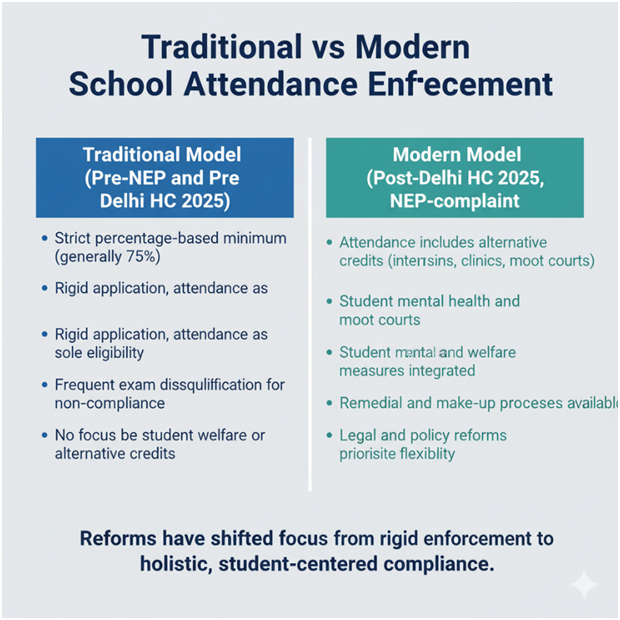
The Court explained that whereas the minimum requirement for attendance has been specified by the college, the BCI's Legal Education Rules, specified only the maximum framework for attendance and thus colleges cannot impose a more stringent limit.
The Court further emphasised on a simple yet important point which was that legal education is not only academic but must integrate practical training such as internships, moot courts, and research projects. In Paragraph 29, the court highlighted that these activities contribute meaningfully to a student’s engagement and learning, and the same is akin to a classroom attendance.
Moreover, the court ordered the BCI to review attendance policies under the NEP and emphasized upon flexibility through alternative compliance measures such as extra classes, research assignments, or moot court participation.
Student Welfare and Mental Health Considerations
Student welfare has now emerged as an aspect of compliance. The case of Sushant Rohilla was one of the examples of how stringent institutional policies can have drastic effects on the mental health of students and how all of it could have devastating consequences.
Speaking to Sankalp Tiwari from LCI, Dr. Neelakshi Talukdar opined that “ I agree with the court’s direction and emphasis upon the revisitation of the attendance policy in colleges. One needs to realise that a student is more than its attendance and there are various aspects in a student’s life that needs to be assessed upon in order to gauge its merit and sincerity.”
Upon being asked the question of attendance being mandatory or not in colleges Dr Talukdar stated that “ Attendance is an important aspect in student as well as a teacher’s life. It is necessary that certain percentage of attendance remains to be mandatory so as to ensure that students don’t miss out on important lectures and lessons.”
She further said that “What we really need to understand is that attendance has become a tool of power that a professor holds upon a student which is neither effective nor healthy for both of them. Attendance percentage shouldn’t be used in this way and should act as a deterrent in a student’s life.
Each student is different and all of them have different ways to learn and grasp things and attendance shouldn’t be something that students have to stress so much about. The joy of learning goes away for both the teacher as well as the student when the latter feels compelled to sit in a class without any interest.”
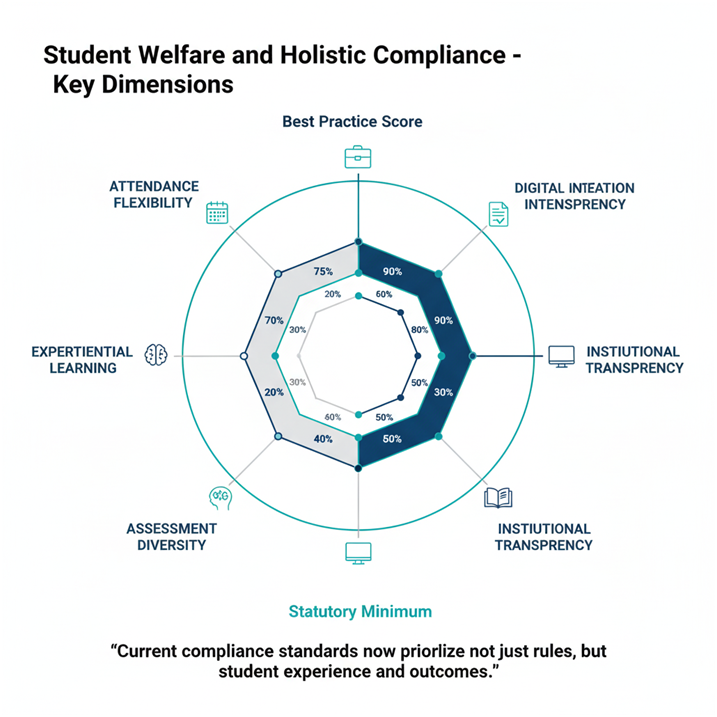
Thereby, in the recent times courts have been increasingly maintaining that the compliance mechanism must be student friendly and strike a balance between academics and mental well being.
The Delhi High Court, in paragraph 33 of the 2025 judgment, directed the law schools to adopt flexible remedial measures, which may involve additional classes, assignments, or research tasks rather than exclusionary punishments. The Court believed that punitive approaches create unnecessary stress, which can detract from both academic and professional development.
In the case of BCI v. Rajesh Kumar, paragraph 35, the Supreme Court had further held that all such schools must support students in welfare and career development. Therefore, compliance is not just a question of adherence to statutory rules, but also the educational environment must foster mental health, practical skill building, and ethical professionalism.
Flexible Compliance Mechanisms and Experiential Learning
The current trends in compliance therefore support the use of flexible, student-centered approaches to attendance and evaluation, as well as practical training in law schools. The NEP emphasizes experiential learning, internships, participation in legal aid, and projects as key components. Courts have recognized these activities as legitimate measures of engagement.
It is evident from paragraph 27 of the Delhi High Court judgment that moot courts, legal aid, internships, and research projects can be considered substitutes for regular classroom attendance, so long as such activities meet learning outcomes as prescribed by the BCI. The approach has aligned statutory compliance with a larger educational philosophy of holistic legal training in which students are evaluated on knowledge, practical skill, and professional ethics.
An experienced law faculty from Amity University, while speaking to Sankalp Tiwari from LCI, said that “The recent judgment of the Delhi High Court on attendance policies in law schools is a timely reminder that legal education must adapt to the changing needs of students and the profession. While regular attendance is essential for academic discipline and participation, the strict enforcement of attendance percentages often fails to recognise the importance of practical exposure in a lawyer’s training. Internships, research work, and court visits are not diversions from study; they are vital extensions of classroom learning that help students understand how the law functions in practice.
Upon the question of should BCI reconsider the attendance guidelines, the professor opined that “Reconsidering attendance policies does not mean abandoning academic rigour. It means creating a system that values both consistent learning and professional development. Law colleges and the Bar Council of India could work together to design a framework where practical experience is formally acknowledged, and students are encouraged to engage meaningfully in both academic and professional settings. This balanced approach would produce graduates who are both theoretically sound and practice ready.”
Giving her advice to the students, the respected faculty maintained that “To young law students, I would say that success in this field depends on discipline, curiosity, and balance. Treat your classes and internships as equally important parts of your growth. Learn to manage your time, seek mentorship, and always approach your work with sincerity. The profession rewards those who can think deeply, act responsibly, and understand the law as a living system that shapes society. If this judgment prompts institutions to revisit outdated attendance norms, it will be a positive and progressive step for legal education in India”
Implications for Modern Law Schools
These holdings have important implications for today's law schools, some of which are,
- Attendance policies should be congruent with BCI rules and permit alternative methods of engagement.
- Assessment needs to incorporate practical, competence-based testing along with theoretical testing.
- Compliance must take into account the welfare and mental health of the student.
- Experiential learning, internships, and research projects are considered legitimate means of compliance by courts.
- Institutions should have detailed records of participation, assignments, and other such things that would help them with the compliance of BCI and judicial requirements.
Taken together, these measures help make the compliance educationally meaningful, not just procedural, and thus assure competent, well-rounded legal professionals.
Approval, Recognition, Inspections, and Reporting Compliance
BCI Approval and Recognition
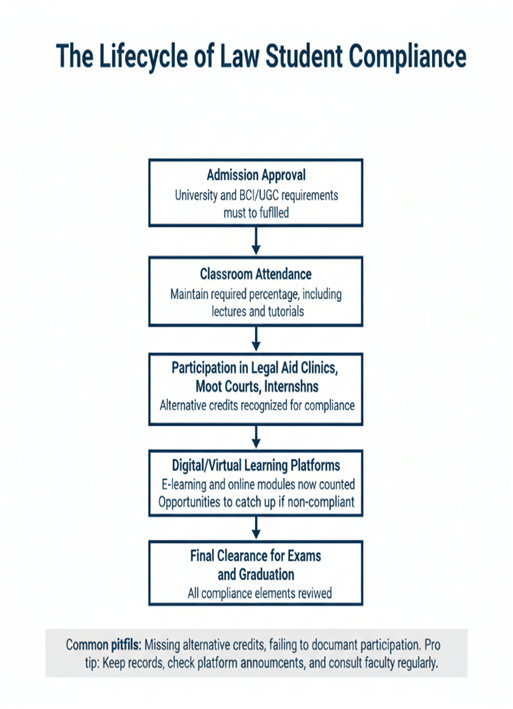
No law school shall be set up except with the prior approval of the Bar Council of India. Rule 11 of Legal Education Rules, states that institutions should take prior recognition for offering law courses.
The Supreme Court, in the case of Bar Council of India v. Bonnie Foi Law College, para 22, ruled that degrees from unapproved colleges have no validity for enrollment as an advocate. The judgment has made it very clear that approval is an important compliance and not just a procedural formality.
Approval from the authorities ensures that the there is uniformity maintained in the curriculum, faculty, and infrastructure and thus forms an important part of the compliance system. The law schools need to furnish detailed documents on faculty qualifications, library resources, and classrooms.
Renewal approval, time to time, is granted provided the institutions continue their adherence to the BCI standards.
Inspections and Reporting
The requirement of Rule 14 is that BCI periodically inspects the law colleges. These inspections encompass the facilities, staff, library, course structure, and examination system.
Reporting the same periodically ensures transparency and accountability. Non-filing of proper records or non-compliance with the instructions of inspection by the institutions leads to the withdrawal of approval. Legal requirements make the law schools responsible to students, regulators, and the legal system at large.
Monitoring and Compliance Culture
Compliance is a continuing process. Courts have always pointed out that the institutions have to constantly upgrade the infrastructure, faculty, and learning methodology. The modern law schools are encouraged to cultivate a compliance culture, integrating statutory norms with student welfare, experiential learning, and digital pedagogy.
Attendance, evaluation, and practical engagement have also come to be viewed as part of modern compliance through digital record-keeping. Reforms under NEP place emphasis on continuous monitoring with the integration of technology for transparency and maintenance of educational quality.
Ethical and Professional Standards in Law Schools
Ethical compliance necessarily starts with the moral infrastructure in legal education. Law schools are not only a place for academic training but also the site for the training of future guardians of justice. The Supreme Court of India in V. Sudeer v. Bar Council of India observed that "the role of the Bar Council is not limited to granting licenses to lawyers but extends to ensuring their ethical preparedness before entering the profession" (para 19).
This principle necessarily suggests that law schools have an onus to frame their internal ethics policies in line with the Code of Conduct and training prescribed by the BCI. Institutions have to conduct seminars on professional ethics, maintain strong anti-ragging and anti-harassment mechanisms, and have in place a grievance redressal mechanism that reflects procedural fairness.
Further clarity came to light in Bar Council of India v. Bonnie Foi Law College wherein the Supreme Court set aside the admission to certain law colleges for not following institutional norms prescribed by BCI and UGC. The Court, in paragraphs 41 to 44, expressed strong disapproval of the “commercialization of legal education” and passed on the directions that the BCI shall ensure the ethical, academic, and infrastructural standards of law colleges on a periodic basis.
It noted that when there is non-compliance with the BCI rules, it will be highly prejudicial not only to the students but, in the long term, even to the administration of justice.
Another landmark in ethical compliance is Sushant Rohilla v. GGSIP University, where the student's tragic death due to rigid attendance policies triggered national introspection into the ethical responsibility of law schools toward their students. The Court held in paragraph 22 that education cannot be conducted in an environment of fear and rigidity and that there is an ethical responsibility to show sensitivity toward students' mental health and learning flexibility.
Institutional Governance and Accountability
The other essential aspect of compliance is institutional governance. Law schools operate under an ecosystem of statutory regulators, which include the Bar Council of India, University Grants Commission, and affiliating universities. All these together oversee curricula, qualifications of faculty members, infrastructure, and rules for admissions.
In BCI v. UOI, the Supreme Court upheld the BCI’s regulatory powers regarding legal education, noting in paragraph 36 that the Council must ensure that “no law college is run as a profit-making venture” and that transparency in governance is indispensable.
Transparency has been a recurring concern in judicial oversight. In Modern Dental College & Research Centre v. State of Madhya Pradesh, although dealing primarily with medical education, the Supreme Court laid down guiding principles that apply to all professional institutions. The Court held that the right to establish educational institutions under Article 19(1)(g) is subject to reasonable regulation to maintain standards and prevent exploitation (para 62).
Therefore, law schools have to maintain transparent financial disclosures, fair faculty recruitment processes, and merit-based admissions. This was further reiterated in the Delhi High Court judgment of 2025, relating to attendance and academic flexibility, as the bench, at paragraph number 33, observed that institutional compliance is directly reflected in attendance enforcement, internship facilitation, and examination policies, for instance.
The Court also made it clear that colleges cannot devise rules supplemental to, but not in consistency with, the norms prescribed by the BCI, or deny students a fair opportunity for completion by remedial measures. This was a judicial recognition of the fact that institutional governance has to put student welfare and professional preparedness at the forefront of bureaucracy.
Conclusion
Compliance for law schools in India is multifaceted, covering statutory, regulatory, and judicial mandates. Institutions must ensure proper infrastructure, qualified faculty, curriculum adherence, attendance flexibility, evaluation fairness, student welfare, BCI approval, inspections, reporting, ethical governance, and institutional accountability.
Judicial decisions, including Delhi High Court 2025 attendance ruling, Bar Council of India v. Bonnie Foi Law College, and Subhash Chandra Agarwal, provide authoritative guidance on implementing these measures effectively.
Modern legal education emphasizes experiential learning, digital integration, and student-centered approaches. Compliance is no longer a static checklist but a dynamic, ongoing responsibility that balances academic rigor, professional preparation, and student well-being.
By adhering to statutory and judicial frameworks, law schools can cultivate competent, ethical, and professionally ready graduates, ensuring that legal education in India meets contemporary standards while remaining aligned with global best practices.
FAQs
1. What are the primary compliance requirements for law schools in India?
Law schools in India must comply with the Bar Council of India Legal Education Rules, 2008, UGC Regulations, and the National Education Policy, 2020. These cover student attendance, infrastructure, faculty qualifications, clinical legal education, and ethical conduct. The Supreme Court in Bar Council of India v. Union of India (2012) 8 SCC 243 reaffirmed that legal education is a regulated field and that institutions must maintain prescribed standards in teaching, administration, and professional training.
2. Can a law college bar a student from examinations due to attendance shortage?
No. The Delhi High Court in Dr. Akash Sharma v. Bar Council of India (2025) ruled that no student can be denied the right to appear in exams solely because of attendance shortage. In paragraph 33, the Court stated that law schools must adopt flexible remedial measures like extra classes or assignments. This position builds upon the earlier Sushant Rohilla v. GGSIP University (2016) judgment, which condemned rigid attendance policies as detrimental to students’ welfare.
3. Who is responsible for regulating law schools in India?
The Bar Council of India (BCI) is the primary regulatory authority overseeing standards of legal education. It frames curricula, approves new colleges, and conducts periodic inspections. The University Grants Commission (UGC) supervises academic and financial norms for affiliated universities. Together, they ensure that institutions follow the dual compliance system of professional regulation (BCI) and academic governance (UGC).
4. What are the ethical obligations of law schools toward students?
Ethical compliance requires law schools to uphold fairness, inclusivity, and accountability in their functioning. As held in V. Sudeer v. Bar Council of India (1999) 3 SCC 176 (para 19), legal education is not limited to teaching statutes but must also instill ethical preparedness in future lawyers. Hence, institutions must conduct ethics seminars, establish anti-harassment cells, and ensure transparency in evaluation and administration.
5. Are private law colleges bound by the same compliance rules as public institutions?
Yes. The Supreme Court in T.M.A. Pai Foundation v. State of Karnataka (2002) 8 SCC 481 held (para 68) that private institutions, though autonomous, must adhere to regulatory standards to ensure fairness and meritocracy. Law colleges, whether public or private, are subject to BCI approval and must maintain uniform academic and ethical benchmarks.
6. How are law schools monitored for compliance?
Monitoring occurs through BCI inspections, university audits, and UGC oversight. The Supreme Court in Bar Council of India v. Bonnie Foi Law College (2023 SCC OnLine SC 125) directed that the BCI conduct surprise inspections to prevent commercialization and ensure academic integrity (paras 41–44). Non-compliant colleges risk suspension of affiliation or withdrawal of recognition.
7. What legal remedies are available to students against non-compliant law colleges?
Students can file writ petitions under Article 226 of the Constitution for violation of fundamental or statutory rights. The Supreme Court in Ramesh Ahluwalia v. State of Punjab (2012) 12 SCC 331 recognized that students have locus standi to challenge arbitrary administrative actions by educational institutions. Additionally, complaints can be made to the BCI or the UGC Ombudsperson under the UGC (Grievance Redressal) Regulations, 2023.
Join LAWyersClubIndia's network for daily News Updates, Judgment Summaries, Articles, Forum Threads, Online Law Courses, and MUCH MORE!!"


Tags :Others