
INTRODUCTION
One of the main reasons for social, political, and legal disputes in India has been religious conversions .Although there are many different faiths in the nation, changing one's religion still causes controversy. A number of states have enacted anti-conversion or "Freedom of Religion" laws in an effort to stop conversions that are carried out by coercion, deception, or seduction as a result of the contentious recent debate. Opponents argue that these regulations violate the Indian Constitution's Articles 25 to 28 on the freedom of conscience and religion, despite the fact that they are meant to protect the weak.
The Supreme Court of India, as the protector of the Constitution, has been a forum for redressal, weighing the fine line between an individual's choice of religion and the State's obligation to ensure public order. The Court's stance over the years, starting with Rev. Stanislaus v. State of Madhya Pradesh (1977) and continuing up to the latest remarks of 2025, reflects the gradual recognition of fundamental rights in a democratic and secular republic. This article reviews the courts' stance on conversion regulations, examining their origins, legal provisions, significant court decisions, and the constitutional and societal implications of the issue
HISTORICAL CONTEXT

The legal framework concerning religious conversions in India has been a complex issue for a long time. There was no anti-conversion laws enacted across India during the British administration. In fact, early colonial policies were designed to facilitate the work of missionaries. (However, a few princely states were already implementing laws in this regard: the State of Raigarh enacted the Conversion Act of 1936 and other similar laws initiated by the states of Surguja (1942) and Udaipur (1946) to maintain the Hindu identity) After India gained independence, it was Parliament that not only considered the idea of anti-conversion laws but also decided against them by voting down the associated bills. For example, the Indian Conversion (Regulation and Registration) Bill of 1954, along with equivalent bills from 1960 and 1979, was rejected by the Lok Sabha. Prime Minister Nehru explained that if one were to control religious propagation by means of issuing a license, it would give the police the power to interfere "too much," and the citizens could be harassed. He also maintained that in cases of coercion, law enforcement agencies would come into play through general laws rather than religious laws. Briefly, there was never a law during the colonial era that would have made conversion a crime, and the Union government of India has not imposed a total ban on changing one's religion to date.
Nevertheless, the issue of conversions through regulations has been left to the jurisdiction of states. Thus, the district councils of several provinces in India, from the late 1960s, enacted "Freedom of Religion" acts that prohibited conversion accomplished by force or fraud. The Orissa came first (1967), followed by Madhya Pradesh (1968), Gujarat (2003), Himachal Pradesh (1969, last updated in 2019), and Chhattisgarh (2000). These laws of the states consistently provided for criminal liability for illegal conversion obtained by means of coercion, undue influence, allurement, or fraud, without outlawing voluntary changing of faith. Besides that, Arunachal Pradesh (1978), Jharkhand (2017), Uttarakhand (2018), and other states also passed laws of a similar nature. Not every effort, however, resulted in success: the Tamil Nadu 2002 law was rescinded after minority groups protested, and the Rajasthan bill was left hanging due to a lack of presidential approval.
Throughout the 1970s–1990s, the courts of India established some of the principles that guide the measure. For instance, in Rev. Stanislaus v. State of M.P. (1977), the Supreme Court decided that it was lawful for the State to prohibit forced conversions as a measure to maintain public order. The Court declared that the right to propagate religion under Article 25 of the Constitution "does not comprise the right to forcefully or fraudulently convert anyone." Nevertheless, it also suggested that voluntary conversion is not inherently illegal.
The later court decisions re-established individual freedom of will, especially in matters of personal life: in 2017, the Supreme Court declared the right to privacy under Article 21 which covers personal choices like religion as the most important one which "hands over to every person the freedom 'to choose a faith and to express or not express such choices publicly'". The case of Shafin Jahan v. Ashokan K.M. in 2018 affirmed the right of a person to change their religion. The Court emphasized that an adult's personal faith and marriage are matters that reside with the person alone, and the person is least expected to share them, even with their closest family members.
STATE ANTI-CONVERSION STATUTES
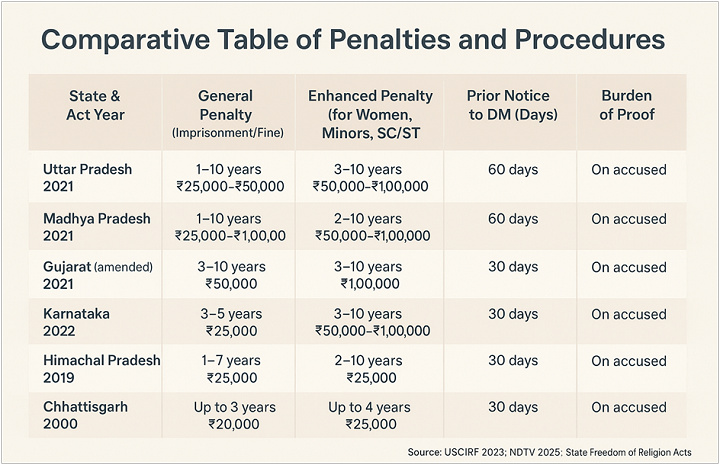
According to United States Commission on International Religious Freedom (USCIRF) Issue Update ,12 of India’s 28 states have anti-conversion laws. Over a span of a few years, many states enacted an enormous number of anti-conversion laws. The most significant legislations are recognized in Uttar Pradesh (2021), Madhya Pradesh (2021), Gujarat (amended 2021), Karnataka (2022), Haryana (2022), Uttarakhand (2018), Himachal Pradesh (2019), Odisha (1987, amended 2022), Arunachal (1978), Chhattisgarh (2000), Jharkhand (2017) etc. These bills usually came up as "Freedom of Religion Acts". They generally prohibit religious conversion by force, misrepresentation, undue influence, allurement or fraudulent means, or marriage alone. Some of them, in particular, make it a punishable offence if someone helps or encourages such conversions. Marriage for conversion is the only one referred to in a few laws; for example, Karnataka's law prohibits "conversion for the sole purpose of marriage," and similar clauses are also found in UP and other Acts.
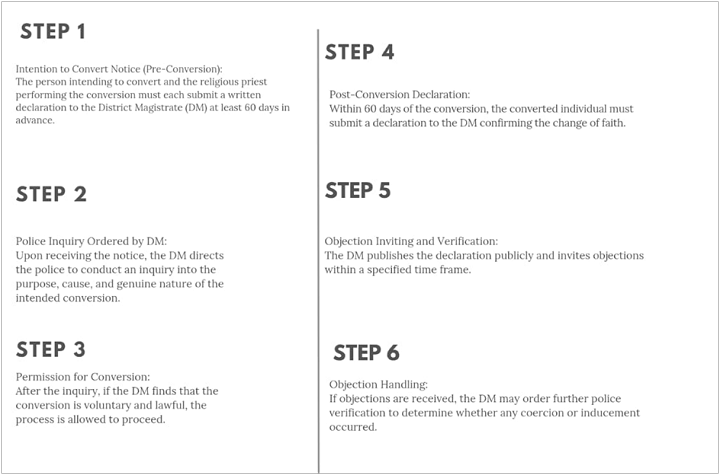
They often lay numerous limitations and stipulations on the process of changing religion. The Uttar Pradesh Prohibition of Unlawful Conversion of Religion Act, 2021, which is mainly based on a 2020 Ordinance, for instance, mandates that the convert and the officiating religious person must inform the District Magistrate (DM) 60 days ahead of a conversion ceremony and empower the DM to get a police investigation done to find out the "actual, factual and legal" basis of the conversion. Additionally, the person must file a post-conversion declaration of the event details with the DM, who is then required to make it public and address any objections that may be raised. The Madhya Pradesh Freedom of Religion Act, 2021 (telegraphed January 2021) also requires the submission of a 60-day notice by the convert and the priest conducting the ceremony, following which the DM can give his consent or disallow the change. As per a news report from NDTV 283 cases registered in Madhya Pradesh between Jan 2020–mid-2025 under its anti-conversion law. As of 2022, the law in Karnataka remains essentially unchanged, as it also requires authorities to be forewarned and seeks public input from voluntary conversions before and after. (On the contrary, states such as Himachal have a 2019 law wherein the considerable public-notice requirement that was used in the earlier 2006 law was dropped).
Penalties under these laws vary, but they can be pretty harsh, and, in general, these penalties include imprisonment for a few years to up to 10 years. More stringent minimums are set up for quarters if women, children, or members of the Scheduled Caste/Tribe are involved, or if cases of "mass conversions" are alleged. For example, the State of Karnataka applies terms of 3-5 years for regular cases and 3-10 years (along with higher fines) in a situation when the accused targeted children, women, or SC/ST persons. Offences are usually made cognizable and non-bailable. (Previously enacted state laws e.g. Orissa 1967, MP 1968 were generally more lenient in terms of punishment, but the current laws in BJP-led states have raised the penalties.)
SUPREME COURT'S JURISPRUDENCE
The Indian Supreme Court has yet to make a final decision regarding the constitutionality of state anti-conversion laws. However, judging by its recent comments and orders, it appears to be following certain principles while also struggling to reconcile them.
One of the first decisions made clear that the right to religious propagation (Article 25) does not mean a right to coerce others. The Rev. Stainislaus v. M.P. case (1977) saw the Court acknowledge conversion undertaken voluntarily as a faith practice, while at the same time allowing states to prohibit forced conversions to maintain public order. Recently, the Court has linked religious freedom to the rights to privacy and personal liberty. The 2017 Puttaswamy privacy case was, in fact, the venue where the full bench of nine judges quite directly stated that "personal choices governing the way of life" here, a person's faith are part of the right to privacy. Consequently, the Court saw Article 25 as covering not only one's right to pick one's religion, but also "the freedom of an individual to choose a faith and express or not express such choices publicly". Several arguments of the Court in this respect have played a role in recent court decisions as well: a bench was of the opinion in October 2025 that religious freedom under Article 25 "is closely linked to the rights of privacy by which a person is entitled to freedom of conscience as a matter of his being". The Court emphasised that "the freedom of conscience guaranteed by Article 25 is a matter of the zone of purely private thought process" and that the autonomy of a person in selecting religion or a life partner is "supreme".
In 2018, the Supreme Court in Shafin Jahan v. Asokan K.M. (the Hadiya case) was unanimous in its decision to invalidate a Kerala High Court order that had annulled an interfaith marriage. The apex court held that an adult woman's right to change her religion and marry is a fundamental one. The case, although concerning marriage, ultimately confirmed that the right to change one's religion is an essential aspect of freedom of religion. These types of decisions imply that voluntary conversion is a domain that should not face any restrictions unless there is a strong justification for them.
On their part, the courts are of the view that the State has the right to be concerned about the matter of forcible religious conversions. In a November 2022 hearing, a Supreme Court panel Justices Shah and Kohli said that a forced religious conversion is an "extremely grave issue" that, among other things, can endanger "national security, freedom of religion and freedom of conscience". The Court tweeted to the central government to place before it the steps taken to address the problem of forced conversions. During the related proceedings, the Solicitor General informed the Court that a forcibly induced conversion is a "serious menace" and "national issue" and that different states have enacted laws to tackle this problem.
The Centre, before the Court, went to the extent of stating that "religious freedom does not grant a fundamental right to convert other persons," thereby conforming to the old Stanislaus principle. These speeches demonstrate the judiciary's acknowledgement of the executive's viewpoint, even when the judiciary seeks to set limits as defined by the Constitution.
The Supreme Court began to cast doubt on specific parts of anti-conversion laws. In October 2025, the Court ordered multiple FIRs in Uttar Pradesh to be invalidated in connection with the SHUATS mass conversion case, a criminal case group in UP. The law enforcement cases that were filed against the group of persons for unlawful conversion in several districts of the State of Uttar Pradesh were quashed by the two-judge bench Justices Pardiwala and Misra. While doing this, the Court observed that many clauses of the UP legislation imposed "burdensome" conditions on those who had converted. It was a tough point for the Court that the requirements of a 60-day prior notice, automatic police investigations by the District Magistrate, and public disclosure of a person's personal details during conversion were "very onerous" and, perhaps, invasive. The Court held that although the State can intervene to put a stop to "coercion, inducement or fraud," the law's broad directions e.g., the requirement to notify about a conversion and seek permission in advance raise questions about their consistency with constitutional rights. The judges emphasised India's secular nature and cautioned that the complex procedures in the law might restrict the right to change one's religion more than necessary. Additionally, they ruled, based on the facts, that the complainants who had filed those FIRs under the unamended law did not have the right to bring the case, as the law itself only allowed the convert and a few relatives to complain.
Pointing out these issues, the Court indicated that it was not throwing the regulation out of the window altogether indeed, since the question of the UP Act's constitutionality was not directly before the Court, it "confined its remarks to the minimal extent". This October 2025 decision was, however, very significant in that it made an explicit connection between the right to conversion and that of privacy citing Article 25 as "having aspects of privacy rights" and confirmed again that changing one's religion is a purely personal matter. Commenting on this case as well as the previous proceedings, observers feel that the Court's remarks may be interpreted as a signal of increased scrutiny of anti-conversion laws. A Catholic magazine wrote that the bench was of the view that the issue of forced conversions being checked should not unintentionally 'restrict voluntary religious change'. It conveyed that the laws, which require obtaining permission beforehand or notifying the public, should be reviewed thoroughly.
Supreme Court interventions are mostly an indication of what is at stake constitutionally. In January 2023, a panel led by Chief Justice Chandrachud of the Supreme Court began hearing the long-pending petitions of Citizens for Justice and Peace (CJP) challenging the constitutionality of the anti-conversion laws of multiple states. The bench, which had hearings with several petitioners, suggested that petitioners should consolidate their cases, and the matter was adjourned for further hearings. Some of the spoken words that have been reported from these hearings reflect that the Court is aware of the issues of privacy and equal liberty that arise from the case.
In October 2025, the Court once again, in broadly similar terms, reasserted the idea that the adoption of a particular religion (and a partner) is an "autonomous" right held by the person, which is protected by Articles 21 and 25. To sum up, the Court is still holding off on a definitive judgment regarding the anti-conversion laws. However, its recent decisions link the right to religious conversion to the right to privacy and liberty, and it is evident that the Court is scrutinising these laws' stipulations.
Flowchart of Mandatory Conversion Steps under the Uttar Pradesh Prohibition of Unlawful Conversion of Religion Act, 2021
COMPARATIVE PERSPECTIVE: GLOBAL APPROACHES TO RELIGIOUS CONVERSION LAWS
Democracies generally perceive religious conversion as a fundamental right of an individual, a choice based on one's personal nature and outside the jurisdiction of state authority.
The First Amendment of the Constitution in the U.S. is beyond any doubt the one that affords the absolute freedom to profess and change religion. Courts have consistently held that the government should not question the sincerity of a belief. In fact, it is not permissible for the government to notify or seek permission as a result of a change in religious affiliation.
The UK is governed by the Human Rights Act, which aligns with Article 9 of the European Convention on Human Rights. This article recognises and guarantees the human right not only to hold certain beliefs but also to manifest and change them freely.
Article 26 of the Constitution of Nepal prohibits both the act of conversion and the effort to convert others, and such acts are punishable with imprisonment of up to five years.
The Pakistan Penal Code, Sections 295-A to 298-C, defines the criminal act of "outraging religious feelings" and the introduction of provincial bills has been instrumental in the targeting of abusers in the realm of alleged enforced conversion, especially in the case of minors and women, who thus become victims of sexual exploitation and forced conversion, without their voices being heard or lack of support from the society in these matters.
The European Court of Human Rights (ECHR) in Kokkinakis v. Greece (1993) held that "to be able to change one's religion is a vital feature of identity and one's moral sense." Such understanding positions the act of voluntarily converting as the central aspect of human dignity.
India is between the two extremes of Western liberalism and South Asian conservatism. The country is seeking a way to strike a balance between personal freedom and social order. However, while doing so, it often encounters the problem of protecting the faith through regulation a contradiction that still marks its constitutional path.
EXPERT OPINIONS
Leading judges and constitutional experts have also responded to the debate around conversion laws with their insightful and expert commentaries. Each of them considers the issue using their own unique perspective.
Chief Justice D.Y. Chandrachud, whose interpretations of fundamental rights have been notably progressive, has on numerous occasions linked the concept of personal autonomy to that of belief. In a recent hearing, he stated, "the right to religion necessarily encompasses the freedom to change it, for belief and identity lie at the heart of personal liberty." The essence of one's belief and even identity is the very core of liberty. His assertions align with the privacy law established by the Supreme Court in the K.S. Puttaswamy v. Union of India (2017), where it was held that the most fundamental freedom is that of individual conscience and choice. The Chief Justice thus brought religious liberty under the umbrella of personal autonomy, stating that conversion, in particular, is a matter of personal faith, like privacy, which is a realm that the State may regulate only in the rarest of cases.
Senior Advocate Indira Jaising, on the occasion of a 2024 symposium on constitutional morality, delivered a sharp and incisive comment regarding the expansion of the State's role in supervising matters related to the conscience of the individual. She warned that "The moment the State decides to intervene in matters of belief, Democracy is carried to the brink of Majoritarianism." Her warning is based on the Indian constitutional discourse tradition, which is deeply rooted and has been in place for a long time, that laws designed to prevent coercion must not, in effect, coerce conformity themselves. By using this approach, Jaising not only changes the locus of conversion from the centre to the periphery, but she also raises an issue of structural imbalance and the consequent authoritarianism that might result from the bureaucratic machinery governing faith.
From a practitioner's point of view, Advocate Mr. Deepanshu Dudeja, Delhi High Court said that freedom of religion must be exercised responsibly. The Supreme Court decision supporting the regulatory framework for religious conversions has once again highlighted the issue of the need to balance individual liberty with societal order. According to me, the Court’s argument reveals that the most important thing about constitutional freedoms is that they do not exist in a vacuum
and that with freedom come also duties and responsibilities.
It is known that the Constitution in its Article 25 grants every human the right to freely profess, practice, and propagate their religion, but it also limits this freedom to public order, morality, and health. Such a constitutional arrangement is meant to ensure that the choice of religion or changing one’s religion is not a means of violating the rights of others or of using religion for inducements or coercion. Hence, the state’s limited intervention is not a rejection of faith but a
safeguarding of faith from manipulation
The problem of forced or mischievous conversions is not just a hypothetical one. In numerous regions, the evidence of the exploitation of the destitute for the purpose of misrepresentation or enticement is on the rise. In such a scenario, it cannot be said that the requirement for prior notification of authorities is an invasion of privacy; rather, it is a measure that prevents illegal and involuntary conversions. It gives a firm support to the idea of airing out the situation while at the same time, it allows for the practice of religious faithes which are done sincerely and are free.
Besides, these rules neither regulate nor interfere with interfaith marriages that are based on love and mutual consent. What they are aiming at, is the gravest 'love-jihad' phenomenon that is characterized most often by the use of conversion as a means to attain illicit ends. Accordingly, separation is made between religion as an individual’s choice and religion being
a cover for the exploitation.
Essentially, the court ruling revives the idea that religion freedom is one of the rights that should be used in a proper way. It is the right of every human being to follow and spread their faith, however, it is also the right of each and every individual to be safeguarded against fraud, force, and unfair influence. The real essence of secularism is not in the nonexistence of control, but in guaranteeing that religion is still a personal decision and not a forced one.
CONCLUSION
The religious conversion laws debate in India is a clash of two strong constitutional impulses that the Supreme Court must consider: the right of every person to choose their faith freely and the State's duty to protect citizens from fraud or coercion. The apex court, entrusted with striking a balance between these values, has indicated a tilt towards individual autonomy. Its latest rulings closely link the right to religion with personal liberty and privacy. However, the Court remains sensitive to the State's concerns: it has, in fact, recognised that forced conversions constitute a primary social concern. Indirectly, the Court's pending rulings and comments will determine how extensively local governments will be able to regulate religion and whether India will move towards more severe control or greater tolerance of voluntary faith changes.
One thing is certain: conversion laws have become a significant source of legal and political conflicts. Therefore, determining the outcomes of such debates will significantly impact India's secular character, minority rights, and personal liberty. Prominent lawyers foresee the Supreme Court's final decisions most probably in late 2025 or early 2026 as milestone judgments that will first and foremost decide the constitutionality of the procedural requirements, such as advance notice, public disclosure, prior approval and in the second instance, the Court's interpretation of Articles 25–28 vis-à-vis privacy rights. Meanwhile, state administrations are implementing their regulations, and civil society is keeping a close eye on them. Some commentators believe that India's stance could also influence the debate in other countries. The UN experts and various international Christian groups have already expressed their concerns regarding the anti-conversion laws. Whatever the case may be, people will be waiting anxiously to see how the Supreme Court of India will tackle this delicate intersection of faith, freedom, and law.
Join LAWyersClubIndia's network for daily News Updates, Judgment Summaries, Articles, Forum Threads, Online Law Courses, and MUCH MORE!!"


Tags :Others