

Case:
Dhiraj Dutta v. Anirban Sen & Ors.
Bench:
Justice Sanjay Karol and Justice Vipul M. Pancholi
SUBJECT:
Law of Limitation, Revocation of Probate, Constructive Notice, Testamentary Succession, Property Mutation Proceedings, Indian Succession Act, 1925.
IMPORTANT PROVISIONS
- Article 137, Limitation Act, 1963 – Prescribes a residual limitation period of three years for applications where no specific period is provided elsewhere in the statute.
- Section 263, Indian Succession Act, 1925 – Empowers courts to revoke or annul a grant of probate or letters of administration for “just cause”.
- Section 3, Transfer of Property Act, 1882 – Incorporates the concepts of actual notice, constructive notice, and wilful abstention from inquiry.
- Principles governing constructive knowledge, due diligence, and finality of judicial proceedings.
Master CPC - Once and for All: Master Course by Adv. Roma Bhagat. Enroll Now!
OVERVIEW
The Supreme Court was asked to decide whether a challenge to a grant of probate almost 30 years ago would be entertained as applicants had acquired knowledge of the grant in recent years. The case was triggered by a probate which had been granted in 1995 in respect of an instrument of testamentary disposition relating to rights in immovable property.
The respondents filed proceedings under Section 263, Indian Succession Act in 2022 to set aside the probate. Their main allegation was that they were not told anything about the probate process and learned about the grant in 2019. They relied on this reasoning to conclude that the limitation period for application for revocation should be deemed to begin with the date of actual knowledge.
The appellant, however, challenged the plea, arguing that the respondents had already been involved in mutation proceedings long ago and that they had already been served with notices in 2013, the content of which was clear and self-evident that it was sufficient for an inquiry into the source of the title to be conducted. The notice recipients were held legally accountable to pursue investigation of the basis on which rights to the property were being used.
Accepting the appellants' arguments, the Supreme Court decided that the plea of ignorance cannot be accepted by the respondents in view of the surrounding circumstances, which would have alerted a reasonable man. The Court noted that the law affords not only actual knowledge, but constructive notice, such as when a party knowingly refrains from making inquiries that prudent inquiry would demand.
Given the respondents' extensive opportunity to find out about the probate's existence, the Court found the application filed in 2022 to be hopelessly barred by limitation. The judgment has confirmed the application of Article 137 of the Limitation Act in revocation of a probate proceeding, and emphasizes the need for a degree of care in safeguarding legal rights.
ISSUES RAISED
- Whether the application for the revocation of probate under Section 263 of the Indian Succession Act comes under Article 137 of the Limitation Act, 1963?
- Whether limitations begin when the applicant actually knows about the probate or when they should reasonably have known about the probate?
- Whether the notices received in the mutation proceedings are a constructive notice for the existence of the mutation proceedings?
- Whether the party may avoid the bar of limitation based on his or her own ignorance, when he or she had enough time to discover the facts?
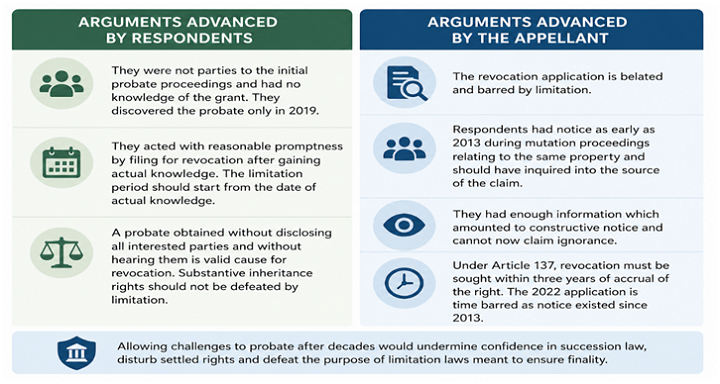
ARGUMENTS ADVANCED BY RESPONDENTS
Respondents argued that they were not parties to the initial probate proceedings nor they were beneficiaries under the grant. They reported that they never knew they had been awarded a probate in 1995, and did not have cause to object to the same for several years.
It was argued that they only became aware of the existence of the probate in 2019, after which they took “reasonable prompt action” by launching the revocation proceedings. The respondents argued that the right to seek revocation could only be granted once the grantee had actual knowledge of the grant and, thus, the limitation period provided in Article 137 could only begin as of this date.
The respondents also argued that a probate is valid cause for revocation even if it is issued with a lack of disclosure of all parties interested and without giving a chance to them to disagree with the proceedings. Therefore, it could not be found that the application could only be rejected on the grounds of limitations if the rights involved were substantive rights in inheritance or succession.
ARGUMENTS ADVANCED BY THE APPELLANT.
The appellant strongly opposed the maintainability of the revocation application and contended that the proceedings were grossly belated and the same were barred by limitation.
It was argued that the respondents were apprised of the notice in the course of the mutation proceedings as soon as in 2013. The proceedings before them dealt with the same property and it was clear from these proceedings that there had been claims arising out of the probate. The appellant says that any reasonable man interested in safeguarding his proprietary interest would have inquired into the source of such interest.
The appellant also argued that the respondents failed to conduct any investigation and had enough information to put them on investigation. This was said to be constructive notice to the law, and thus not open to the respondents to claim ignorance later on.
Article 137 of the Limitation Act was also relied upon to argue that an application for revocation of probate shall be made within three years of the date of the accrual of the right to apply. The application was time barred, as the respondents must have had constructive notice since 2013, and the time limit for the same had expired by the time of the filing of the application in 2022.
The appellant ultimately contended that for challenges to probate to be allowed after decades would be perverse because it would destroy confidence in succession law, upset settled expectations of rights and destroy the protective purpose of limitation laws which are designed to finality in legal proceedings.
JUDGMENT ANALYSIS
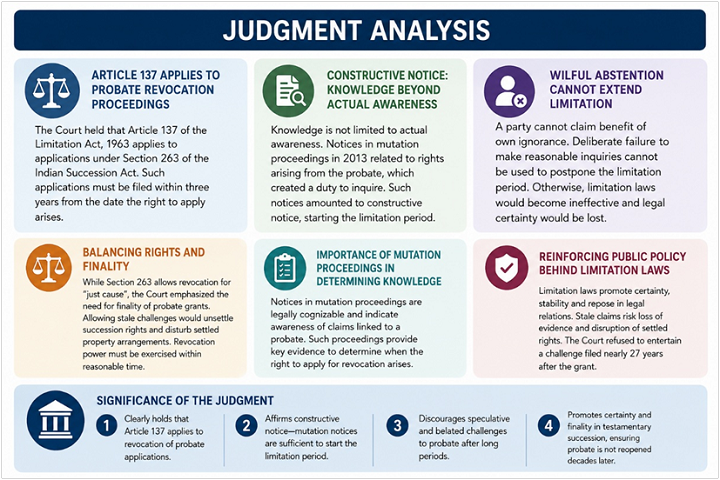
Article 137 applies to Probate Revocation Proceedings.
The most important point before the Supreme Court were whether any limitation period would apply to an application for revocation of probate under Section 263 of the Indian Succession Act and, if so, what was the applicable time limit. The Succession Act does not specify a Limitation period for such applications and the Court ruled that Article 137 of the Limitation Act, 1963 will apply.
Article 137 is a residuary provision covering applications to which a limitation period is not prescribed. The Court restated the rule that the application to revoke probate must be made within three years after the right to make such application arises. This discovery is important because parties often believe that they can file an action for unknowingly giving up rights to property in a probate matter in any time for any reason, such as fraud, concealment or lack of notice. Even such challenges fall under the "discipline of the limitation law," the judgment states.
The ruling thus reinforces the notion that succession disputes should not be allowed to drag on in perpetuity and that a probate grant should have some finality after issuance by an appropriate court.
Constructive Notice: Knowledge beyond actual awareness.
The important thing to note about the judgment is the Court's extensive comments on constructive notice. The respondents contended that the knowledge of the probate only occurred in 2019, thus limitation should commence from that date. The Court was unconvinced by this argument and noted that knowledge is not limited to the actual knowledge. A person has knowledge of a fact if in a number of circumstances a reasonable person would have been likely to make inquiries.
The respondents got the notices in the course of mutation proceedings in 2013, it was admitted. Those notices related to rights to property that could be traced back to the probate process. The Court said that such notices created a duty on the respondents to delve into the origin of the claim and to find out the basis on which rights are being claimed. The Court extended the scope of the doctrine beyond the standard definition of real estate transactions by imposing it on the context of an estate case. The Court extended the doctrine beyond the typical real estate transaction and imposed it into a succession case.
Wilful Abstention Cannot Extend Limitation
The Court noted that the respondents had no reason to bar the respondents from discovering the existence of the probate. Instead, they omitted to exercise the most basic procedures to investigate issues which were directly at stake in their proprietary interests. This was not a case of ignorance, but rather of deliberate action.
A litigant cannot be allowed to reap the benefits of his own ignorance. Where a party knowingly fails to make inquiries that are likely to uncover relevant facts, then that party will not be able to use the lack of knowledge as a defence against limitation. This principle is a key policy goal. Otherwise, if the court would accept any plea of ignorance of the circumstances of the crime, it would be impossible to implement any limitation statutes and legal certainty would be lost.
Balancing the Right to Challenge Probate and the need for finality:
The judgment exemplifies the Court's effort to balance two interests.
But, on the other hand, Section 263 of the Indian Succession Act allows the revocation of the probate if there is a "just cause". This is especially important because probate can be reached in some instances by a misrepresentation of the facts and some irregularities.
Pro-bate, on the other hand, is meant to definitively determine the validity of a testamentary instrument. After a grant is made and acted upon, legal heirs, purchasers and others deal with the property on the basis of believing that the grant is valid and final. However, the Court noted that allowing challenges after decades would throw a monkey wrench into succession rights and upset established property arrangements. The determination thus reiterates the rule that the power of revocation must be used within reasonable time limits.
Importance of Mutation Proceedings in Determining Knowledge
One of the key points to take from the judgment is the evidentiary value placed on mutation proceedings. The proceedings of mutation are viewed often as processes of revenue or administration. The Supreme Court, however, ruled that notices issued during such procedures constituted “legally cognizable” evidence of notice.
The judgment contains an acceptance that mutation proceedings often result in conflicting claims to a property, and that wills or succession certificates, as well as probate grants, may be discovered. This means that a person to whom notice is given in such proceedings may not subsequently assert the lack of knowledge. Next, this part of the ruling will probably affect future inheritance cases where the court will look at the mutation records to ascertain when limitation set in.
Reinforcing Public Policy behind Limitation Laws
The underlying principle is a wider one of jurisprudence: Limitation statutes are public policy.
The law of limitation isn't just about the 'punishment of delay'. Instead, it aims to achieve certainty, stability and repose in legal relationships. Stale claims have never been revived after lengthy periods of dormancy due to the loss of evidence, the unavailability of witnesses and settled rights that may be disrupted.
The Supreme Court affirmed that legal remedies should be taken stridently, by declining to hear a challenge that was brought almost 27 years after the grant of the probate. The ruling will repel criticism that the rights can be forfeited not just by explicit forfeiture, but also by long, unexplainable silence.
Significance of the Judgement
The Judgment is a judgment with a broader significance. The ruling has significant ramifications for estate and succession litigation in India.
Firstly, it clearly states that Article 137 applies to applications for revocation of probate.
Secondly, it enhances the principle of constructive notice by accepting that mutation notices are enough to provide knowledge for the purposes of limitation.
Thirdly, it deters speculative challenges to probate grants after long periods of time.
Lastly, the judgment gives certainty in testamentary succession, which is one goal of probate, in that it will not be reopened decades later because someone says that they didn't know what was happening.
CONCLUSION
The Supreme Court judgment in the case of Dhiraj Dutta v. Anirban Sen & Ors. is significant as a reiteration of the principles of ‘limitation’, ‘diligence’ and ‘finality' in the probate process.
The Court determined that such a probate notice was constructive notice of the probate and that wilful abstention from inquiry would not extend limitation forever, thereby preventing the reopening of a probate grant, nearly 30 years after it was granted.
The judgement reinforces the applicability of Article 137 of the Limitation Act to the proceedings for revocation of probate and also sets out the standard that limitation starts when the party reasonably should have known of its existence. The decision reinforces the rule of law in will disputes and provides caution to post mortem objections that are based on ignorance which may have been addressed with ordinary care.


