Bench
Justice G.R. Swaminathan
Date of Judgment
17 October 2025
Parties Involved
Petitioner: K. Heerajohn
Respondents:
1.The District Registrar, Madurai District, Madurai
2.The Sub Registrar, Melur East Sub Registrar Office, Madurai District
Subject Matter
The writ petition arose from the refusal of registration authorities to register an adoption deed executed by K. Heerajohn and his wife for the minor Mohammed Saleem, son of the petitioner’s deceased brother. The petitioner sought judicial intervention to secure the registration of the adoption deed in accordance with the JJ Act, 2015, arguing that statutory provisions override personal law constraints in the context of adoption, and that procedural compliance under the Adoption Regulations, 2022, suffices for legal recognition of adoption.
Factual Background
K. Heerajohn, a practicing Muslim from Madurai, approached the District Registrar to have an adoption deed registering his intention to adopt a child under the Juvenile Justice ( Care and Protection of Children ) Act. The adoption was already done through legal procedure and accompanied by proper documents.
When the deed was brought to the District Registrar, however, the registrar refused to register. The explanation provided was simple but questionable under the law. Islamic personal law, the Registrar explained, does not provide for adoption the way the Hindu Adoptions and Maintenance Act does.
This denial led the petitioner to approach the High Court under Article 226. Heerajohn's contention was that the JJ Act is a secular law permitting any citizen, regardless of religion, to adopt a child, and that denial by the Registrar was contrary to the guarantees of equality and dignity under Articles 14, 15(3), and 21.
The case thus raised a recurring and constitutionally fraught question: can a public authority refuse registration on the basis of personal law when Parliament has legislated a uniform, religion-blind model of adoption?
Legal Concerns Before the Court
Justice G.R. Swaminathan encapsulated the conflict in terms of two central issues. One, whether the Juvenile Justice Act presents a full secular framework for adoption that supersedes personal law limits. Two, whether the District Registrar, in exercising powers under the Registration Act 1908, can question or deny registration of a document based only on religious grounds.
Arguments of the Petitioner
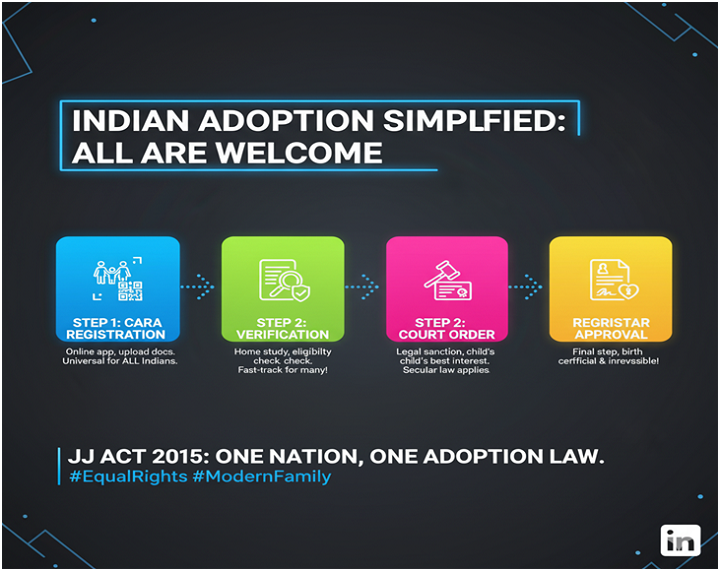
Heerajohn's counsel submitted that Section 41(6) of the JJ Act clearly permits adoption by any individual, as long as the adoption is done in accordance with procedures laid down by the Central Adoption Resource Authority. The Act, the counsel submitted, is a self-contained code for adoption and guardianship and does not depend on personal law. The refusal by the Registrar thus constitutes an infringement of the statutory right to register a valid instrument.
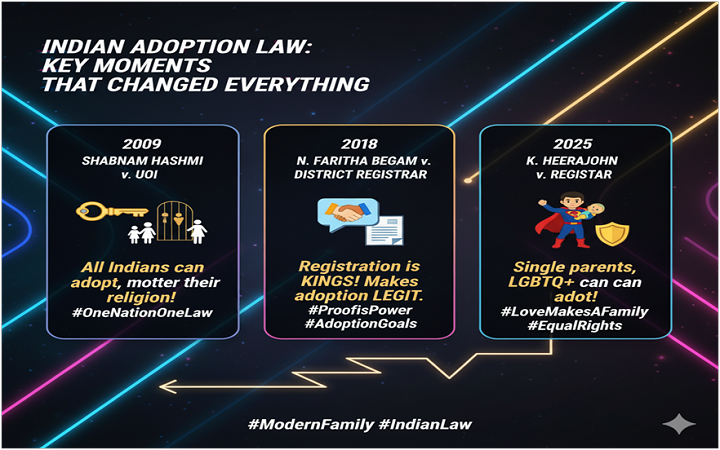
Drawing on the case of Shabnam Hashmi v. Union of India, the petitioner emphasized the fact that the Supreme Court had already acknowledged the JJ Act as a secular law granting adoption rights to all citizens. The counsel also relied on N. Faritha Begam v. District Registrar and C. Pakkir Maideen v. District Registrar, in which the Madras High Court had already held that Registrars cannot refuse registration of adoption deeds signed by Muslims or Christians. The Registrar's action, it was argued by counsel, was arbitrary and against these binding precedents.
Heerajohn's side also appealed to Article 21 to highlight that the right to family and emotional security is part of the constitutional right to life. Denial of registration, they argued, deprived both the adopter and the child of the recognition and protection under the law.
Respondent's Arguments
On behalf of the State, the Government Advocate represented the action of the District Registrar, contending that the refusal was not arbitrary and beyond power. Under Islamic personal law, it was submitted that the institution of legal adoption does not exist in the same manner as under Hindu law. The system of kafala, however, provides for guardianship, which permits care of a child without cutting off ties with the natural parents.
The State argued that the Registrar had acted strictly in compliance with the circulars and departmental instructions then prevailing. Such official notices, published by the Registration Department, advise officers against registering deeds that could directly contravene personal law provisions.
It was also contended that as the Juvenile Justice Act does not specifically state that it overrides personal laws, the Registrar was justified in making sure that the document being submitted for registration was legally viable.
The State also pointed out that the Registration Act, calls for officers to be convinced regarding the legality of the documents presented before them, and that registration of a document in violation of prevailing personal law would lead to confusion and give rise to litigation. Based on this reason, it was argued that the caution of the Registrar was reasonable because he had simply acted in accordance with administrative procedure and not on personal whim.
Court's Analysis and Findings
Justice Swaminathan began his justification by noting that the Registrar has a ministerial, rather than an adjudicatory, function under the Registration Act. In paragraph 9, he said that refusal on religious grounds to register an adoption deed is "an assumption of jurisdiction that the law does not grant." The Registrar is only bound to check procedural compliance; he cannot examine theological correctness or interpret personal law.
Considering the statutory context, the Court reviewed Chapter VIII of the JJ Act specifically Section 56 and Section 41(6). Justice Swaminathan pointed out that these sections evidently permit any individual to adopt subject only to CARA guidelines, which are common to all citizens.
He observed that the language used in the Act is religion-neutral and its purpose purely child-oriented. He reiterated in paragraph 12 that "the statute's focus is the welfare of the child, not the faith of the adopter."
In support of this argument, the Court relied strongly on the Supreme Court's verdict in Shabnam Hashmi. Justice Swaminathan paraphrased the top court's statement in paragraph 37 of the aforementioned case that adoption under the JJ Act is a secular right and that any Indian citizen, irrespective of religion, can adopt. He argued that this binding precedent does not leave any room for bureaucratic reluctance.
The hon'ble judge then also referred to his own previous ruling in C. Pakkir Maideen at para 18, wherein he had held that the JJ Act is independent of personal law.
The Court restated that the "notion of kafala in Islamic law cannot supersede the secular mandate of Parliament." He emphasized that Muslims are not excluded from adopting under the JJ Act; they just do so based on a distinct legal source than the Hindu Adoptions and Maintenance Act.
Justice Swaminathan also remembered the coordinate bench judgment in N. Faritha Begam, which addressed a very similar factual matrix. In that regard, the Registrar had declined registration of an adoption deed signed by a Muslim lady.
The High Court had struck down the refusal and held that "administrative officers cannot create religious hurdles where the statute has pulled them down." Relying on that logic, the current verdict reiterated that once an adoption deed is submitted in proper form, it cannot be refused registration on grounds of religion.
In paragraph 15, Justice Swaminathan dealt with the State's contention regarding possible conflict between the JJ Act and personal law. He noted that Shabnam Hashmi had already made it clear that personal law remains in force for whoever wants to follow it but secular law offers a competing path. "The Registrar's duty," the Court noted, "is to record lawful acts, not to police belief."
Interaction Between Personal Law and Secular Statutes
The judgment spent considerable time harmonising personal law traditions with statutory rights. Justice Swaminathan took a purposive view, believing that although Islamic law may accept guardianship over adoption, Parliament's purpose behind the JJ Act is to make child welfare paramount in every circumstance.
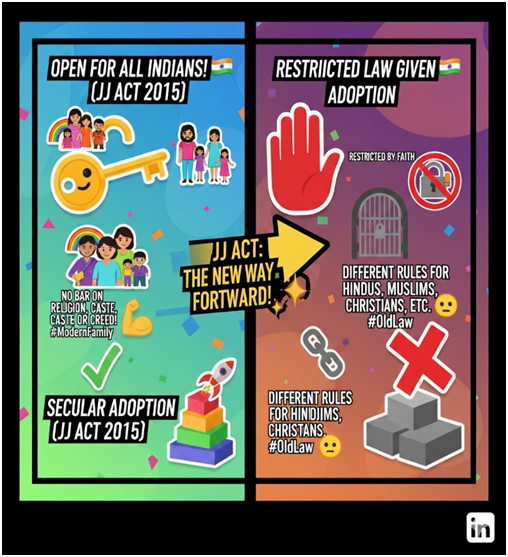
He noted in paragraph 18 that a secular statute in pursuit of child welfare must prevail over a restrictive interpretation of personal law when the two are in conflict.
The Court relied on Lily Thomas v UOI, para 32, for the rule that statutory legislation, being enacted in the interests of public welfare, overrides personal customs. Justice Swaminathan clarified that this is not a dilution of religious freedom but a reinforcement of constitutional equality. "Faith may control conscience," he established at paragraph 21, "but law controls rights."
He also made reference to the previous view of the Madras High Court in Philomina v. District Registrar, wherein Justice Anand Venkatesh opined that the Registrar would have no discretion to refuse registration of adoption deeds on grounds of religion. By intertwining these precedents in the rationale, the Court created an unbroken judicial strand upholding secular adoption rights within communities.
Constitutional Reasoning
Justice Swaminathan's ruling derives support from constitutional provisions of equality, freedom, and child well-being. Relying on Articles 14 and 15(3), he noted that excluding Muslim adopters from registration would result in an inadmissible classification and run counter to the obligation of the State to make special provision for children. In paragraph 23, he has said that "the child's right to family cannot be made contingent upon the adopter's faith."
The ruling also links the right to life under Article 21 to adoption. Justice Swaminathan quoted the Supreme Court's statement in Maneka Gandhi v. Union of India that life under Article 21 is not just existence and includes the right to live with dignity. He applied the same reasoning to children waiting to be adopted, saying that the child's dignity includes the right to belong to a family.
In addition, the Court relied on Jasvir Singh v. State of Punjab, in which a right to procreation and family life was considered inherent under Article 21. Justice Swaminathan argued that if biological parenthood is given protection, adoptive parenthood, being an equally legitimate form of family life, must be given constitutional protection as well.
Administrative Accountability and Directions
Having found the Registrar acted beyond jurisdiction, the Court quashed the impugned order of refusal. In paragraph 26, the Justice Swaminathan ordered the Registrar to register the adoption deed forthwith. He also exhorted the State Government to issue a circular to all Registration Offices making it clear that the adoption deeds executed under the JJ Act should be registered irrespective of the religion of the adopter.
The judgment concludes with a sharp reprimand. At paragraph 28, the Court stated that "administrative officers must realise that their allegiance is to the Constitution, not to personal law codes." This remark reshapes the decision from an ordinary statutory interpretation into a pronouncement of constitutional administration.
Broader Implications And Discussion
The ruling in K. Heerajohn is a sequel to the Madras High Court's enlightened jurisprudence on secular adoption. By reaffirming that the JJ Act is a universal, child-oriented law, the Court has de facto extended adoption rights to communities who hitherto did not enjoy them under personal law.
Practically, the judgment will instruct Registrars throughout Tamil Nadu and probably elsewhere to accept adoption deeds from non-Hindu citizens without fear or favor. It establishes administrative responsibility by making it clear that registration is a procedural obligation rather than an ethical question.
Upon the issue of the Juvenile Justice Act and the need for reforms in the same, Advocate Arshita Anand, while speaking to LaWyersClubIndia said that “the problem doesn’t lie in the laws, they have been made watertight enough to protect the kids. The problem always lies in execution. Public servants in India are way too lackadaisical when it comes to human rights, and that shows in Juvenile justice as well”.
When asked about the suggestions and what could possibly change within the system, Adv Anand mentioned that “The laws themselves are not being followed. On paper you can show anything because you have the power (specially in case of higher officials in India)”. Giving an example she further opined that “Let's say the law says to rehabilitate kids, provide them nutritious food and good education. Are they actually doing that? Implementation is the only problem. If that changes, everything will change”
Thus, Advocate Arshita Anand's words put the true picture before us. Laws in India, particularly those for children, have been made robust on paper, but the actual test comes when they are implemented. The ruling in K. Heerajohn has made the law more lucid and robust, but its intent will still be half achieved if the implementors do not demonstrate the same sense of responsibility and empathy that the Court did.
This ruling is not just a legal victory but rather a call for reform in the way the system operates. The decision put forward the proposition for the officers, registrars, and public bodies to look at adoption not as a document to be processed but as a right that protects a child's future. The law may open the door, but it is empathy, responsibility, and quick action that will allow children to walk through it.
FAQs
1. What was the K. Heerajohn case about?
The case dealt with whether a Muslim couple could lawfully register an adoption deed under the Juvenile Justice (Care and Protection of Children) Act 2015. The District Registrar, Madurai had refused to register the deed, citing that Islamic personal law does not recognise adoption.
2. What did the Madras High Court decide?
Justice G. R. Swaminathan held that the Juvenile Justice Act is a secular, child-centric statute. He ruled that the Registrar had no authority to deny registration based on religion and directed that the adoption deed be registered without delay.
3. Does the Juvenile Justice Act allow adoption by people of all religions?
Yes. The Court reaffirmed that Section 56 and Section 41(6) of the JJ Act permit any Indian citizen to adopt, irrespective of their faith, as long as the adoption follows the Central Adoption Resource Authority (CARA) guidelines.
4. How did the Court respond to the State’s argument about Islamic law?
The Court noted that while Islamic law recognises kafala (guardianship), the JJ Act provides a separate, secular route to adoption. Personal law cannot override a parliamentary statute enacted to protect child welfare.
5. Why is this judgment significant?
The decision reinforces secular adoption rights in India and clarifies that registration officers perform only administrative duties. It strengthens accountability in the Registration Department and ensures uniform application of the JJ Act.
6. What constitutional principles did the Court rely on?
The judgment relied on Articles 14, 15(3), and 21 of the Constitution, holding that equality, child welfare, and the right to life with dignity all support universal adoption rights.
7. How might this ruling affect future adoption cases?
The decision sets a clear precedent for other states. Registrars are now expected to register adoption deeds from non-Hindu citizens without hesitation, promoting a more uniform and inclusive adoption system across India.
Click here to download the original copy of the judgement