
Gratuity is one of the most familiar forms of terminal employment benefit in India. For an employee, it is generally understood as the amount payable after years of service when employment comes to an end. For an employer, it is often treated as an item to be calculated during final settlement. But legally, gratuity involves much more than a simple calculation based on salary and years of service.
The recent Supreme Court judgment in M/s Oil and Natural Gas Corporation Ltd. v. Suryakand D. Lad & Ors, brings one of the less understood aspects of gratuity law into focus: the identity of the person who is legally responsible for paying gratuity.
The case concerned workers engaged through a contractor at ONGC and raised a specific jurisdictional question, i.e. could the Controlling Authority under the Payment of Gratuity Act fasten gratuity liability upon ONGC, even though the workers were not its employees? The Supreme Court answered that question in the negative on the facts before it.
The judgment is important for another reason. It comes at a time when India's gratuity law has moved from the Payment of Gratuity Act, into Chapter V of the Code on Social Security. The four Labour Codes came into force from 21 November last year and the Ministry of Labour and Employment has since clarified that the gratuity provisions under the Code would apply from that date.
The ONGC judgment thus provides an opportunity to review gratuity from the grassroots, understand what gratuity is, when it becomes payable, how it is calculated, what continuous service means, when gratuity can be forfeited, what happens to contract labour, what decisions the competent authority can take and, most importantly, who ultimately would bear legal liability for payment.
From The Payment Of Gratuity Act To The Code On Social Security
For decades, gratuity was principally governed by the Payment of Gratuity Act, 1972. The Act created a statutory scheme for employees in specified establishments and provided detailed rules concerning eligibility, calculation, nomination, forfeiture, determination of disputes and recovery.
That statutory framework has now been consolidated into the Code on Social Security, replacing and consolidating several earlier labour statutes. The Payment of Gratuity Act is one of the enactments subsumed into the Code on Social Security.
Chapter V of the Code contains the present gratuity framework. Section 53 is the principal provision governing payment of gratuity, while subsequent provisions deal with compulsory insurance, determination, nomination, competent authorities, appeals, recovery and other matters.
This transition is important when reading recent judgments. A dispute concerning employment or gratuity that arose before November 2025 may have been governed by the earlier Act, while gratuity becoming payable after the commencement of the Code is dealt with under the new statutory framework.
The basic architecture, however, remains recognisable. Gratuity continues to be linked to length of service, termination of employment and last-drawn wages, while the new Code introduces several changes, including a specific statutory treatment of fixed-term employment.
What Exactly Is Gratuity?
Gratuity is a statutory social-security benefit payable to an eligible employee when the employment relationship ends in circumstances recognised by law.
Its purpose is connected with long service. An employee does not ordinarily receive gratuity every month as part of current wages. Instead, it accumulates as a statutory terminal benefit and becomes payable when the employment terminates upon the occurrence of a legally recognised event.
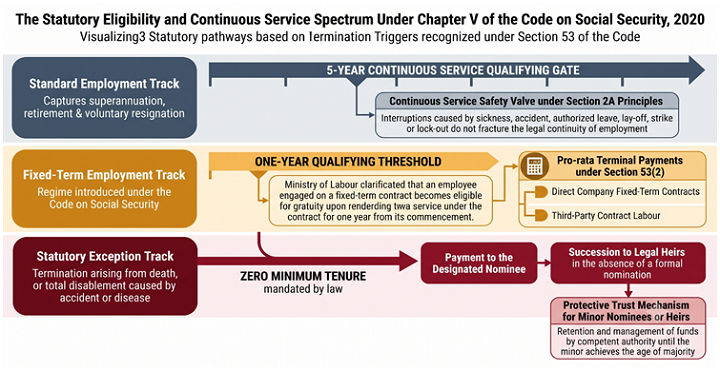
Section 53(1) of the Code on Social Security provides for gratuity upon termination after the prescribed period of continuous service on superannuation, retirement or resignation. It also covers death or disablement caused by accident or disease and termination of the contract period in fixed-term employment. In cases of death, disablement and expiry of fixed-term employment, the five-year requirement does not apply in the manner in which it ordinarily does for resignation, retirement or superannuation.
Gratuity should therefore not be confused with bonus, salary, provident fund or leave encashment. Each is governed by a separate legal framework and has different conditions of entitlement.
Who Is Entitled To Gratuity?
The first question in every gratuity dispute is whether the person claiming the benefit falls within the statutory framework.
The Code defines "employee" broadly for purposes of its social-security provisions, while also defining "contract labour", "contractor" and "employer". The distinction becomes particularly important where a person works at the premises of one establishment but is formally engaged through another entity.
The physical location where a person performs work is not, by itself, sufficient to determine who the legal employer is.
A security guard working at a large corporation's premises may be supplied by a security agency. A housekeeping employee may be engaged through a facility-management company. A technician may work continuously inside a public sector undertaking while remaining employed by a contractor. In each situation, the question of gratuity liability requires examination of the legal employment relationship. That issue lies at the heart of the ONGC judgement.
How Long Must An Employee Work To Become Eligible?
Under the general rule contained in Section 53, gratuity becomes payable after five years of continuous service in cases such as superannuation, retirement and resignation.
There are, however, statutory exceptions. The requirement of five years is not necessary where termination occurs because of death or disablement. The Code also specifically recognises expiry of fixed-term employment as an event for which the five-year requirement does not operate in the same manner.
This is an important change in the practical operation of gratuity law because the Code gives fixed-term employees a statutory gratuity entitlement on a pro-rata basis when the fixed-term contract comes to an end.
The Ministry of Labour has clarified that a fixed-term employee becomes eligible for gratuity upon rendering service under the contract for one year from the commencement of the contract.
Therefore, the familiar statement that "five years are always necessary for gratuity" is no longer an accurate description of the present law.
What Is Continuous Service?
Continuous service is important because gratuity is fundamentally linked to the period for which an employee has rendered qualifying service.
Under the earlier Payment of Gratuity Act, Section 2A treated service as continuous even where it was interrupted by specified circumstances such as sickness, accident, leave, lay-off, strike or lockout, provided the statutory requirements were met. The provision also contained deemed-service rules based upon the number of days actually worked during the relevant period.
The concept prevents an employer from defeating a gratuity claim merely by pointing to every temporary interruption in attendance.
At the same time, continuous service does not mean that every period spent in connection with an organisation automatically counts as service with that organisation. That distinction becomes particularly important for contract labour. If an employee is legally employed by a contractor, the period of service has to be considered within the correct employment relationship.
How Is Gratuity Calculated?
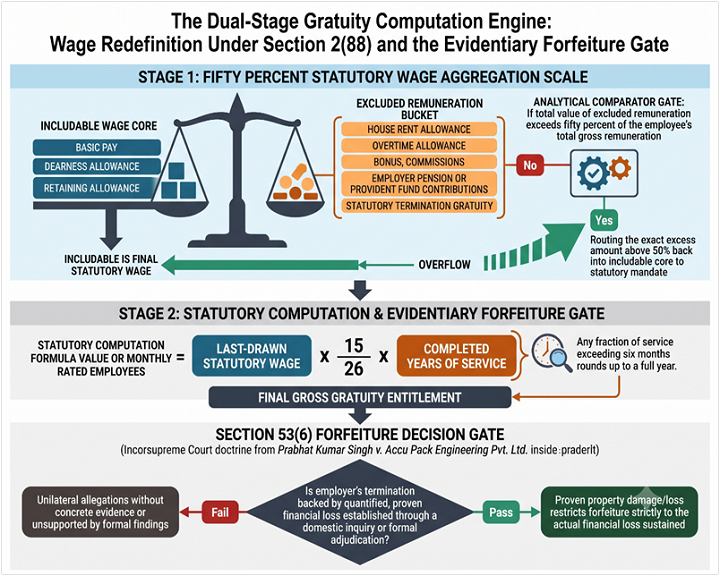
The basic gratuity formula remains fifteen days' wages for every completed year of service, or part thereof in excess of six months, subject to the statutory provisions applicable to different categories of employees.
For a monthly-rated employee, the familiar calculation is:
Gratuity = Last drawn wages × 15/26 × completed years of service
The statutory formula uses twenty‑six days to calculate fifteen days’ wages for a monthly‑paid employee.
For example if the last drawn wages are ₹60,000 per month. The employee has worked 12 years and 8 months the extra months after the first six months are treated as an extra full year, in the statutory calculation.
The calculation therefore becomes ₹60,000 × 15/26 × 13 = ₹450,000.
The Code also provides separate rules for piece-rated employees, seasonal establishments, fixed-term employees and deceased employees. For fixed-term employees and deceased employees, gratuity is payable on a pro-rata basis.
The statutory ceiling is also relevant. The amount of gratuity payable cannot exceed the amount notified by the Central Government.
What Wages Are Considered For Gratuity?
The amount of gratuity depends not merely upon the figure described by an employer as "salary". The statutory definition of wages determines which components enter the calculation.
Section 2(88) of the Code on Social Security defines wages to include basic pay, dearness allowance and retaining allowance, while excluding specified components. The exclusion list includes items such as certain bonuses, house rent allowance, overtime allowance, commission, employer contributions to pension or provident fund and gratuity payable upon termination.
The Code also contains the broader "50 per cent" rule concerning excluded allowances. Where the specified excluded components exceed the prescribed proportion of total remuneration, the excess can be added back into wages for statutory purposes. The Ministry of Labour has issued clarifications explaining how this rule operates.
This is particularly significant for gratuity because changes in the statutory definition of wages can alter the wage base on which the terminal benefit is calculated.
Is Gratuity Payable On Resignation?
Yes, subject to the statutory eligibility requirements.
Gratuity is not restricted to retirement. Section 53 expressly recognises resignation as one of the events upon which gratuity becomes payable after the required continuous service.
An employee who resigns after satisfying the applicable service requirement does not lose gratuity merely because the employment ended voluntarily.
This is an important distinction between gratuity and certain other employment benefits that may depend upon the reason for separation. The statutory scheme treats resignation as a recognised mode of termination for gratuity purposes.
Is Gratuity Payable On Death?
Yes
When an employee passes away the gratuity is paid to the nominee. If there is no nomination the gratuity goes to the heirs following the law. A minor nominee or heir's share is likewise protected by the legislative structure, which mandates that it be handled by the appropriate authorities in the way specified until the minor reaches majority.
The simple fact that the employee passed away before fulfilling the five-year continuous-service criteria does not negate the claim.
The same general rule applies to disability brought on by illness or accident, in which case the standard five-year limit is eliminated by the legislative exemption.
Can Gratuity Be Forfeited?
Yes, but certain legal requirements govern forfeiture.
The framework of the previous Section 4(6) of the Payment of Gratuity Act is essentially carried over into Section 53(6) of the Code.
Gratuity may be forfeited to the amount of the harm or loss incurred if the employer's property is damaged, lost, or destroyed as a result of an act, deliberate omission, or carelessness leading to termination.
In cases when services are terminated due to rioting or disorderly behaviour, another act of violence, or an infraction involving moral turpitude committed while on the job, the Code also allows for whole or partial forfeiture.
The crucial thing to remember is that misbehaviour does not always lead to complete gratuity forfeiture.
The requirements set forth by law must be met. The Supreme Court's decision in Prabhat Kumar Singh v. Accu Pack Engineering Pvt. Ltd illustrates the point.
The employees had worked for the company from around 2007 onwards. They were terminated in 2018 after the employer alleged misconduct and financial loss. The employer issued show-cause notices alleging losses of approximately ₹50 lakh and sought to forfeit gratuity to the extent of the alleged loss. No departmental inquiry preceded the termination.
The Supreme Court found that the employer had not produced evidence establishing the extent of the alleged financial loss. The Court also noted that the criminal investigation had resulted in a closure report finding no financial loss or misappropriation of the kind alleged by the company.
The Court relied upon the principle that forfeiture based on damage to the employer's property cannot exceed the damage or loss actually established. It consequently restored the order of the Controlling Authority directing payment of gratuity.
The decision demonstrates why an allegation of misconduct and a legally established basis for gratuity forfeiture are not interchangeable.
What Is The Role Of The Gratuity Authority?
This is where the ONGC judgment becomes especially significant. Under the earlier Payment of Gratuity Act, Section 7 required the employer to determine the amount of gratuity payable and arrange payment within thirty days after gratuity became payable. Where there was a dispute concerning the amount, admissibility of the claim or the person entitled to receive gratuity, the Controlling Authority could inquire into the dispute and determine the matter.
The Authority therefore did not merely perform a mechanical arithmetic exercise in every case. The statute expressly authorised an inquiry into specified disputes.
However, the jurisdiction still had to arise from the statute.
The Authority could not simply use a gratuity proceeding to create liability against an entity that was not the employee's employer merely because that entity was the principal establishment where the employee performed work.
That distinction was decisive in the ONGC case.
The ONGC Case: What Was The Dispute?
The dispute concerned workers who had been engaged through contractors for work connected with ONGC.
The workers claimed gratuity and proceedings were initiated before the Controlling Authority. The Authority ultimately fastened liability upon ONGC. The Appellate Authority interfered with that determination. The Bombay High Court subsequently reversed the Appellate Authority's decision, leading ONGC to approach the Supreme Court.
ONGC's central objection was that the concerned workers were not its employees. They had been engaged through contractors, and the contractual arrangements did not create an employer-employee relationship between ONGC and the workers.
The contractual documents were relevant because the arrangement was expressly characterised as a job contract and stated that it did not create an employer-employee relationship between ONGC and the contractor's employees.
The dispute consequently went beyond the amount of gratuity. The real question became whether the Controlling Authority could determine that ONGC itself was the entity legally liable to pay the gratuity.
What Did The Supreme Court Hold?
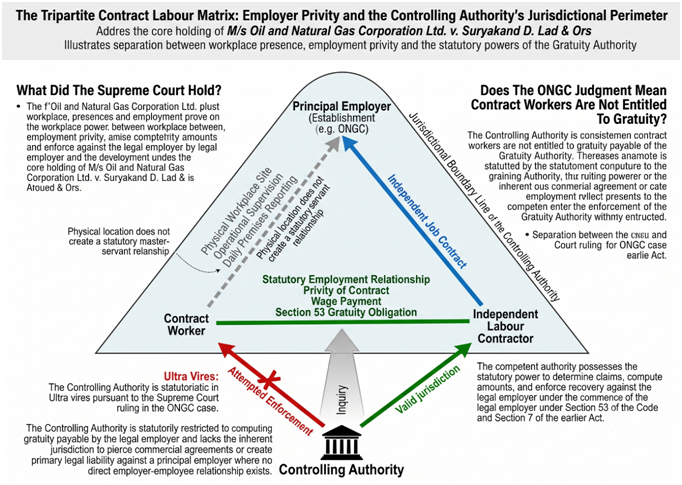
The Supreme Court allowed ONGC's appeals. The Court agreed with the submission that the proceeding before the Controlling Authority was not maintainable insofar as it sought to fasten gratuity liability upon ONGC for workers who were not its employees.
The Court explained that the statutory power of the Controlling Authority extended to computing the amount that may be payable to the concerned "employee". The adjudication concerning liability against ONGC, in the circumstances before the Court, travelled beyond that jurisdiction. The Supreme Court therefore held that the Appellate Authority had rightly interfered with the Controlling Authority's order and that the High Court was not justified in reversing the Appellate Authority.
The Court also considered submissions concerning the Payment of Wages Act and the Contract Labour Act.
Importantly, ONGC had already paid the gratuity amount to the workers during the litigation. The Supreme Court directed that no recovery should be made from the workers. The case is reported as M/s Oil and Natural Gas Corporation Ltd. v. Suryakand D. Lad & Ors.
Does The ONGC Judgment Mean Contract Workers Are Not Entitled To Gratuity?
No. That would be an unnecessarily broad reading of the judgment.
The Supreme Court was dealing with the question of whether ONGC, as the principal employer, could be made liable for gratuity through proceedings under the gratuity legislation when the workers were not ONGC's employees.
The judgment does not establish that contract workers have no gratuity rights.
In fact, the current position under Section 53 of the Code on Social Security expressly recognises gratuity liability in the context of contract labour. The Ministry of Labour's 2026 FAQ specifically states that, in the case of contract labour, the contractor is the employer responsible for paying gratuity after the prescribed period of continuous service.
This clarification is particularly useful because it places the ONGC judgment in the context of the law now in force.
The crucial distinction is therefore between entitlement to gratuity and identification of the legally responsible employer.
A contract worker may have a gratuity entitlement while the principal employer may nevertheless not be the entity legally responsible for paying it.
Who Pays Gratuity To Contract Labour Under The Current Law?
The Code on Social Security has a useful answer. The Ministry of Labour has explicitly stated that where workers are contract labour, gratuity liability under Section 53 is to be borne by the contractor who is the employer in relation to those workers. The contractor must pay gratuity after the requisite period of continuous service at the statutory rate based on last-drawn wages.
This clarification is consistent with the Code's definitions of "contract labour" and "contractor". Contract labour is generally a worker hired in connection with an establishment by or through a contractor while the contractor is the person who undertakes specified work or supplies contract labour.
The distinction is therefore not simply a matter of terminology. This tells us which entity is responsible, for the statutory employment obligation.
I wonder why the principal employer matters if the contractor is responsible. Because contract labour often works almost entirely within the principal employer's establishment.
A worker may report every day to the principal employer's premises, work under operational supervision, use the principal employer's facilities and remain there for years. Yet the worker may continue to be legally employed by an independent contractor.
There is a practical temptation to treat the principal employer as the worker's employer for every statutory purpose. The Supreme Court's ONGC decision shows why this approach cannot be adopted automatically. The legal relationship must first be established.
The principal employer and contractor can have extensive statutory responsibilities towards contract labour without being identical for every employment benefit. Whether a liability attaches to one or the other depends upon the governing legislation, the employment relationship and the specific statutory obligation.
Can A Principal Employer Ever Become Liable In A Contract Labour Arrangement?
The answer cannot be reduced to a universal proposition that a principal employer is never liable for anything concerning contract labour.
Different statutes impose different obligations and the legal consequences of a contractor's default depend upon the particular statutory framework.
The ONGC judgment is therefore best understood as a decision on the limits of the Controlling Authority's jurisdiction under the gratuity law and the absence of an employer-employee relationship between ONGC and the workers in question.
The judgment should not be transformed into a general proposition that a principal employer has no legal responsibilities towards contract workers under any labour legislation.
This distinction becomes more important after the Code, on Social Security came into force because the Code itself now contains a statutory framework dealing with contract labour and gratuity.
What Happens If The Employer Does Not Pay Gratuity?
Under the earlier Payment of Gratuity Act, Section 7 required payment within thirty days after gratuity became payable and provided for interest where payment was delayed, subject to the statutory conditions. Section 8 provided for recovery where gratuity remained unpaid. The controlling authority could issue a certificate for recovery to the Collector, allowing the amount to be recovered as arrears of land revenue.
The present Code retains a structured enforcement framework through the competent authorities and recovery provisions.
This is significant because an employee does not have to rely exclusively upon an ordinary civil suit or a contractual claim for recovery. Gratuity is a statutory social-security entitlement supported by a specialised enforcement mechanism.
Can An Employer Pay More Than The Statutory Gratuity?
Yes. Section 53(5) of the Code preserves the employee's right to receive better terms of gratuity under an award, agreement or contract with the employer.
The statutory formula is therefore not necessarily the ceiling on what an employee can receive. An employment contract, settlement, award or employer policy may provide more favourable terms.
This provision is important in sectors where employers have enhanced terminal-benefit schemes or where collective settlements provide gratuity benefits above the statutory minimum.
The existence of better contractual terms, however, does not alter the question of who is the employer. A contractual enhancement must still be enforced against the entity legally bound by that arrangement.
What About Fixed-Term Employees?
The Code makes a significant change here. Under the earlier gratuity regime, the general five-year requirement created difficulties for employees engaged for relatively short periods. The Code specifically provides gratuity upon termination of the contract period under fixed-term employment and removes the five-year requirement in cases where employment terminates because the fixed-term period expires. Section 53(2) further provides for gratuity to a fixed-term employee on a pro-rata basis.
The Ministry of Labour has clarified that a fixed-term employee becomes eligible after rendering service under the contract for one year from the start of the contract.
This should not be confused with contract labour supplied through an outside contractor. The government has separately explained that a fixed-term job means people who are directly hired by the company and does not always include workers who are hired through contractors.
This difference is very important for human resources teams because the words "fixed-term worker" and "contract worker" are often used the way in regular work talk even though the legal rules, for them are different.
What Is The Practical Lesson For Employees?
Employees should first identify the entity that legally employs them.
An employee should maintain appointment letters, employment contracts, salary slips, service records, relieving letters and other documents that establish the employment relationship and period of service.
For contract workers, the identity of the contractor becomes particularly important. A worker who has spent five or more years at the same principal employer's establishment should not automatically assume that the principal employer is the entity responsible for gratuity. The contract, appointment documentation and applicable statutory provisions need to be examined.
The same principle applies to employees who move between contractors while continuing to work at the same establishment.
What Is The Lesson For Employers And Contractors?
Employers should not treat gratuity as a calculation to be performed only when an employee leaves.
The employer should maintain accurate records of service, wages, nominations and the circumstances of termination. In contract labour arrangements, the principal employer and contractor should clearly allocate responsibilities in their agreements while ensuring that contractual arrangements do not contradict mandatory statutory obligations.
Contractors, in particular, must account for gratuity as part of their employment liabilities rather than treating it as an unexpected terminal expense.
Principal employers should also undertake appropriate compliance checks concerning contractors. The ONGC judgment does not mean that a principal employer can ignore the statutory framework governing contract labour. It means that a gratuity authority cannot automatically convert a principal employer into the statutory employer of workers who are not its employees.
Gratuity And The Identity Of The Employer
The central lesson from the ONGC case can be expressed through a simple distinction. First question: Is the worker legally entitled to gratuity?
The second question is who is the worker's employer for the purpose of that statutory entitlement?
The third question is, which authority has jurisdiction to determine the dispute? These questions are related,. They are not the same.
The Controlling Authority may determine a gratuity dispute within the jurisdiction granted by the statute. That does not mean that every dispute concerning the broader employment relationship can be converted into a gratuity proceeding.
Where the alleged liability depends upon establishing that a principal employer is itself the employer of contract workers, the statutory authority must remain within the boundaries of the jurisdiction conferred upon it. That is the significance of the Supreme Court's ruling.
Why The Judgment Matters Under The New Labour Code
The timing of the ONGC judgment makes it particularly relevant.
The litigation arose under the earlier Payment of Gratuity Act, but gratuity law now operates under the Code on Social Security. The Ministry's current guidance specifically addresses contract labour and states that the contractor bears gratuity liability under Section 53 where the statutory conditions are met. The judgment therefore should not be read in isolation from the new statutory framework.
For employees, the major takeaway is that statutory entitlement survives the change in legislation, but the applicable rules must be identified according to when gratuity became payable and which statutory regime governs the claim.
For contractors, the present framework makes gratuity liability a direct compliance issue.
For principal employers, the judgment provides an important jurisdictional safeguard but does not eliminate the need to properly structure and monitor contractual labour arrangements.
Conclusion
Gratuity is often reduced to a familiar formula: fifteen days' wages multiplied by the completed years of service. That formula, while important, represents only one part of the law.
The actual gratuity regime determines who qualifies as an employee, what constitutes continuous service, when gratuity becomes payable, which wage components enter the calculation, what happens when employment ends through resignation or retirement, what happens upon death or disablement, how fixed-term employees are treated, when gratuity may be forfeited and how an unpaid claim can be recovered.
The Supreme Court's decision in M/s Oil and Natural Gas Corporation Ltd. v. Suryakand D. Lad & Ors. adds another crucial question to that framework: who is legally responsible for paying the gratuity?
The Court held that, in the circumstances before it, the Controlling Authority under the Payment of Gratuity Act could not fasten gratuity liability upon ONGC for workers engaged through contractors where there was no employer-employee relationship between ONGC and those workers. The Authority's statutory power could not be expanded into a determination of liability against a principal employer outside the employment relationship recognised by the statute.
The judgment does not mean that contract workers have no gratuity rights. Indeed, the current Code on Social Security specifically addresses gratuity for contract labour, and the Ministry of Labour has clarified that the contractor, as the employer, bears the gratuity liability under Section 53.
The broader lesson is therefore straightforward. A gratuity claim cannot be decided only by looking at where a worker worked or for how many years the worker remained at a particular establishment. The law requires the employment relationship, statutory entitlement and jurisdiction of the authority to be examined separately.
As India moves from the Payment of Gratuity Act into the Code on Social Security, gratuity remains a significant statutory social-security benefit. But the ONGC ruling shows that even a straightforward claim for a terminal benefit can raise a fundamental legal question: before asking how much gratuity is payable, the law must first identify who is legally required to pay it.
Frequently Asked Questions
Is the Payment of Gratuity Act, 1972 still the main law governing gratuity?
No. The Code on Social Security, 2020 came into force from 21 November 2025 and subsumed the Payment of Gratuity Act, 1972. Gratuity is now principally governed by Chapter V of the Code.
Is five years of service always necessary for gratuity?
No. The general rule continues to require five years of continuous service for events such as retirement, resignation and superannuation. However, the requirement does not apply in cases such as death, disablement and expiry of fixed-term employment as provided by the Code. Fixed-term employees are eligible on a pro-rata basis subject to the statutory conditions.
How is gratuity calculated?
For a monthly-rated employee, the traditional statutory formula is fifteen days' wages for each completed year of service, with the monthly wage divided by 26 and multiplied by 15. The Code also contains separate rules for piece-rated, seasonal, fixed-term and deceased employees.
Can gratuity be forfeited because of misconduct?
Yes, but only in the circumstances specified by Section 53(6) of the Code. Depending upon the nature of the misconduct and termination, gratuity may be forfeited wholly or partially. Where the employee causes damage or loss to the employer's property, forfeiture is limited to the extent of the damage or loss caused.
Can an employer simply withhold gratuity because it alleges financial loss?
No automatic right of forfeiture arises merely from an allegation. The statutory conditions must be satisfied, and the extent of actual damage or loss becomes relevant where forfeiture is claimed on that basis. The Supreme Court's decision in Prabhat Kumar Singh v. Accu Pack Engineering Pvt. Ltd. illustrates this requirement.
Does the ONGC judgment say that contract workers are not entitled to gratuity?
No. The judgment concerns the liability of the principal employer and the jurisdiction of the gratuity authority. It does not establish a general exclusion of contract workers from gratuity protection.
Who pays gratuity to contract labour under the current law?
The Ministry of Labour has clarified that under Section 53 of the Code on Social Security, the contractor, as the employer of the contract labour, bears the gratuity liability when the statutory conditions are satisfied.
Can a principal employer be made liable merely because contract workers worked at its establishment?
Not merely on that basis. The ONGC judgment holds that, in the circumstances before the Court, the Controlling Authority could not fasten gratuity liability on ONGC where there was no employer-employee relationship between ONGC and the workers.
What happens if an employer does not pay gratuity?
The gratuity legislation provides statutory mechanisms for determination, recovery and enforcement. Under the earlier Payment of Gratuity Act, delayed payment attracted statutory interest subject to the conditions of the Act, and unpaid gratuity could be recovered through the mechanism provided by Section 8. The present Code continues the statutory enforcement framework.
Can an employee receive gratuity on resignation?
Yes. Resignation is expressly recognised as an event triggering gratuity subject to the applicable service requirement.
Can an employee receive gratuity after death before completing five years?
Yes. The five-year requirement does not apply where employment terminates because of death. The gratuity is payable to the nominee or, in the absence of a nomination, the legally entitled heirs.
Can an employee receive more than the statutory gratuity?
Yes. Section 53(5) preserves the right to better terms of gratuity under an award, agreement or contract with the employer.
What is the biggest takeaway from the Supreme Court's ONGC judgment?
The existence of a gratuity entitlement and the identity of the person legally responsible for paying it are two different questions. A worker may be entitled to gratuity without the principal employer automatically becoming liable for that payment. The legal employer and the jurisdiction of the statutory authority must first be identified.
Join LAWyersClubIndia's network for daily News Updates, Judgment Summaries, Articles, Forum Threads, Online Law Courses, and MUCH MORE!!"

Tags :Others