
TWO PLOTS ON A SINGLE STREET, WITH A ₹6 CRORE DIFFERENCE
Imagine two parcels of land placed side by side in Chandigarh. Each is the same size, i.e 744.44 square yards. Both share the same purpose, as each is designated for nursing homes. Both carry the same reserve price of ₹6.91 crore. The same auctioneer handled both, and the bidding took place on the same day. One of them sells for ₹18.25 crore. The other is sold for ₹12.58 crore.
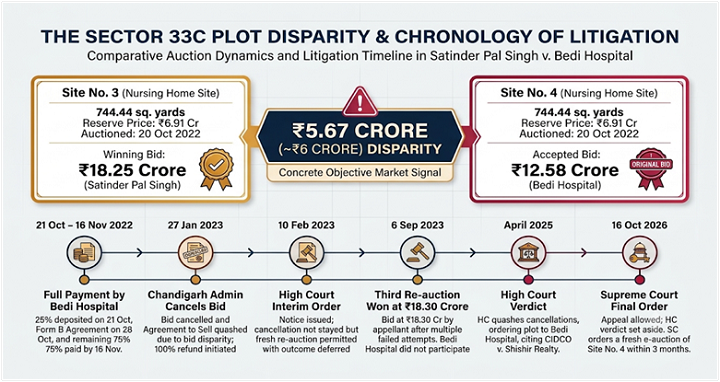
Were you the owner, you would wonder what had gone wrong. When the owner is the State, and the land belongs, in a real sense, to the public, that question becomes harder to set aside. The Chandigarh Administration raised it. It concluded that the lower bid did not reflect the market, cancelled the deal, refunded every rupee and returned the plot to auction. The highest bidder, Bedi Hospital, took the matter to court and won before the Punjab and Haryana High Court.
On 16 October 2026, the Supreme Court overturned that outcome. In Satinder Pal Singh v. Bedi Hospital the court ruled that a public authority may recall or revisit an auction of public property in order to obtain a better price, as long as a binding contract has not yet come into being.
The case raises a particular question, and that is how much weight should the State's duty to secure the best price carry against a bidder's expectation that the highest bid, once accepted and paid for, is final?
How the dispute started
On 31 August 2022, the Chandigarh Administration issued an e-auction notice for fifteen sites on a freehold basis: twelve residential, one commercial and two nursing home sites. A corrigendum dated 4 September 2022 set the reserve price of each nursing home site at ₹6.91 crore. The appeals concerned only those two, Site No. 3 and Site No. 4 in Sector 33C.
Both Bedi Hospital and the appellant, Satinder Pal Singh and others, placed bids for both sites. When the auction closed on 20 October 2022, the appellant won Site No. 3 at ₹18.25 crore. Bedi Hospital won Site No. 4 at ₹12.58 crore. Both bids were accepted and approved.
What happened next with Site No. 4 appeared to be a deal progressing smoothly toward completion:
- 21 October 2022: Bedi Hospital deposited 25% of its bid.
- 28 October 2022: the Estate Officer issued an Agreement to Sell in its favour.
- 16 November 2022: it paid the remaining 75%, well within the 90 days allowed.
By this point, the hospital had paid the entire price. Just two steps were left: the allotment letter and the conveyance deed. Neither of them arrived. On 12 January 2023, Bedi Hospital sent a letter to the Administration, urging it to move things along faster.
By that time, however, the Administration had already started having doubts. The record reveals a reconsideration on 11 January 2023. The explanation lay in simple arithmetic. A matching plot next door, sold on the very same day, had brought in about ₹6 crore more.
On 27 January 2023, the Administration cancelled the bid contract "with immediate effect". According to the letter, the difference between two adjoining sites of equal size "does not reflect the market trend". Site No. 4 was to be re-auctioned, with the reserve price fixed at the winning bid for Site No. 3. The deposit was to be refunded by 31 January 2023, and Bedi Hospital was informed that it could participate in the new auction.
The letter relied on two documents. The first was clause I(i) of the general terms of the e-auction, which granted the Estate Officer an absolute right to accept or reject any offer, or to cancel the auction, without providing reasons. The second was clause 4 of the Agreement to Sell. It stated that if the seller failed to transfer the property, the 25% would be returned and the bidder could not claim damages. On 9 February 2023, the Administration also formally cancelled the Agreement to Sell.
The High Court, and an auction held mid-litigation
Bedi Hospital submitted a writ petition. Three days later, when the Administration cancelled the Agreement to Sell, the hospital amended its petition to challenge that letter as well.
The case was listed for admission in Feb 2023 as well. At this point, the High Court made an interim decision that would influence everything that followed. It issued notice, yet it neither stayed the cancellation nor dismissed the petition. It allowed the Administration to proceed with a fresh auction, provided that the outcome would not be finalised before the next date of hearing.
The re-auction did not proceed smoothly. Notices in April and July 2023 were unsuccessful, as the bids received were either deficient or failed to meet the technical requirements. A third notice inviting e-tenders was issued on 5 August 2023, with a reserve price of ₹18.25 crore. Three bidders qualified following a pre-bid technical session on 8 August. On 6 September 2023, the appellant emerged victorious with a bid of ₹18.30 crore.
Bedi Hospital did not participate. In a status report dated 20 November 2023, the Administration informed the High Court of the result. The appellant, now the winner of the second auction, applied to be joined as a party.
The High Court granted Bedi Hospital's request in April of 2025. Both cancellation letters were quashed. The Supreme Court's ruling in CIDCO v. Shishir Realty, which warns that a general claim of income loss cannot be used to withdraw from contracts and that the mere prospect of greater money for the State does not in and of itself serve the public interest, was a major component of its rationale.
Appeals were filed by the Chandigarh Administration as well as the appellant. The site's status quo was mandated by the Supreme Court in August of 2026.
AT WHAT POINT DOES AN ARRANGEMENT WITH THE STATE TURN INTO A CONTRACT?
The Supreme Court did not start with lofty principles and it started with the rules. Land sales in Chandigarh are regulated by the Chandigarh Estate Rules and Rule 5 sets out the auction process in the below manner:
- an earnest money deposit to qualify as a bidder;
- 25% of the bid price paid when the hammer falls;
- an Agreement to Sell in Form B;
- the remaining 75% within 90 days, otherwise the offer is treated as cancelled;
- upon full payment, an allotment letter and a conveyance deed in Form C within 30 days.
Two provisions were of greatest importance. Explanation I to Rule 5 permits the Estate Officer to withdraw any site put up for auction and to accept or reject the highest bid without stating reasons, and it makes his decision final. Clause VI(5) of the e-auction terms states essentially the same thing, almost word for word. Clause VI(1) further provides that if the Administration does not allot the property "for any reason or in public interest", it will refund the 25% and the bidder will have no right to claim damages.
The Court then posed the question on which the case truly hinged: when does the bargain become a binding contract? The answer it gave is the most significant legal holding in the judgment. In paragraph 19, the Court stated:
"An agreement enforceable in law alone is a contract. Such an enforceable agreement, in the present case, will come into existence only upon execution of the conveyance deed."
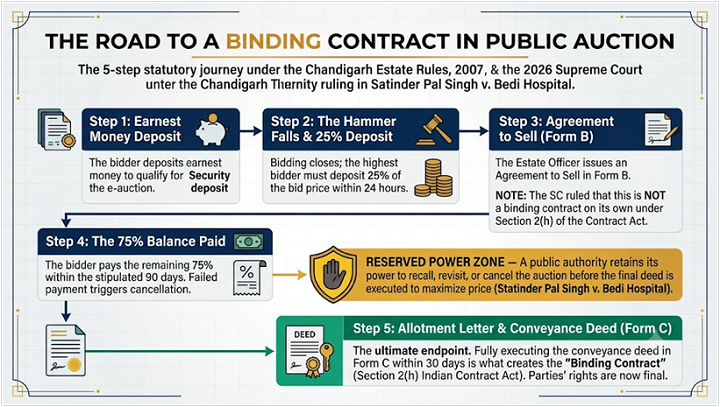
The Court went even further. It ruled that an Agreement to Sell under Rule 5(iv) is not, on its own, an enforceable contract within the meaning of Section 2(h) of the Contract Act. In its opinion, the conveyance deed is the endpoint of a chain, that is, promise, offer, acceptance, payment, and the Agreement to Sell. The parties' rights take shape only once that chain is complete, and from that point they are regulated by the deed.
The Court also provided a method for lower courts. In construing auction rules alongside tender conditions, judges should try to pinpoint the events through which the contract is concluded. Until those events occur, the authority keeps its reserved powers. Once they occur, it is bound.
When applied here, the conclusion came swiftly. No allotment letter had been issued, and no conveyance deed had been signed. The Administration was therefore still at liberty to invoke its power under Rule 5(vi), Explanation I, and clauses VI(1) and VI(5). As the Court put it, it was "entitled to exercise its power to cancel."
BEST PRICE AS A LEGITIMATE PUBLIC PURPOSE
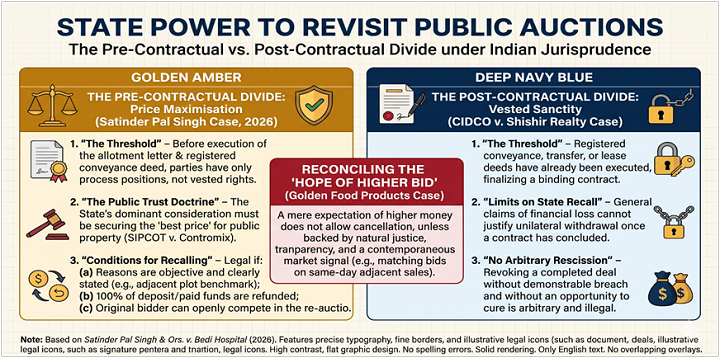
Possessing a contractual power to cancel is one matter. Exercising it fairly is another. The Court acknowledged that a public authority is never merely a private seller. Even prior to the existence of a contract, it is bound by a public law duty not to act arbitrarily and further that its conduct must show fairness in action and must serve a lawful purpose.
The question, therefore, was whether pursuing a better price amounts to a fair and public reason. The Court answered yes in the passage that has since been widely reported:
"When it comes to matters involving the sale or lease of public property, a public authority's decision to recall or revisit the auction process would be justified if that decision is meant to maximise the price for the sale or lease of public property. This is permissible provided that no enforceable contract has yet been entered into."
For support, it turned to SIPCOT v. Contromix, in which the Court had held that when selling public property, the dominant consideration is securing the best price. The bench further observed that, at the pre-contract stage, a substantially lower price can be a valid reason for not concluding the deal with a "so-called 'highest bidder'". The quotation marks around those final words are revealing. According to the Court, being the highest bidder is a position within a process, not a vested right.
WHY THE SHISHIR REALTY CASE PRECEDENT DID NOT HELP
The High Court had relied on CIDCO v. Shishir Realty. The Supreme Court found that case inapplicable. In that case, CIDCO had unilaterally cancelled lease deeds that had already been executed. It alleged breaches of the lease terms, but both the High Court and the Supreme Court found that no breaches existed. The lessee was given no opportunity to cure any defect. That amounted to arbitrary State action against a concluded contract.
Chandigarh's case differed on both counts. No contract had been concluded. Moreover, the cancellation came with a full refund and an open invitation to bid again.
WHY GOLDEN FOOD PRODUCTS DID NOT HELP EITHER
Bedi Hospital also relied on Golden Food Products India v. State of Uttar Pradesh. That decision holds that an auction has sanctity, that a valid bid above the reserve price may be discarded only for a valid reason, and that merely hoping for a higher bid is not such a reason.
The Court distinguished it on the facts. In Golden Food, the highest bidder only discovered that its allotment had been cancelled by examining the authority's internal notes. It was never informed of anything. That amounted to a failure of natural justice and transparency. In this case, the 27 January 2023 letter explained to Bedi Hospital precisely why its bid was being cancelled, the money was returned, and the hospital was invited to take part in the fresh auction.
The Court found that there was "no illegality or arbitrariness" in the Administration's decision and set aside the reasoning of the High Court.
THE STORY DOES NOT END HERE
At this stage, a reader might expect the appellant to walk away with Site No. 4. It had won the re-auction at ₹18.30 crore, paid the price, and now the cancellation that had cleared the way for that auction had been upheld. The Court took a different view. It began the next section of its judgment with a simple statement: the story does not end here.
The bench then turned its attention to the High Court's interim order of 10 February 2023. In its opinion, that order was where the problems began. At admission, the High Court had two straightforward options. It could have dismissed the petition, or it could have stayed the cancellation letters. Instead, it allowed a fresh auction to proceed while the challenge to the first one was still pending. According to the Court, that half-measure gave rise to a second round of litigation that continued for more than two years.
Even worse, when the High Court finally decided the petition, it did not address what its own interim order had brought about. It decided the writ on the merits as though the second auction had never taken place. It did not discuss the status report or the rights of the new winning bidder.
The Supreme Court affirmed that the second auction was "legal and valid". It had been conducted at the High Court's own instruction, and Bedi Hospital was free to participate. And the figures could not simply be ignored. The bench observed that six crores "is not a small amount" and that it could not close its eyes to the reality of price discovery.
AN OFFER TO MATCH
Then an unusual moment arose in the courtroom. The bench inquired of Mr. Patwalia whether Bedi Hospital would match the appellant's price. After conferring with his client, and with what the judgment openly describes as "some amount of hesitation", he stated that it would pay ₹18.30 crore.
Mr. Guru Krishna Kumar raised an objection. His client had paid the full consideration. It would be unjust, he contended, to permit Bedi Hospital to step in now by matching a price it had declined to bid in the open auction, particularly after taking its money back.
The Court did not choose a winner. Reflecting on what it termed the unfortunate situation created by the inconclusive interim arrangement, it held that the interests of justice and public purpose would be best served by a fresh e-auction of Site No. 4.
The final order
- The appeals were allowed, and the High Court's judgment dated 1 April 2025 was set aside.
- The Chandigarh Administration must conduct a fresh e-auction of Site No. 4, Sector 33C, under the Chandigarh Estate Rules, 2007.
- The entire process must begin and conclude within three months.
- No order as to costs.
QUESTIONS THAT THE JUDGMENT LEAVES UNANSWERED
The outcome can be defended, and the instinct behind it is reasonable. Public land should not be sold at an obvious discount when the market has just demonstrated, right next door and on the very same day, what that land is worth. Even so, an attentive reader will spot a few loose ends.
Is an Agreement to Sell truly not a contract? Any property lawyer will take note of the statement that an Agreement to Sell under Rule 5(iv) is not an enforceable contract under Section 2(h). Under ordinary civil law, an agreement to sell immovable property is most certainly an enforceable contract. It is the foundation of countless suits for specific performance. What it does not do is transfer title, which passes only through a registered conveyance. The more sound reading of the judgment is probably narrower: under this specific statutory scheme, with powers expressly reserved to the Estate Officer until allotment, the parties' obligations are not final until the conveyance deed. Read broadly, the sentence could create confusion far beyond Chandigarh.
HOW DOES THIS SQUARE WITH GOLDEN FOOD PRODUCTS CASE?
That decision, which the Court itself quoted, holds that the hope of a higher bid is not, by itself, a reason to reject the highest bid. The Court distinguished it on natural justice grounds. Yet the substantive tension persists. Chandigarh's reasoning was, in essence, that it expected more. The difference may lie in the evidence. Chandigarh did not merely hope; it had a concrete comparator in the ₹18.25 crore paid for an identical adjacent plot. Future benches will likely draw the line there, between a speculative expectation and an objective, contemporaneous market signal.
What about damages? Rule 5(iv) of the Estate Rules provides that if the Administration fails to transfer the property for reasons other than public order, security of the State or a change in public policy, it must return the 25% together with an equivalent amount as damages. By contrast, clause VI(1) of the tender and clause 4 of the Agreement to Sell provide that no damages are payable. Price maximisation is not one of the three reasons listed in the Rule. The judgment does not address whether Bedi Hospital could have claimed that equivalent sum, or which instrument prevails when the tender terms conflict with the statutory rule.
Is that fair to the appellant? The appellant followed the rules. It bid in an auction held on the High Court's direction, won it, and paid. Now it must compete again, against a rival who stayed out of that auction. The Court's answer is that the interim order made any outcome imperfect, and that a fresh, open auction is the least unfair option. That is a reasonable answer. It is not a costless one.
WHY THIS RULING MATTERS
For public authorities, the message offers reassurance, though it comes with conditions. You can withdraw from an auction to safeguard public funds, but only before the contract is finalized, only for a reason you can clearly state, and only if you deal with the bidder fairly. Chandigarh's approach is nearly a template for how to handle this. It should have a written justification, a solid market comparison, a swift and complete refund, and a clear path to re-auction.
For bidders, the takeaway is a sobering one. Being named the highest bidder, putting down 25%, signing an Agreement to Sell, and even paying the full amount may still not be sufficient. The contract is unstable until those final documents are received if the regulations permit a right to withdraw until allocation or transfer. It is important to remember that bidders should carefully review the tender requirements, ascertain the exact date of contract conclusion, and account for that risk in their bids.
For courts, the judgment carries a quieter but useful warning about interim orders. When a court allows a second auction to proceed while the first is still being challenged, it must later address the rights that the second auction creates. Overlooking them merely escalates the dispute to a higher level, which is exactly what occurred here for over two years.
This case also joins a long series of Supreme Court rulings that regard public property as a trust held on behalf of the people. The State is not a private seller free to be generous or careless with assets of its own. When it sells land, the public is the true owner, and the public deserves the best price that an open market will offer.
CONCLUSION
Satinder Pal Singh v. Bedi Hospital answers a practical question with a clear rule. Until the contract is concluded, which under the Chandigarh scheme means the conveyance deed, a public authority may revisit an auction to maximise the price of public property, as long as it acts fairly and for a demonstrable public purpose.
The ruling is strongest on its facts. Two identical plots, one road, one day, and a ₹6 crore difference made a compelling case for a second look. Its broader statements, especially on the status of an Agreement to Sell, may need careful handling in later cases. And its ending is a reminder that in public auctions, the litigation can sometimes cost more than the difference in price. For now, Site No. 4 goes back on the block, four years and four auction notices after it was first sold, with a three-month deadline to finally find its owner.
Join LAWyersClubIndia's network for daily News Updates, Judgment Summaries, Articles, Forum Threads, Online Law Courses, and MUCH MORE!!"

Tags :Others