
1. Indemnity Clause
Purpose
An indemnity clause protects one party against specified losses, liabilities, claims, damages,
costs, and expenses arising from defined events or breaches.
Drafting Checklist
✔ Clearly identify who indemnifies whom
✔ Specify what losses are covered
✔ Include third-party claims where necessary
✔ State whether legal costs are recoverable
✔ Mention notice requirements
✔ Clarify whether payment is due upon liability or actual loss
✔ Include survival after termination where appropriate
Remember
- Avoid using vague phrases like “all losses whatsoever.”
- Define the scope precisely.
- State whether indirect and consequential losses are covered.
- Consider monetary caps if commercially required.
2. Limitation of Liability Clause
Purpose
This clause limits the financial exposure of one or both parties in case of breach.
Drafting Checklist
✔ Specify the maximum liability
✔ Exclude consequential damages (if intended)
✔ Identify liabilities that cannot be excluded
✔ Clarify whether indemnity obligations fall within or outside the liability cap
✔ State exceptions for fraud, wilful misconduct, or gross negligence
Remember
- Liability caps should be commercially reasonable.
- Courts may refuse to enforce clauses that are unconscionable or contrary to public policy.
- Never assume every liability can legally be excluded.
3. Force Majeure Clause
Purpose
Allocates the risk of extraordinary events beyond the parties' control that prevent contractual
performance.
Drafting Checklist
✔ List force majeure events
✔ Include epidemics, government action, war, cyber incidents (where relevant)
✔ Specify notice period
✔ Mention mitigation obligations
✔ State consequences of prolonged force majeure
✔ Clarify suspension versus termination
Remember
- Indian law applies Section 56 ICA only in limited situations.
- A comprehensive force majeure clause gives greater contractual certainty.
4. Termination Clause
Purpose
Defines how and when the contractual relationship may end.
Drafting Checklist
✔ Material breach
✔ Cure period
✔ Insolvency
✔ Convenience termination
✔ Immediate termination events
✔ Post-termination obligations
✔ Return of confidential information
Remember
- Every termination event should have clear consequences.
- Specify obligations that survive termination.
5. Dispute Resolution & Governing Law Clause
Purpose
Determines how disputes will be resolved and which legal system governs the agreement.
Drafting Checklist
✔ Governing law
✔ Jurisdiction
✔ Arbitration or litigation
✔ Seat of arbitration
✔ Venue
✔ Number of arbitrators
✔ Language
✔ Institution (SIAC, MCIA, ICC etc.)
Remember
- Do not confuse the seat of arbitration with the venue.
- State governing law separately from jurisdiction.
- Ambiguity in dispute resolution clauses often results in unnecessary litigation.
Quick Drafting Checklist
Before finalising any contract, ask yourself:
☐ Are all defined terms used consistently?
☐ Is every obligation clearly allocated?
☐ Have liability limits been expressly stated?
☐ Does the indemnity clause specify its scope?
☐ Does the force majeure clause define triggering events?
☐ Are termination rights clearly drafted?
☐ Is the governing law expressly mentioned?
☐ Is the dispute resolution mechanism complete?
☐ Have all cross-references been checked?
☐ Would a third party understand every clause without further explanation?
|
|
Sr.No. |
Mistake |
Why it matters and how to fix it |
|
1 |
Vague or undefined key terms |
Price, quantity, delivery dates, and standards like “reasonable efforts” left undefined invite conflicting readings. Fix: define every material term and give objective yardsticks wherever possible. |
|
2 |
Outdated cross-references |
After revision rounds, references to “Clause 8.2” may no longer point to the right provision. Fix: re-check every cross-reference after each redraft. |
|
3 |
Omitting essential clauses |
Missing dispute resolution, termination, or governing-law provisions can leave a contract incomplete or unenforceable in the way the parties intended. Fix: work from a clause checklist for every draft. |
|
4 |
No express governing law |
Silence invites conflicting law arguments and forum disputes the moment something goes wrong. Fix: always state governing law and the forum for disputes explicitly. |
|
5 |
Copy-paste drafting without tailoring |
Reusing precedent language without adapting it to the actual deal is a leading cause of clauses that don't fit the transaction. Fix: use the deal memo, not the precedent, as the drafting checklist. |
|
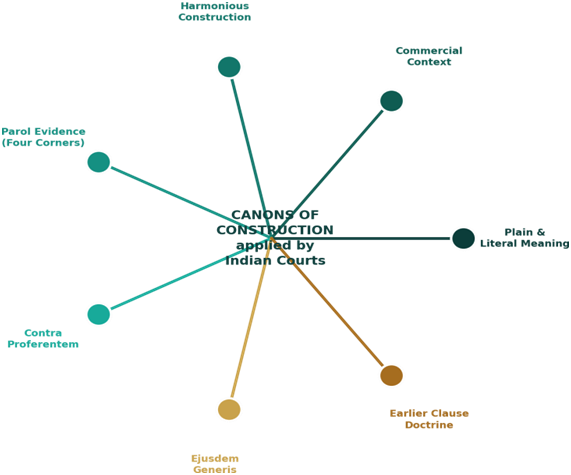
1. Plain Meaning, Read in Commercial Context
Courts start with the plain and natural meaning of the words used, but following the approach associated with Investors Compensation Scheme Ltd. v. West Bromwich Building Society and echoed in Indian decisions such as Konark Power Projects they read that meaning against the "matrix of fact" reasonably available to both parties at the time of contracting, not in a vacuum.
2. Harmonious Construction
Wherever possible, courts try to give effect to every clause of a document, reading provisions together rather than treating any one clause as surplus or redundant a principle restated in Bharat Sher Singh Kalsia.
3. Parol Evidence Rule (Four Corners Doctrine)
Once a contract is reduced to writing, courts are generally confined to interpreting it within its four corners; extrinsic evidence cannot ordinarily be used to contradict or vary the express terms chosen the principle applied in Mangala Waman Karandikar v. Prakash Damodar Ranade.
4. Contra Proferentem
Genuine ambiguity in a clause is generally construed against the party that drafted it or that seeks to rely on it a principle with particular force in standard-form and insurance contracts, where one party had no real opportunity to negotiate the wording.
5. Ejusdem Generis & Noscitur a Sociis
General words that follow a list of specific items are read as limited to the same class of things as those specific items (ejusdem generis); more broadly, a word's meaning is coloured by the words surrounding it (noscitur a sociis). A poorly drafted catch-all ("and other similar matters") is read far more narrowly than most drafters intend.
6. The Earlier Clause Doctrine
Where two clauses in the same document are genuinely irreconcilable, the earlier of the two prevails over the later the default rule restated in Bharat Sher Singh Kalsia v. State of Bihar. An explicit order-of-precedence clause avoids the need for a court to ever apply this default.
7. Courts Will Not Rewrite the Bargain
Indian courts consistently decline to create rights or obligations that the contractual text does not itself grant, and will not relieve a party of a bad bargain freely entered into reinforcing that the words chosen on the page, not the parties' unexpressed intentions, are what ultimately governs.
Join LAWyersClubIndia's network for daily News Updates, Judgment Summaries, Articles, Forum Threads, Online Law Courses, and MUCH MORE!!"


Tags :others