
I. INTRODUCTION
India’s statutory framework for protecting national symbols has, since Independence, developed unevenly. While the National Flag and the Constitution have long enjoyed express penal protection, and the National Anthem was brought within that protection by Section 3 of the Prevention of Insults to National Honour Act, 1971 (‘the 1971 Act’ or ‘the parent Act’), the National Song , Vande Mataram , occupied an ambiguous constitutional and statutory space for over five decades. It carried immense symbolic and historical weight as a rallying cry of the freedom movement, yet it possessed no express constitutional recognition and no penal insulation comparable to that enjoyed by the Anthem.
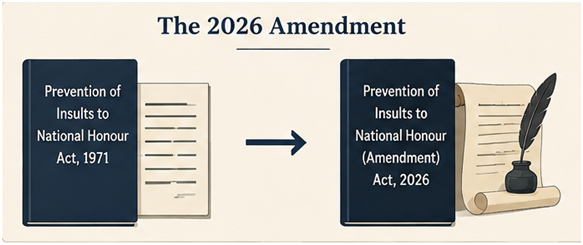
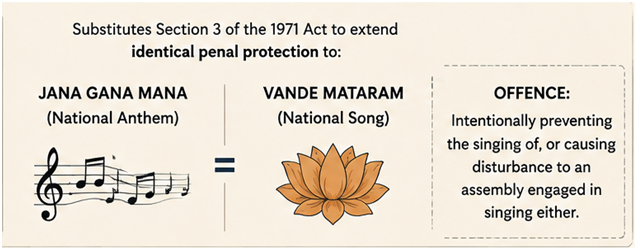
The Prevention of Insults to National Honour (Amendment) Act, 2026 closes that gap. It does so not by creating a freestanding new offence, but by textually substituting Section 3 of the 1971 Act so that the existing offence of intentionally preventing the singing of, or causing disturbance to an assembly engaged in singing, the National Anthem now applies with equal force to the National Song.
Master The Constitutional Expert Combo by Dr. Ravishankar Mor and Kush Kalra. Enrol Now!
This article examines the amendment under five heads: (II) the constitutional and historical position of Vande Mataram; (III) the parent statutory framework of 1971; (IV) the legislative journey of the 2026 Amendment Bill through Parliament; (V) the text and legal effect of the amended Section 3; and (VI) the surrounding litigation and constitutional concerns the amendment is likely to generate, before offering concluding observations.
II. HISTORICAL AND CONSTITUTIONAL BACKGROUND OF VANDE MATARAM
A. Composition and Adoption
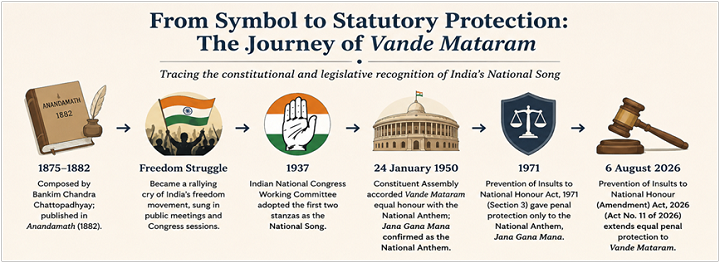
Vande Mataram was composed by Bankim Chandra Chattopadhyay in Sanskritised Bengali and first published in the literary journal Bangadarshan on 7 November 1875, later forming part of his 1882 novel Anandamath. It was set to music by Rabindranath Tagore and, over the following decades, became one of the most potent anthems of the Indian freedom struggle, sung at public meetings and Congress sessions and invoked during the Swadeshi movement.
The Indian National Congress’s Working Committee accorded the first two stanzas of the song the status of the National Song in 1937 , a decision driven partly by the fact that later stanzas contain overt invocations of the Hindu goddesses Durga, Lakshmi and Saraswati, which some sections, particularly within the Muslim community, viewed as being in tension with the song’s use as a symbol of a religiously plural nation.
B. The Constituent Assembly’s Resolution of 24 January 1950
The status of Vande Mataram alongside Jana Gana Mana was addressed on the final day of the Constituent Assembly’s sittings, 24 January 1950, when Dr. Rajendra Prasad, presiding, made a statement according the song equal honour with the National Anthem, while confirming Jana Gana Mana as the National Anthem in its formal sense. This 1950 statement, though carrying immense moral and historical authority, was not itself an amendment to the Constitution and did not, by itself, create any justiciable legal status or statutory protection for the National Song.
C. Constitutional Silence
Unlike the National Flag (addressed through Article 51A(a) as a Fundamental Duty and through the Flag Code of India) and the National Anthem (similarly protected under Article 51A(a) and, since 1971, under penal law), the Constitution of India does not anywhere expressly designate or define a ‘National Song’. The 2026 Amendment therefore represents the first instance of Parliament placing Vande Mataram within an express statutory , as opposed to purely conventional or honorific , framework of protection, even though it stops short of a constitutional amendment.
III. THE PREVENTION OF INSULTS TO NATIONAL HONOUR ACT, 1971 , STATUTORY ARCHITECTURE
The 1971 Act (Act No. 69 of 1971) was enacted to penalise insults to the National Flag, the Constitution of India, and the National Anthem. Its principal provisions, prior to the 2026 Amendment, were structured as follows:
- Section 2 , penalises showing disrespect to the Indian National Flag or the Constitution of India (or any part thereof), by burning, mutilating, defacing, defiling, disfiguring, destroying, trampling upon, or otherwise bringing into contempt, whether by words (spoken or written) or by acts, with imprisonment extending to three years, or fine, or both.
- Section 3 (prior to substitution) , penalised intentionally preventing the singing of the National Anthem, Jana Gana Mana, or causing disturbance to any assembly engaged in such singing, with the same punishment structure as Section 2.
- Section 4 , prescribes an enhanced minimum sentence of not less than one year’s imprisonment for a second or subsequent conviction under Section 2 or Section 3.
- Section 5 (as later inserted) , deals with prevention of insults to the Flag Code and improper use of the National Flag in relation to other national symbols.
The Act was substantively amended in 2003 (through changes to the Flag Code of India, made pursuant to the Supreme Court’s decision in Union of India v. Naveen Jindal, (2004) 2 SCC 510, which recognised a qualified fundamental right to fly the National Flag) and again by the Prevention of Insults to National Honour (Amendment) Act, 2005, which enlarged the range of prohibited misuses of the Flag. Until 2026, however, Section 3 had never been touched: its protective scope remained confined to the National Anthem alone.
IV. LEGISLATIVE JOURNEY OF THE 2026 AMENDMENT
A. Introduction and Passage
The Prevention of Insults to National Honour (Amendment) Bill, 2026 was introduced in the Rajya Sabha on 24 July 2026. It was taken up for consideration and passed by the Rajya Sabha on Wednesday, 29 July 2026, following a discussion in which the Minister of State for Home Affairs, Nityanand Rai, moved and defended the Bill. It was passed by the Lok Sabha the following day, Thursday, 30 July 2026, by voice vote, after a brief but charged debate marked by opposition protests. The Bill received the assent of the President of India on 6 August 2026 and was published in the Gazette of India (Extraordinary), Part II, Section 1, on the same date as Act No. 11 of 2026.
B. Parliamentary Debate
The government’s stated rationale, articulated by Minister Nityanand Rai, was that the amendment reflected a ‘collective commitment to India’s national consciousness, cultural heritage, and the ideals of the freedom struggle’, and was not directed against any particular state, language, or political ideology. The government also invoked the historical anchor of Dr. Rajendra Prasad’s 24 January 1950 statement to Vande Mataram’s equal status, and the coincidence of the amendment with the song’s 150th anniversary.
The Bill nonetheless drew sharp opposition, principally from the DMK. In the Lok Sabha, MP Kanimozhi Karunanidhi argued that Parliament’s founding generation had deliberately confined official recognition to the first two stanzas of the song, and that reopening this settled compromise risked deepening social divisions. She contended that the legislation disregarded the cultural and linguistic identity of states such as Tamil Nadu, which maintain their own state songs, and objected to the manner and timing of the Bill’s passage amid unrelated protests in the House concerning a Ram Mandir donation controversy and police action against student protesters. The Bharatiya Janata Party, in turn, characterised the Opposition’s conduct as an implicit admission that it could not openly oppose the Bill, noting that no Congress member rose to speak against it during the Rajya Sabha debate.
C. Timeline of Key Events
|
7 November 1875 |
Vande Mataram first published in Bangadarshan (Bankim Chandra Chattopadhyay). |
|
1937 |
First two stanzas adopted as the National Song by the Congress Working Committee. |
|
23 December 1971 |
Prevention of Insults to National Honour Act, 1971 enacted (Act No. 69 of 1971). |
|
28 January 2026 |
MHA circular/protocol prescribing rendition of all six stanzas of Vande Mataram at official functions, effective 6 February 2026, issued to mark the song’s 150th anniversary. |
|
25 March 2026 |
Supreme Court dismisses writ petition (Mohammed Sayeed Noori v. Union of India) challenging the MHA circular as premature; holds the circular carries no penal consequence. |
|
9 April 2026 |
Karnataka High Court declines to entertain a PIL against the same MHA advisory, similarly noting its non-mandatory, advisory character. |
|
24 July 2026 |
Prevention of Insults to National Honour (Amendment) Bill, 2026 introduced in Rajya Sabha. |
|
29 July 2026 |
Bill passed by the Rajya Sabha. |
|
30 July 2026 |
Bill passed by the Lok Sabha by voice vote. |
|
6 August 2026 |
President’s assent; publication in the Gazette of India as Act No. 11 of 2026. |
V. TEXT AND LEGAL EFFECT OF THE AMENDED SECTION 3
A. The Amended Text
"3. Preventing or disturbing singing of National Anthem or National Song. , Whoever, intentionally , (a) prevents the singing of the National Anthem or the National Song; or (b) causes disturbance to any assembly engaged in such singing, shall be punishable with imprisonment for a term which may extend to three years, or with fine, or with both."
This is a substitution, not an insertion , the pre-existing Section 3 has been entirely replaced. Structurally, the amended provision retains the twin ingredients of the original offence , (i) intentional prevention of singing, and (ii) intentional causing of disturbance to an assembly so engaged , and simply extends both ingredients from the National Anthem alone to ‘the National Anthem or the National Song’. The prescribed punishment , imprisonment extendable to three years, or fine, or both , remains unchanged. Because Section 4 of the parent Act (enhanced minimum sentence of one year for repeat offenders) refers generically to convictions ‘under section 2 or section 3’, it automatically extends to repeat offences involving the National Song without any need for separate amendment.
B. Elements of the Offence
- Intention , the offence, on the plain language of Section 3, requires that the accused act ‘intentionally’; negligent, inadvertent, or merely disrespectful conduct falling short of intentional prevention or disturbance would not, on the text, attract the provision.
- Prevention of singing , the first limb criminalises intentionally preventing the singing of the National Anthem or National Song, envisaging, for instance, physically stopping or obstructing a scheduled rendition.
- Disturbance to an assembly , the second limb criminalises causing disturbance to ‘any assembly engaged in such singing’, which could, depending on judicial interpretation, extend to disruptive protest, heckling, or interference during an ongoing rendition.
- Punishment , imprisonment up to three years, or fine, or both, for a first conviction; a minimum of one year’s imprisonment for a second or subsequent conviction, by operation of Section 4.
C. Interpretive Uncertainties
Two textual features of the amendment merit particular scrutiny. First, the Act does not define ‘the National Song’ or specify which version , the two-stanza version historically treated as authoritative, or the six-stanza version promoted by the MHA’s 2026 protocol , attracts protection. Since the offence is triggered by intentional prevention of, or disturbance to, ‘the singing of ... the National Song’ without further qualification, courts may eventually be called upon to determine whether refusal to sing, or objection to the inclusion of, the later stanzas (which invoke Hindu deities) could itself be characterised as causing ‘disturbance’ within the meaning of the section , a question with obvious implications for religious minorities and non-participants. Second, the amendment does not itself compel anyone to sing the National Song; it penalises those who intentionally prevent others from singing or disturb an assembly doing so. The distinction between non-participation (which remains unpenalised) and active disruption (which is now penalised) is likely to be the central interpretive battleground in future prosecutions.
VI. RELATED LITIGATION AND CONSTITUTIONAL CONCERNS
A. The Supreme Court’s Treatment of the MHA Protocol
The controversy predates the 2026 Amendment. Acting on the occasion of Vande Mataram’s 150th anniversary, the Ministry of Home Affairs issued a circular/protocol dated 28 January 2026, titled broadly as an ‘Orders Relating to the National Song of India’, prescribing that when the National Song and National Anthem are performed together at official events, all six stanzas of Vande Mataram (as opposed to the conventionally sung first two) should be rendered, with a total prescribed duration and specific sequencing. This attracted objection from bodies including the All India Muslim Personal Law Board and the Jamiat Ulema-e-Hind, who argued that stanzas invoking Hindu deities conflicted with the song’s use as a unifying national symbol in a plural, secular polity.
A writ petition, Mohammed Sayeed Noori v. Union of India, W.P.(C) No. 341/2026, was filed before the Supreme Court by the founder of the Raza Academy, represented by Senior Advocate Sanjay Hegde, contending that the advisory could indirectly compel participation and expose non-participants to social discrimination, notwithstanding the absence of an express penal sanction. A Bench of the then Chief Justice of India, Surya Kant, and Justices Joymalya Bagchi and Vipul M. Pancholi, dismissed the petition on 25 March 2026 as premature, observing that the circular used the permissive word ‘may’, prescribed no penal or adverse consequence for non-compliance, and that the petitioner could approach the Court afresh if and when any concrete penal or discriminatory consequence materialised.
It is against this specific judicial backdrop , a circular held to carry ‘no penal consequence’ , that the 2026 Amendment assumes particular significance: while the underlying MHA protocol on the number of stanzas remains a non-binding administrative advisory, the Amendment Act now supplies, for the first time, an actual criminal sanction (up to three years’ imprisonment) applicable to intentional prevention of, or disturbance to, the singing of the National Song, independent of and without amending the MHA protocol itself.
B. High Court Proceedings
Parallel challenges were mounted before High Courts. The Karnataka High Court, in a PIL filed by advocate Somashekhar Rajavamshi, was asked to strike down the MHA’s six-stanza protocol as violative of the secular character of state-funded education. A Division Bench of Chief Justice Vibhu Bakhru and Justice C.M. Poonacha declined to entertain the petition on 9 April 2026, holding that the National Song is not governed by any statutory framework, that the advisory’s use of the word ‘may’ rendered it non-mandatory, and that a materially similar challenge had already been rejected by the Supreme Court.
A comparable challenge remains pending before the Calcutta High Court, where a Division Bench of Acting Chief Justice Tapabrata Chakraborty and Justice Partha Sarathi Sen has been hearing public interest litigation , including a petition argued by Senior Advocate Bikash Ranjan Bhattacharya , against a state-level circular directing the rendition of all six stanzas of Vande Mataram in madrasas. During the course of the hearing, the Bench orally remarked that ‘heavens will not fall’ if the complete song were sung in madrasas, drawing an analogy with prayer practices in Christian-run schools, while also questioning whether any coercive or punitive action had in fact been taken against non-compliant institutions. The matter, as of the date of this article, continues to be heard, and no final order appears to have been reported.
C. Constitutional Dimensions Likely to Arise
- Freedom of religion and conscience (Articles 25–28) , objections have centred on stanzas of Vande Mataram that invoke Hindu deities, with concerns that penalising ‘disturbance’ to the singing of such stanzas in religiously diverse or minority-run institutions could operate in tension with religious freedom, particularly for students and staff of minority educational institutions.
- Compelled speech and the right to silence , the constitutional touchstone here remains Bijoe Emmanuel v. State of Kerala, (1986) 3 SCC 615, in which the Supreme Court held that expelling Jehovah’s Witness students for silently standing, but not singing, the National Anthem violated their fundamental rights under Article 19(1)(a) and Article 25, since there was no legal compulsion to sing the Anthem, only to show respect. Because the amended Section 3 penalises active prevention or disturbance rather than mere non-singing, the Bijoe Emmanuel principle , that respectful non-participation is constitutionally protected , is likely to be invoked to argue that the amendment does not, and constitutionally could not, criminalise silent non-participation in the National Song.
- Federalism and linguistic identity , the Opposition’s objection, particularly from Tamil Nadu-based parties, framed the amendment as insensitive to states with their own historically significant compositions and state songs, raising (as a political rather than strictly legal matter) questions of cooperative federalism and cultural pluralism.
- Vagueness of ‘disturbance’ , the absence of a statutory definition of ‘disturbance’ leaves open how courts will treat conduct such as peaceful protest, sitting down, or vocal objection during a rendition, as opposed to physical obstruction , a distinction with direct bearing on the offence’s compatibility with Article 19(1)(a).
VII. LAWYER’S INSIGHT - Pratham Kindra
On a plain reading, this amendment is narrower than the political noise around it suggests. Section 3, both before and after the amendment, criminalises intentional prevention of singing or disturbance to an assembly engaged in singing it does not, and constitutionally could not, criminalise a person’s choice to stay silent. That distinction traces directly back to Bijoe Emmanuel, where the Supreme Court protected students who stood respectfully but did not sing the National Anthem. Nothing in the 2026 Amendment disturbs that position; Parliament has extended the existing offence to a second symbol, not created a new duty to sing.
Where this will actually get tested is at the margins, a student sitting through only two stanzas, a protest during a six-stanza rendition, a heckler at a public function. Whether that conduct is ‘disturbance’ within the meaning of Section 3 or protected non-participation/protest under Article 19(1)(a) is precisely the kind of question the text doesn’t answer and a magistrate’s court will have to. Practitioners advising clients schools, in particular should therefore treat the MHA’s six-stanza protocol and the penal provision as two separate things: the protocol remains a non-binding advisory, while the penal consequence attaches only to active obstruction, not to a student or teacher simply not singing along. Conflating the two, as some of the public debate has, overstates what the law actually requires.
VIII. CONCLUDING OBSERVATIONS
The Prevention of Insults to National Honour (Amendment) Act, 2026 closes a five-decade-old asymmetry in India’s statutory protection of national symbols, placing Vande Mataram on textually equal footing with Jana Gana Mana for the narrow purpose of Section 3. The amendment is legislatively modest in form , a single substituted section, an unchanged punishment structure , but symbolically and politically significant, arriving at the confluence of the National Song’s 150th anniversary, a contested MHA protocol on the number of stanzas to be sung, and a series of unsuccessful constitutional challenges before the Supreme Court and the Karnataka High Court to that protocol.
Two propositions can be stated with reasonable confidence. First, the amendment does not, on its text, compel any person to sing Vande Mataram; it penalises intentional prevention or disturbance of others who choose to do so, and the constitutional protection recognised in Bijoe Emmanuel for respectful non-participation should, in principle, remain undisturbed. Second, the amendment leaves unresolved , and does not purport to resolve , the anterior and more contentious question of which version of the National Song (two stanzas or six) attracts protection, a question that remains governed by the non-statutory, advisory MHA protocol rather than by the Amendment Act itself. Litigation before the Calcutta High Court and potential future prosecutions under the amended Section 3 are likely to be the principal vehicles through which courts eventually clarify the scope of ‘disturbance’ and its interface with the fundamental rights to conscience, religion, and expression.
Join LAWyersClubIndia's network for daily News Updates, Judgment Summaries, Articles, Forum Threads, Online Law Courses, and MUCH MORE!!"


Tags :others