


A collar grabbed in a Delhi court toilet in 2005 has just told India's lawyers, in 2026, exactly how far their duty of decency extends , and to whom.
Every law student is taught that an advocate owes a duty to the court and a duty to the client. Far fewer are taught, in as many words, that an advocate owes a duty to the person on the other side of the case , including the opposing litigant they may never exchange a single pleasant word with. The Supreme Court has just spelled that out, in a case that took twenty:-one years to reach a final word.
1. What Actually Happened
The story begins in a Labour Court at Karkardooma, Shahdara, back in 2005. Advocate Sudhendu Prakash Gautam was appearing for a company in a dispute against S.L. Chaudhary. When Chaudhary's application was dismissed, things allegedly turned physical , inside the court premises, in the court's toilet. Chaudhary's account, later recorded in Bar Council proceedings, was that Gautam grabbed him by the collar, assaulted him, hurled abuse, threatened to kill him, and pressured him to withdraw a separate complaint he had filed.
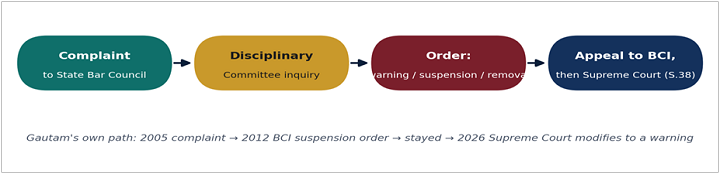
Chaudhary did what any litigant in his position would do: he went to the police, and he also filed a professional misconduct complaint with the Bar Council of Delhi. That complaint bounced around the system for years. It was initially dismissed on a technical ground , Gautam was never actually Chaudhary's own lawyer, so how could this be “misconduct” against him? On review, notice finally went out to Gautam, and in 2012 the Bar Council of India's Disciplinary Committee suspended him from practice for one year.
Gautam appealed to the Supreme Court under Section 38 of the Advocates Act, 1961. The suspension was stayed at the interim stage , and simply sat there, unresolved, for over a decade, until a Bench of Justices Prashant Kumar Mishra and Shree Chandrashekhar finally took it up and disposed of it this year, noting that nearly two decades had already passed since the incident.
2. The Arguments Before the Court
|
Side |
Core Argument |
|
Advocate Gautam (Appellant) |
He was never Chaudhary's advocate , he was opposing counsel in an unrelated matter. Professional misconduct under the Advocates Act, he argued, presupposes some advocate–client relationship or at least a nexus to the conduct of a case; a personal altercation outside that relationship could not be dressed up as “misconduct” attracting Bar Council jurisdiction. He also pointed to an alleged procedural lapse in the disciplinary hearing, and to the fact that the criminal allegations had already gone to the police separately. |
|
Bar Council of India / Chaudhary (Respondent) |
Conduct inside court premises is not immune from disciplinary scrutiny merely because the advocate and the complainant were not formally client and counsel. An advocate is an officer of the court at all times inside the court building, and indecent, threatening, or violent behaviour there strikes at the dignity of the institution itself , not just at the individual on the receiving end. |
What the Court Held
The Bench agreed with neither side entirely. It rejected the argument that the absence of an advocate–client relationship placed Gautam's conduct outside the Bar Council's reach. At the same time, it drew a careful line: the alleged assault and threats were criminal matters for the police to investigate, not something the Bar Council was equipped to adjudicate. What the Bar Council could and should examine, the Court said, was the indecent behaviour itself, as conduct unbecoming of an advocate inside court premises.
|
“Every lawyer has a duty to act decently in the Court premises not only with his own clients but, also towards the lawyers appearing from the other side and also to the parties against whom he is appearing.” Supreme Court of India, Sudhendu Prakash Gautam v. S.L. Chaudhary, 2026 INSC 791 |
Balancing the seriousness of the alleged conduct against the sheer passage of time , two decades, a stayed suspension that was never actually served, and a procedural gap in the original hearing , the Court modified the BCI's order. The one:-year suspension was set aside. In its place, Gautam received a formal warning to always conduct himself properly in court premises, towards opposing counsel, his own clients, and the opposing party alike.
|
WHY THIS MATTERS BEYOND ONE CASE The ruling doesn't create a new rule so much as it makes an old, half:-visible one explicit and enforceable. It confirms that “misconduct” under the Advocates Act is not confined to how a lawyer treats their own client or argues before a judge , it extends to how they behave toward everyone sharing the court's physical space, including the person on the other side of the very case. |
3. Where Do These Ethics Actually Come From?
India doesn't leave “how a lawyer should behave” to individual conscience alone. It is written down, layered, and statutory.
The Legal Architecture
- The Advocates Act, 1961 , Section 49(1)(c) empowers the Bar Council of India to frame rules on standards of professional conduct and etiquette; Section 35 is the provision under which “professional or other misconduct” is examined by State Bar Councils; Section 38 allows appeals to the Supreme Court.
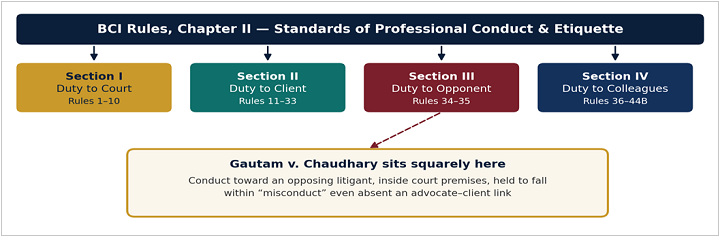
- Bar Council of India Rules, Part VI, Chapter II , the actual rulebook. It opens with a preamble reminding every advocate that they must, at all times, carry themselves as “an officer of the Court, a privileged member of the community.” It is then split into distinct duty:-heads.
How a Complaint Actually Travels
4. How Other Jurisdictions Handle the Same Question
India is far from alone in treating courtroom decorum as a distinct, enforceable duty , separate from how competently a lawyer argues the actual case.
|
Jurisdiction |
Governing Framework |
Core Idea |
|
United States |
ABA Model Rule 3.5 (Impartiality and Decorum of the Tribunal), adopted state:-by:-state |
Bars ex parte contact with judges or jurors, and separately requires lawyers to avoid abusive, intimidating, or disruptive conduct toward anyone in the courtroom , opposing counsel, witnesses, and litigants included. Violations can draw reprimands, suspension, or disbarment. |
|
England & Wales |
Bar Standards Board Handbook , Core Duties 1 to 10 |
Core Duty 1 makes the duty to the court paramount, ahead even of the duty to the client (Core Duty 2), whenever the two conflict. Core Duty 5 separately bars conduct, in or out of court, that would damage public trust in the profession. |
|
India |
Advocates Act, 1961 + BCI Rules, Chapter II |
Duties are split into four discrete heads , court, client, opponent, colleagues , making the duty to the opponent a freestanding, independently enforceable category, exactly what the Supreme Court leaned on in Gautam. |
The common thread across all three systems is a quiet but firm idea: an advocate's zeal for their client is never a licence for how they treat everyone else in the room. As one American disciplinary rule puts it, dignity and decorum are ingredients of the proper administration of justice itself , not an optional courtesy layered on top of it.
5. Lawyer's Insight – Pratham Kindra
PRACTITIONER'S TAKE
Talking to lawyers about this ruling, a recurring theme comes up: for most practitioners, the surprising part of Gautam v. Chaudhary isn't the outcome, but how long it took to say something that litigation lawyers already treat as obvious in daily practice. Court corridors and waiting halls are shared, cramped, adversarial spaces , and a lawyer's professional identity as an “officer of the court” doesn't switch off the moment they step outside the courtroom door and run into the other side. The view from the Bar seems to be that this ruling won't change how most lawyers already behave, but it closes a real gap: without it, an advocate's bad conduct toward someone who was never technically their “opponent of record” in a formal sense could have escaped Bar Council scrutiny altogether on a technicality. Practitioners also flag the twenty:-one:-year timeline as its own quiet indictment , a reminder that even well:-settled principles of professional ethics can take a generation to be authoritatively confirmed by the Supreme Court, by which time the deterrent value of the original sanction has largely evaporated.
6. The Bigger Picture
Strip away the specifics and Gautam v. Chaudhary is really about where the boundaries of professional identity sit. An advocate's robe doesn't come with an on/off switch keyed to who they're representing that day. The Bar Council's disciplinary jurisdiction, the Court has now confirmed, follows the advocate through the court premises , corridors, waiting rooms, and yes, even the toilets , and attaches to how they treat everyone they encounter there, not just the client whose brief they're carrying.
Join LAWyersClubIndia's network for daily News Updates, Judgment Summaries, Articles, Forum Threads, Online Law Courses, and MUCH MORE!!"


Tags :Others


