
|
A closure report is the police's opinion, not a judicial verdict. In Akhaya Kumar Rout v. State of Odisha (Vigilance), the Orissa High Court held that a Magistrate or Special Judge may direct further investigation even when neither the investigating agency nor the complainant has asked for it. The ruling is important not only for Section 173(8) CrPC, but also for the court's duty to test an incomplete investigation, the evidentiary role of recovery in bribery cases, and the new safeguards in Section 193(9) of the BNSS. |
Key takeaways
|
1. A police closure report does not bind the Magistrate. The court may accept it, reject it and take cognizance, or direct further investigation. |
|
2. The absence of a request from the police or complainant does not prevent the court from ordering further investigation where the record reveals material gaps. |
|
3. Further investigation supplements the earlier investigation. It is not the same as a fresh or de novo investigation that wipes the slate clean. |
|
4. In a bribery case, non-recovery of the tainted currency is relevant but not automatically fatal. Demand and acceptance remain the central ingredients and may be proved through admissible circumstantial evidence. |
|
5. Under Section 193(9) BNSS, further investigation during trial requires the trial court's permission and ordinarily must be completed within ninety days, subject to a court-granted extension. |
The question behind the headline.
The term "last report" tends to be a false impression. It appears to a non-expert that the criminal investigation is finished. Why? In criminal procedure, the investigating officer's conclusion is what is meant by a final or closure report. The case is presented to a judge, who must make an independent decision on the outcome.' Although the police are investigating, the court is not obligated to give its verdict to the cops.
The difference is at the heart of both Akhaya Kumar Rout and Another v. The Orissa High Court made a ruling on the case of Gujarat (Vigilance) on 22 February May 2026. It asked whether a Special Judge had the power to order further inquiry under Section 173(8) of the Codes of Criminal Procedure, 1973 (the latter having not requested such action from either the Vigilance Department or the complainant). The High Court answered yes. The order was not quashed and the investigating agency was instructed to submit its final version within eight weeks.
While the ruling may be a simple one-liner, its significance lies in the question it addresses within the institution. If an investigation has only focused on one piece of evidence and failed to provide any other information, is it appropriate for the court to pass judgment on the closure? According to the Orissa High Court, judicial scrutiny doesn't become ineffective when the parties have silenced each other.
How did the vigilance case go wrong?
The demand for Rs 4 lakh by a serving Tahasildar led to the prosecution case. The complaint stated that the initial payment would be Rs 50,000. A trap was arranged, and the complainant purportedly transferred the corrupted money to a private Amin who followed the Tahasildar's orders. The results of the Amin's hand-wash test were declared to be positive. The notes were not retrieved because they were said to have been given to someone else before the trap team could access them.
The investigating officer's Final Report No. 40. December 2016, primarily depending on the lack of confirmation from an overheard witness and the failure to recover the notes that were stained. The case was complex. On 11. December 2017 saw the Special Judge (Vigilance), Bhubaneswar, rejecting the report. The investigation was deemed too focused on recovery by the judge, who instructed for further investigation to be conducted under Section 173(8) CrPC.
The accused objected to that instruction under Section 482 CrPC and Section 528 BNSS. According to them, the order was impermissible unless there was a request from the investigating agency or complainant, and the missing currency caused the prosecution case to be destroyed, while the investigation had become too laborious. According to the Vigilance Department's statement, additional evidence surfaced in January 2026 regarding their disappearance, and they concluded the inquiry during the proceedings. It was not decided by the High Court whether that material was ultimately reliable.". It was determined that questions of credibility, admissibility, constructive acceptance, and proof beyond reasonable doubt were relevant in a trial.
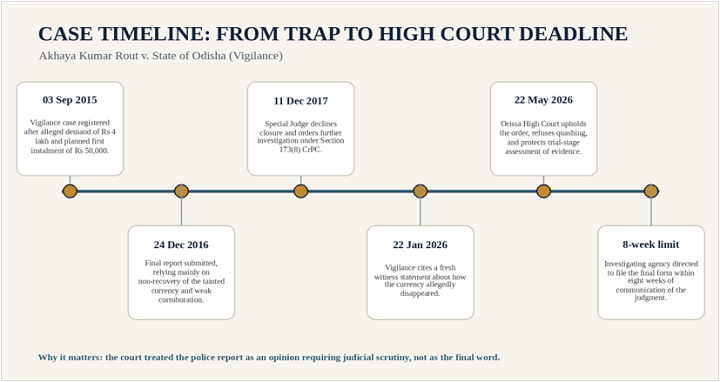
Infographic 1: The eleven-year procedural timeline and the High Court's eight-week completion direction.
THE CORE ARGUMENT
Even without a formal application, the High Court recognized the power of the Special Judge to order additional inquiry. Both its logic and doctrinal validity were grounded in factual evidence. The report on closure regarded non-recovery as significant, but did not give enough weight to the alleged demand, receipt through the Amin, positive hand-wash result and the overall trap situation. The judiciary had the authority to investigate whether the investigation had addressed the relevant issues when reviewing a police report. This was an absolute right.
This strategy complies with the lengthy decree established in Bhagwant Singh vs Commissioner of Police. A police report's approval or rejection is not the sole outcome when presented to a Magistrate. The court has the option to approve and abandon proceedings, dispute the closure report, or take cognizance if the evidence suggests otherwise. Additionally. If the court wishes to accept the closure and end proceedings, informant must be given notice and an opportunity to hear.
The consequence is a system of shared accountability. Police have operational control over the investigation. It is not the court's responsibility to conduct the investigation or determine the outcome. Despite this, it is the court's obligation to ensure that the report is accepted without judicial application of mind. A further investigation is the procedural bridge that connects those two roles.
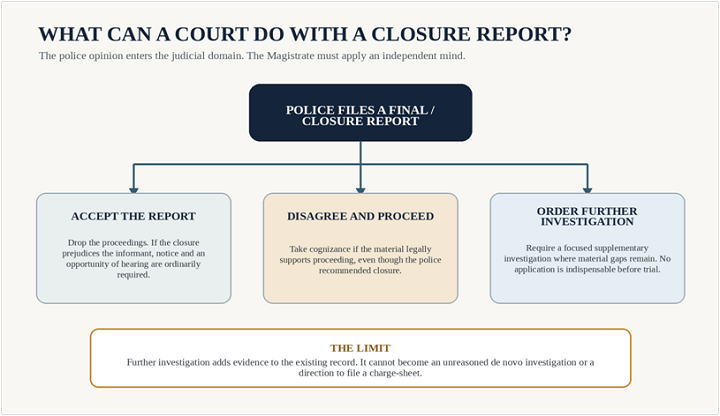
Infographic 2: The judicial options when a final or closure report is placed before the court.
STATUTORY POWER, RATHER THAN INHERENT (FREE-FLOATING) POWER NEEDS TO BE CLARIFIED HERE.
One word in the Orissa case deserves a careful handling. Despite the absence of a prayer, the Magistrate or Special Judge is not delegated the authority to investigate. While precedent has been used to support the operative conclusion, it is not accurate to interpret the expression as acknowledging an infinite amount of inherent criminal jurisdiction in each Magistrate.
Vinubhai Haribhain Malaviya v. State Of Gujarat was decided by a three-judge panel of the Supreme Court. In the statutory scheme, particularly Sections 156(3) and 173(8), as well as in the definition of investigation under Section 2(h) CrPC, the Magistrate's authority was found by the State of Gujarat. The statement explicitly stated that the Magistrate's inherent power is not challenged when the authority aligns with those provisions. Until the trial begins, a Magistrate can exercise their power suo motu, as per the facts, in addition.
This distinction matters. The boundaries and objectives of a statutory power are clearly defined. This action should only be carried out by a well-reasoned court order, for definite investigative needs, and not turned into another round of investigation from scratch. The power "inherent" should not be used as a shortcut to bypass those boundaries.'". A party's application to the court for statutory supervisory jurisdiction is not binding, according to this more robust formulation. ".
FURTHER INVESTIGATION ISN'T REINVESTIGATION.
Nothing in Section 173(8) CrPC can be done to eliminate all that has already been done. In Vinay Tyagi v. According to Irshad Ali, the Supreme Court's decision, a continuation of an earlier investigation is necessary. This means that it will gather further testimony or other written evidence and present it to the court in a supplement. The same investigative record contains both the original report and supplementary report.
There are differences between fresh investigation, reinvestigation, and de novo investigation. A restart is required and the earlier investigation may be replaced. Superior constitutional courts are responsible for supervising exceptional orders, not the average Magistrate acting under Section 173(8). A Magistrate may require the examination of defects, the tracking of witnesses, collection of documents, or the pursuit of a hidden inquiry. It is not within the Magistrate's power to pre-determine guilt, script witness statements, or order the police on file to file a charge-sheet.
The distinction protects both sides. Hence, it prevents the State from repeatedly rebuilding an unsuccessful case until it achieves its intended outcome. This prevents a plainly incomplete investigation from obtaining artificial finality just because'reports have been submitted', simultaneously.
THE COMPATIBILITY OF THE RULING WITH THE SUPREME COURT'S 2026 VERDICT IN PRAMOD KUMAR CASE?
The Orissa ruling is of particular interest due to a recent Supreme Court decision. In Pramod Kumar v. Uttar Pradesh, delivered on 4 April. The Supreme Court deliberated in February 2026 on whether the police could pursue further investigation after a final report without seeking the court's permission. It was held that the investigating agency cannot reopen itself to the investigation after the report had entered the legal system. If the agency believes that additional investigation is necessary, it must appeal to the Magistrate or court which has judicial discretion.
Pramod Kumar and Akhaya Kumar Rout work through the same control mechanism, but from opposite directions. Pramod Kumar restrains executive self-authorisation. Despite visible flaws, Akhaya Kumar Rout prevent[vague] executive action by not seeking further work to avoid judicial paralysis.
Not every disagreement with a closure report is an excuse for another investigative round.' The order must state why the investigation is not complete and which legal or factual gap needs to be addressed. "... Especially when considerable time has passed, the defendant has experienced prolonged uncertainty, or the proposed process is similar to a fishing investigation, reasons are necessary.’ The said statement was released on Friday.
If the money involved in bribery is not recovered, how can it be considered as the conclusion of the case?
The second crucial problem centered around evidence. However, the petitioners regarded the absent ransacked currency as the body of work of that crime and said its unrecovery rendered the case untenable. The High Court denied that proposition at the threshold stage. According to it, physical recovery is a significant corroboration evidence, but not the exclusive legal approach for establishing demand and acceptance.
The Supreme Court's corruption jurisprudence demands precision in this matter. The demand and acceptance of illicit pleasures are crucial foundational truths. Proof of demand and conscious acceptance is not enough for mere recovery.' In contrast, the non-existence of physical recuperation doesn't necessarily eliminate other credible evidence. In Neeraj Dutta v. State NCT Of Delhi According to the Supreme Court's ruling, demand and acceptance in cases lacking direct evidence can be established by presenting an extensive and dependable circumstantial evidence. The ingredients' authenticity must be established beyond reasonable doubt by the prosecution during the trial.
This is why, the Orissa High Court did not convict these petitioners or prove the prosecution version.". It held that the notes that were absent could not be quashed as they contained allegations of a specific request, intermediary service (through an agent), confirmation of positive handshakes, and later evidence that could explain why the items had gone missing. The trial court must decide after conducting an examination and cross-examination whether the circumstances are sufficient to create a trustworthy chain. The evidentiary threshold for conviction and the procedural threshold to allow a full investigation are not interchangeable.
ARTICLE 21 AND THE EIGHT-WEEK LIMIT, WHICH INCLUDES DELAY.?
The case is characterized by the most awkwardness caused by time. As of 2015, the trap was in place until 2016, as per the closure report, and until 2017 with a new investigation. In 2026, the High Court delivered its verdict.' A decade of a closed criminal process places 'a real burden on the accused' and undermines public confidence in prosecuting corruption.
The Court acknowledged this problem. It deemed the prolonged inactivity as a matter of great judicial concern and connected prompt investigation and trial to Article 21. Despite this, the organization declined to suppress the matter solely due to delay, as the State maintained that additional proof had been presented and that the inquiry was concluded. The process was made inconspicuous by the requirement to submit the final form within eight weeks.
This balance balancing exercise should not be mistaken for the general rule that there is no harm in delaying. The constitutionality of delay can be upheld in cases where the investigation has no significant progress, the continuation is oppressive on account of evidence, or the process is being used for collateral pressure. Not just the calendar, so what's relevant? It is necessary for the courts to consider factors such as cause of delay, parties involved and their conduct, case status, newly filed material, and any prejudice suffered by the accused. The decision of the court may also impact the nature of claims.
THE PERIOD FROM SECTION 173(8) CRPC TO SECTION 193(9) BNSS IS SUBJECT TO THE REGULATIONS.
The current criminal procedure is covered by Section 193(9) of the Bharatiya Nagarik Suraksha Sanhita, 2023. Similar to Section 173(8) CrPC, it maintains the option of additional inquiry following a police report and mandates that more evidence be transmitted through an additional report. Consequently, the basic concept of supplementation persists.
The BNSS includes an express trial-stage safeguard. Only when the court has given its approval can they proceed with further investigation during trial. Within ninety days, the completion time is mandatory and may be extended by court. Due to the absence of a comparable statutory timeline in the CrPC text and the pre-BNSS jurisprudence of the Supreme Court, this is significant. The trial-stage further investigation is now considered under Section 193(9), but it is subject to time and permission.
We shouldn't limit the implementation of the nineties to a routine extension system. A court considering an extension must inquire about the remaining work to be done, why it cannot been completed and whether the request is truly supplementary in nature and how the accused will suffer prejudice. Although the underlying proceedings were brought before the CrPC, an eight-week deadline has been given by Orissa High Court in accordance with the same principle.
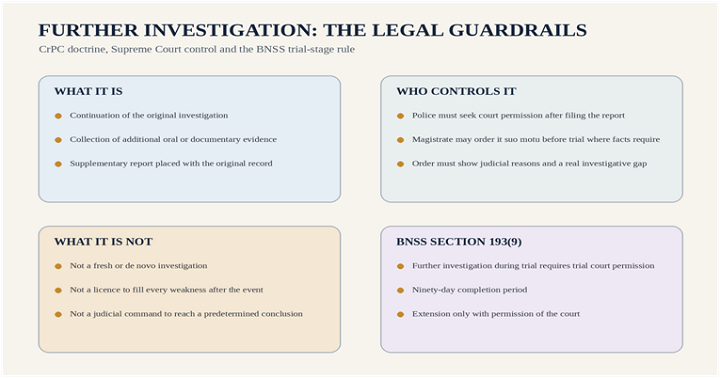
Infographic 3: The doctrinal limits of further investigation and the express BNSS trial-stage safeguard.
HOW DOES THIS RULING AFFECTS REAL LIFE?
Magistrates and Special Judges are now obligated to read the police report along with their case diary and accompanying material, rather than accepting the investigating officer's conclusion as dispositive. A focused further investigation may be warranted if the report does not include a material witness, an evident documentary trail, or forensic evidence. Order must clearly state where there is a deficit but not require police to come up with an answer.” Is what the court had said.
The acceptance, rejection, or inconclusiveness of significant inculpatory and exculpatory material should be documented in a closure report for investigating agencies. One item missing may lead to a report that leaves the rest of the material untreated, which could be rejected by the court. Following the presentation of the report in court, Pramod Kumar instructs the agency to obtain authorization instead of commencing a new investigation.
The ruling affirms that a formal prayer isn't the only factor that warrants judicial scrutiny for complainants. A protest petition is still an effective remedy, but the court's obligation to apply its mind doesn't disappear simply because the complainant hasn't authored one. Why? The judgment doesn't strip those who are accused of wrongdoing. Those options may include challenging an order that is not justified or jurisdictionally improper, asserting that the task is a de facto investigation, displaying prejudice against delay and arguing against all evidence presented at trial.
The primary practical discipline for trial courts is stage sensitivity. Prior to trial, a genuine absence can be resolved with more investigation.' Permission and the ninety-day framework are at the heart of the BNSS trial. Upon substantial evidence advancement, the court should be particularly mindful of attempts to fill in a gap in prosecution cases rather than uncovering fresh evidence.
WHAT THE JUDGMENT DOESN'T SAY.
Not every closure report should be turned down, the ruling says. The allegation is not required to be acknowledged as true by a complainant. The presence of a positive hand-wash test does not automatically prove bribery. Nevertheless, it doesn't weaken the prosecution's responsibility to demonstrate demand and acceptance beyond reasonable doubt. A Magistrate cannot order a new investigation or charge-sheet being filed.
The High Court's decision on guilt was not decisive. The High Court's restricted function during the initial phase means that it will not challenge, as disputed credibility and evidentiary issues usually fall under trial. The ruling upholds the inquiry and provides a conclusion.' Despite the circumstances, the prosecution is still required to convert allegations and investigative material into evidence that can be used for legally.
Speaking to LCI, Advocate Sudhanshu Khetrapal said that “The biggest takeaway for me is that we need to stop treating police closure reports like they’re the final word. It’s just an opinion, and as the Orissa High Court just reminded us in Akhaya Kumar Rout, a Magistrate isn't a rubber stamp. If the investigation looks lazy, like they just gave up because they couldn't find the cash, but ignored all the other evidence and the court has full authority to order them back to work under Section 173(8) CrPC.
The best part? You don’t even need a formal request from the cops or the complainant to get that moving. The judge can call for it on their own if they see the gaps in the record. “
He further said that “Also, keep an eye on how this shifts under Section 193(9) of the BNSS. Once we're in the trial stage, further investigation now requires the judge's permission and comes with a 90-day deadline, which keeps things from dragging on forever.
It’s really about judicial oversight versus executive convenience. The court has the power to keep them accountable, and it’s about time more people realized that a "final report" is really just the beginning of the court's actual decision-making process.”
THE COURT'S DECISION IS NOT THE SAME AS THAT OF THE POLICE.
A criminal court is not a police station, as demonstrated by Akhaya Kumar Rout. The decision to issue a closure report rests with the judicial officer, who must determine whether the investigation has dealt an equitable hand. If the report is clearly incomplete, the court may still order an additional investigation without any formal request.
The power, however, isn't unbounded. It's statutory, reason-dependent and stage-sensitive. It cannot be employed to erase the earlier investigation, create a prosecution case, or subject an accused to perpetual uncertainty.'
Frequently asked questions
Can a Magistrate order further investigation without an application from the police?
Yes, before the commencement of trial, a Magistrate may direct further investigation on the court's own assessment where the police report or record reveals a material investigative deficiency. The order must be reasoned and must seek a supplementary investigation, not a fresh investigation from the beginning.
Is a closure report binding on the court?
No. A closure report is the investigating agency's opinion. The court may accept it, disagree and take cognizance where legally permissible, or direct further investigation. If the court proposes to accept the closure and drop the case, the informant is ordinarily entitled to notice and an opportunity of hearing.
Can the police conduct further investigation without the court's permission?
After the report has been filed before the court, the Supreme Court in Pramod Kumar held that the investigating agency must seek the permission of the Magistrate or court. Executive or police authorities cannot simply authorise themselves to recommence the investigation.
Does non-recovery of bribe money automatically end a corruption case?
No. Non-recovery may weaken the prosecution and is an important factual circumstance, but it is not automatically fatal. Demand and conscious acceptance must still be proved, and they may be established through direct or reliable circumstantial evidence. Mere recovery without demand is also insufficient.
What is the BNSS equivalent of Section 173(8) CrPC?
Section 193(9) BNSS. It preserves further investigation after the police report and expressly provides that further investigation during trial requires the trial court's permission and should be completed within ninety days, extendable with the court's permission.
SEO publication pack
|
SEO element |
Recommended text |
|
Primary headline |
When the Police Close the File, Can the Court Reopen the Investigation? |
|
Alternative SEO headline |
Magistrate Can Order Further Investigation Without a Request: Orissa High Court on Section 173(8) CrPC |
|
Meta title |
Magistrate's Power Under Section 173(8) CrPC |
|
Meta description |
Orissa High Court says a Magistrate can order further investigation without a request. Read what it means under CrPC, BNSS and corruption law. |
|
Suggested URL slug |
magistrate-further-investigation-section-173-8-crpc-orissa-high-court |
|
Focus keyword |
Magistrate order further investigation under Section 173(8) CrPC |
|
Secondary keywords |
Orissa High Court further investigation, closure report CrPC, Section 193(9) BNSS, Magistrate power over final report, non-recovery of tainted money |
|
Suggested excerpt |
The Orissa High Court has clarified that a Magistrate or Special Judge need not wait for the police or complainant to request further investigation. The ruling explains why a closure report is not a judicial verdict and how the position changes under the BNSS. |
Join LAWyersClubIndia's network for daily News Updates, Judgment Summaries, Articles, Forum Threads, Online Law Courses, and MUCH MORE!!"


Tags :Others