
Index
- Introduction
- Factual Background
- The Legal Issue Before the Court
- Statutory Framework: Section 102 CrPC and the Powers of the Cyber Cell
- "Proceeds of Crime": A Borrowed Term from the PMLA
- The Court's Reasoning
- The Key Distinction Drawn by the Court
- Reliance on Precedent: Khalsa Medical Store v. RBI
- Directions Issued by the Court
- Implications for the Legal Profession
- Conclusion
- FAQs
1.Introduction
On June 25, 2026, a Division Bench of the Allahabad High Court, comprising Justice J.J. Munir and Justice Arun Kumar, delivered a significant ruling clarifying that professional fees received by an advocate from a client cannot be classified as ‘proceeds of crime’ merely because the client happens to be an accused in a criminal or cyber fraud investigation. The ruling, delivered in Ayush Bajpai v. State of U.P. and 2 Others (Writ C No. 24589 of 2026), arose out of a challenge to the freezing of an advocate's bank account by the Uttar Pradesh Police Cyber Cell.
The judgment is of considerable significance because it addresses a growing and troubling trend: the indiscriminate freezing of advocates’ bank accounts by cyber-crime cells and investigating agencies, often without adequate application of mind to the source and character of the funds involved. The Court's observations touch upon the scope of police power under Section 102 of the Code of Criminal Procedure, the practical functioning of the justice delivery system, and the statutory protections available to advocates under the Advocates Act, 1961.
India has witnessed a sharp rise in cyber fraud complaints in recent years, and the National Cybercrime Reporting Portal has emerged as the principal mechanism through which victims report suspicious transactions and trigger the freezing of downstream bank accounts identified in the resulting money trail. Advocates, who routinely receive fee payments through digital transfers from a wide range of clients, are structurally more exposed to being caught in such a money trail than most other professionals, which makes the Court's clarification particularly timely and relevant beyond the facts of this individual case.
2.Factual Background
The petitioner, Ayush Bajpai, is a practising advocate maintaining an account with the State Bank of India, Krishna Nagar Branch, Kanpur. The Branch Manager reported that the account had been frozen by the Cyber Cell of the Uttar Pradesh Police in connection with an investigation into alleged fraudulent transactions.
The Court's order recorded a credit of Rs. 20,000 on March 18, 2026, and three separate credits of Rs. 3,700 each, one on April 23, 2026, and two more on the same date. The total balance in the account stood at Rs. 1,03,071 at the time the matter was heard. The petitioner's case was that these were legitimate professional fees received from clients in the ordinary course of legal practice, and that the freezing of the entire account, rather than any specific suspicious credit, was disproportionate.
The petitioner was represented by Advocates Archit Mishra and Saurabh Chaturvedi. The State of Uttar Pradesh and the other respondents were represented by the Standing Counsel, who accepted notice on behalf of respondents 1 and 3.
3.The Legal Issue Before the Court
The central question before the Bench was twofold.
First, whether a Cyber Cell or investigating authority has the power to freeze an advocate's entire bank account merely on the ground that it has, at some point, received funds connected however loosely to a suspected offence. Second, and more specifically, whether professional fees paid by a client, who is himself under investigation or facing prosecution, to his advocate for legal services rendered can be treated as tainted money or proceeds of crime in the hands of the advocate.
This issue sits at the intersection of criminal procedure, banking regulation, and the statutory protections that govern the legal profession. It is not merely a question of an individual advocate's grievance but one that has structural implications for access to legal representation, particularly for persons accused of financial or cyber offences who would otherwise struggle to retain counsel if advocates feared that accepting fees from such clients could expose their own accounts to seizure.
4.Statutory Framework: Section 102 CrPC and the Powers of the Cyber Cell
Freezing of bank accounts by investigating agencies in India is typically carried out under Section 102 of the Code of Criminal Procedure, which empowers a police officer to seize any property that may be alleged or suspected to have been stolen, or which may be found under circumstances creating suspicion of the commission of an offence. In the context of cyber fraud, this power is frequently invoked through the National Cybercrime Reporting Portal (NCRP), which allows victims to report fraud and enables a form of administrative debit-freeze on accounts identified in the "money trail" of a reported transaction.
The difficulty, as the Court noted, is that this mechanism often results in accounts being frozen in their entirety, even where only a small fraction of the funds, or in some cases none at all, can be traced to the alleged offence. The Bench observed that such freezes, when applied to an advocate's account, carry consequences well beyond the individual, since they interfere with the advocate's capacity to discharge professional duties owed to multiple clients, not merely the one under investigation. Banks, for their part, typically act on the instructions of the investigating agency without independently verifying whether the freeze is proportionate to the suspected taint, which leaves account holders with little recourse other than approaching the High Court under its writ jurisdiction, as the petitioner did in this case.
5."Proceeds of Crime": A Borrowed Term from the PMLA
The expression "proceeds of crime" is not a term used loosely in Indian law. It carries a precise statutory meaning under Section 2(1)(u) of the Prevention of Money Laundering Act, 2002 (PMLA), where it refers to property derived or obtained, directly or indirectly, by any person as a result of criminal activity relating to a scheduled offence. Attachment of such proceeds under the PMLA follows a structured, multi-stage process: an Enforcement Case Information Report must be registered, a provisional attachment order must be passed under Section 5 by an authorised officer of the Enforcement Directorate, and that order must subsequently be confirmed by the Adjudicating Authority within a statutorily prescribed period, failing which the attachment lapses.
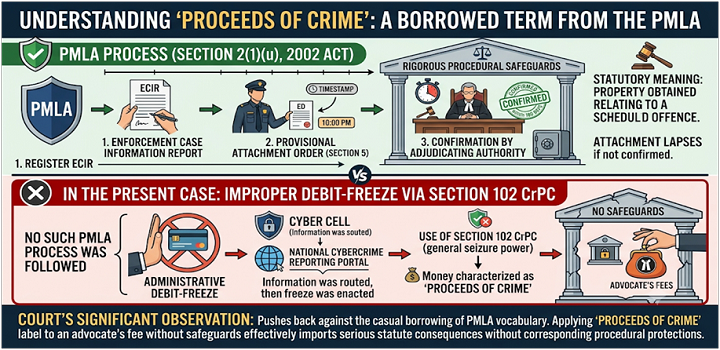
In the present case, however, no such process was followed. The freeze was an administrative debit-freeze effected through the Cyber Cell acting on information routed through the National Cybercrime Reporting Portal, invoking the general seizure power under Section 102 CrPC rather than any provision of the PMLA. The Court's observations are significant precisely because they push back against the casual borrowing of PMLA vocabulary, describing money as "proceeds of crime", to characterise funds frozen under a far less rigorous procedural framework. Applying this label to an advocate's professional fee, without any of the safeguards that accompany a formal PMLA attachment, effectively imports the consequences of a serious statute without its corresponding procedural protections.
6.The Court's Reasoning
The Bench took a firm view that a blanket freeze of an entire account is not permissible under the scheme of Section 102 CrPC. It reiterated the principle that only the specific amount that is genuinely traceable to a suspicious transaction or the proceeds of a crime may be frozen, and not the account as a whole. Applying this principle to the facts, the Court found no basis to treat the petitioner's modest professional receipts as proceeds of crime.
The Bench expressed concern about the wider consequences of such actions for the administration of justice. It observed that if an advocate's account could be frozen simply because a sum of money traceable to a client under investigation had been remitted to it, advocates would find it exceedingly difficult to discharge their professional duties under the Advocates Act, and the functioning of courts themselves would be compromised.
7.The Key Distinction Drawn by the Court
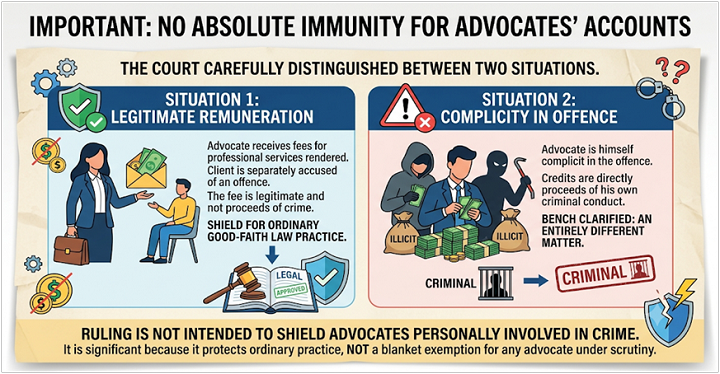
Importantly, the Court did not lay down an absolute immunity for advocates' accounts. It carefully distinguished between two situations. The first is where an advocate receives fees for professional services rendered to a client who is separately accused of an offence; in such a case, the fee is legitimate remuneration and is not proceeds of crime. The second is where the advocate is himself complicit in the offence and the credits in his account are directly the proceeds of his own criminal conduct.
The Bench clarified that the latter situation would be an entirely different matter, and nothing in its ruling was intended to shield an advocate who is personally involved in the commission of a crime. This distinction is significant because it means the ruling operates as a shield for the ordinary, good-faith practice of law rather than as a blanket exemption for any advocate whose account happens to be under scrutiny.
8.Reliance on Precedent: Khalsa Medical Store v. RBI
The Bench grounded its reasoning in the Court's own recent Division Bench precedent in Khalsa Medical Store through Prop. Yashwant Singh v. Reserve Bank of India through Governor and 3 Others (2026:AHC-LKO:3701-DB). That earlier ruling had already established that on account of a single fraudulent transaction, a Cyber Cell cannot freeze an entire bank account except to the extent of the amount that represents the suspicious transaction or the proceeds of the underlying crime.
By extending this principle to the specific context of an advocate's professional account, the Court has effectively read the Khalsa Medical Store proportionality principle into the practice of law, recognising that the profession carries distinctive constitutional and statutory protections that make indiscriminate account freezes especially damaging.
9.Directions Issued by the Court
The Court did not stop at merely deciding the individual petitioner's grievance. It directed the Additional Chief Secretary (Home), Government of Uttar Pradesh, to file a personal affidavit explaining the safeguards and regulatory framework currently in place to govern the freezing of advocates' bank accounts, so that such actions do not unnecessarily interfere with the administration of justice. This direction signals that the Court views the issue as a systemic one requiring a policy-level response, not merely a one-off correction of an individual Cyber Cell action.
The Registrar (Compliance) was directed to communicate the order to the Additional Chief Secretary (Home), the Cyber Cell of the Uttar Pradesh Police, and the Branch Manager of the State Bank of India, Krishna Nagar Branch, through the respective Chief Judicial Magistrates at Lucknow and Kanpur Nagar, with compliance expected by the following Monday.
10.Implications for the Legal Profession
The ruling has practical significance for practising advocates, particularly those handling criminal defence, white-collar crime, and cyber fraud matters, where clients are frequently under investigation at the time fees are paid. Left unchecked, indiscriminate account freezes create a chilling effect: advocates may become reluctant to represent accused persons in financial crime cases for fear that their own accounts could be frozen, which in turn undermines the constitutional guarantee of access to legal representation under Article 22 and the fair trial protections embedded in the criminal justice system.
For law students and young practitioners, the case is also a useful illustration of how procedural safeguards under the CrPC interact with sector-specific realities such as cyber fraud investigation, and how courts balance investigative efficiency against professional and constitutional rights. It reinforces that proportionality, rather than administrative convenience, must govern the exercise of seizure powers.
The ruling also implicitly reaffirms the private and contractual character of the advocate-client fee relationship. An advocate's entitlement to charge and recover fees for professional work is recognised under the framework of the Advocates Act, 1961, and the rules framed by the Bar Council of India governing professional conduct. Fee arrangements between an advocate and a client are ordinarily a matter of private contract between them, and third-party action against that fee, taken without any finding that the advocate participated in wrongdoing, sits uneasily with this framework. By treating professional remuneration as presumptively legitimate unless shown otherwise, the Court has reinforced the functional independence of the Bar from unwarranted executive interference, an independence that is itself instrumental to the rule of law.
11.Conclusion
The Allahabad High Court's ruling in Ayush Bajpai v. State of U.P. is a carefully calibrated intervention. It does not immunise advocates from scrutiny where they are themselves complicit in crime, but it firmly establishes that legitimate professional fees, earned for rendering legal services, cannot be swept into the "proceeds of crime" net simply because the paying client is under investigation. By directing the State to explain its regulatory safeguards, the Court has placed the issue squarely before the executive, signalling that a systemic fix, and not merely case-by-case litigation, is required to prevent future interference with the legal profession's ability to function.
Until such regulatory safeguards are formally put in place, the ruling itself functions as the operative precedent that advocates faced with similar account freezes can rely upon. It offers a workable test: the source of the credit must be examined transaction by transaction, the freeze must be confined to the specific tainted sum, and the professional character of a fee payment must be respected unless there is material to show the advocate's own complicity. That test balances the legitimate interests of criminal investigation against the equally legitimate interest in an unimpeded legal profession.
12.FAQs
Q1. Can an investigating agency freeze an advocate's entire bank account if it suspects one transaction is linked to a crime?
No. The Allahabad High Court has held that only the specific amount traceable to the suspicious transaction or proceeds of crime may be frozen, not the account in its entirety. Freezing an advocate's whole account for one questionable credit is disproportionate and unsustainable under Section 102 CrPC.
Q2. Does this ruling protect an advocate who is personally involved in a crime?
No. The Court expressly distinguished between fees received for genuine professional services and money that constitutes the proceeds of an advocate's own criminal conduct. Where an advocate is personally complicit in an offence, the protection recognised in this ruling does not apply.
Join LAWyersClubIndia's network for daily News Updates, Judgment Summaries, Articles, Forum Threads, Online Law Courses, and MUCH MORE!!"


Tags :others