
The failure by Mamata Banerjee to step down as Chief Minister following the 2026 West Bengal Assembly poll results has generated one of the most intense constitutional row in contemporary Indian politics. The disagreement is not merely about the record of individual resistance against rejection but constituting a paradigm where the line of political opposition is crossed and where the constitution,the Governor and democratic norm put the harmony of the constitutional order back on track.
Things got more intense, however, when Banerjee vowed not to resign, claimed that the elections had been rigged, and drew the fight into "a larger battle over democratic legitimacy" than a simple transfer of power. Lines like that threw the confrontation squarely onto the constitutional level, since under Indian law a Chief Minister must hold office not just by "political capital" but through a government that exists under the provisions of Article 164 and the "collective responsibility of the Council of Ministers to the Legislative Assembly."
What makes this episode particularly noteworthy is the fact that it lies at the confluence of emotion, electoral mistrust and a legal principle. Banerjee has charged the electoral process as having been manipulated and the Election Commission as having authored a 'dark chapter' in India's democratic annals, while her party has concurrently indicated political resistance as well as resort to the judiciary. Simultaneously the constitutional documents and practice have implied that in the event of a new mandate wielded by a different majority, the Chief Minister's place becomes a political as well as a legal minefield unless consistency hinges on the trust of the assembly.
This is exactly why the Bengal resignation row is (also) a matter of national concern. It raises basic issues such as whether a sitting Chief Minister can refuse to resign despite electoral loss; what we mean by the 'pleasure of the Governor'; whether the Governor has independent powers of removal, and how we deal with charges of electoral irregularity without freezing the process of government formation. They are not simply committee procedures but question the very essence of Indian constitutionalism, which is based just as much on conventions of restraint as on written rules.
The Political Spark Behind the Controversy
No sooner had the 2026 West Bengal polling stations closed and results indicated a landslide for the Trinamool Congress and showed a direct threat to Banerjee remaining in power than the initial controversy ensued. Rather than tendering her resignation in the standard manner Banerjee refused to accept the verdict as reflecting the popular will, claiming massive fraud and distortion.
But her statements did not simply equate to a technical procedural objection. She characterized the election as an institutional attack on democracy, asserting that the contest was indeed not only against the BJP but also against the Election Commission and the government machinery of the state. Though her framing is politically potent, it would make her surrender which is a rather routine constitutional undertaking, sound like an act of symbolic ousting.
Banerjee then went further, in essence arguing that she would still face removal from outside-and that the political impact of such an action would be a black day. The controversy was cemented because it set a precedent that the reason for the removal would need to be found externally by the Governor or other institutional actors rather than by following the traditional parliamentary custom where a defeated incumbent relinquishes office and makes way for the new majority.
Political theatre has a place because constitutional crises are seldom generated by text. Instead they happen when conventions which facilitate smooth change are scorned in public. In a Westminster-style regime, the patience, sensibility and implicit faith in that country's verdict which govern most critical junctureswill cease to have a place in virtually every proceeding.
Why the Legal Question Is Not Simple
Easily, many citizens think: if a CM loses a vote for election, the resignation is inevitable. Unfortunately, in legal point of view this is a little more complicated. The Constitution doesn't hold a series of exact mechanical provisions that reads like: after every failing election vote, a CM has to resign in 23 hours.
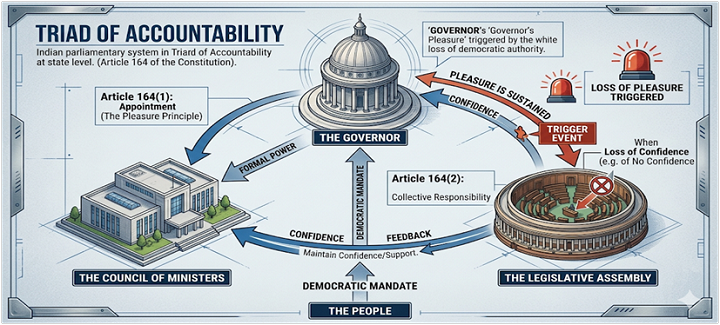
Instead, Article 164 lays down the dispensation. This Provision states that appointment of theChief Minister during passage, appointment of evena minister by the Governor shall be made by him, even hence 'He is overall boss: appointment of a minister shall be made by the Governor on the 'advice of the 'Chief Minister, that the office of a minister shall be terminable during the pleasure of Governor, and that the Council of Ministers shall be collectively responsible to the Legislative Assembly of the State. Those hurriedly constructed words contain the entire architecture of responsible government at the state level.
In essence the real constitutional inquiry is not personal conviction, rhetorical resistance or emotional disagreement with the result. It is whether the ministry can legitimately claim to have or to be possible to have the confidence of the House that results from the election. If the answer is clearly in the negative then the moral and constitutional justification for remaining in office appears to diminish substantially.
However the complication adds up as it is a common misconception that the 'pleasure of the Governor' means that the Governor may crassly appoint and appoint governments as he pleases. In Parliament democracy, the Governor's job is normally one that is defined by constitutional convention and the requirement for the identification of the leader by the Assembly as having majority support.
That difference is vital. The Governor is not an overlord-politician. The Governor is not a Big Show Stouter when a sitting politician has plainly lost the democratic authority that gives this office effectiveness. That is when he Is relevant. That is when it counts.
Article 164 and the Governor's Role
Article 164(1) of the constitution states that the CM shall be appointed by the Governor of the state and the ministers shall hold office at the Governor's pleasure, this is also known as the pleasure principle. Further, cl. (2) of Art. 164 provides that the Council of Ministers shall be collectively responsible to the Legislative Assembly of the State; this is one of the basic principles of parliamentary democracy that the machinery of the executive will be responsible to the popular House.
These two clauses however must be considered together. While 'pleasure' in isolation appears wide-arguably allowing any one to hold office where it is 'pleasure', when considered constitutionally, it is grounded in legislative confidence and responsible government. Practically, the Governor's 'pleasure' is a device to protect a government lacking democratic support from maintaining office forever.
Indeed this is precisely the reason why many constitutional experts argue that where a ministry has lost its majority, Governor is acting constitutionally if he/she removes the then Chief Minister who is not willing to step down; even where a fresh elections has disclosed a alternative majority. In Indian constitutional practice, the normal remedy though is not its summary removal but following constitutional steps that make it evident where does the vote truly reside.
Tensions in Bengal exist because the arguments is not about a mid-term rebellion in the House of Commons but about a new electoral verdict itself. Given that facts it would seem a natural rule that the outgoing administration be a caretaker administration waiting for resignation and transition, rather than a provocative extra-territorial political government that can resist being displaced ad infinitum. If an incumbent election shall deny legitimacy to the latter, that argument can be litigated or reconciled through the courts and other legal channels, but a regime of legal remedies does not specifically suspend the constitutional imperative of eventually forming a new government.
Yet there is also an underlying principle at work. India's Constitution does not prize constitutional brinkmanship. It provides for channels of protest, review and resolution but it does not authorize power in a user-independent of institutions. A defeated government may protest, but it cannot a priori turn protest into a way of life.
Electoral Irregularity Allegations and Their Legal Place
Banerjee's key argument is inherently political and legal: she maintained that the election was not conducted properly and that electoral fraud had marred it. This line of reasoning is not at all insignificant as mere semantics but was acknowledged as serious by the Supreme Court of India when it questioned the administrative handling of the voter lists in West Bengal at that time.On the Supreme Court on January 2026 the Election Commission to highlight the names of the serial number 4 voters of the logic errors list at the time to Special Intensive Revision of electoral rolls in West Bengal. The court observed there were 1.25 crore West Bengal voters on this list, it need transparencyl, the names displayed locally, and the opportunity for persons affected to file
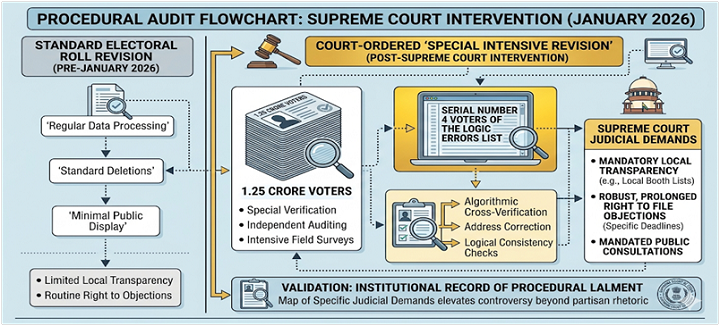
documents or objections. As a result of this judicial intervention proved Banerjee later claims about the final election results but it indicates the doubts of the final election result of their procedures voter-roll was reaching to the apex court to cause active monitoring.
This is legally significant because it depicts the episode as more than usual partisan anger. When any politician asserts that a democratic process was defeated, the seriousness of the assertion hinges on whether there is an institutional record of procedural lament. In this case there was at least judicial record of concern about openness and possible irregularities in the roll revision process.
There is still a constitutional limit to be considered. While allegations of irregularity or other defects, however grave and meritous, may provide ample reason for a Governor to re-stall or even stall an outgoing Chief Minister from taking office by ignoring a declared result, their effect on the Governor's constitutional duty should not. This is to seek the remedy in the judi-cal's court, election petitions or other legally recognized proceedings or with the machinery of representative government remaining intact.
This dividing line between a legal challenge (the known) and an executive continuation (the unknown) is where a lot of public debate starts to go awry. What is often assumed is that in the presence of a pending grievance, the incumbent's 'job' should be seen as continuing, full stop. The Constitution doesn't work by that logic. It draws a clear line and distinguishes between a process of settling disputes and that of maintaining the daily grind.
Convention, Morality, and Constitutional Behaviour
Much of the outrage around the Banerjee episode stems from the fact that constitutional democracies are sustained through unwritten practices. Not every norm exists in statute, but a fair number are fundamental to avoid public institutions having an open fracas; but resignation on defeat is one.
That rule isn't mere politeness. It recognizes a more fundamental insight about parliamentary life: governments don't hold office, they hold it provisionally – until a new decision unmistakably goes another way. Until then, an ex-indecate government must assist in the change, not trouble holding on.
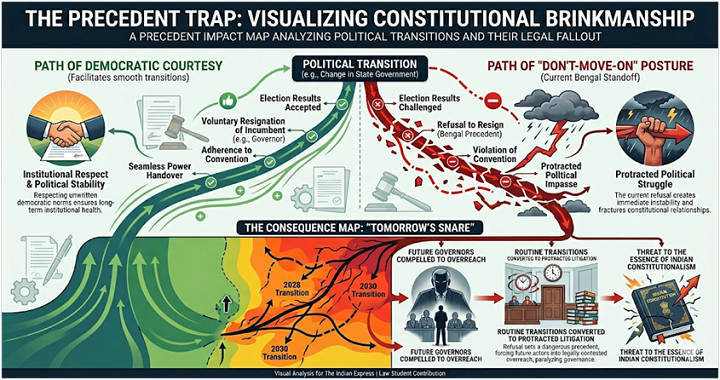
While it remains fair that some politicians do not concede out of the suspicion that quick concessions end up in giving legitimacy to an already flawed process, this is precisely the emotional motivation that we see in Banerjee's actions and speech. What is required in accordance to our "constitutional" conduct is to challenge the process in whatever form and happen to reject, disapprove, oppose, contest the process without a marginalizing this don't-move-on posture over the political or personal resistance against institutional resilience.
If this is where the lessons for all the parties, including the TMC, lie, the day's precedent could very well be the tomorrow's snare. Future political leaders who set a precedent for not resigning and stepping aside even after a still shorter term forfeit mandate could call constitutional transitions as warfare in various states, with Governors being compelled to further excel, and the mundane task of democratic courtesy replaced by litigations.
The Floor Test Debate
Most talk about whether a government in India has rightful power leads straight to what people call a floor test. When judges have ruled on such matters, plus when experts weigh in, they tend to agree - majority support should show itself openly in the legislature instead of being guessed by governors behind closed doors. What stops leaders from using personal opinion over actual vote counts? That rule.
Bengal's situation isn’t quite like past midpoint power clashes. Usually, when doubt hits, it’s within a standing legislature - shifting loyalties or broken alliances stir confusion. This time, votes had just been counted after an election. People expect outcomes then to reset the entire game. The argument emerges not from crumbling backing but from what comes after a clear ballot outcome.
Here’s the thing: certain analyses suggest relying on a trust vote might matter less right now, particularly because the current Assembly's time is nearly up, so the Governor could simply call on the victorious group to take charge. What actually hangs in the balance isn’t if Banerjee stays at the helm of a fading legislature, rather whether she leverages unclear constitutional grounds to slow down the emergence of its successor.
Still, the idea of a floor test holds value when thinking things through. That much shows how power in India needs proof inside official systems, not just speeches into cameras. Through votes, invitations by protocol, seats won, or shifts ordered by governors - each case makes clear one thing. Real control comes only where lawmakers give their trust.
When A Chief Minister Refuses The Governor Might Still Act?
True, within the rules of the constitution, it can happen - yet careful steps are needed. If a Chief Minister loses majority backing but stays put, the Governor holds power to step in, clearing space for a new administration that matches what lawmakers actually support. Still, any move like this only stands if built on real evidence of shifting numbers, not just someone's political advantage.
Most times, calling something a "dismissal" stirs up confusion instead of clarity. To many people, it feels like someone being slapped down. Yet within the framework of how governments are built, it means acknowledging plainly: when leaders lose their mandate, staying on isn’t an option just by refusing to go. What matters here isn’t pride - it’s putting order back where it belongs.
Some reports captured the heart of the matter by pointing out how, under strict reading, the Governor holds power to remove the Chief Minister since tenure depends on gubernatorial approval. Yet they went on to observe that India's legal framework lacks clear directions when such rare clashes happen. Uncertainty exists, true - still, that does not mean institutions are powerless. The gap between rulebook precision and real-world complexity remains wide.
A rulebook rarely covers every moment a democracy might stumble. Still, what counts is staying true to core ideas. Suppose one side wins outright while the current leader cannot earn support in Congress. In that case, holding on feels empty under constitutional terms.
The Broader Democratic Message
One moment it’s just about West Bengal, next it cracks open something wider. Not only that, it reveals how shaky things get when power refuses boundaries. What happens then? Norms hold firm - yet they need cooperation to mean anything. Instead of seeing process as routine, some call retreat betrayal. Procedures become attacks, if your side faces them. Over time, resentment sticks around like smoke after fire.
Danger lives there, since democracy needs more than just winning words; it demands clear ways out. When results come, a leader can question them, rally people behind, take legal steps, point at flaws, keep pushing later. Yet holding power without real public backing shifts resistance into something the system never allowed.
Now comes a moment where doubt might actually sharpen how fairness is seen. Not just the outcome matters, but whether people feel it was open to view. When the highest court stepped into West Bengal’s list updates, it revealed how hidden steps stir heat. Quiet processes risk looking like tricks if eyes cannot follow. Even perfect paperwork fails if voters think edits happen behind curtains. Power shifts legally - yet still feels shaky when clarity takes a back seat.
Here’s how it looks right now, split into two parts. One, Banerjee not stepping down feels off - maybe even unworkable - under Article 164, especially after voters have shifted support somewhere new; trust in shared cabinet duty depends on such moves. Two, the claims behind her stance highlight something pressing: clearer election rules would help, since respect for the constitution grows stronger when systems show they’re guarded.
Constitutional Law Relevance in Public Discourse
What sticks out for those studying constitutional law is how the living nature of the document shows up not just in words on paper, yet also in everyday practice. While Article 164 sets down structure, understanding grows from watching appointments unfold, executive authority shift, shared accountability play out, governors make choices, courts step in, along with norms shaped by democracy - all bumping into one another as events move forward.
Most people just need to remember one thing. Even top leaders answer to the rules voters live by. Still, doubts about fairness can’t be ignored either. What matters is seeing clearly - change happens on schedule, while questions about how votes were counted still get fair attention.
What keeps things steady makes all the difference between fair rule and outright political war. Not just pushing someone out or winning an argument fixes deep hurt in Bengal. Only when courts, laws, and systems show both sides - victors and defeated - that change happens by rules people believe in does real healing start. Trust built slowly, not declared loudly, ends unrest.
Join LAWyersClubIndia's network for daily News Updates, Judgment Summaries, Articles, Forum Threads, Online Law Courses, and MUCH MORE!!"


Tags :Others