Introduction
Do the non-negotiable principles of Rule of Law, which are not foreign to interpretation of contractual clauses, not exist, where the State and its instrumentalities are parties to the same? This was among the major concern that arises in this issue.
The Hon’ble Supreme Court on 23.03.26 has restored an arbitral award in favour of ABS Marine Services, stating that, State authority cannot unilaterally determine breach of contract and bar judicial or arbitral scrutiny through contractual clauses in the case of ABS Marine Services Vs. The Andaman and Nicobar Administration (2026 INSC 274). By doing this Supreme court has set aside the impugned judgement passed by Calcutta High court.
Before deep diving into the analysis of court’s reasoning, one must be clear about the facts of the said case.
Factual matrix
The Appellant and the Respondent signed a Manning Agreement on 26.12.2008 to man 17 vessels. The working terms were as follows: The Appellant had the duty to supply complement of officers on board the vessel at all times (clause 2.1); the duration of the contract was between 01.10.2008 and 30.09.2009 (clause 3.14); and the fee that was to be paid was in the form of the fee of Rs. 12,67,200/- per month per ship (clause 3.15). The law applied was the Indian law (clause 3.23).
Shipping Corporation of India Ltd. was selected as the Technical Manager of the vessels by another agreement.
On 06.07.2009, the ship, M.V.Long Island, heading back to Campbell Bay, after picking Mazahua, began floating out of its course in the rough sea amid winds and hit a submerged rock. It refloated at high tide, and with the aid of its engines, the ship managed to be berthed at Campbell Bay. Nevertheless, it was too late, the damage was done.
On 15.02.2013, the Respondent gave the Appellant a Show Cause Notice as to why penalty was not to be imposed, and recovery process was not to be undertaken. The Appellant refuted its liability by a response of 12.03.2013. On 25.09.2014, the Respondent recovered a sum of Rs.2,87,84,305/- towards penalty on grounding of the vessel, out of the ongoing bills of the Appellant.
Eventually, it was a case that was referred to arbitration. In a matter that presented itself before this Court, by an order of 02.11.2015, the Hon'ble Justice S.S. Nijjar, a former Judge of this Court was appointed as a sole arbitrator to settle the disputes by this court.
The primary issue that can be considered is whether the logic used by the High Court as presented hereinabove, in allowing the Respondent’s Section 37 appeal under the Arbitration and Conciliation Act, is legally valid?
Award dated 08.05.2017
The award seems to indicate that the plea on lack of jurisdiction to arbitrate the dispute was not taken in the first written objections by the Respondent. It was also not considered in the response to the revised statement of claim. A handwritten application was made on the day the oral evidence was closed to frame other issues and the same was granted.
The arbitrator decided that the clause 3.20 was invalid and that it was in breach of Section 28 of the Indian Contract Act, 1872 since it clearly imposed an absolute bar on any decision being appealed in any Court of law. It was also the provision which by its terms the arbitrator said that the parties could not invoke arbitration, and consequently violated Section 28 for this reason as well.
Learned Arbitrator held that the clause on arbitration was extremely broad and the clause 3.20 must be read together with clause 3.22 as it could not be read separately and would leave the claimant without a remedy. The educated arbitrator believed that the tribunal must make an effort to interpret the clause in a manner that would not cause absurdity and inconsistency. The clauses must be interpreted in harmony and the arbitrator had to hold that clause 3.22 would take precedence over clause 3.20. The arbitrator also determined that the Respondent had accepted the fact that the arbitration was not forbidden and had never at any point pursued the plea in any of the courts in which the arbitrator could not be appointed since the recovery had already been made in Clause 3.20. The arbitrator believed that the Respondent was not allowed to argue that the arbitration proceedings were not in jurisdiction.
The arbitrator directed the payment of Rs. 2,87,84,305/- plus interest of 9 per cent since the date of recovery up to the date of the award. Arbitrator ordered that he should pay within three months and in default of which interest at 12 per cent should be paid since award date to date of payment. Costs of Rs. 27,21,222/- were also ordered.
Arguments of both the parties
The appealant contends that disputes concerning the breach of agreement and alleged negligence can be decided by the arbitrator; that the endeavour of every authority should be to interpret Clauses in a manner so as to not lead to any absurdity and inconsistency; that interpretation of the contract is within the jurisdiction of the arbitrator; that what is 'excepted', is the quantification and not the decision with respect to whether there was "wilful action /omission/commission or negligence" on the part of the Appellant; that Clause 3.20 insofar as it excludes resort to a Court of law and Arbitration is void as it will render the Appellant remediless; that the Respondent had acquiesced to the arbitrability of dispute and is estopped from challenging the jurisdiction of the arbitrator; that the arbitration clause is very widely worded and, that the High Court has exceeded its jurisdiction Under Section 37 of the A&C Act.
The respondent defended the impugned judgment by stating the rationale behind a decision by the High Court. It is argued by the Learned ASG that the arbitrator only derives his powers through the contract and that the proper remedy was to challenge the clause in the Civil Court, that Clause 3.20 and 3.22 are collectively construed to indicate the extent of the jurisdiction that the arbitrator had, by expressly leaving out of the arbitration certain so-called excepted matters, and that it is only to the extent that they fall within the arbitrator's mandate and that the arbitrator could not have trespassed into the zone of excepted matter.
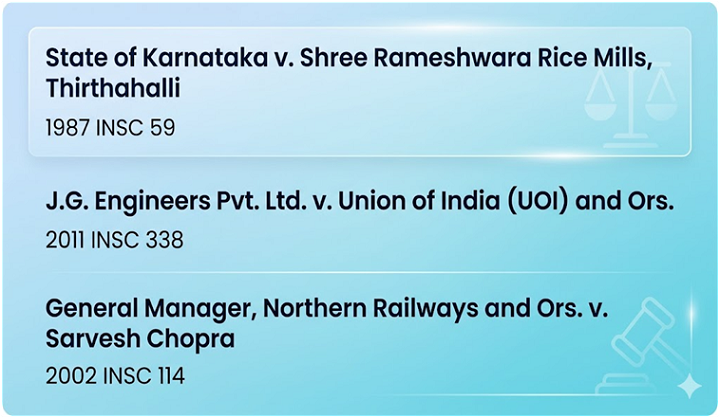
Authority referred by the court
The precedents referred by this Hon’ble court for the rightful diposal of the matter are as follows:-
Analysis
The Hon’ble Supreme Court granted the appeal and said that the High Court had made a seriously flawed decision. It pointed out that in cases of dispute over liability, a contracting party particularly the State cannot take the adjudicator role. Restating established law, the Court noted that one of the sides of a contract could not act as a judge of his own.
The Court also did not accept the meaning of the clause as excluding any remedy, in which such a meaning would result in the emptying out of the law. Accentuating that there is no possibility of the contractual terms taking precedence over the fundamental legal principles, the Court referred to the maxim ubi jus ibi remedium and mentioned that the right to adjudication cannot be brought to extinction by contracts.
The Court reminded that these kinds of clauses should not be found in State contracts, and as much as some of the controversies can be removed through arbitration, it is impossible to say, exceptionally, something, which one may and must omit, justice.
By harmonious interpretation of the agreement, the Court decided that the wide-worded arbitration clause was applicable to disputes where liability was in controversy. The so-called finality clause could at its best be only applicable in situations where a breach is already found and concerns the quantification and not where the underlying matters of liability are challenged.
Without looking at the ruling by the High Court, the Supreme Court rehabilitated the May 8, 2017 arbitral award reiterating that one cannot avoid adjudication or water down the rule of law through contractual drafting.
Conclusion
The resolution of this dispute brings to the fore a recurring and troubling tendency in the drafting of State contracts: the attempt to insulate administrative action from independent scrutiny through "excepted matter" or "finality" clauses. While the Court today restores the arbitral award based on the specific interplay of Clauses 3.20 and 3.22, we find it necessary to underscore a more foundational principle that governs the Republic.
The Rule of Law is not a fair-weather doctrine, nor is it a principle that may be bargained away at the signing of a commercial deed. When the State enters the marketplace, it does not shed its constitutional character. Unlike private entities, the State and its instrumentalities carry the perpetual burden of fairness, transparency, and non-arbitrariness. To suggest that a State authority can, by a stroke of a contractual pen, unilaterally determine a breach, quantify a penalty, and simultaneously bar the gates to a tribunal or court is a proposition repugnant to our legal heritage.
Such clauses often masquerade as "commercial expediency" or "administrative finality." However, in substance, they frequently violate the mandate of Section 28 of the Indian Contract Act, 1872. Any clause that renders a party remediless or makes one party the sole judge of its own cause—nemo debet esse judex in propria causa—strikes at the very root of judicial independence. The maxim ubi jus ibi remedium (where there is a right, there is a remedy) is the cornerstone of our legal architecture. If a contract creates a right but destroys the remedy for its breach, it is not a contract; it is a decree of servitude.
We must caution State authorities against the use of "take-it-or-leave-it" clauses that seek to bypass the Arbitration and Conciliation Act. The purpose of arbitration is to provide an efficient, neutral, and expert forum for dispute resolution. It is not a mechanism to be toggled on or off at the convenience of the State. Contractual interpretation must always lean toward the preservation of adjudicatory rights rather than their extinction. We hold that any interpretation of a contract that leads to an absurdity—where a party is accused, tried, and penalized by its own creditor without the oversight of a neutral third party—cannot be countenanced in a society governed by the Constitution. Finality in State contracts must be the result of a fair process, not a prerequisite of a lopsided agreement.
Join LAWyersClubIndia's network for daily News Updates, Judgment Summaries, Articles, Forum Threads, Online Law Courses, and MUCH MORE!!"


Tags :Others