
SYNOPSIS
1.Meaning of International Disputes
2.Peaceful Methods of Settlement
- Negotiation
- Good Offices
- Mediation
- Conciliation
3.Legal Methods of Settlement
- Arbitration
- Judicial Settlement
4.The International Court of Justice
- Composition
- Jurisdiction
- Advisory Opinions
- Procedure
5.Enforcement of Judgments
6.Non-Peaceful Methods (Historical)
- Retorsion
- Reprisals
- Intervention
7.Conclusion
1.The Meaning of International Disputes.
An international dispute occurs when two or more States are at issue on questions of law, fact or policy which impact on the legal rights or the legal obligations of the parties with respect to the international law. In the Mavrommatis Palestine Concessions Case (1924), the Permanent Court of International Justice has given the classical definition of the term saying that a dispute is a disagreement on point of law or a fact, a conflict of legal opinion or a conflict of interests between two persons. This definition remains the guiding principle to the modern international jurisprudence and has been reaffirmed by the International Court of Justice (ICJ) on numerous occasions.
The international disputes can be divided into:
- Legal issues - connected to interpretation of treaties, violation of international commitments, diplomatic protection, territorial sovereignty, maritime delimitation, and responsibility of states.
- Political differences - entail policy questions, national interest, ideology differences, or national security.
The fact that the distinction between legal and political disputes is purely conceptually helpful, in practice, most disputes are characterized by both of these aspects. An example of this is a territorial conflict which can be both a legal assertion via the international law, but also a political and strategic implication.
The present global legal system attaches much importance to peaceful settlement. The Charter of the United Nations provides in article 2(3) of the Charter that the States should resolve their disputes peacefully in order to protect international peace and security. Moreover, Article 33 enumerates some of the peaceful approaches that could be used by States.
The importance of defining an international dispute is related to the jurisdiction. In the case of the ICJ, only in the instance when there is a real dispute between the parties can the ICJ exercise contentious jurisdiction. Judicial settlement is a preliminary requirement before the existence of a dispute.
Finally, the collaborative resolution of international conflicts is one of the foundations of international law, which specifies the change in the world order where war was a legitimate tool of policy to one where cooperation and legality were prioritized.
2.Peaceful Methods
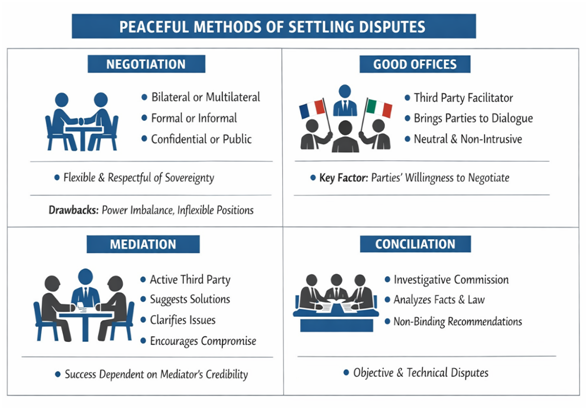
Non-coercive methods of settling disputes that do not involve the use of force are peaceful methods of settling disputes. Article 33(1) of the UN Charter lists negotiation, enquiry, mediation, conciliation, arbitration, judicial settlement, and recourse to regional agencies as the means that are acceptable.
A. Negotiation
The most traditional and common dispute settlement technique is negotiation. It entails face to face communication between conflicting States with the aim of getting a solution that is acceptable to all.
Negotiations may be:
- Bilateral or multilateral,
- Formal or informal,
- Confidential or public.
Flexibility, respect of sovereignty as well as maintenance of diplomatic relations are the benefits of negotiation. It enables the parties to establish solutions based on political realities and not rigid rules of law.
Nonetheless, negotiation can fail because:
- There is a power imbalance,
- Parties take inflexible stances,
- Home politics does not allow compromise.
The negotiations are in most instances the precursor of other dispute settlement methods such as adjudication at the ICJ. Before the courts accept jurisdiction, they usually want evidence of the fact that diplomatic efforts have been exercised.
B. Good Offices
Good offices entail the aid of an intermediary who aims at uniting warring States and leading to dialogue. The third party does not suggest solutions or engage in substantive discussions.
Good offices in international conflicts are often undertaken by the Secretary-General of United Nations. Such services may also be given by regional organizations and neutral States.
Good offices are powerful because of its non-intrusive nature and neutrality. It comes in handy especially in situations where diplomatic relations between States have declined such that direct correspondence is hard to achieve.
Nonetheless, as the third party does not directly influence the result, its success is determined to a great extent by the readiness of the parties to negotiate in good faith.
C. Mediation
A third-party intervention that is more active is mediation. In contrast to good offices, a mediator is an active participant of the discussion, and he/she can suggest terms of settlement.
The mediator:
- Remains impartial,
- Clarifies issues,
- Encourages compromise,
- Recommends action measures.
Armed conflicts and boundary conflicts have been solved due to mediation. Even though mediation proposals do not have binding powers unless the parties accept them, they tend to have persuasive power.
The effectiveness of mediation is determined by the reputation of the mediator and the political environment, in which the conflict occurs.
D. Conciliation
Conciliation lies in between the diplomatic and legal means. It entails the creation of a commission that:
- Investigates the dispute,
- Analyzes legal, factual problems,
- Prepares a report and recommendations.
The recommendations are not a binding one, however, they are founded on objective analysis. The process of conciliation is especially applicable in technical disputes, where the technical aspect like maritime delimitation or environmental matters are involved.
The trend towards structured but flexible dispute resolution mechanisms in many modern treaties reflects the presence of conciliation clauses in many of these treaties.
3.Legal Methods
Legal modes of settlement of international disputes are methods by which the disputes are settled by means of application of international law by unbiased tribunals or international courts. The legal methods, as opposed to the diplomatic approaches, which are based on compromise and the political accommodation, yield some binding decisions based on the existing legal principles.
The rule of law, predictability and stability of international relations are enhanced by legal settlement. It makes sure that conflicts are not solved only by means of the power politics but based on objective implementation of the legal norms. The two major techniques of law are Arbitration and Judicial Settlement.
Arbitration
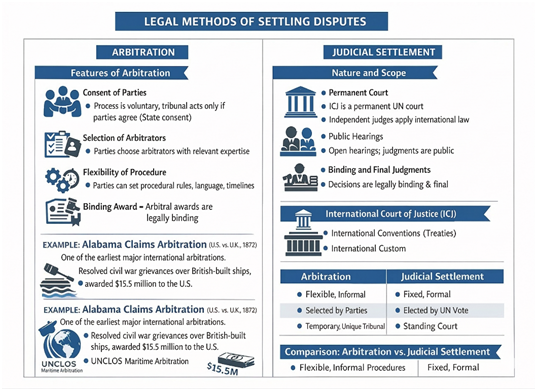
Arbitration is one of the most ancient and versatile legal mechanisms of peaceful settlement of conflicts. It implies supplying a dispute by individual consent of the disputing parties to an arbitration tribunal that was formed in that case. The tribunal makes a binding ruling that is referred to as arbitral award.
Arbitration is based on State consent. An agreement of a State cannot be persuaded to refer a dispute to arbitration against its will. This consent may be given:
- By a special settlement (compromis) where there is a dispute.
- Under an arbitration provision of a treaty.
- By prior acceptance under a general arbitration treaty.
The Alabama Claims Arbitration (1872) between the United States and the United Kingdom was one of the first and biggest instances of international arbitration. The case involved British built ships that were involved in the American Civil war by the Confederacy. The lawsuit gained the United States a compensation which proved that even politically sensitive cases could be solved in peaceful ways in court. This case was a turning point of institutionalization of arbitration.
The international arbitration today is sustained by the institutions like the Permanent Court of Arbitration, set by the 1899 and 1907 conventions of Hague. Although named so, the Permanent Court of Arbitration is not a court, in its literal sense; it is the administrative back-up and a list of arbitrators, of which the parties may pick.
Features of Arbitration
1.Consent of Parties
The process of arbitration is a voluntary one. The tribunal has the regional power to act only upon the will of the controversial States. This is a manifestation of the sovereign equality.
2.Selection of Arbitrators
Parties are at liberty to appoint arbitrators, who are usually persons of experience in the subject matter being addressed, like maritime law, environmental law or boundary delimitation. This improves trust in the process.
3.Flexibility of Procedure
Arbitration gives parties the chance to establish procedural rules, timelines, language and even law to be applied. This is its flexibility in contrast to judicial settlement in which procedures are pre-empted.
4.Binding Award
The award of the arbiter is binding on parties. International law may lead to a breach of obligation when the obligation is not respected.
Areas of Application
Arbitration is commonly applied in:
- Disputes over the maritime delimitation.
- Boundary disputes
- Dispute over investment (especially bilateral investment treaties)
- Environmental claims
- Trade disagreements
As an example, under the United Nations Convention on the Law of the Sea (UNCLOS) framework, arbitration has been an important mechanism in settling maritime disputes.
Judicial Settlement
Judicial settlement uses a permanent international court that resolves disputes and uses the existing rules of international law on the basis of formal judicial processes. As compared to arbitration where tribunals are established on particular disputes, the courts are institutional bodies that have laid down rules and composition.
International Court of Justice (ICJ) is the main judicial body of the United Nations. The ICJ, which was formed in the year 1945 as a successor of the Permanent Court of International Justice, is an international court that carries on its legacy as the most important international court in the world.
Nature and Scope
Judicial settlement is typified by:
- Permanent judges
- Existing procedural rules.
- Public hearings
- Reasoned judgments
Cases adjudicated by the Court as per the international law include:
- International conventions (treaties)
- International custom
- General principles of law
- As subsidiary means, judicial decisions and scholarly writings.
States are the only parties that can take part in contentious cases before the ICJ; this confirms its inter-State nature.
Significance of the Judicial Settlement.
The judicial settlement guarantees:
1.Impartial Adjudication
The judges are also in an independent position, and they should not take into consideration national interests. This enhances legitimacy and justice.
2.Historical Development of Jurisprudence.
The ICJ judgments elucidate the principles of law and help in the further evolution of the international law. Several historic decisions have informed doctrines like the state responsibility, self-defense, and delimiting the maritime.
3.Coherency in Interpretation
This makes the ICJ an active court as it encourages consistency in treaties and customary laws of international justice, thus increasing the levels of legal certainty.
4.Binding and Final Judgments
The decisions are final and binding on respective parties and no appeal. Revision can however be requested on the basis of restricted conditions when new overwhelming facts come forth.
Other Comparative Perspective: Arbitration vs Judicial Settlement.
Although arbitration and judicial settlement yield the binding decisions according to the international law, they are different in various aspects:
- Arbitration is informal and improvisational; court settlement is formal and institutional.
- In arbitration, judges are selected; in judicial settlement the judges are elected.
- Arbitration can be procedurally customized; settlement by the courts under the set rules.
Both of these mechanisms, nevertheless, support the idea that international conflicts must be solved in accordance with the law and not force.
4.The International Court of Justice.
The judicial organ of the United Nations is the International Court of Justice (ICJ) which was founded in 1945 under the Charter of the United Nations and whose work began in 1946. It replaced the Permanent Court of International Justice and goes on with its predecessor in ensuring the rule of law at the international level. The Court is located in the Peace Palace in The Hague, Netherlands, and it is at the center of peaceful resolving disputes between States.
A. Composition
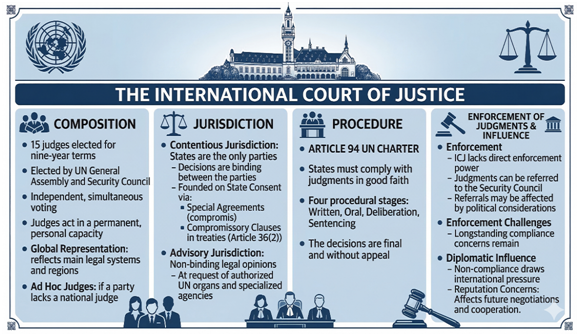
The Court is made up of 15 judges who are elected into a nine year term by the UN General Assembly as well as the Security Council, but independently and simultaneously. In order to be elected, a candidate should acquire the absolute majority in both organs. Both the international community and representation are guaranteed by this dual system of voting.
Judges should be individuals of good moral standing and who have attained the qualification to hold the highest judicial offices in their respective countries, or who are jurisconsults of competence in the international law. The Court should be composed of the main systems of the world, which will guarantee not only the geographical diversity but also the legal one. The judges of any State are not supposed to be two in a row, and impartiality and equality are to be maintained.
The Court renews the terms of President and Vice-President to three years. Even in disputable cases, in case a party lacks a judge of his or her nationality, then he or she may appoint an ad hoc judge, making equality among the parties a-priori.
B. Jurisdiction
The ICJ is completely jurisdictional based on State consent in terms of the principle of sovereign equality.
1.Contentious Jurisdiction
States are the only ones that can be parties in contentious proceedings. The decisions made by the Court are a binding law to the disputing parties. Jurisdiction can be acquired under:
- Exceptional agreements (compromis),
- In treaties compromissory clauses,
- Article 36(2) optional clause declarations in the ICJ Statute.
2.Advisory Jurisdiction
The Court can give advisory opinion on the request of authorized UN bodies and specialized agencies. Such views provide international jurisdictional issues.
C. Advisory Opinions
Advisory opinions are not binding but with great legal force. The Court has issued the most notable advisory opinions, such as the opinion of the use or threat of nuclear weapons as legal in 1996 and the opinion of the lawfulness of the construction of a wall in Occupied Palestinian Territory in 2004. Such opinions, though not binding, have an impact on the international law development and affect the activities of the States and international organizations.
D. Procedure
Cases before the ICJ are heard in four stages:
- Written Proceedings - presentation of memorials, counter-memorials, replies and rejoinders.
- Oral Hearings - hearings conducted by the general public at which the arguments are presented by the agents and the counsel.
- Deliberation - in-house judge conferences.
- Sentencing - rendered publicly and with justifiable opinions.
Verdicts are absolute and unappealable. Interpretation or revision can however be requested in exceptional circumstances outlined in the Statute. The ICJ supports the legitimacy of international law in the international system through its formal process and the rationality of its decision making.
5.Enforcement of Judgments
The success of any system of justice is mostly determined by the enforceability of the decisions made. When it comes to international law, enforcement is a different matter since there is no single global force. The Charter of the United Nations deals with the subject of member states complying with the ruling of the international court of justice (ICJ) in any case that the member state is a party to in article 94(1). This is an obligation that arises under the law whereby States have a duty to enforce the judgments of the Court in good faith.
In case a State does not abide by the judgment made in the ICJ, Article 94(2) provides that the aggrieved section may refer the issue to the Security Council. Recommendations may then be made by the Security Council or measures decided to be taken to bring into effect the judgment. But, the Charter does not stipulate automatic enforcement measures. The Council still reserves the right to do as it likes, and action can be influenced by politics, in particular the veto of permanent members.
The ICJ lacks its own enforcement equipment, unlike domestic courts because it lacks a police force or other enforcement mechanisms that are mandatory. Its jurisdiction is strongly based on the principle of pacta sunt servada (agreements should be observed) and the larger sense that States should honour their international commitments.
Practically, there has usually been a high level of compliance to the judgments of ICJ. States often comply because:
- Political Will: Governments are aware that the compliance to the international adjudication contributes to the diplomatic credibility and stability in the international relations.
- Diplomatic Pressure: Non-compliance can draw the criticism of other States and international organizations.
- Reputation and Legitimacy Concerns: Continuous ignorance of judgements can harm the reputation of a State on the international scale and can influence future negotiation or cooperation.
However, there are examples of slow or incomplete compliance which proves the structural weak point of international adjudication. The enforcement mechanism is eventually more of a voluntary cooperation and political mechanism than a coercive mechanism. In spite of this shortcoming, the rulings of the ICJ have a significant morally, legally and diplomatically high weight, which leads to the consolidation of the international rule of law.
6.Non-Peaceful Methods (Historical).
Before the establishment of the UN Charter in 1945, the international law failed to exhaustively forbid the use of force. War was considered to be a valid tool of national policy. States often used force to resolve the conflict or defend their interests. Even though these historical practices are highly discouraged or forbidden in the modern international law, it is significant to understand how these practices may have contributed to the development of peaceful dispute settlement.
Retorsion
Retorsion is considered unfriendly but lawful action imposed on the other State in retaliation of unfriendly actions. That is, in contrast to reprisals, retorsion does not entail the contravention of the international law. It is also an acceptable mode of reaction in the modern international law.
Widespread examples of retorsion are:
- Expulsion of diplomats
- Introduction of trade barriers.
- Suspension of economic aid
- Cessation of voluntary cooperation.
These are political as opposed to legal measures. They tend to express disapproval without necessarily turning into illegal behavior. Retorsion expresses the sovereign equality of States, and it gives them an opportunity to govern their external relations within the framework of legality.
Reprisals
Historically, reprisals dealt with acts which would otherwise have been illegal, but were taken as a response to a previous wrongful act by another State. This was to cause compliance or reparation.
The classical law of the law of nations allowed reprisals by seizing property, blockading or even restricted armed force. Nevertheless, the UN Charter changed this stance with the implementation of the Charter. Article 2(4) forbids any threat or the use of force against the territorial integrity or political independence of any State. A modern international law, therefore, has outlawed armed reprisals.
The institution still exists today in a modified version as countermeasures under the law of State responsibility. These countermeasures must:
- Be proportionate,
- Be instructed on compliance induction,
- Not involve the use of force,
- Adhere to basic human rights requirements.
In this way, the contemporary international law strictly controls and restricts coercive reactions.
Intervention
Intervention is described as meddling in internal or external matters of another State by one State in another State. Traditionally, strong States tended to intervene in order to defend its nationals, keep peace or advance ideological purposes.
The principle of non-intervention has been established by the contemporary international law. The Charter of the United Nations forbids intercession in the areas that basically lie within the local jurisdiction of States. The ban is strictly connected with the principle of sovereign equality.
Only two exceptions are identified:
- The Security Council pursued under Chapter VII of the UN Charter on the maintenance of international peace and security.
- Article 51 on self-defence when faced with an armed assault.
The principle of non-intervention is thus one of the pillars of the modern international legal order fortifying respect of sovereignty and territorial integrity.
7.Conclusion
The resolution of international disputes is one of the key pillars of international law in the contemporary world. Since the classical definition offered by the Permanent Court of International Justice to the modern international court of justice, the international legal system has transformed in the direction of peaceful and legal settlement instead of force. The Charter of the United Nations strongly provides the requirement of the States to settle disputes by peaceful methods including negotiation, mediation, arbitration, and judicial settlement.
On the one hand, diplomatic strategies enhance flexibility and cooperation, whereas on the other hand, legal mechanisms lead to binding and principled results that are based on international law. Even though there are issues of enforcement that should be tackled especially with the help of consent of the State and the political will, the general structure is indicative of a world commitment to stability and legality. The move toward historical forms of coercion to organized judicial and arbitral methods highlights the increasing power of the rule of law in international relations and the need in general to achieve a more peaceful international order.
Join LAWyersClubIndia's network for daily News Updates, Judgment Summaries, Articles, Forum Threads, Online Law Courses, and MUCH MORE!!"


Tags :Others