
Introduction: In which Geography is a Issue of Constitutionality.
The degradation of environmental protection via administrative ambiguity. In the case of the Aravallis which are among the oldest mountain ranges in the world they perform very important ecological services which in turn support climate stability, groundwater systems and biodiversity in the north western part of India. Also despite of long term judicial interest and statutory protections the region has seen continuous environmental decline. This decline is not due to the absence of laws but instead is a result of a progressive erosion of legal protections which in turn we see redefinition of what the said protections are for.
By way of bringing suit of its own accord the Supreme Court has put forth that environmental governance is not to be reduced to technical classification which ignores ecological fact. The case brings up basic issues of how we as a legal system recognize nature, how we as a body grant administrative discretion, and how we as a Constitution fulfill our environmental protection responsibilities. At the heart of the issue is the question of which we as a society should allow bureaucratic definitions to pass for the health of natural systems which do not operate in isolated parts.
The Aravalli range as a living ecological system.
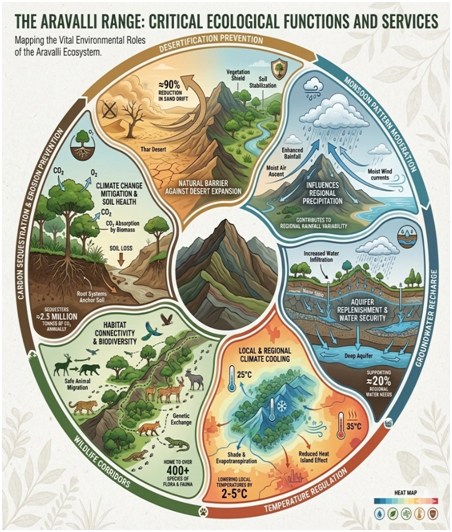
The Aravalli range which runs through Gujarat, Rajasthan, Haryana, and Delhi forms a geologic structure which is a hundred million years before the Himalayas. It’s a far from marginal role which the range plays. The Aravallis act as a break against desertification, they influence monsoon patterns, moderate extreme temperatures and also play a role in recharging groundwater in what is largely an arid and semi arid setting. Also the forested areas of the Aravallis support wildlife corridors and function as carbon sinks which the bare rock hill systems in turn do their part by regulating surface run off and preventing soil erosion.
Despite what is put forth by those functions, the Aravallis’ legal status has been very much a patchwork. Instead of presenting itself as a whole ecological unit the range has been divided up into what may be described as discrete parcels based on land use records, forest notifications, or planning zones. This approach puts aside the fact that from a scientific point of view ecological systems do not recognize administrative boundaries. What may happen in terms of environmental issues in one part of the Aravalli range will have a reaction in other parts of the region which may at first appear remote from the site of the issue at hand.
The Supreme Court notes that which environmental law must be in agreement with ecological continuity. We treat the Aravallis as a legal entity instead of a living system which in turn breaks the very base of environmental protection.
Historian’s account of the Aravalli Region’s Legal Protection.
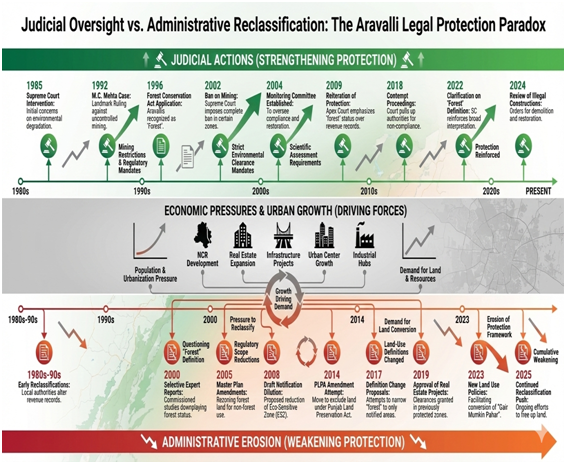
Judges have been involved in the issue of Aravalli Hills protection for many decades. The Supreme Court has brought up issues of mining, deforestation, and industrial activity which it saw to be the result of unregulated extraction. Also early judicial orders put forth that which mining do be restricted and that environmental clearances should be based in scientific assessment.
At the same time executives issued notifications for the control of land use and mining in the Aravalli region. What they did was to put into practice constitutional and statutory precepts under environmental law. But their success was a function of the clarity which the rules brought to bear on which areas they covered. As economic pressure grew which we see with the growth of urban centers in the National Capital Region that which made it attractive to reduce the scope of environmental regulation.
Over the years the Aravalli Hills definition has become fluid. Various departments put forth different criteria, which expert reports supported selectively, and we saw administrative classifications which changed in regard to development needs. This loss of definitional clarity in turn made judicial and regulatory interventions less and less effective which in turn put the Supreme Court to act in the present case.
Administrative Reform and the Structure of Regulatory Evasion.
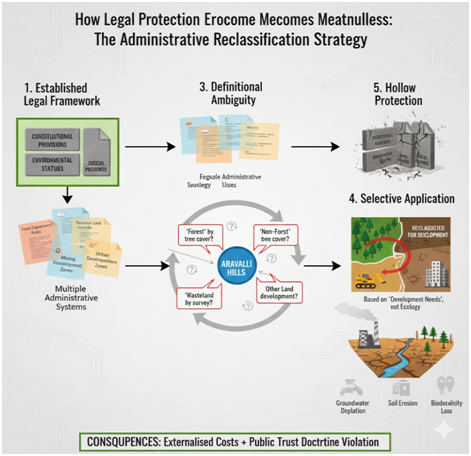
The Aravalli debate is a case of a larger trend in environmental policy which sees ecological damage done via the legal back door so to speak we see this in how authorities have redefined the Aravalli Hills’ which in turn has allowed them to put forward large areas out of environmental protection which they did so without changing any actual laws or regulations.
This strategy brings up the issue of the rule of law. We see that environmental policies and constitutional tenets are put in place to prevent permanent damage to natural resources. When through administrative reclassification their application is done away with that is when the law becomes a tool for short term economic gain. The Supreme Court’s role in this picture is to put forth that which which is variable in regulatory definition cannot be the base of environmental protection.
In this case we are asked to reevaluate the notion that environmental law has to put substance over form. Environmental identity is not to be done away with by administrative decree, and legal interpretation must present environmental reality instead of institutional convenience.
Mining, urban development, and the environmental damage which becomes the new normal.
Mining has through history been a very destructive practice in the Aravalli region. Although we see many a time prohibitions and regulatory frameworks put in place, mining which is just as much if not more present in other areas which the law doesn’t define as part of the Aravalli also happens. That which puts forth such reasoning is to ignore geologic continuity and the cumulative environment impact.
Urban growth has accelerated its footprint in this region. In Delhi’s nearby areas we see large scale development projects which have taken over our hills that for long had served as a natural defense against pollutants and flooding. We have seen the land change -- from covered in trees to large scale alteration of the terrain which in turn has led to drop in ground water levels and poor air quality. These are now playing out in the form of water scarcity issues and environmental stress which we see play out in our everyday lives.
By way of clarifying the definition which gives rise to such activities the Supreme Court is putting forward to the issue of structural elements which promote ecological damage at the same time which we see as legal compliance.
Protected Establishments of Natural Protection
The Incomparable Court’s suo motu activity is grounded in sacred convention. Article 21 of the Structure, as deciphered by the Court, includes the right to a solid environment as an basic component of the right to life. Articles 48A and 51A(g)v strengthen this commitment by coordinating the State and citizens to secure and progress the environment.
These arrangements force positive obligations on the State. Natural assurance is not a matter of approach caution but a sacred prerequisite. When official activity undermines this necessity through subjective or informal classifications, legal mediation gets to be essential. The Aravalli case outlines how definitional control can viably deny citizens of their sacred right to natural quality without any formal authoritative change.
Precautionary Rule and Intergenerational Equity
Central to Indian natural statute is the preparatory guideline, which requires that natural hurt be expected and anticipated or maybe than tended to after it gets to be irreversible. The definitional uncertainty encompassing the Aravalli Slopes undermines this rule by permitting possibly hurtful exercises to continue until harm is conclusively established.
Closely connected is the guideline of intergenerational value. The Aravalli extend, formed over topographical time scales, cannot be recovered inside any significant human time period once annihilated. Its debasement speaks to a changeless misfortune not as it were to the display era but to all future eras. The Incomparable Court’s request on definitional clarity reflects an understood acknowledgment that the display era holds common assets in believe or maybe than ownership.
Scientific Information and the Limits of Bureaucratic Authority
Environmental administration must be educated by logical understanding. Geographical progression, hydrological affect, and biological work cannot be decided by income records or zoning maps alone. However, the Aravalli contention uncovers a diligent propensity to subordinate logical prove to regulatory convenience.
By addressing the premise of the definitions embraced by governments, the Incomparable Court is reaffirming that bureaucratic specialist has limits. Regulatory tact cannot abrogate environmental reality, especially where the results of blunder are irreversible. This approach adjusts with the Court’s broader law underscoring the part of master input in natural decision-making.
Federalism and Shared Natural Responsibility
The Aravalli Slopes span different states, making their assurance a shared duty. Whereas arrive and mining are state subjects, natural assurance falls inside the concurrent space, requiring coordination between the Union and the states. The discussion uncovered the dangers of divided administration, where states organize neighborhood financial interface at the cost of broader environmental concerns.
The Incomparable Court’s examination of the Union government’s position underscores that federalism cannot serve as a legitimization for natural disregard. Where states fall flat to maintain natural benchmarks, the Union bears a sacred duty to mediate. The suo motu procedures hence fortify the thought that natural assurance rises above authoritative boundaries.
Remedial Law and Authorization Failure
A repeating challenge in natural arbitration is the hole between legal statements and regulatory usage. In spite of various court orders confining mining and ordering natural shields in the Aravalli locale, corruption has continued. Definitional equivocalness has permitted specialists to claim compliance whereas proceeding hurtful activities.
By centering on the definition itself, the Court is moving from long winded restriction to auxiliary redress. This speaks to a develop medicinal approach that looks for to address the root cause of administrative disappointment or maybe than its symptoms.
Environmental Run the show of Law and Law based Accountability
The Aravalli case too highlights issues of equitable responsibility. Definitional changes with significant natural results have regularly been made without significant open discussion. Their specialized nature shields them from examination, permitting environmental hurt to continue through schedule regulatory processes.
Judicial audit in such settings serves a equitable work by subjecting official activity to protected benchmarks. It guarantees that natural administration remains straightforward, contemplated, and responsible to open intrigued or maybe than protects inside bureaucratic processes.
Toward a Steady System for Environmentally Delicate Areas
The noteworthiness of the Preeminent Court’s mediation expands past the Aravalli Slopes. A science-based approach to characterizing environmentally touchy ranges might impact natural administration over the nation. Clear definitions grounded in biological reality would diminish administrative instability and constrain openings for manipulation.
Such a system would reinforce natural law by adjusting lawful assurance with natural work. It would too give clarity to controllers, designers, and communities, guaranteeing that advancement continues inside biologically economical limits.
Land Utilize Arranging, Urban Administration, and the Imperceptible Disintegration of Environmental Safeguards
An extra measurement that requests consideration in the Aravalli Slopes discussion is the part of arrive utilize arranging and urban administration in encouraging natural corruption. Ace plans, zoning directions, and improvement consents regularly work as the last watchmen between biological assurance and irreversible change of scenes. In the setting of the Aravallis, arranging disobedient have over and over been adjusted with contract authoritative definitions or maybe than biological substances. Ranges once perceived casually as portion of the slope framework have been redesignated as private, commercial, or mechanical zones through arranging archives, in this manner legitimizing development movement without activating natural scrutiny.
This prepare makes a criticism circle between arranging specialists and natural controllers. Once arrive is appeared as developable in a ace arrange, natural clearance forms tend to continue on the presumption that the biological address has as of now been settled. The definitional equivocalness encompassing the Aravalli Slopes hence relocates from natural law into urban administration, inserting biological disintegration inside the engineering of city arranging itself. The Preeminent Court’s mediation verifiably challenges this energetic by proposing that arranging choices cannot abrogate environmental truth. Urban administration, in any case modern, cannot be allowed to work as a backdoor for disassembling natural assurances.
Natural Affect Appraisal and the Figment of Procedural Compliance
Environmental Affect Appraisal forms are planning to serve as a basic defend against naturally destructive ventures. In any case, in the Aravalli locale, these forms have regularly worked as procedural customs or maybe than substantive assessments. When a venture location is authoritatively avoided from the Aravalli classification, the scope of natural appraisal is naturally limited. The total affect of different ventures on the broader slope framework is seldom inspected, as each extend is surveyed in segregation inside an misleadingly limited spatial frame.
This compartmentalised approach undermines the exceptionally rationale of natural evaluation. Environmental frameworks do not react to ventures independently but to their combined impacts over time. The Incomparable Court’s concern with definitional clarity is hence closely connected to the keenness of natural appraisal components. Without a steady and logically grounded understanding of the Aravalli Slopes, natural clearance forms chance getting to be works out in procedural compliance or maybe than disobedient of biological protection.
The Judiciary’s Organization Memory and Natural Continuity
One of the qualities of legal mediation in natural things lies in the Court’s organization memory. Not at all like regulatory organizations, which may alter positions with moving political or financial needs, the legal holds coherence through point of reference. The Incomparable Court’s past engagement with the Aravalli locale gives a verifiable record of biological concern that cannot be deleted through authoritative reinterpretation.
The suo motu procedures can hence be caught on as an statement of legal progression against authoritative instability. By returning to the definitional establishments of prior orders, the Court is reaffirming that its natural law cannot be rendered out of date by moving official accounts. This coherence is especially vital in natural law, where hurt gathers steadily and gets to be obvious as it were over amplified periods. Legal memory serves as a counterweight to short-term decision-making that organizes quick picks up over long-term biological stability.
Economic Advancement, Natural Trade-Offs, and Untrue Dichotomies
The Aravalli wrangle about is regularly surrounded as a strife between natural security and financial improvement. This surrounding is deluding. The issue is not whether improvement ought to happen, but whether it ought to continue through the disintegration of biological shields camouflaged as definitional alterations. Economical improvement, as perceived by Indian courts, requires adjusting financial development with natural assurance, not subordinating the last mentioned through semantic manoeuvres.
The corruption of the Aravalli Slopes eventually forces financial costs that are seldom accounted for in advancement calculations. Groundwater exhaustion, discuss contamination, expanded flooding, and misfortune of climate flexibility carry long-term social and financial results. By permitting natural hurt to continue through authoritative uncertainty, administration frameworks externalise these costs onto future eras and helpless communities. The Incomparable Court’s intercession challenges the untrue polarity between improvement and assurance by demanding that improvement choices must be grounded in biological honesty.
Public Believe Tenet and the Limits of State Discretion
The open believe teaching gives a capable conceptual system for understanding the Aravalli discussion. Beneath this teaching, the State holds characteristic assets in believe for the open and cannot resign its duty by exchanging control or modifying classification in a way that undermines collective intrigued. The definitional weakening of the Aravalli Slopes successfully constitutes a halfway abandonment of this believe, permitting private misuse of assets that serve basic open functions.
Judicial examination of such activities is not an interruption into official policy-making but an authorization of guardian obligation. The Incomparable Court’s suo motu activity fortifies the thought that state tact over normal assets is compelled by sacred commitment. Authoritative specialist does not amplify to rethinking open believe resources out of legitimate existence.
The Broader Flag to Natural Administration in India
Beyond the prompt setting of the Aravalli Slopes, the Preeminent Court’s intercession sends a broader flag around the future of natural administration in India. It shows legal unwillingness to endure administration procedures that depend on specialized equivocalness to delude natural shields. It moreover proposes a reestablished accentuation on coherence, consistency, and logical establishing in natural decision-making.
If the Court succeeds in building up a clear and strong definition of the Aravalli Slopes, it will fortify the regulating establishment of natural law. It will illustrate that environmental frameworks cannot be divided into regulatory comforts and that natural assurance requires devotion to reality or maybe than adaptability of interpretation.
Conclusion
The Incomparable Court’s suo motu cognisance of the definitional uncertainty encompassing the Aravalli Slopes goes up against a systemic shortcoming in India’s natural administration. By tending to how biological spaces are characterized, the Court is challenging the inconspicuous components through which natural assurance is dissolved without formal lawful change.
This intercession reaffirms that natural assurance is a sacred basic grounded in logical truth, intergenerational obligation, and the run the show of law. In demanding that nature cannot be authoritatively re-imagined out of presence, the Preeminent Court is not only securing a mountain run. It is fortifying the foundational guideline that the law must serve biological reality or maybe than delete it.
Join LAWyersClubIndia's network for daily News Updates, Judgment Summaries, Articles, Forum Threads, Online Law Courses, and MUCH MORE!!"


Tags :Others