
Index
- Introduction
- Background of the Case
- The Petitioner’s Grievance
- The RTI Applications Filed by the Petitioner
- The High Court’s Response to the RTI Queries
- Arguments Before the Court
- Findings of the Division Bench
- Legal Reasoning on Article 14
- The Role of Notarised Affidavits
- Why the Writ Petition Was Dismissed
- Conclusion
- Frequently Asked Questions
1.Introduction
The High Court of Judicature at Allahabad, Lucknow Bench, recently decided a writ petition that questioned the fairness of a long-standing administrative practice known as the Photo Affidavit Identification Regime. The case, Biswajit Chowdhury v. Registrar General, High Court of Judicature at Allahabad and Others, was heard by a Division Bench of Hon’ble Alok Mathur, J. and Hon’ble Amitabh Kumar Rai, J. in Writ-C No. 6896 of 2026. The judgment, delivered on July 16, 2026, dismissed the petition but clarified an important point of procedure that affects every litigant who files a writ petition before the Allahabad High Court, whether at the Principal Seat or the Lucknow Bench.
This article examines the facts of the case, the petitioner’s arguments, the Court’s reasoning, and what the ruling means for future litigants who wish to avoid unnecessary travel for the purpose of affidavit attestation.
2.Background of the Case
The petitioner, Biswajit Chowdhury, appeared in person through online mode. He challenged the validity of an Office Memorandum dated October 7, 2015, along with all connected memoranda and administrative instructions issued under it. His central prayer was for a declaration that the Photo Affidavit Identification Regime was arbitrary and discriminatory, and therefore violated Article 14 of the Constitution of India, which guarantees equality before the law.
Before approaching the Allahabad High Court, the petitioner had already moved the Supreme Court of India by filing Writ Petition (Civil) No. 479 of 2025. The Supreme Court disposed of that petition but granted him liberty to submit a representation before the Chief Justice of the Allahabad High Court. Following this, the petitioner used the Right to Information Act, 2005 to seek official clarity on the rules governing photo affidavit attestation.
3.The Petitioner’s Grievance
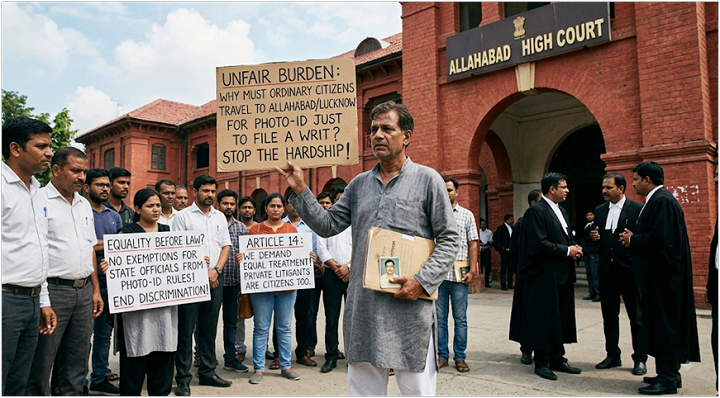
The petitioner’s core complaint was straightforward. He argued that no litigant should be compelled to travel physically to Allahabad or its Lucknow Bench simply to complete a photo identification process before filing a writ petition. According to him, this requirement placed an unfair burden on ordinary citizens, particularly those living far from these two cities.
He further pointed out what he saw as an unequal system. Officials of the State Government, the Union Government, and various instrumentalities of the State appeared to enjoy an exemption from this photo identification requirement, while private litigants did not. He argued that this differential treatment lacked a rational basis and therefore violated the equality clause of the Constitution.
4.The RTI Applications Filed by the Petitioner
To test his understanding of the rules, the petitioner filed a detailed RTI application containing five specific queries. These included the following points.
First, whether litigants residing outside Allahabad or Lucknow were required to travel to these Benches solely to obtain photograph-based affidavit attestation.
Second, whether the Office Memorandum of October 7, 2015 was still in force.
Third, whether the High Court Registry accepted affidavits sworn before Notaries Public at the applicant’s place of residence.
Fourth, whether affidavits containing photographs taken elsewhere, but otherwise valid and duly notarised, were treated as defective at the filing stage.
Fifth, whether affidavits notarised through recognised e-notarisation platforms, which use video-based verification, were accepted for filing.
5.The High Court’s Response to the RTI Queries
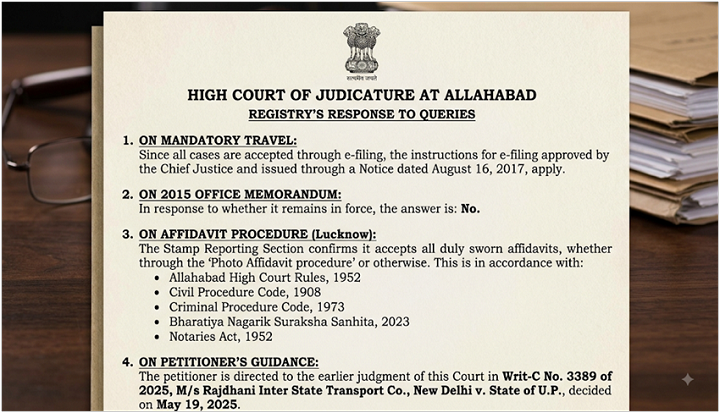
The High Court’s Registry responded to each point. On the question of mandatory travel, the Registry clarified that since all cases were being accepted through e-filing, the instructions for e-filing approved by the Chief Justice and issued through a Notice dated August 16, 2017 applied to such cases.
On the second query, regarding whether the 2015 Office Memorandum remained in force, the Registry gave a simple answer: No.
On the third query, the Stamp Reporting Section at Lucknow confirmed that it accepted all duly sworn affidavits, whether sworn through the Photo Affidavit procedure or otherwise, in line with the Allahabad High Court Rules 1952, the Civil Procedure Code 1908, the Criminal Procedure Code 1973, the Bharatiya Nagarik Suraksha Sanhita 2023, and the Notaries Act 1952.
On the fourth query, the Registry pointed the petitioner to an earlier judgment of the Court in Writ-C No. 3389 of 2025, titled M/s Rajdhani Inter State Transport Co., New Delhi v. State of U.P., decided on May 19, 2025.
6.Arguments Before the Court from both sides
During the hearing, Shri Vijay Dixit, learned counsel appearing for Respondent Nos. 1 and 2, informed the Bench that notarised affidavits were indeed accepted by the Stamp Reporting Section and that no defects were being raised against affidavits simply because they were notarised rather than photo verified.
The petitioner also told the Court that he had earlier filed Writ Petition No. 7285 of 2023 under Article 227 of the Constitution. He stated that no adverse report had been submitted by the Registry regarding that petition, even though he had, on that earlier occasion, travelled to Allahabad to complete photo verification. He explained that he had done so because his counsel at the time had advised him that such travel was mandatory.
7.Findings of the Division Bench
The Bench carefully examined the response furnished by the High Court, especially the answer to Query No. 3. It found that the Stamp Reporting Section of the Lucknow Bench accepted all duly sworn affidavits, regardless of whether they were sworn through the Photo Affidavit procedure or through ordinary notarisation.
Based on this, the Court concluded that an affidavit duly notarised anywhere in the country is accepted at the stage of filing a writ petition. This meant that no person is mandatorily required to visit the Photo Verification Centre established within the High Court premises simply to get an affidavit verified before filing.
The Bench also noted that during the COVID-19 pandemic, the Chief Justice had introduced e-filing rules, and these instructions continued to remain in force. In effect, the entire system of filing petitions had shifted toward electronic submission, further reducing the practical need for in-person photo verification.
8.Legal Reasoning on Article 14
Although the petitioner had framed his case as a constitutional challenge based on Article 14, the Court did not need to enter into an extended analysis of equal protection principles. This is because the factual premise of the petitioner’s argument, namely that ordinary litigants were forced to appear in person while government officials were exempted, did not hold up once the Court examined the actual practice followed by the Registry.
The Bench found that notarised affidavits from anywhere in India were accepted without objection. Since there was no genuine two-tier system in operation, the alleged discrimination did not exist in practice. The Court therefore did not find it necessary to strike down the 2015 Office Memorandum or examine whether it violated the equality clause, because the memorandum itself was no longer in force and the current practice already permitted litigants to avoid physical travel.
As per Aadhithya Sarathy, an associate at Athena Legal, the court’s decision did not hold that the 2015 Office Memorandum’s exemption for government officials was constitutionally valid, or that such an exemption would survive Article 14 scrutiny if still in force and applied unevenly. It simply held that the OM was no longer operative and that the alleged discrimination did not exist in practice. That was a finding of fact, not a constitutional ruling.
9.The Role of Notarised Affidavits
One of the most useful clarifications to come out of this judgment is the confirmation that affidavits notarised anywhere in the country, not only in Allahabad or Lucknow, are acceptable for filing writ petitions. This is significant because many litigants and even some advocates continue to believe that photo verification at the High Court premises is compulsory.
The Court’s finding effectively confirms that a litigant residing in a distant state, or even outside India, can have an affidavit notarised locally and file it along with a writ petition without needing to travel to Uttar Pradesh at all.
The judgment also highlights how e-filing has changed the practical landscape of litigation before the Allahabad High Court. Instructions approved by the Chief Justice and issued through the 2017 Notice on e-filing remain applicable, and these rules were expanded and relied upon extensively during the pandemic years. The Court’s observation that these instructions continue to remain in force means that litigants can rely on electronic submission as the primary and often sufficient mode of filing.
10.Why the Writ Petition Was Dismissed
The Bench held that once the High Court itself had clarified through its RTI response that notarised affidavits were accepted, there was no reason for the petitioner to continue pursuing the writ petition. The Court observed that the petition had become superfluous and had consumed the Court’s time in examining contentions that were already resolved by the Registry’s own admission.
The Bench was also careful to note that it would not comment on the advice given to the petitioner by his own counsel in the earlier 2023 matter, since legal advice given by a counsel to a client cannot be the subject of adjudication in a writ petition. The Court limited itself to examining the actual rules governing affidavits, and on that basis, found no interference was warranted.
Accordingly, the writ petition was dismissed on July 16, 2026.
For readers looking to build on the procedural clarity offered by this judgment, understanding how to draft and file writ petitions effectively remains a valuable skill for practitioners and law students alike. Lawyers Club India's Writs and PIL's Practical Training course, led by Kush Kalra, offers a practical approach to mastering writ jurisdiction and Public Interest Litigation covering drafting techniques, procedural nuances, and courtroom strategy that go beyond textbook theory.
11.Conclusion
This judgment, though ultimately a dismissal, performs a useful clarifying function for the legal community. It confirms, on record, that the Allahabad High Court and its Lucknow Bench do not require litigants to physically travel for photo-based affidavit verification, and that notarised affidavits sworn anywhere in India are acceptable. While the petitioner did not succeed in obtaining the constitutional declaration he sought, his persistence through RTI applications and subsequent litigation produced a clear administrative clarification that will likely benefit countless future litigants who might otherwise have travelled unnecessarily based on outdated advice or assumptions.
12.Frequently Asked Questions
- a.Is it mandatory to travel to Allahabad or Lucknow to get a writ petition affidavit verified?
No. The Allahabad High Court has confirmed that affidavits notarised anywhere in the country are accepted for filing. Physical travel to the Photo Verification Centre is not compulsory. - b.What happened to the Office Memorandum dated October 7, 2015?
The High Court Registry confirmed, in response to the petitioner’s RTI application, that this Office Memorandum is no longer in force.
Join LAWyersClubIndia's network for daily News Updates, Judgment Summaries, Articles, Forum Threads, Online Law Courses, and MUCH MORE!!"


Tags :Others