
INTRODUCTION
The Supreme Court has recently delivered an important judgment on gender equality in matters of compassionate appointment, holding that a married daughter cannot be excluded from consideration merely because of her marital status.
In Sayara Khatoon @ Shayara Khatoon & Anr. v. State of Bihar & Ors., decided on July 23, 2026, the Supreme Court examined the validity of a Bihar Government policy which restricted compassionate appointment to divorced or deserted daughters. The Court found that such a distinction could not be sustained in law, particularly when it assumed that a daughter, after marriage, necessarily leaves her parental family and becomes a part of her matrimonial family.
The Bench comprising Justice M.M. Sundresh and Justice Prasanna B. Varale made it clear that there can be no presumption in law that marriage severs a daughter's ties with her parents. The Court further observed that a classification differentiating a daughter from a son merely on the basis of marital status is constitutionally impermissible.
However, the judgment does not mean that every married daughter is automatically entitled to compassionate appointment. The Supreme Court's ruling is more precise: marriage cannot be used as a blanket ground to exclude a daughter from consideration. The applicant must still satisfy the other requirements of the applicable compassionate appointment scheme. The judgment assumes significance because it places the focus on the actual circumstances of the family rather than traditional assumptions surrounding a woman's marital status.
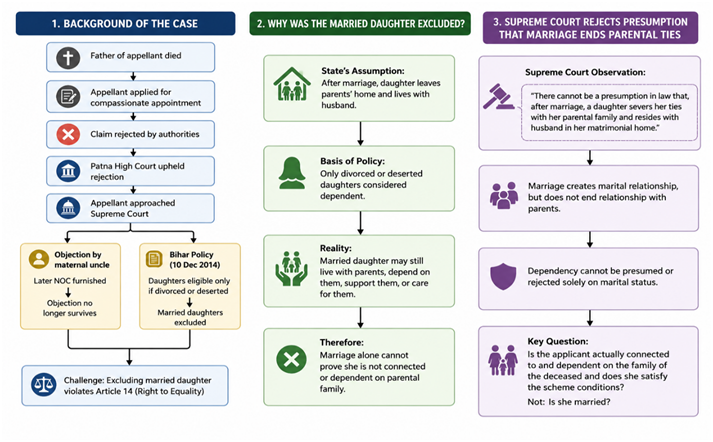
BACKGROUND OF THE CASE
The dispute arose following the death of the appellant's father, after which the appellant sought compassionate appointment. Her claim was rejected by the concerned authorities, and the matter subsequently reached the Patna High Court, which upheld the rejection. Aggrieved by the High Court's decision, the appellant approached the Supreme Court.
The rejection of the claim involved more than one ground. One of the objections concerned a family member who had opposed the claim. However, during the proceedings, it was brought to the Court's attention that the concerned maternal uncle had subsequently furnished a No-Objection Certificate (NOC). Consequently, the objection which had earlier been relied upon by the authorities no longer survived.
The more important issue concerned the Bihar Government's policy dated December 10, 2014. Under the policy, daughters could be considered for compassionate appointment only if they were divorced or deserted. This meant that a daughter who was married but was neither divorced nor deserted was effectively excluded from consideration.
The appellant challenged this distinction, arguing that excluding a married daughter merely because of her marital status was contrary to the constitutional guarantee of equality under Article 14. The issue before the Supreme Court, therefore, was not simply whether the appellant was entitled to compassionate appointment. The more fundamental question was whether the State could prevent a daughter from even being considered for such appointment solely because she was married.
Why Was the Married Daughter Excluded?
The State's position was based on a conventional understanding of family structure. The underlying reasoning was that a daughter ordinarily leaves her parental home after marriage and resides with her husband in her matrimonial home. Consequently, a married daughter was presumed to no longer be dependent upon her parental family.
This assumption formed the basis for distinguishing between divorced or deserted daughters and other married daughters. The Supreme Court, however, found that such an assumption could not form the basis of a legal classification.
A woman's marital status does not necessarily reveal her financial circumstances, place of residence or relationship with her parents. A married daughter may continue to live with her parents, depend upon them financially, support them financially, or remain responsible for their care. Therefore, the mere fact that she is married cannot conclusively establish that she is no longer connected with or dependent upon her parental family.
SUPREME COURT REJECTS PRESUMPTION THAT MARRIAGE ENDS PARENTAL TIES
The most significant observation of the Supreme Court concerned the assumption that marriage automatically changes a daughter's relationship with her parental family.
The Court observed:
“There cannot be a presumption in law that, after marriage, a daughter severs her ties with her parental family and resides with husband in her matrimonial home.”
This observation strikes at the foundation of the Bihar policy. The State had effectively treated marriage as a legal indicator that a daughter had moved out of her parental family. The Supreme Court rejected this approach.
Marriage undoubtedly creates a matrimonial relationship, but it does not legally erase the relationship between a daughter and her parents. More importantly, dependency cannot be presumed or rejected solely on the basis of marital status.
If the object of compassionate appointment is to provide relief to a family facing financial hardship following the death of an employee, the relevant question should be whether the applicant is actually connected to and dependent upon that family, and whether she satisfies the conditions prescribed by the scheme. The answer cannot simply be determined by asking whether she is married.
Article 14: Can a Daughter Be Treated Differently From a Son?
The constitutional issue in the case primarily arose under Article 14 of the Constitution. Article 14 guarantees equality before the law and equal protection of the laws. While the State is permitted to create reasonable classifications, such classifications must have a legitimate basis and cannot be arbitrary or discriminatory.
The Supreme Court observed that it has repeatedly held that a classification differentiating a daughter from a son is “per se, unconstitutional.” The Bihar policy effectively imposed a restriction on daughters based upon their marital status. A divorced or deserted daughter could fall within the category of persons eligible for compassionate appointment, whereas a married daughter who was neither divorced nor deserted could not.
The Court found that this distinction could not be justified merely by relying upon the assumption that married daughters leave their parental families. The problem becomes even clearer when the position of sons is considered. Marriage does not automatically terminate a son's relationship with his parents. A married son continues to be regarded as a member of his parental family for numerous legal and social purposes. There was therefore no constitutionally sustainable reason to treat marriage as having a different legal consequence for a daughter.
The Court's reasoning reinforces the principle that gender-based assumptions cannot be converted into eligibility conditions for government benefits without a constitutionally valid justification.
THE APPELLANT'S ACTUAL CIRCUMSTANCES
The factual circumstances of the appellant also played an important role in the Court's reasoning. The appellant submitted that although her divorce had not been formally recognised in law, she was residing with her parental family and was receiving support from her mother and brother.
This was particularly significant because it directly contradicted the State's assumption. The State's position essentially proceeded on the basis that because the appellant was married, she belonged to her matrimonial family. But the facts before the Court demonstrated that her actual circumstances were different. She continued to live with her parental family and remained connected to them.
The Supreme Court therefore refused to allow a general assumption about married women to override the factual circumstances of the individual case. This is an important aspect of the judgment. The Court did not hold that marital status can never be relevant while determining dependency. Rather, it held that marital status cannot be treated as conclusive proof that dependency does not exist. The actual circumstances have to be examined.
SUPREME COURT CRITICISES A "HYPER-TECHNICAL" APPROACH
The Court also took note of the manner in which the appellant's claim had been dealt with by the authorities. The Supreme Court observed that:
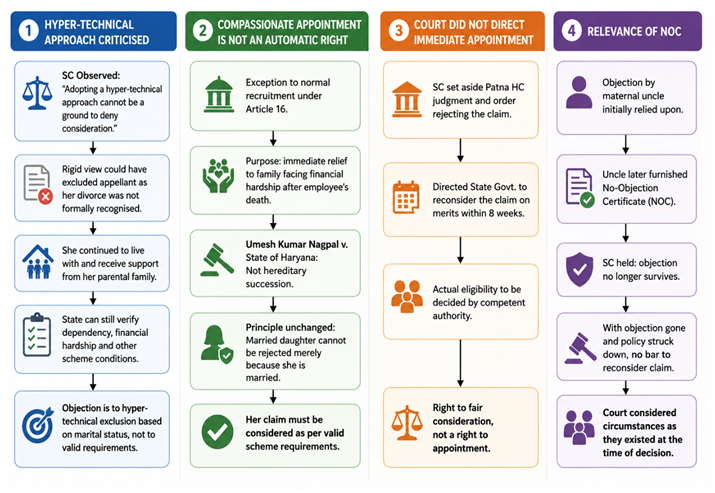
“adopting a hyper-technical approach cannot be a ground to deny consideration of her claim for compassionate appointment.”
The observation is significant in the context of the appellant's marital and family circumstances. A rigid interpretation of the policy could have resulted in the appellant being excluded because she did not formally fall within the category of a “divorced” daughter. However, the Court found that the authorities could not use such a technical approach to avoid examining the substance of the claim, particularly when the appellant continued to live with and receive support from her parental family.
At the same time, the Court did not eliminate the requirements of the compassionate appointment scheme. The State can still determine whether the applicant is actually dependent upon the deceased employee's family, whether there is financial hardship and whether the applicant satisfies the other conditions prescribed under the applicable rules.
The Court's objection was therefore to a hyper-technical exclusion based upon marital status, rather than to the enforcement of legitimate eligibility requirements.
Compassionate Appointment Is Not an Automatic Right
It is important to understand the judgment alongside the settled law on compassionate appointment. Compassionate appointment is an exception to the normal rule governing public employment. Ordinarily, government posts are required to be filled through a proper recruitment process consistent with the constitutional guarantee of equality of opportunity under Article 16.
Compassionate appointment exists for a limited purpose: to provide immediate relief to the family of a government employee who dies while in service and leaves the family facing financial hardship. In Umesh Kumar Nagpal v. State of Haryana, the Supreme Court explained that compassionate appointment is intended to enable the family to overcome the sudden financial crisis caused by the death of the employee. It is therefore not a form of hereditary succession.
This principle remains unchanged by Sayara Khatoon. The Court did not say that every married daughter is entitled to government employment. Instead, it held that a married daughter cannot be rejected at the threshold merely because she is married. Her claim must be considered in accordance with the valid requirements of the applicable scheme.
The Court Did Not Direct Immediate Appointment
This distinction is particularly important. Although headlines may suggest that the Supreme Court has granted married daughters a right to compassionate employment, that is not what the judgment actually holds.
The Court did not direct the State to appoint the appellant immediately. Instead, it set aside the Patna High Court's judgment and the order rejecting the appellant's claim and directed the State Government to reconsider her claim for compassionate appointment on its own merits within eight weeks.
Thus, the Supreme Court removed the unconstitutional barrier but left the actual determination of eligibility to the competent authority. The State must now consider the claim without treating the appellant's marital status as an automatic disqualification.
This preserves the distinction between a right to fair consideration and a right to appointment.
The Relevance of the NOC
The Supreme Court also dealt with the objection raised by the appellant's maternal uncle. Initially, this objection had been relied upon as one of the reasons affecting the claim. However, the uncle subsequently furnished a no-objection certificate, following which the Supreme Court observed that the objection no longer survived.
Although this issue was relatively straightforward, it was relevant to the Court's ultimate decision. Once the objection had ceased to operate, and the marital-status restriction itself was found constitutionally unsustainable, there remained no basis for preventing the State from reconsidering the appellant's claim on its merits.
The Court therefore considered the circumstances as they existed at the time of its consideration rather than allowing an earlier objection to continue indefinitely after the person concerned had withdrawn it.
EARLIER JUDICIAL RECOGNITION: VIMLA SRIVASTAVA V. STATE OF U.P.
The Supreme Court's reasoning is consistent with earlier judicial decisions dealing with the exclusion of married daughters from compassionate appointment.
In Smt. Vimla Srivastava v. State of U.P., the Allahabad High Court considered the Uttar Pradesh Recruitment of Dependents of Government Servants Dying-in-Harness Rules, 1974. The rules treated an unmarried daughter as a member of the relevant family but did not impose an equivalent restriction on sons.
The Court found the distinction unconstitutional. The underlying assumption was similar to the one challenged in the present case: a son remained part of his parental family even after marriage, whereas a daughter was treated as ceasing to be part of that family once she married.
The Allahabad High Court rejected this approach and held that the exclusion of married daughters violated the constitutional guarantees of equality. The reasoning in Sayara Khatoon therefore forms part of a broader judicial recognition that marriage cannot automatically determine a daughter's legal relationship with her parental family.
KULSUM NISHA: ANOTHER STEP AWAY FROM MARITAL STATUS-BASED EXCLUSION
The Supreme Court's decision also comes shortly after its judgment in Kulsum Nisha v. State of Uttar Pradesh, 2026 INSC 617. Although that case arose under a different scheme, the underlying issue was similar.
A married daughter had sought appointment as a fair price shop dealer on compassionate grounds following the death of her mother. The applicable government order excluded a married daughter from the relevant definition of family. The Supreme Court rejected such an exclusion and emphasised that dependency is a factual question.
A woman does not become automatically independent of her parental family simply because she gets married. While Kulsum Nisha concerned a fair price shop dealership rather than a government service appointment, the constitutional reasoning is relevant to Sayara Khatoon. Both decisions reject the idea that marital status can serve as a conclusive substitute for an inquiry into actual dependency.
WHAT DOES THE JUDGMENT MEAN FOR MARRIED DAUGHTERS?
The judgment does not create a blanket entitlement to compassionate appointment. Instead, it establishes an important constitutional safeguard: a married daughter seeking compassionate appointment cannot be rejected merely by saying that she is married and therefore belongs to her matrimonial family.
Her actual circumstances must be examined, and if she satisfies the other requirements of the applicable scheme, her claim must be considered in accordance with law. The relevant inquiry therefore shifts from simply asking whether she is married to examining whether she is otherwise eligible and whether the circumstances of the family justify compassionate relief.
This may require the authorities to examine factors such as dependency, financial hardship, residence, educational qualifications and other conditions prescribed under the applicable rules. The State remains entitled to enforce legitimate eligibility requirements, but it cannot use marriage as an automatic disqualification.
WHY THE JUDGMENT MATTERS BEYOND COMPASSIONATE APPOINTMENT
The significance of Sayara Khatoon extends beyond the particular Bihar policy. At its heart, the case concerns the use of gender stereotypes in government policy.
The assumption that a daughter belongs to her parental family only until marriage is rooted in a traditional understanding of family relationships. The Supreme Court has made it clear that such a social assumption cannot automatically become a legal presumption.
A woman's marital status does not tell the State everything about her economic circumstances. She may be married but dependent upon her parents, married but living with her parents, married and supporting her parents, or responsible for the care of members of her parental family. These circumstances cannot simply be disregarded because the woman has a husband.
The Constitution requires the State to examine relevant facts rather than rely upon assumptions based on gender and marital status. In that sense, the judgment is not merely about compassionate appointment; it reflects a broader constitutional insistence that administrative policies must be based on relevant criteria rather than traditional notions about the place of women within families.
EXPERT OPINION
The judgment is significant because it shifts the focus from a daughter's marital status to her actual dependency and family circumstances. A married daughter may continue to live with, support, or remain financially dependent upon her parental family. Therefore, treating marriage as conclusive proof that she has ceased to be a part of that family is difficult to justify.
At the same time, the judgment does not create an automatic right to compassionate appointment for married daughters. The applicant must still satisfy the conditions prescribed under the applicable scheme, including requirements relating to dependency, financial hardship and eligibility. What the Court has rejected is the use of marital status as a blanket disqualification.
The decision is also important from an Article 14 perspective. Government policies may create reasonable classifications, but such classifications must have a rational connection with the purpose of the scheme. Where the purpose is to provide relief to a financially distressed family, excluding a daughter simply because she is married may not have a sufficient connection with that objective.
The judgment therefore represents a broader move away from gender-based assumptions towards an individual assessment of dependency. It reinforces that constitutional equality requires authorities to examine the actual circumstances of a family rather than presume that a woman's responsibilities and relationship with her parents end upon marriage.
CONCLUSION
The Supreme Court's decision in Sayara Khatoon @ Shayara Khatoon v. State of Bihar is an important reaffirmation of the constitutional principle of equality in the context of compassionate appointment.
The Bihar Government's policy created a distinction between divorced or deserted daughters and other married daughters. The State attempted to justify the distinction by relying upon the assumption that a daughter ordinarily leaves her parental family after marriage.
The Supreme Court rejected this reasoning and held that there can be no presumption in law that marriage severs a daughter's ties with her parental family. The actual circumstances of the individual must be considered. The appellant's own case demonstrated why such an assumption could be problematic: despite her marital status, she was residing with her parental family and continued to receive its support.
The Court also refused to permit a hyper-technical approach to defeat consideration of the claim and noted that the objection raised by the appellant's maternal uncle had ceased to survive after an NOC was furnished.
At the same time, the Court maintained an important limitation: the judgment does not grant married daughters an automatic right to compassionate appointment. The Supreme Court merely removed the unconstitutional barrier and directed the State to reconsider the appellant's claim on its own merits within eight weeks.
The larger constitutional principle, however, is significant. A daughter's relationship with her parents does not come to an end merely because she gets married. Where a government scheme is intended to provide relief to dependent family members, the State must determine dependency on the basis of actual circumstances rather than assumptions about where a married woman is presumed to belong.
The judgment therefore represents a shift from marital status to actual dependency, from presumption to evidence, and from traditional gender roles to constitutional equality.
Join LAWyersClubIndia's network for daily News Updates, Judgment Summaries, Articles, Forum Threads, Online Law Courses, and MUCH MORE!!"


Tags :Others