
INTRODUCTION
The institution of marriage has traditionally formed the foundation of family law in India. Consequently, many statutory protections available to women have historically been premised on the existence of a legally valid marriage. However, changing social realities have increasingly challenged this traditional understanding. Live-in relationships, though not equivalent to marriage in law, have gradually gained judicial recognition, compelling courts to reconsider whether women in such relationships should be denied statutory protection merely because they are not formally married.
One such question recently came before the Supreme Court in Dr. Lokesh B.H. & Ors. v. State of Karnataka & Anr. (2026 INSC 784). The Court was required to determine whether Section 498A of the Indian Penal Code, 1860 (IPC) and its corresponding provision, Section 85 of the Bharatiya Nyaya Sanhita, 2023 (BNS) could apply where the parties were in a relationship that possessed the characteristics of marriage, even if a legally valid marriage did not exist. The issue assumed considerable importance because it required the Court to reconcile two competing principles: the rule that penal statutes must ordinarily be interpreted strictly and the equally well-established principle that social welfare legislation should be interpreted in a manner that advances its remedial purpose.
The Supreme Court ultimately held that the expression "husband" under Section 498A cannot invariably be confined to a man in a legally valid marriage. Where a relationship satisfies the judicially recognised test of being "in the nature of marriage", criminal protection against cruelty cannot be denied solely because the relationship lacks formal legal validity. At the same time, the Court clarified that this protection is not available to every live-in relationship but only to those possessing the essential attributes of marriage.
THE STATUTORY FRAMEWORK: SECTION 498A IPC AND SECTION 85 BNS
Section 498A of the Indian Penal Code was inserted by the Criminal Law (Second Amendment) Act, 1983 to address the growing incidence of cruelty and harassment faced by married women. Parliament recognised that the existing criminal law framework did not adequately address sustained domestic abuse occurring within matrimonial relationships. The new provision therefore created a distinct offence aimed at punishing a husband or his relatives who subjected a woman to cruelty.
The provision states that a husband or the relative of a husband who subjects a woman to cruelty shall be punished with imprisonment extending up to three years and shall also be liable to fine. The accompanying Explanation defines "cruelty" broadly to include both wilful conduct likely to drive a woman to commit suicide or cause grave injury to her physical or mental health, and harassment intended to coerce unlawful demands for property or valuable security. Consequently, the provision is considerably wider than a mere anti-dowry measure and seeks to combat various forms of domestic abuse.
With the enactment of the Bharatiya Nyaya Sanhita, 2023, Parliament substantially retained this offence under Section 85. The language of the new provision is materially identical, continuing to criminalise cruelty by "the husband or the relative of the husband of a woman." Since the wording remains substantially unchanged, the Supreme Court's interpretation of Section 498A simultaneously governs the interpretation of Section 85 BNS.
FACTS GIVING RISE TO THE DISPUTE
The appeal arose from criminal proceedings initiated by the second respondent against Dr. Lokesh B.H. The complainant asserted that the parties had married according to Hindu customs and rituals on 17 October 2010 and thereafter lived together as husband and wife. Their relationship subsequently deteriorated, resulting in two criminal complaints alleging cruelty and other offences. Charge sheets were eventually filed under Section 498A IPC along with several allied provisions of the Penal Code and the Dowry Prohibition Act.
The appellant's defence was fundamentally different. Rather than primarily disputing the allegations of cruelty, he questioned the very applicability of Section 498A. According to him, no legally valid marriage had ever existed between the parties. Since Section 498A expressly employs the word "husband", he argued that the offence could arise only where there was a valid subsisting marriage recognised by law.
The Karnataka High Court rejected this contention. It observed that the parties had cohabited, represented themselves socially as husband and wife, and shared a relationship bearing all the characteristics of marriage. The High Court therefore concluded that the expression "husband" under Section 498A could extend not only to legally valid marriages but also to void or voidable marriages and relationships in the nature of marriage, provided the essential ingredients of cruelty were established.
This interpretation gave rise to an important legal question before the Supreme Court: whether such an expansive understanding of Section 498A was consistent with the principles governing criminal law or whether it amounted to an impermissible judicial enlargement of a penal statute.
CAN SECTION 498A EXTEND BEYOND A LEGALLY VALID MARRIAGE?
The controversy before the Supreme Court did not merely involve the interpretation of a single statutory expression. Rather, it required the Court to determine whether criminal law should remain confined to traditional legal concepts of marriage or evolve to address changing social realities. At the heart of the dispute lay a simple yet significant question—does the word "husband" under Section 498A IPC include only a legally wedded husband, or can it also encompass a man who is in a relationship that is "in the nature of marriage"?
The appellant argued that Section 498A is a penal provision and therefore demands strict interpretation. According to him, Parliament deliberately used the expression "husband", which necessarily presupposes the existence of a legally valid marriage. Expanding the provision to include live-in relationships would amount to judicial legislation rather than interpretation. It was further submitted that women in live-in relationships were not left remediless because they could seek protection under the Protection of Women from Domestic Violence Act, 2005 (DV Act), which expressly recognises "relationships in the nature of marriage." The appellant therefore contended that if Parliament intended to extend criminal liability under Section 498A to such relationships, it would have done so expressly.
Interestingly, the Union of India also supported this interpretation. Referring to parliamentary debates surrounding the DV Act, it argued that Parliament consciously adopted wider terminology in that legislation while retaining the narrower expression "husband" in Section 498A IPC. Consequently, any further expansion of criminal liability should come through legislative amendment rather than judicial interpretation.
On the other hand, the respondent and the amicus curiae urged the Court to adopt a purposive interpretation. They argued that Section 498A is a beneficial provision enacted to combat domestic cruelty and should therefore receive an interpretation that advances its remedial object. Denying protection merely because a relationship is technically void or lacks formal legal recognition would permit an accused to benefit from his own wrong, particularly where he induced the woman to believe that she was in a marital relationship. Reliance was placed on decisions such as Reema Aggarwal v. Anupam and A. Subash Babu v. State of Andhra Pradesh, which recognised that socially beneficial legislation cannot always be interpreted through a rigid literal approach.
The Supreme Court therefore found itself confronted with two well-established yet apparently competing principles of statutory interpretation. On one side stood the doctrine that penal statutes must be construed strictly. On the other stood the principle that welfare legislation enacted to remedy social injustice must be interpreted in a manner that furthers, rather than frustrates, its legislative purpose.
STRICT INTERPRETATION DOES NOT MEAN BLIND LITERALISM
Before addressing whether Section 498A could extend to marriage-like live-in relationships, the Supreme Court first examined the principles governing the interpretation of penal statutes. The Court observed that this preliminary exercise was essential because the answer to the main issue depended upon the interpretative approach adopted.
The Court acknowledged the well-settled principle that penal statutes ordinarily require strict interpretation. Criminal law directly affects an individual's liberty and reputation; therefore, courts cannot create offences through implication or enlarge the scope of criminal liability merely because such an expansion appears desirable. This principle has consistently been recognised to ensure fairness in criminal jurisprudence.
However, the Court cautioned against equating strict interpretation with rigid literalism. Referring to Constitution Bench decisions including Commissioner of Customs v. Dilip Kumar & Co. and Standard Chartered Bank v. Directorate of Enforcement, the Court observed that strict construction does not compel courts to ignore the legislative purpose behind a statute. Rather, the objective is to ascertain the true intention of Parliament while ensuring that criminal liability is not imposed beyond what the legislature intended.
The judgment makes an important doctrinal distinction. A literal interpretation focuses exclusively on the ordinary grammatical meaning of statutory words. Strict interpretation, however, seeks the true construction of the statute by reading its language in light of its purpose. Consequently, where a purely literal reading produces absurdity or defeats the object of the legislation, courts are not bound to adopt such an interpretation merely because the provision is penal.
In support of this proposition, the Supreme Court referred to several leading precedents explaining that statutory interpretation is not a mechanical exercise. Courts must identify the legislative intention underlying the enactment and interpret the provision in a manner that suppresses the mischief which Parliament intended to remedy. The Court emphasised that the legislature cannot anticipate every factual situation that may arise over time. Consequently, judges are often required to apply established principles of interpretation to ensure that statutory protections remain effective despite changing social conditions.
This discussion marked an important shift in the judgment. Rather than beginning with an isolated examination of the word "husband", the Court chose first to identify the social problem that Section 498A was enacted to address. Only after understanding the legislative object could the Court determine whether excluding women in marriage-like relationships would advance or defeat that purpose.
THE MISCHIEF RULE AND PURPOSIVE INTERPRETATION
Having clarified that strict interpretation does not exclude purposive construction, the Supreme Court turned to the mischief rule, commonly known as Heydon's Rule. The Court explained that this principle requires judges to identify the defect or "mischief" in the existing law, examine the remedy introduced by Parliament, and interpret the legislation in a manner that suppresses the mischief while advancing the remedy.
Relying on authorities such as Shailesh Dhairyawan v. Mohan Balkrishna Lulla, D. Vinod Shivappa v. Nanda Belliappa, Bengal Immunity Co. Ltd. v. State of Bihar, and RBI v. Peerless General Finance & Investment Co. Ltd., the Court reiterated that purposive interpretation has become an accepted principle of modern statutory construction. The role of a judge is not merely to read statutory words in isolation but to interpret them within the broader context of the legislation, the social conditions that led to its enactment, and the object sought to be achieved.
Applying this principle to Section 498A, the Court observed that the provision was enacted to protect women from cruelty occurring within domestic relationships. If the expression "husband" were interpreted so narrowly that a woman who had lived for years in a marriage-like relationship could be denied protection solely because the marriage was legally defective, the very social evil that Parliament intended to remedy would continue unchecked. Such an interpretation, the Court indicated, would frustrate rather than fulfil the legislative objective.
Relationships in the Nature of Marriage: The Foundation of the Court's Reasoning
Having discussed the principles of statutory interpretation, the Supreme Court proceeded to examine the concept of a "relationship in the nature of marriage." The Court clarified that the present decision was not intended to treat every live-in relationship as equivalent to marriage. Instead, it sought to determine whether relationships that substantially resemble marriage should receive the same protection against domestic cruelty.
The Court observed that Indian jurisprudence has progressively recognised such relationships over the last two decades. Beginning with D. Velusamy v. D. Patchaiammal and later in Indra Sarma v. V.K.V. Sarma, the Supreme Court had explained that only those live-in relationships possessing the essential characteristics of marriage could be regarded as relationships "in the nature of marriage." These decisions rejected the notion that every romantic or cohabiting relationship automatically attracts legal protection. Rather, courts must examine factors such as the duration of cohabitation, the existence of a shared household, financial arrangements between the parties, social recognition of the relationship, domestic responsibilities, and the intention of the parties to live together as spouses. The present Bench reaffirmed these principles and held that they continue to guide the determination of whether a relationship falls within the protective ambit of Section 498A IPC and Section 85 BNS. The Court thus made it clear that casual relationships, temporary arrangements, or purely sexual relationships remain outside the scope of the provision. The extension of criminal liability is confined only to relationships that genuinely possess the attributes of marriage.
This distinction is significant because it dispels the misconception created by several media reports suggesting that the Supreme Court had extended Section 498A to all live-in relationships. The judgment does no such thing. Instead, it insists upon a careful factual inquiry before determining whether the relationship satisfies the legal threshold developed through earlier judicial precedents.
IS PROTECTION UNDER THE DOMESTIC VIOLENCE ACT SUFFICIENT?
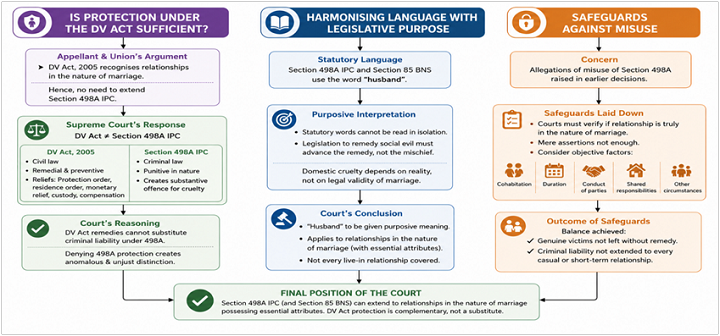
One of the principal arguments advanced by the appellant and the Union of India was that women in live-in relationships already enjoy protection under the Protection of Women from Domestic Violence Act, 2005. Since the DV Act expressly recognises relationships in the nature of marriage, it was argued that there was no necessity to expand the scope of Section 498A IPC.
The Supreme Court did not accept this contention. It observed that although the Domestic Violence Act provides important civil remedies, its object and nature are fundamentally different from that of Section 498A IPC. The DV Act primarily enables a woman to seek protection orders, residence orders, monetary relief, custody orders and compensation. It is remedial and preventive in character. Section 498A, on the other hand, creates a substantive criminal offence designed to punish acts of cruelty. Consequently, the availability of civil remedies under one statute cannot be regarded as a substitute for criminal liability under another.
The Court further reasoned that accepting the appellant's argument would produce an anomalous legal position. A woman could be recognised as being in a domestic relationship for the purposes of obtaining civil protection under the DV Act but simultaneously be denied criminal protection against identical acts of cruelty merely because the relationship lacked formal legal validity. Such an interpretation would undermine the legislative purpose underlying Section 498A and create an artificial distinction between women who are similarly situated in substance. It is precisely to avoid such inconsistency that the Court harmonised the two statutes rather than treating them as mutually exclusive.
HARMONISING THE LANGUAGE OF THE STATUTE WITH ITS LEGISLATIVE PURPOSE
The Court acknowledged that Parliament deliberately used the expression "husband" in Section 498A IPC and retained identical terminology in Section 85 BNS. Nevertheless, statutory words cannot be interpreted in complete isolation from the object they seek to achieve. Referring to the principle of purposive interpretation, the Court observed that legislation intended to remedy a social evil should receive a construction that advances the remedy rather than one that perpetuates the mischief.
Domestic cruelty is not determined by the legal validity of a marriage certificate. The physical, emotional and psychological harm suffered by a woman in a stable marriage-like relationship may be no different from that experienced by a legally wedded wife. If criminal liability were excluded merely because the relationship was technically void or lacked formal legal recognition, the perpetrator would effectively benefit from a legal technicality while the victim would be deprived of the very protection that Parliament intended to provide. Such an outcome, according to the Court, would be contrary to both legislative purpose and constitutional values.
The Court therefore concluded that the expression "husband" must receive a purposive interpretation in cases where the relationship possesses all the essential characteristics of marriage. However, this interpretation is carefully confined to relationships that satisfy the established judicial tests and cannot be extended indiscriminately to every form of cohabitation.
SAFEGUARDS AGAINST MISUSE
While extending the scope of Section 498A, the Supreme Court was equally conscious of concerns regarding possible misuse of the provision. The Court noted that allegations of misuse have frequently been raised in earlier decisions dealing with Section 498A. Nevertheless, the possibility of abuse cannot justify denying protection to genuine victims of domestic cruelty.
Instead of narrowing the provision itself, the Court emphasised procedural safeguards. Trial courts must carefully examine whether the relationship genuinely qualifies as one in the nature of marriage before permitting prosecution to proceed. Mere assertions by the complainant are insufficient. Courts must consider objective evidence relating to cohabitation, the duration of the relationship, the conduct of the parties, shared responsibilities, and other surrounding circumstances. Only after this threshold is crossed can the allegations of cruelty be examined on their merits.
These safeguards ensure that the judgment strikes a balance between two competing concerns. On the one hand, women in genuine marriage-like relationships are not left without criminal remedies. On the other hand, criminal liability is not indiscriminately extended to every romantic association or short-term live-in arrangement.
LAWYER’S INSIGHT
The judgment is significant because it attempts to balance two competing concerns in criminal law: the need for strict interpretation of penal provisions and the need to ensure that protective legislation remains effective in changing social circumstances.
The Court's reasoning is particularly important because it does not treat every live-in relationship as equivalent to marriage. Instead, it retains the requirement that the relationship must possess the essential characteristics of marriage, including factors such as duration of cohabitation, shared household, financial arrangements, social recognition and domestic responsibilities.
At the same time, the decision recognises that the availability of remedies under the Domestic Violence Act cannot by itself substitute criminal protection under Section 498A. The two statutes serve different purposes: the DV Act primarily provides civil and protective remedies, whereas Section 498A creates a criminal offence of cruelty.
The judgment therefore represents a purposive approach without completely abandoning the safeguards required in criminal law. Its real significance lies in ensuring that a technical defect in the legal status of a relationship does not automatically deprive a woman of protection where the relationship substantively possesses the characteristics of marriage.
CONCLUSION
The decision in Dr. Lokesh B.H. & Ors. v. State of Karnataka & Anr. represents a significant development in Indian criminal jurisprudence. Rather than creating a new offence, the Supreme Court has interpreted an existing welfare provision in a manner consistent with its legislative purpose and contemporary social realities. By holding that Section 498A IPC and its corresponding provision under Section 85 of the Bharatiya Nyaya Sanhita may extend to relationships in the nature of marriage, the Court has ensured that women are not deprived of protection against domestic cruelty solely because their relationship lacks formal legal recognition.
Equally important is the restraint exercised by the Court. The judgment does not equate every live-in relationship with marriage, nor does it dilute the requirement of proving that the relationship genuinely possesses marital characteristics. By reaffirming the principles laid down in Velusamy and Indra Sarma, the Court has preserved an objective legal threshold while preventing perpetrators from exploiting technical defects in the legal status of a relationship.
From a broader perspective, the ruling reflects the judiciary's continuing effort to adapt established legal principles to evolving social conditions without usurping the legislative function. The judgment demonstrates that purposive interpretation does not mean rewriting a statute; rather, it ensures that the statute continues to fulfil the very objective for which Parliament enacted it. As Indian society continues to witness changing forms of domestic relationships, this decision is likely to remain a landmark precedent governing the interpretation of both Section 498A IPC and Section 85 of the Bharatiya Nyaya Sanhita, ensuring that the protection afforded by criminal law depends upon the reality of domestic life rather than the mere formality of a marriage ceremony.
FREQUENTLY ASKED QUESTIONS
1.Has the Supreme Court extended Section 498A to all live-in relationships?
No. The judgment does not extend Section 498A to every live-in relationship. The relationship must possess the essential characteristics of a marriage.
2.What does “relationship in the nature of marriage” mean?
It refers to a relationship which, although not necessarily a legally valid marriage, substantially possesses the characteristics of marriage. Courts may examine factors such as the duration of cohabitation, shared household, financial arrangements, social recognition, domestic responsibilities and the parties' intention to live as spouses.
3.What evidence can establish a relationship in the nature of marriage?
The Court's approach requires a factual assessment. Relevant circumstances may include cohabitation, duration of the relationship, shared household, financial arrangements, social recognition, domestic responsibilities and the parties' intention.
4.Can a short-term or casual live-in relationship attract Section 498A?
Not merely because the parties lived together. The judgment expressly distinguishes genuine marriage-like relationships from casual relationships, temporary arrangements and purely sexual relationships.
5.What about misuse of Section 498A?
The Court acknowledged concerns regarding misuse but held that the possibility of abuse cannot justify denying protection to genuine victims. Instead, courts must scrutinise whether the relationship actually qualifies as one in the nature of marriage before allowing prosecution to proceed.
Join LAWyersClubIndia's network for daily News Updates, Judgment Summaries, Articles, Forum Threads, Online Law Courses, and MUCH MORE!!"


Tags :Others